What the Military Draft 2026 Changes Mean for You
Quick Answer: What’s happening with the military draft in 2026?
- No active draft exists. The U.S. has relied on an all-volunteer military since 1973.
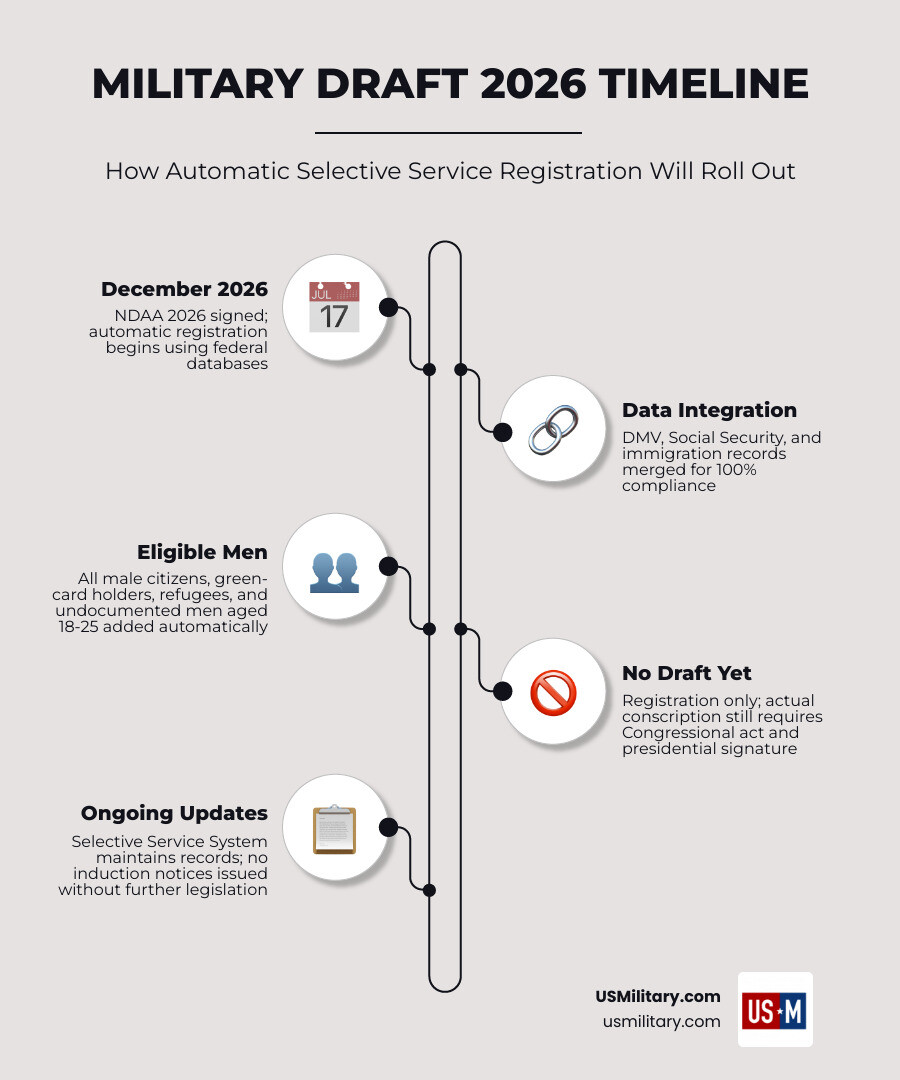
- Registration is going automatic. Starting December 18, 2026, eligible men will be automatically registered for the Selective Service — no manual sign-up required.
- This is not a draft. Automatic registration is a paperwork modernization, not conscription.
- A real draft would require an act of Congress plus a presidential signature — neither has happened.
- Who is affected? Male U.S. citizens and male immigrants ages 18–25, including green-card holders, refugees, and undocumented men.
The military draft in 2026 is one of the most searched — and most misunderstood — topics in America right now. Tensions abroad, White House comments about keeping “options on the table,” and a major change to how young men get registered for Selective Service have combined to create a wave of confusion and concern.
Here’s the short version: something real is changing, but it’s not what most people fear.
Starting in December 2026, the U.S. government will automatically register eligible men for the draft pool using existing federal data — no more filling out a form and hoping you remembered. This change was signed into law as part of the fiscal year 2026 National Defense Authorization Act (NDAA). It’s a logistical upgrade, not a call to arms.
But with ongoing U.S. military operations and political figures sparring over conscription, it’s worth understanding exactly how the system works, who it affects, and what would actually need to happen before anyone gets an induction notice.
I’m Larry Fowler, publisher of USMilitary.com and a longtime resource for active military, veterans, and families navigating service-related decisions — including questions about the military draft in 2026. In the guide below, I’ll walk you through every step of the process so you know exactly where things stand.
Easy military draft 2026 glossary:
What is Changing with the Military Draft 2026?
The biggest headline surrounding the military draft 2026 is the transition to an automatic registration model. Historically, young men in the United States had to take it upon themselves to register with the Selective Service System within 30 days of turning 18. Whether they filled out a postcard at the local post office or submitted their info online, the responsibility fell entirely on the individual.
That is about to change. Under the fiscal year 2026 National Defense Authorization Act (NDAA), signed into law in late 2025, the federal government is shifting the administrative burden from young citizens to federal databases.
According to details highlighted by CNN Politics, this nationwide modernization is designed to save taxpayer dollars and prevent young men from facing severe, often accidental, penalties for failing to register. By utilizing existing federal data sources, the government can keep its registration records updated without costly public awareness campaigns.
To dive deeper into the specific legislative text and timeline, you can review our Military Draft 2026 Guide.
Who is Affected by Automatic Selective Service Registration?
The criteria for who must be in the Selective Service database remains unchanged, even as the method of collection shifts. The rule applies to:
- All male U.S. citizens aged 18 through 25.
- Male immigrants in the same age bracket, including green-card holders, refugees, asylum seekers, and undocumented men.
Dual citizens are also required to register. The only young men exempt from this process are those on active military duty (who are already in the system) or non-citizens residing in the U.S. on valid, temporary nonimmigrant visas (such as international students or tourists).
How the Automatic Military Draft 2026 Registration Works
Instead of requiring young men to seek out registration forms, the Selective Service System will integrate directly with other federal databases. For years, the agency has relied heavily on state databases; in fact, over 60% of all registrations previously came directly from state motor vehicle departments (DMVs). Under the new law, federal data integration will pull information from sources like Social Security Administration records and DMV files to register eligible individuals automatically. Once registered, individuals will receive a written confirmation notice in the mail.
Currently, 46 states and territories already have some form of automatic or DMV-linked registration in place. This federal upgrade simply standardizes the process nationwide to achieve near 100% compliance.
| Feature | Manual Registration (Pre-December 2026) | Automatic Registration (December 18, 2026 Onward) |
|---|---|---|
| Primary Responsibility | The individual (must submit form within 30 days of 18th birthday) | The federal government (data integration) |
| Primary Data Sources | Post office cards, federal student aid forms, DMV check-boxes | Social Security records, DMV databases, federal data mining |
| Average Compliance Rate | ~81% (as of 2024) | Projected near 100% |
| Notification Method | Self-initiated confirmation | Automatic written notice sent to home address |
Does Automatic Registration Mean the Draft is Back?

Let’s address the elephant in the room: No, automatic registration does not mean the military draft is back.
We have lived with an all-volunteer military since February 1973, when active conscription ended during the Vietnam War. The Selective Service System is an independent agency that exists in a state of constant readiness, but it does not have the authority to call anyone into active service on its own.
Maintaining a registry of eligible young men is simply a contingency plan. It ensures that if a massive national crisis ever arises, the infrastructure is ready. For more context on why these two concepts are frequently confused, check out our analysis on Is the Military Draft Coming Back.
The Geopolitical Context: Iran Conflict and Draft Speculation
The sudden public interest in the military draft 2026 isn’t happening in a vacuum. It is heavily fueled by recent geopolitical events. Following recent U.S. military actions, including airstrikes in Iran, rumors of a potential draft have flooded social media.
The administration’s refusal to completely rule out ground troops or a draft — standard strategic ambiguity meant to keep foreign adversaries guessing — has only added fuel to the fire. However, military experts emphasize that the U.S. currently possesses an active-duty force of over 1.3 million personnel. This provides substantial operational capacity before any form of conscription would ever be considered. For a detailed breakdown of how current global tensions relate to the draft, read our Iran Attack Draft Guide 2026.
What It Takes to Reinstate an Active Military Draft 2026
Bringing back an active draft is not something a president can do with the stroke of a pen. It requires a rigorous legislative process:
- Congressional Action: Both the House of Representatives and the Senate must pass a bill authorizing conscription.
- Presidential Signature: The President must sign the bill into law.
- National Emergency: There must be a clear, overwhelming national crisis where the existing all-volunteer force is mathematically incapable of defending the country.
The administrative barriers are incredibly high. To learn more about what this process might look like under extreme global scenarios, you can read Newsweek’s article on 2026 conscription.
How a Modern Draft Lottery and Induction Process Works
If Congress and the President were to authorize a draft, the process would be highly structured, transparent, and vastly different from the historical drafts of the early 20th century. Today’s Selective Service System operates on an annual budget of approximately $31.3 million, supporting a lean network of 124 full-time civilian employees, 175 part-time reserve officers, and up to 11,000 part-time civilian volunteers.
The Department of Defense requires the Selective Service to deliver the first group of draft inductees to military processing stations within 193 days of a draft being authorized.
Who Gets Called First in a Draft?
If a draft lottery is triggered, the sequence of who is called is strictly regulated by age. Unlike historical drafts that prioritized the youngest eligible men, a modern draft lottery places 20-year-olds at the front of the line.
The sequence of priority works as follows:
- 20-Year-Olds: Men whose 20th birthdays fall within the calendar year of the draft lottery.
- 21 to 25-Year-Olds: Called sequentially from oldest to youngest.
- 19-Year-Olds: Called next if manpower needs are still unmet.
- 18.5-Year-Olds: Called last.
The actual lottery would use a “two-drum” system overseen by the National Institute of Standards and Technology (NIST) to ensure absolute randomness. One drum contains air-mixed balls representing every day of the year (1 through 366), while the second drum contains sequence numbers (1 through 366). If your birthdate is drawn alongside low sequence numbers, you are called first to report for evaluation. You can review a complete breakdown of this process in our guide Who Gets Pulled First in a US Military Draft.
Exemptions, Deferments, and Conscientious Objector Status
Being called in a draft lottery does not mean you are immediately sent to basic training. It simply means you must report to a Military Entrance Processing Station (MEPS) for mental, moral, and physical evaluations.
During this phase, individuals can file claims for exemptions, deferments, or postponements. These claims are reviewed by a network of more than 2,000 local draft boards staffed by civilian volunteers in communities across the country.
Common categories include:
- Conscientious Objectors: Individuals who hold sincere religious or moral beliefs against participating in war. They may be assigned to non-combatant military roles or civilian service.
- Ministerial Deferments: Ordained ministers and divinity students are generally exempt from service.
- Hardship Deferments: Available to men whose families would face extreme financial or emotional hardship if they were drafted.
- Medical Disqualifications: Physical or psychological conditions that prevent military service.
For a comprehensive list of what would disqualify an individual, check out What Disqualifies You From the Military Draft.
Frequently Asked Questions About the Draft
Are women required to register for the draft?
No. Under current federal law, only male citizens and male immigrants are required to register with the Selective Service. While there has been significant debate in Congress during recent NDAA negotiations regarding whether to expand registration to women, the law signed for 2026 did not change this requirement. Any future change to include women in draft registration would require an act of Congress. You can read more about this ongoing debate in our Women Draft Complete Guide 2026.
What are the penalties for failing to register?
Under the Military Selective Service Act, failing to register is a felony. It is punishable by up to five years in prison and a fine of up to $250,000.
While criminal prosecutions are rare, the civil penalties are automatic and severe. Failing to register can permanently disqualify you from:
- Receiving federal student loans or grants.
- Obtaining federal job training.
- Working for the federal government or many state government agencies.
- Obtaining U.S. citizenship (for immigrant males).
To understand the long-term impact of these restrictions, read our guide on No Registration No Education The Penalties for Skipping Selective Service.
What is the maximum age to be drafted?
The standard draft age range is 18 through 25. Once you turn 26, you are no longer in the primary draft pool. However, the U.S. military retains emergency plans for a “special-skills draft.” This would target licensed healthcare professionals and other specialists up to age 45, but such a measure would require unique congressional approval. For a detailed look at how age limits work, read The Draft Age Debate Can You Be Called to Serve After 26 or Even 40.
Conclusion
The upcoming shift to automatic registration in December 2026 is a major logistical update, but it is not a signal that the U.S. is returning to conscription. It is simply a way for the Selective Service System to modernize its records, save taxpayer dollars, and protect young men from accidental penalties.
At USMilitary.com, we are committed to providing clear, accurate, and up-to-date information on everything affecting our service members, veterans, and their families. Whether you are looking for details on VA home loans, disability ratings, or simply trying to stay informed on military policy, we are here to help.
For further reading on the history and mechanics of conscription in the United States, please visit our comprehensive overview: What is the US Military Draft.
Free for Service Members & Veterans
Get the military benefits intel no one tells you about.
Weekly updates on VA benefits, pay changes, and money tips — free for service members and veterans.
No spam. Unsubscribe anytime. Your info is never shared.


