All 7 branches of the military are among the most-searched military topics online—and for good reason. If you want a quick answer, here it is:
| # | Branch | Department |
|---|---|---|
| 1 | U.S. Army | Dept. of Defense |
| 2 | U.S. Navy | Dept. of Defense |
| 3 | U.S. Marine Corps | Dept. of Defense (via Dept. of the Navy) |
| 4 | U.S. Air Force | Dept. of Defense |
| 5 | U.S. Space Force | Dept. of Defense |
| 6 | U.S. Coast Guard | Dept. of Homeland Security |
| 7 | U.S. National Guard | Dept. of Defense (dual state/federal authority) |
Quick note: Officially, U.S. federal law recognizes six armed forces. The National Guard is counted as a seventh because it functions as a distinct reserve component with unique constitutional status — more on that below.
The U.S. military is massive. As of 2026, it includes roughly 1.3 million active-duty service members, operates around 800 military bases worldwide, and spent nearly $997 billion in 2024 — that’s 37% of all global defense spending. Understanding how each branch fits into that picture matters, whether you’re thinking about enlisting, planning a military career, or just trying to make sense of how it all works.
I’m Larry Fowler, a military veteran, publisher of USMilitary.com since 2007, and a longtime resource for active-duty members, veterans, and recruits navigating all 7 branches of the military. Below, I’ll break down what each branch does, who leads it, and how to decide which one is right for you.
Simple guide to all 7 branches of the military terms:
- What is the Army’s new helicopter, S-97 Raider
- The U.S. and its regional allies have deployed 64 Apache helicopters in a mission to take down Iran’s fleet
- How Does The Military Celebrate Easter When Overseas
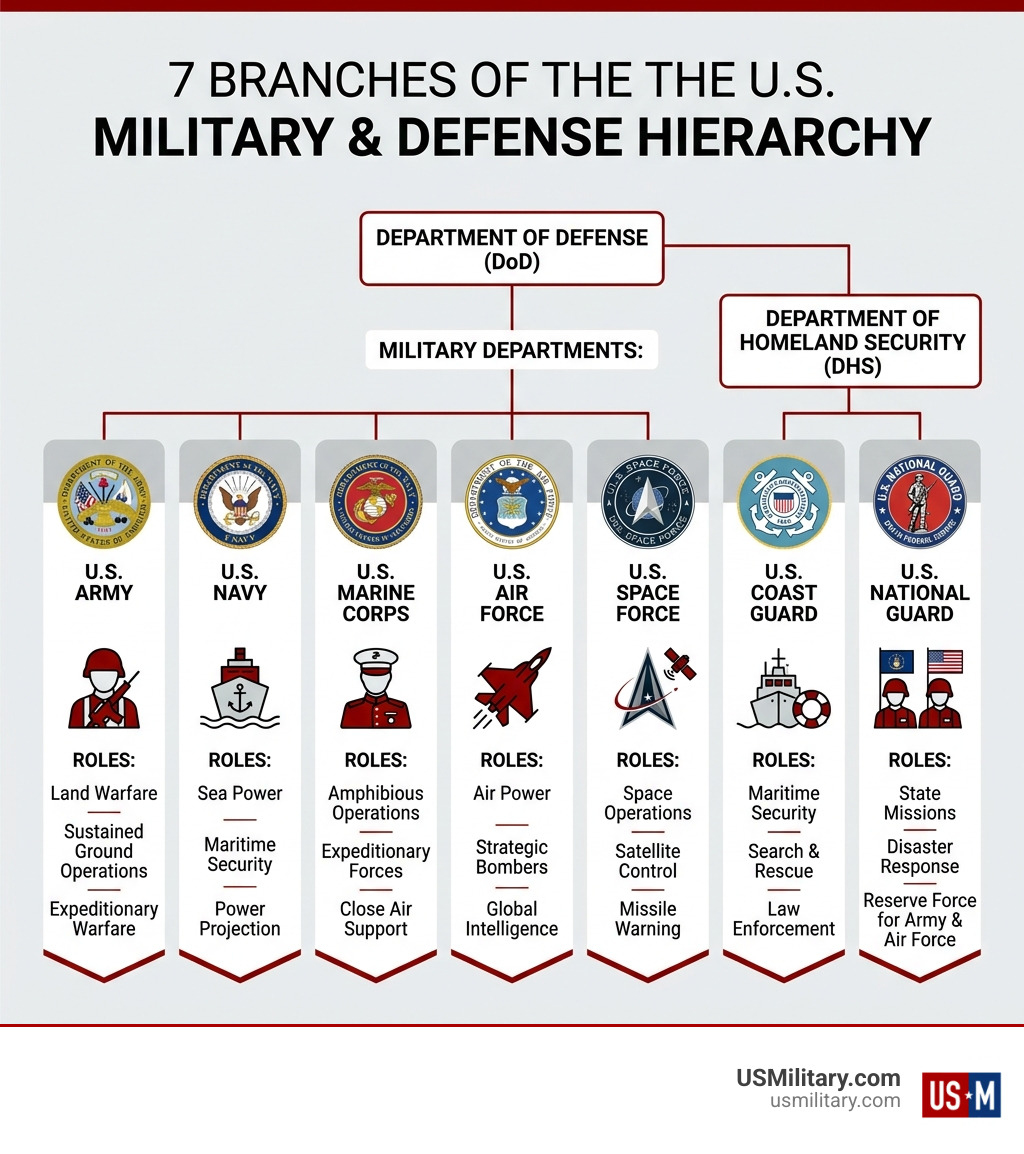
When we talk about the U.S. military, we are looking at a complex hierarchy designed for civilian oversight and rapid response. At the very top sits the President of the United States, who serves as the Commander-in-Chief. Beneath the President, the chain of command flows through the Secretary of Defense (SecDef) for most branches.
The Department of Defense (DoD) is the world’s largest “company,” employing over 2 million civilian and military personnel. It manages the Army, Navy, Marine Corps, Air Force, and Space Force. However, the Coast Guard is the “odd one out” in peacetime, operating under the Department of Homeland Security (DHS) and focusing on domestic maritime law enforcement.
To ensure all these moving parts work together, the Joint Chiefs of Staff — a body of senior uniformed leaders — advise the President and SecDef. They don’t command troops directly; instead, operational command flows to Unified Combatant Commands, which are organized either geographically (like U.S. Central Command) or by function (like U.S. Cyber Command). This structure ensures that in a conflict, all 7 branches of the military can fight as one “joint” force.
For those just starting their journey, our Beginner’s Guide to U.S. Military Branches/ offers a great deep dive into this hierarchy. You can also learn about the U.S. military branches through official government portals.
| Branch | Primary Domain | Established | Dept (Peacetime) |
|---|---|---|---|
| Army | Land | June 14, 1775 | DoD |
| Navy | Sea | Oct 13, 1775 | DoD |
| Marine Corps | Amphibious | Nov 10, 1775 | DoD (Navy) |
| Air Force | Air | Sept 18, 1947 | DoD |
| Space Force | Space | Dec 20, 2019 | DoD (Air Force) |
| Coast Guard | Maritime | Aug 4, 1790 | DHS |
| National Guard | Land/Air | Dec 13, 1636* | DoD/State |
*National Guard traces roots to colonial militias.
The Role of the National Guard as the 7th Branch
The National Guard is often called the “7th branch” because of its unique dual-status mission. Unlike the other branches, Guard members report to both their state Governor and the President.
Under Title 32, the National Guard responds to state-level emergencies such as hurricanes, wildfires, and civil unrest. However, under Title 10, they can be “federalized” to support active-duty combat operations overseas. This dual role is constitutionally required, ensuring states maintain a domestic defense force that can also bolster the nation’s global military strength.
If you are considering this path, keep in mind that What Is The National Guard 2/ explains these complexities in detail, and you should check the National Guard Age Limits/ to see if you qualify for service in 2026.
Legal Distinctions Between Armed and Uniformed Services
It is a common “trivia” point that the U.S. actually has eight uniformed services, but only six (or seven, depending on how you count the Guard) are “Armed Forces.” The Uniformed Services of the United States include the National Oceanic and Atmospheric Administration (NOAA) Commissioned Officer Corps and the U.S. Public Health Service (USPHS) Commissioned Corps.
While NOAA and USPHS officers wear uniforms and hold military-style ranks, they are non-combatant services focused on science and health. However, the President can “militarize” them during wartime. For the 7 branches of the military that carry out combat and defense missions, we focus on Title 10 (and Title 14 for the Coast Guard) services.
The Core Combat Forces: Army, Navy, and Air Force
The “Big Three” branches represent the traditional pillars of American power: land, sea, and air. Since 1973, we have maintained an all-volunteer force, meaning every soldier, sailor, and airman chose to be there. This has created a highly professionalized military capable of global power projection. According to Our Forces | U.S. Department of War, these branches form the backbone of our national defense strategy.
U.S. Army: The Foundation of Land Power
The U.S. Army is the oldest and largest branch, established even before the Declaration of Independence in 1775. Today, it consists of roughly one million soldiers across the Regular Army, Army Reserve, and Army National Guard.
The Army’s mission is simple but massive: to dominate the land. We use heavy equipment like the M2 Bradley Fighting Vehicle and the AH-64 Apache attack helicopter to support ground troops. Whether it’s conducting combined arms operations in the Middle East or providing humanitarian aid after a disaster, the Army is the primary force for sustained land combat. When comparing the Army vs. the Marines/, the Army is generally built for large-scale, long-term occupations and heavy armored warfare.
U.S. Navy: Dominating the Maritime Domain
If the Army owns the land, the Navy owns the “blue water.” The U.S. Navy is the most powerful maritime force in history, operating 11 nuclear-powered aircraft carriers. These carriers aren’t just ships; they are floating cities that serve as the nucleus of Carrier Strike Groups, letting the U.S. launch airstrikes from anywhere in the world’s oceans.
Beyond the surface, the Navy operates 68 commissioned submarines, including attack and ballistic missile variants that provide the “silent” leg of our nuclear triad. For those wondering Is the Navy or Marines Better/, it often comes down to whether you prefer technical, ship-based roles or the “boots on the ground” amphibious nature of the Corps.
U.S. Air Force: Air Superiority and Global Reach
The Air Force became a separate branch in 1947, spinning off from the Army. Its goal is total air superiority. We don’t just want to fly; we want to make sure no one else can fly against us.
The Air Force operates cutting-edge platforms like the F-35 Lightning II and the C-17 Globemaster III for rapid global transport. They also maintain a terrifying responsibility: the management of 400 LGM-30G Minuteman III intercontinental ballistic missiles (ICBMs) kept in hardened silos across the American heartland. If you’re torn on your career path, our guide on whether You Should Join the Army Or The Air Force can help you weigh the technical benefits of the “blue suit” versus the “green suit.”
Specialized Missions: Marines, Space Force, and Coast Guard
While the Big Three handle the broad domains of land, sea, and air, the specialized branches focus on niche capabilities that are just as vital to all 7 branches of the military.
U.S. Marine Corps: The Tip of the Spear
The Marines are technically part of the Department of the Navy, but don’t tell a Marine they’re “in the Navy” unless you want a very long lecture. They are a separate service branch with their own commandant and a fierce culture of independence.
The Marines specialize in amphibious warfare and rapid response. A Marine Expeditionary Unit (MEU) consists of about 2,200 Marines and is supplied for 15 days of independent operations. They are often the first on the ground in a crisis. Their training is legendary — a 13-week basic training that is arguably the toughest in the military. To understand how they differ from the “Big Army,” check out Marines Vs Army Key Differences/.
U.S. Space Force: The Newest Frontier in All 7 Branches of the Military
Established on December 20, 2019, the Space Force is the first new military branch in 72 years. While people often joke about “Star Trek,” the Space Force’s mission is grounded in modern reality: protecting the satellites that run our GPS, banking systems, and military communications.
The Space Force was formed by transferring roughly 16,000 personnel from the former Air Force Space Command. It doesn’t have a reserve component yet, and it focuses heavily on “Space Situational Awareness”—making sure our interests in orbit remain secure from adversaries. If you have a STEM background, you might want to look into Space Force Jobs as a career path.
U.S. Coast Guard: Maritime Law Enforcement and Safety
The Coast Guard is unique as the only branch with a domestic law enforcement mission. Because it operates under the Department of Homeland Security, it is not restricted by the Posse Comitatus Act, which generally prevents the military from acting as police on U.S. soil.
The Coast Guard protects our ports, conducts Search and Rescue (SAR) missions, and interdicts drug smugglers. However, don’t let the “peaceful” mission fool you. In times of war, the Department of Defense can transfer the Coast Guard to the Department of the Navy to support combat operations. As noted in the United States Armed Forces – Wikipedia entry, they play a vital role in the nation’s defense-in-depth strategy.
Choosing Between All 7 Branches of the Military
Deciding which of the 7 branches of the military to join is a life-changing decision. It’s not just about the uniform; it’s about the culture, the mission, and where you want to live. Each branch has different ASVAB (Armed Services Vocational Aptitude Battery) score requirements and offers different enlistment bonuses depending on the “needs of the service.”
We always recommend choosing The Military Service Right For You/ by looking at your long-term career goals. Do you want to learn a technical trade, or be on the front lines? Also, consult An Essential Guide To Military Age Limits/ to make sure you’re eligible for the branch you’re eyeing.
Comparing Bootcamps and Training Rigor
If you’re looking for an easy ride, “military” might not be the right word, but some boot camps are shorter than others.
- Marine Corps: 13 weeks (The most physically and mentally demanding).
- Army: 10 weeks.
- Air Force: 8.5 weeks.
- Navy: 7 to 8 weeks.
- Coast Guard: 8 weeks.
While people often ask, “Which military branch has the easiest bootcamp?” “Easy” is relative. The Air Force might have shorter physical training, but their academic requirements are often higher.
Reserve and Guard Opportunities
Not everyone wants to serve full-time. The Reserves and National Guard offer “part-time” service, typically requiring one weekend of drill per month and two weeks of annual training per year. This lets you keep a civilian career or go to college while still serving your country and receiving benefits.
If you’re older or have specific life constraints, check the National Guard Age Limit 3/ to see if you can still get in. Many people find the Guard offers the best of both worlds—serving their local community and their country at the same time.
Frequently Asked Questions about the U.S. Military
Which branch of the military is the oldest?
The U.S. Army is the oldest branch. The Continental Congress established it on June 14, 1775. The Navy and Marine Corps followed shortly after in October and November of the same year. The National Guard traces its lineage back to the Pequot War in 1636, but as a modern federal branch, the Army holds the title.
Is the Space Force part of the Air Force?
No, the Space Force is a separate and distinct military branch. However, much like the Marine Corps sits within the Department of the Navy, the Space Force sits within the Department of the Air Force. This allows them to share administrative resources (like a single Secretary) while maintaining their own unique military leadership and mission.
Can the Coast Guard serve under the Navy?
Yes! While the Coast Guard normally operates under the Department of Homeland Security, federal law allows Congress to transfer it to the Department of the Navy during a formal declaration of war or when the President directs. This has happened in every major U.S. conflict, including WWI and WWII.
Conclusion
At USMilitary.com, we know that navigating all 7 branches of the military can feel like learning a new language. Whether you’re interested in the Army’s land power, the Navy’s maritime dominance, or the Space Force’s high-tech frontier, each branch offers a unique way to serve.
If you are a male aged 18-25, Selective Service registration is still legally required, even though we have an all-volunteer force. Military service is a profound commitment that comes with unmatched benefits, from the GI Bill to VA home loans and specialized training.
If you’re ready to take the next step, we encourage you to explore Navy Jobs or look into career paths in the other branches. Your journey to serving our nation starts with the right information, and we are here to provide it every step of the way.