Civilian Leadership and Operational Command Hierarchy
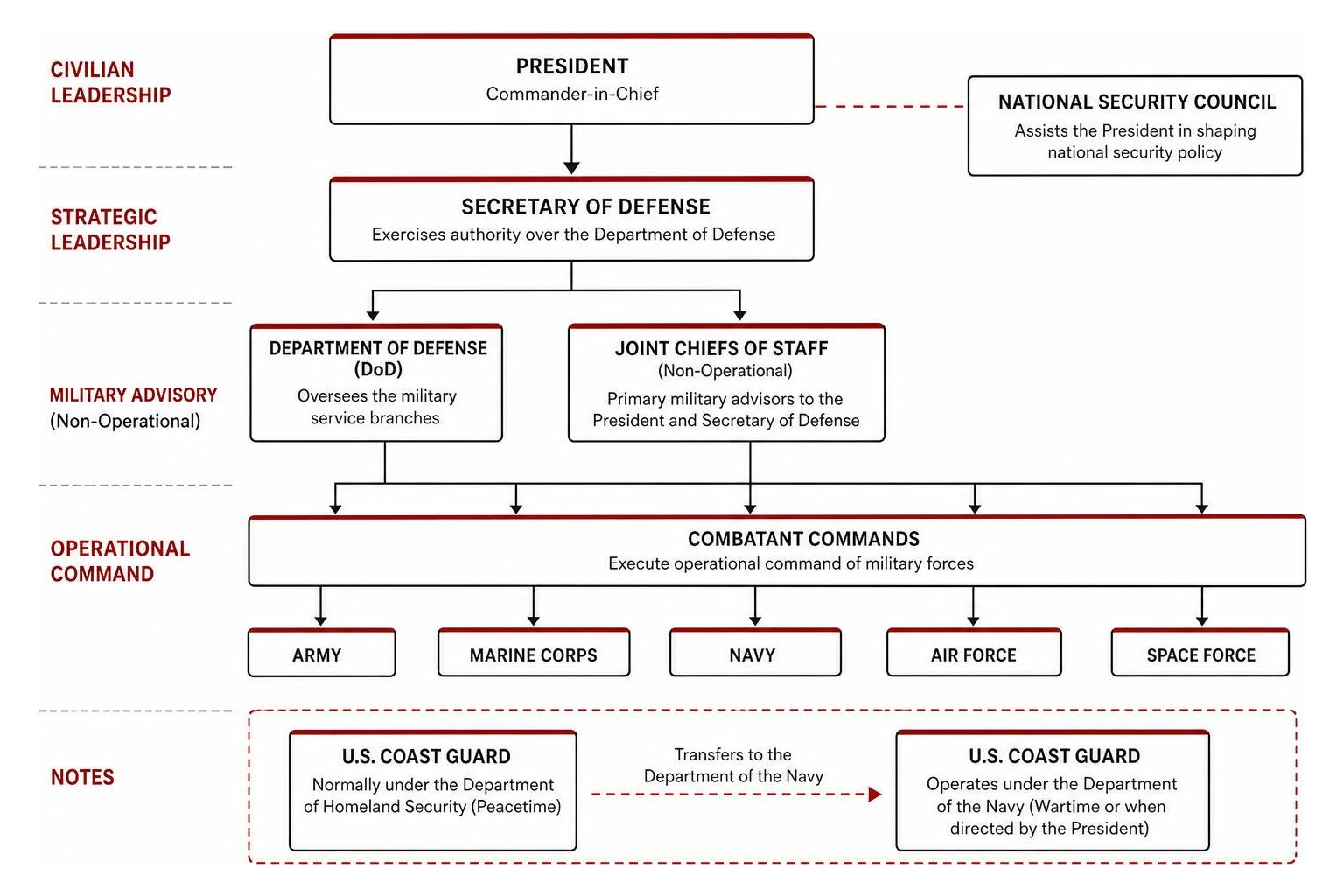
The foundation of the U.S. military relies on a strict principle: civilian leadership holds supreme authority over military operational command. The President of the United States serves as the Commander-in-Chief, holding top executive authority over all military branches. Beneath the President, the Secretary of Defense exercises direct command over the Department of Defense (DoD), managing the military forces necessary to deter war and protect national security.
While the DoD oversees five military service branches, the U.S. Coast Guard functions under the Department of Homeland Security during peacetime. However, during times of war or when directed by the President, the Coast Guard transfers to operate under the Department of the Navy.
Chain of Command in the US Armed Forces
The operational chain of command flows directly from the President, through the Secretary of Defense, to the commanders of combatant commands. The National Security Council (NSC) assists the President in shaping national security policy, bringing together military, diplomatic, and intelligence leadership.
The Joint Chiefs of Staff (JCS)—composed of the highest-ranking military officers from each service branch—functions as the primary advisor to the President and Secretary of Defense. Crucially, the Joint Chiefs do not hold operational command authority over combat forces. Instead, they handle troop readiness, training, and logistics for their respective branches. Within this structure, understanding the clear distinction between officer and enlisted leadership is essential; you can explore our complete guide to US Military Ranks to see how authority translates from strategic headquarters down to tactical field commands.
Unified Combatant Commands and Support Agencies
Operational command of the us armed forces is organized into 11 unified combatant commands, structured either geographically or functionally:
- Geographic Combatant Commands: Responsible for military operations within specific regions worldwide. Key examples include U.S. Central Command (USCENTCOM) in the Middle East and U.S. Indo-Pacific Command (USINDOPACOM) across Asia and the Pacific.
- Functional Combatant Commands: Provide specialized capabilities across regional boundaries, such as U.S. Strategic Command (USSTRATCOM) for nuclear deterrence and U.S. Space Command (USSPACECOM) for orbital defense.
Combat support agencies provide critical specialized support across all commands. The Defense Logistics Agency (DLA) manages global military supply chains, while the National Security Agency (NSA) drives signals intelligence and cybersecurity. Together, these commands and agencies allow the United States Armed Forces to project power and maintain strategic readiness anywhere on Earth.
The Six Branches of the US Armed Forces
The U.S. military organizes its combat power across six distinct branches, each tailored to specific operational domains and capabilities.
| Service Branch | Primary Domain | Authorized Strength (FY2026) | Administrative Department |
|---|---|---|---|
| U.S. Army | Land | 954,000 | Department of the Army (DoD) |
| U.S. Navy | Sea & Maritime | 378,200 | Department of the Navy (DoD) |
| U.S. Air Force | Air & Cyberspace | 495,300 | Department of the Air Force (DoD) |
| U.S. Marine Corps | Maritime Expeditionary | 205,900 | Department of the Navy (DoD) |
| U.S. Space Force | Space Domain | 10,400 | Department of the Air Force (DoD) |
| U.S. Coast Guard | Maritime / Coastal Waters | 50,200 | Dept. of Homeland Security (Peacetime) |
Land, Sea, and Maritime Expeditionary Branches
The U.S. Army is the largest and oldest service branch, designed for large-scale land combat operations. It operates across three primary components: the Regular Army (active duty), the Army National Guard (which operates under dual state and federal authority), and the Army Reserve. To stay updated on ground force readiness and tactical news, visit The Official Home Page of the United States Army.
The U.S. Navy maintains global maritime superiority, projecting combat power across oceans. The Navy operates 11 nuclear-powered aircraft carriers and over 116 surface combatants, alongside stealthy Ohio-class ballistic missile submarines carrying Trident II missiles.
Operating within the Department of the Navy, the U.S. Marine Corps acts as the nation’s premier amphibious expeditionary force. Through its modern Force Design 2030 strategy, the Marine Corps has reshaped its force structure around agile Marine Littoral Regiments focused on sea denial operations in contested environments. To learn more about how these forces operate together, check out our guide on the 6 Branches of the Military.
Air, Space, and Maritime Security Branches
The U.S. Air Force delivers rapid airpower and global mobility within hours. Operating advanced fighters like the F-22A Raptor and strategic bombers like the B-2 Spirit, the Air Force commands air dominance worldwide. For direct news from air force leadership, check out The Official Home Page of the U.S. Air Force.
Established on December 20, 2019, the U.S. Space Force is the newest branch created in 72 years. The Space Force manages vital satellite constellations, including the Global Positioning System (GPS), and tracks over 47,000 orbital objects via the Space Surveillance Network.
The U.S. Coast Guard executes 11 statutory missions covering search and rescue, drug interdiction, and environmental safety. For a deep dive into each branch’s specific capabilities, read our breakdown of the Branches of the US Military.

History and Modernization Priorities Across the Service Branches
The us armed forces have continuously evolved since their establishment during the American Revolutionary War over 251 years ago.
Service Branch Origins and Historical Evolution
The history of the military branches began on June 14, 1775, when the Second Continental Congress formed the Continental Army—predating the Declaration of Independence. The Navy and Marine Corps were established shortly after in 1775. The Coast Guard traces its origins back to August 4, 1790, when Alexander Hamilton founded the Revenue Cutter Service.
The modern defense structure was forged by the National Security Act of 1947, which established the Department of Defense and created the U.S. Air Force as an independent branch from the Army Air Forces. Following the end of the draft in 1973, the U.S. transitioned into an all-volunteer force. Most recently, the U.S. Space Force was established in 2019 to secure national interests in orbit.
Major Acquisition Programs and Modernization
To maintain a competitive edge, each branch focuses on key modernization priorities:
- U.S. Army: Prioritizes Long Range Precision Fires (LRPF), including the Precision Strike Missile (PrSM) and Long-Range Hypersonic Weapon (LRHW).
- U.S. Navy: Prioritizes building the Columbia-class nuclear-powered ballistic missile submarines to replace aging Ohio-class boats.
- U.S. Air Force: Modernizing strategic assets through the B-21 Raider stealth bomber and developing the sixth-generation Next Generation Air Dominance (NGAD) fighter platform.
- U.S. Space Force: Investing in the Deep Space Advanced Radar Capability (DARC) and the Oracle spacecraft to improve cislunar space awareness.

Total Force Capabilities, Budget, and Global Reach
The global power projection of the us armed forces depends on reliable infrastructure, modern hardware, and consistent funding.
Size, Budget, and Reach of the US Armed Forces
For FY2026, the U.S. defense budget sits at US $901 billion, accounting for roughly 3.22% of U.S. Gross Domestic Product (GDP). In comparison, the 2025 military budget reached $957 billion—representing roughly 33% of total global defense expenditures.
This budget supports roughly 800 military bases in over 70 countries, enabling the military to quickly respond to international crises. To analyze official force demographic data, consult the 2023 Demographics Profile of the Military Community.
Active Duty, Reserves, and National Guard Strengths
The total authorized strength of the military in FY2026 stands at 2,094,000 personnel. This force includes 1,344,500 active-duty service members, 339,100 reserve personnel, and 434,300 National Guard members across the country.
Current force demographics highlight steady progress in diversity. Female service members now make up 17.9% of the active-duty force. The average age across active-duty troops is 28.7 years old, ranging from an average of 25.2 years in the Marine Corps to 31.3 years in the Space Force. If you are considering service and want to see which operational branch aligns with your skills, take a look at our guide on Which Military Branch Best For You.
Frequently Asked Questions About the US Armed Forces
What is the oldest and largest branch of the US Armed Forces?
The U.S. Army is the oldest and largest service branch. Founded on June 14, 1775, the Army commands an authorized strength of 954,000 personnel in FY2026 across its regular active-duty, Reserve, and National Guard components.
How does the Coast Guard differ from other military branches?
The Coast Guard operates under the Department of Homeland Security during peacetime, executing law enforcement, search and rescue, and environmental protection missions. During war, or by presidential directive, it transfers to the Department of the Navy as an active military asset.
What are the basic requirements to join the military?
Candidates must be U.S. citizens or permanent legal residents between the ages of 17 and 39 (age limits vary slightly by branch). Applicants must pass physical fitness standards, meet medical criteria, hold a high school diploma or equivalent, and score well on the ASVAB. Male citizens aged 18 to 25 must also register with the Selective Service. Read our full summary of US Military Enlistment Requirements for step-by-step guidance.
Conclusion
The modern us armed forces remain an all-volunteer force capable of multi-domain operations across land, sea, air, space, and cyberspace. Whether providing humanitarian relief at home through National Guard units or deploying overseas to safeguard peace, American military service members are the foundation of national security.
At USMilitary.com, we help service members, veterans, and future recruits navigate military life. Explore our complete guide on how many people are in the US military to view updated troop figures, or discover rewarding career options through our overview of Military Careers and Opportunities.
Free for Service Members & Veterans
Get the military benefits intel no one tells you about.
Weekly updates on VA benefits, pay changes, and money tips — free for service members and veterans.
No spam. Unsubscribe anytime. Your info is never shared.



Leave a Reply