Why Understanding VA Aid and Attendance Income Limits Matters for Veterans
What is the income limit for VA Aid and Attendance in 2025 and 2026? The answer depends on your family status and is tied to the Maximum Annual Pension Rate (MAPR):
2025 Income Limits (Dec 1, 2024 – Nov 30, 2025):
- Veteran with no dependents: $16,815/year ($1,401/month)
- Veteran with spouse or dependent child: $22,006/year ($1,833/month)
- Surviving spouse with no dependents: $11,302/year ($941/month)
- Surviving spouse with dependent child: $14,794/year ($1,232/month)
2026 Income Limits (Dec 1, 2025 – Nov 30, 2026):
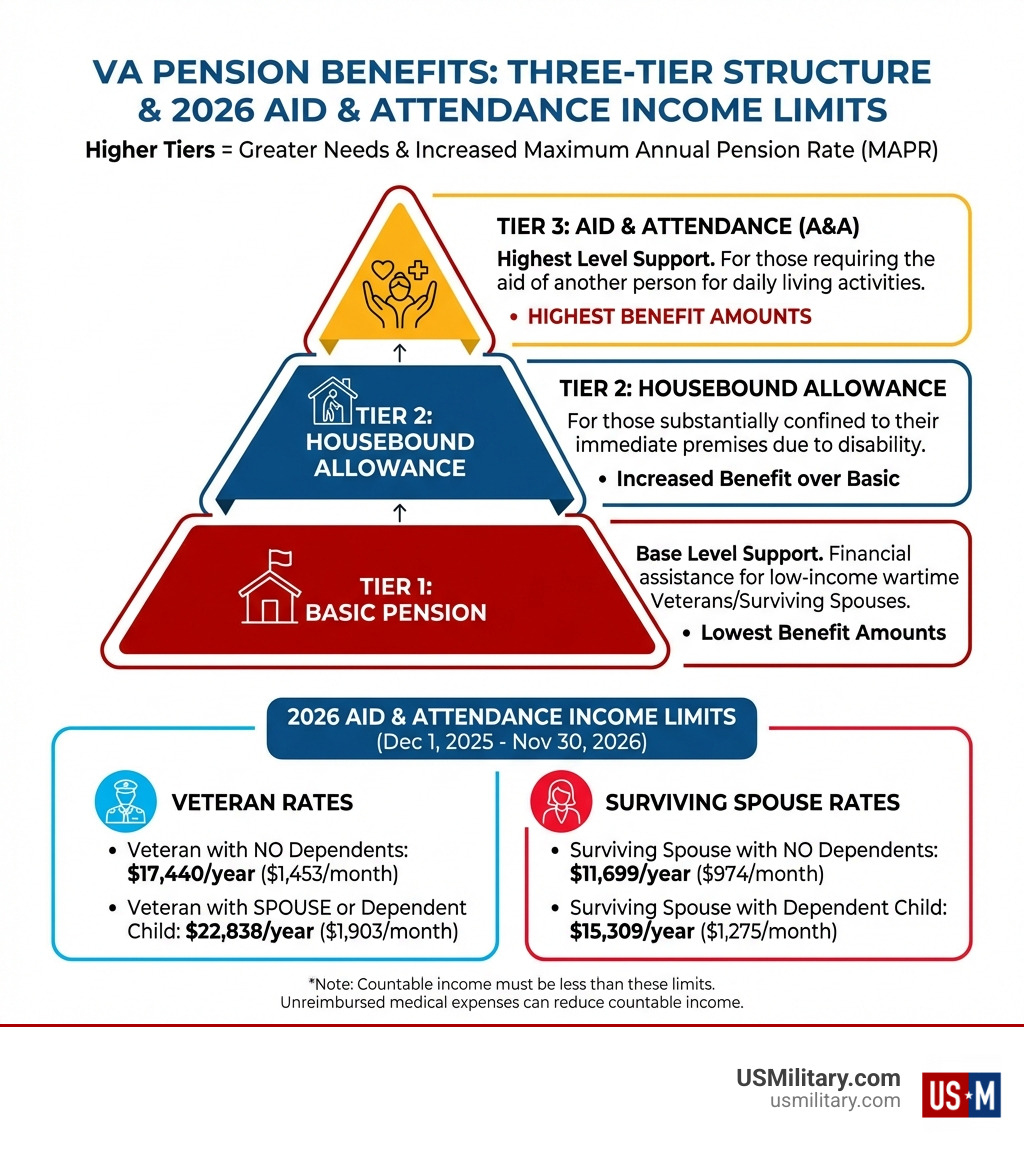
- Veteran with no dependents: $17,440/year ($1,453/month)
- Veteran with spouse or dependent child: $22,838/year ($1,903/month)
- Surviving spouse with no dependents: $11,699/year ($974/month)
- Surviving spouse with dependent child: $15,309/year ($1,275/month)
Important: Your countable income must be less than these limits. However, unreimbursed medical expenses can reduce your countable income, potentially making you eligible even if your gross income exceeds these amounts.
The VA Aid and Attendance benefit provides crucial financial support for wartime veterans and surviving spouses who need help with daily living activities. This special monthly pension—added on top of the basic VA pension—helps cover costs for in-home care, assisted living, or nursing home expenses. But understanding whether you qualify requires knowing how the VA calculates your income and net worth.
The income limits aren’t just simple cutoffs. The VA uses a complex calculation that considers your gross household income, subtracts certain deductible medical expenses, and compares the result to the Maximum Annual Pension Rate for your situation. Many veterans who think they earn too much to qualify find they’re actually eligible once medical costs are factored in.
I’m Larry Fowler, publisher of the USMilitary.com Network since 2007, and I’ve helped thousands of veterans steer what is the income limit for VA Aid and Attendance and understand their eligibility for these crucial benefits. Through our network, we’ve provided up-to-date VA benefit trends and guidance to help veterans maximize their entitled support.
What is the income limit for VA Aid and Attendance terms made easy:
Understanding the VA Aid and Attendance Benefit vs. Housebound Allowance
When we talk about financial assistance from the VA for long-term care, two terms often come up: Aid and Attendance (A&A) and Housebound allowance. Both are valuable additions to a basic VA pension, designed to help veterans and their surviving spouses with the costs of care. However, it’s crucial to understand how they differ, as you cannot receive both simultaneously.
The VA Aid and Attendance benefit is a special monthly pension paid to those who need regular assistance with daily living activities (ADLs). This means they require help with things like bathing, dressing, eating, using the restroom, or adjusting prosthetic devices. Eligibility for A&A also extends to those who are bedridden, patients in a nursing home due to mental or physical incapacity, or have severe visual impairment (e.g., corrected eyesight of 5/200 or less in both eyes, or a visual field contracted to 5 degrees or less). The purpose of A&A is to provide extra financial support when a veteran or surviving spouse can no longer fully care for themselves. For a more detailed look at eligibility, we encourage you to visit our guide on Aid and Attendance Benefits Eligibility.
On the other hand, the Housebound allowance is for veterans and surviving spouses who are substantially confined to their immediate premises due to a permanent disability. While they might not need constant help with ADLs, their disability significantly limits their ability to leave their home. The Housebound benefit recognizes the challenges and costs associated with maintaining a home environment while dealing with a severe, permanent condition.
Both A&A and Housebound benefits are “improved pensions,” meaning they are added to the basic VA pension. This is important because it means even if your income might be too high for the basic pension alone, the additional allowances for A&A or Housebound can increase the total pension amount, potentially bringing you into eligibility. The VA’s definition of annual income, which plays a critical role in these calculations, can be explored further in the electronic Code of Federal Regulations: Read more about how the VA defines annual income.
To summarize, A&A is for those needing hands-on daily care or who are in a nursing home or visually impaired, while Housebound is for those largely confined to their home due to a permanent disability. We cannot receive both, so understanding your specific needs is the first step in determining which benefit might apply to your situation.
What is the income limit for VA Aid and Attendance?
Understanding what is the income limit for VA Aid and Attendance is a bit like solving a puzzle, but we’re here to help put the pieces together. The VA doesn’t set a single, fixed income limit for Aid and Attendance that applies to everyone. Instead, eligibility is determined by comparing your “countable income” to a threshold called the Maximum Annual Pension Rate (MAPR) for your specific situation.
The MAPR is the maximum amount of pension the VA can pay you in a year. This rate varies based on whether you’re a veteran or a surviving spouse, if you have dependents, and whether you qualify for additional allowances like Aid and Attendance or Housebound. Essentially, your “income for VA purposes” (IVAP), after certain deductions, must be less than the MAPR for your category to be eligible for any pension benefit. If your IVAP is negative, the VA considers it zero for calculation purposes.
Let’s look at the MAPR rates for the upcoming years. These figures represent the maximum annual pension you could receive, not necessarily an income cap you must stay under. Your countable income, after deductions, needs to be below these rates.

Here’s a comparison of the MAPR rates for veterans and surviving spouses for 2025 and 2026:
| Category | 2025 MAPR (Annual) | 2025 MAPR (Monthly) | 2026 MAPR (Annual) | 2026 MAPR (Monthly) |
|---|---|---|---|---|
| Veteran with no dependents | $16,815 | $1,401 | $17,440 | $1,453 |
| Veteran with spouse or dependent child | $22,006 | $1,833 | $22,838 | $1,903 |
| Surviving spouse with no dependents | $11,302 | $941 | $11,699 | $974 |
| Surviving spouse with dependent child | $14,794 | $1,232 | $15,309 | $1,275 |
| Veteran (A&A) no spouse/dependent child | $28,160 | $2,347 | $29,091 | $2,424 |
| Veteran (A&A) with spouse/dependent child | $33,351 | $2,779 | $34,486 | $2,873 |
| Surviving spouse (A&A) no dependent child | $18,043 | $1,503 | $18,696 | $1,558 |
| Surviving spouse (A&A) with dependent child | $21,539 | $1,795 | $22,302 | $1,858 |
(Note: These figures are based on improved pension rates. For a comprehensive list of rates, including Housebound and other specific categories, please refer to official VA resources or our Veterans Aid and Attendance Requirements 2026 guide.)
So, if your gross household income, after allowable deductions, falls below the relevant MAPR for your situation (including the A&A benefit), you may be eligible. It’s a nuanced process, and understanding your “countable income” is key to navigating it.
Calculating Countable Income and the 5% Deductible
When the VA calculates your income for pension purposes, they’re looking at your “countable income.” This isn’t just your paycheck; it’s a broader picture of what comes into your household. Generally, countable income includes most money you receive, such as:
- Gross Social Security income: This includes any amounts withheld for Medicare premiums.
- Retirement and pension payments: This covers employer pensions, as well as withdrawals from IRAs and 401(k)s. When you start drawing down these retirement accounts, all payments are considered countable income.
- Earnings from employment: Salary, bonuses, commissions, overtime, and tips are all included.
- Interest and dividends: Money earned from savings accounts, investments, and bonds (even if the bond isn’t redeemed, interest earned is countable).
- Gambling winnings and inheritances: These are generally considered income in the year received.
- VA Disability Compensation: Yes, even other VA benefits like disability compensation are counted as income when applying for pension.
However, not everything counts. The VA also excludes certain types of income, which is good news! Exclusions often include:
- Needs-based benefits like Welfare or Supplemental Security Income (SSI).
- Income tax refunds.
- Loans (as long as they are repayable).
- Certain one-time payments for casualty losses.
- The VA Pension benefits themselves (once you receive them).
- Some state or municipality veterans’ benefits.
- Payments from long-term care insurance policies (though the premiums might be deductible medical expenses).
A crucial aspect of calculating countable income is the “5% MAPR threshold” for medical expenses. We’ll dive deeper into medical expenses next, but in short, you can deduct unreimbursed medical expenses that exceed 5% of your applicable MAPR. This is a significant factor in reducing your countable income and can make a big difference in eligibility, especially for those needing care covered by benefits like What Aid and Attendance Covers for Home Health Care.
It’s a complex calculation, and the VA reviews your entire financial situation. For instance, regular cash contributions for maintenance are not countable gifts if the donor assumes the burden of regular maintenance and the cash is used for basic necessities. However, a surviving spouse beneficiary paid by the State to care for a neighbor might have that income counted, while if they cared for the veteran beneficiary in their home under a chore services program, it might not be. For more intricate details, especially regarding Special Monthly Compensation for Aid and Attendance, our resource on What Is the VA Special Monthly Compensation for Aid and Attendance can provide further insights.
How Medical Expenses Affect the Income Limit for VA Aid and Attendance
This is where the magic often happens for many veterans and surviving spouses who initially think their income is too high. The VA allows us to reduce our “countable income” by subtracting unreimbursed medical expenses (UMEs). This is a critical provision that can help us meet what is the income limit for VA Aid and Attendance.
What are Unreimbursed Medical Expenses (UMEs)? These are out-of-pocket medical costs that are not covered or reimbursed by insurance or any other third party. They include a wide range of expenses directly related to your health and care, such as:
- Assisted living facility costs: The portion of the fees specifically for medical care or assistance with ADLs.
- In-home care services: Fees paid to caregivers, home health aides, or nurses providing assistance with ADLs.
- Nursing home care: The expenses incurred for long-term care in a skilled nursing facility.
- Health insurance premiums: This includes Medicare Part B and D premiums, supplemental insurance, and long-term care insurance premiums.
- Prescription medications: Out-of-pocket costs for necessary prescriptions.
- Doctor and hospital co-pays and deductibles.
- Adaptive equipment: Wheelchairs, walkers, special beds, etc.
- Transportation to medical appointments.
How the Deduction Works:
The VA doesn’t just deduct every dollar of UMEs. There’s a threshold. You can deduct UMEs that exceed 5% of your applicable MAPR. Only the amount above this 5% threshold is subtracted from your countable income.
Let’s use an example:
Suppose an unmarried veteran with no dependent child has an annual MAPR of $17,440 (for 2026, basic pension).
- 5% of this MAPR is $872 ($17,440 * 0.05).
- If this veteran has $1,028 in UMEs, only $156 ($1,028 – $872) can be deducted from their countable income.
This deduction mechanism means that even if your gross income is above the MAPR, significant medical expenses can reduce your “Income for VA Purposes” (IVAP) below the MAPR, thus qualifying you for benefits. For instance, a household earning up to $5,000 a month might still qualify if their income is substantially reduced by medical costs. This is why it’s so important to track all your medical expenses carefully.
✉ Get updates like this in your inbox
Weekly VA benefit changes, pay updates, and money tips for service members, veterans, and military families. Free, no spam.
The actual benefit paid to the claimant is the difference between the applicable MAPR and their IVAP. If the IVAP calculation results in a negative amount, the VA considers it to be zero dollars. This nuanced approach helps ensure that those with high care costs can still access the support they need. You can find more information on current pension rates, which underpin these calculations, at Current pension rates for Veterans.
Net Worth Limits and the 3-Year Look-Back Period
Beyond income, the VA also considers your net worth when determining eligibility for pension benefits, including Aid and Attendance. This is a critical piece of the puzzle for understanding what is the income limit for VA Aid and Attendance. The net worth limit is updated annually, and for the period from December 1, 2025, to November 30, 2026, the limit is $163,699. For 2025 (Dec 1, 2024 – Nov 30, 2025), the limit is $159,240.
How is Net Worth Calculated?
The VA defines net worth as the sum of your and your dependent’s assets and your annual income for VA purposes. This calculation was updated in October 2018 to make the rules clearer.
What Counts as a Countable Asset?
Countable assets generally include:
- The fair market value of all real and personal property you own, minus any mortgages.
- Investments (stocks, bonds, mutual funds).
- Bank accounts (checking, savings, CDs).
- Retirement accounts (IRAs, 401(k)s) that are not yet being drawn down (once withdrawals begin, they become income).
- Other valuable possessions like boats, antique furniture, or secondary properties.
What is Excluded from Net Worth?
Thankfully, not everything you own is counted. The VA excludes several key assets to ensure veterans retain essential property:
- Your primary residence (the home you live in).
- One personal vehicle.
- Basic household items like appliances and furnishings that wouldn’t typically be taken when moving.
- Personal effects, prosthetic devices, and wedding/engagement rings.
For a comprehensive understanding of what the VA considers assets, we recommend reviewing the official regulations: Read more about how the VA defines assets.
The 3-Year Look-Back Period for Asset Transfers
To prevent individuals from artificially reducing their net worth to qualify for benefits, the VA implemented a 3-year look-back period for asset transfers. This means the VA will review any asset transfers you (or your spouse) made for less than fair market value within the three years immediately preceding your pension application.
Consequences of Asset Transfers:
If the VA determines that assets were transferred to meet the net worth limit, it can result in a period of ineligibility for pension benefits, including Aid and Attendance. This penalty period can last for up to five years, depending on the amount transferred. The penalty is calculated by dividing the amount transferred by the maximum annual pension rate. For example, if you transferred $100,000 and the MAPR was $20,000, your penalty period would be 5 years ($100,000 / $20,000 = 5).
This look-back period is similar to what Medicaid uses and is designed to ensure fairness in the system. It’s a crucial consideration for anyone planning to apply for VA pension benefits. We have a dedicated resource that digs into this topic: Does VA Aid and Attendance Have a Look Back Period. It’s always best to consult with a qualified professional if you are considering asset transfers, as the rules can be complex.
Application Process and Eligibility Requirements
Applying for VA Aid and Attendance or Housebound benefits involves a structured process to ensure all criteria are met. While the financial aspects, including what is the income limit for VA Aid and Attendance, are critical, so too are the service, medical, and administrative requirements.
Key Steps in the Application Process:
- Determine Basic Pension Eligibility: Aid and Attendance and Housebound benefits are “add-ons” to the basic VA pension. This means you must first be eligible for the basic pension. This requires meeting service requirements, age/disability criteria, and income/net worth limits.
- Gather Documentation: This is arguably the most time-consuming part. You’ll need:
- Military Discharge Papers (DD214): Proof of honorable discharge and service dates.
- Medical Evidence: A physician’s statement is crucial. Your doctor will need to complete VA Form 21-2680, “Examination for Housebound Status or Permanent Need for Regular Aid and Attendance.” This report should detail your medical condition, how it affects your ability to perform daily activities, your mobility, and if you are confined to home. If you are in a nursing home, VA Form 21-0779, “Request for Nursing Home Information in Connection with Claim for Aid and Attendance,” is also required.
- Financial Records: Documentation of all income and assets for yourself and your dependents. This is vital for the VA to calculate your countable income and net worth.
- Marriage and Death Certificates: If applying as a surviving spouse.
- Social Security or VA File Number.
- Direct Deposit Information.
- Complete the Application Forms:
- VA Form 21P-527EZ: “Application for Veterans Pension” (for veterans).
- VA Form 21P-534EZ: “Application for DIC, Survivors Pension, and/or Accrued Benefits” (for surviving spouses).
You can find more details on the necessary forms, including the Aid and Attendance Form, on our site.
- Submit Your Application: You can submit your application and supporting documents online via QuickSubmit, by mail to the Pension Management Center (PMC) that serves your state, or in person at a VA regional office.
- Await a Decision: Once submitted, the VA will process your claim.
How Long Does It Take?
The processing time for VA claims can vary significantly. It depends on factors like the completeness of your application, the complexity of your case, and the VA’s current workload. While some claims might be processed in a few months, others can take six months or even longer. Claims are generally processed in the order they are received, though some may receive priority processing. Being thorough with your documentation from the start can help prevent delays.
Understanding the distinctions between the basic VA pension and the improved Aid and Attendance benefit is key to a successful application. We dig into this further in our article VA Pensions vs. Aid and Attendance.
Service History and Disability Criteria for the Income Limit for VA Aid and Attendance
Beyond the financial requirements, including what is the income limit for VA Aid and Attendance, specific service history and disability criteria must be met to qualify for these benefits. These requirements ensure that the benefits reach those who have served our nation and are now in need.
Military Service Requirements:
To be eligible for a VA pension (and thus, Aid and Attendance or Housebound benefits), a veteran must meet the following service criteria:
- Wartime Service: The veteran must have served at least 90 days of active duty, with at least one day during a designated wartime period. If they entered active duty after September 7, 1980, they must have served at least 24 months of active duty or completed their entire tour of duty.
- Honorable Discharge: The veteran must have been discharged under conditions other than dishonorable.
Designated Wartime Periods include:
- Mexican Border Period: May 9, 1916, to April 5, 1917
- World War I: April 6, 1917, to November 11, 1918 (or April 1, 1920, if service was in Russia)
- World War II: December 7, 1941, to December 31, 1946
- Korean War: June 27, 1950, to January 31, 1955
- Vietnam Era: February 28, 1961, to May 7, 1975 (if served in Vietnam), or August 5, 1964, to May 7, 1975 (if served elsewhere)
- Gulf War: August 2, 1990, to Present (the exact end date is yet to be determined by law)
Age or Disability Requirements:
In addition to service history, the veteran or surviving spouse must meet one of the following criteria:
- Age 65 or Older: If you are 65 or older, you meet the age requirement.
- Permanent and Total Disability: You are considered permanently and totally disabled, not due to your own willful misconduct. This might be evidenced by receiving Social Security Disability Income (SSDI) or Supplemental Security Income (SSI).
- Nursing Home Residency: You are a patient in a nursing home for long-term care.
- Receiving Social Security Disability or Supplemental Security Income.
Specific Criteria for Aid and Attendance:
To qualify for the improved Aid and Attendance benefit, you must meet at least one of these conditions:
- You require the aid of another person to perform at least two Activities of Daily Living (ADLs), such as bathing, feeding, dressing, toileting, or adjusting prosthetic devices.
- You are bedridden, meaning your disability requires you to remain in bed (apart from any necessary medical treatment).
- You are a patient in a nursing home due to mental or physical incapacity.
- Your eyesight is limited to 5/200 or less in both eyes with corrective lenses, or your concentric contraction of the visual field is 5 degrees or less.
Specific Criteria for Housebound:
To qualify for the Housebound benefit, you must be substantially confined to your immediate premises because of a permanent disability. This means you spend most of your time at home due to your condition.
These criteria ensure that the benefits are directed towards those with significant needs. We provide more in-depth information on these qualifications in our guide, Aid and Attendance Qualifications.
Frequently Asked Questions about VA Aid and Attendance Limits
Navigating VA benefits can bring up many questions, especially concerning financial limits. We’ve compiled some frequently asked questions about what is the income limit for VA Aid and Attendance and related topics to provide clarity.
Can I qualify if my gross income is above the MAPR?
Yes, absolutely! This is one of the most common misconceptions. Many veterans and surviving spouses mistakenly believe they cannot qualify because their gross income seems too high. However, the VA has a provision that allows you to deduct unreimbursed medical expenses (UMEs) from your gross income.
As we discussed, if your UMEs exceed 5% of your applicable Maximum Annual Pension Rate (MAPR), the amount above that threshold can be subtracted from your income. This significantly reduces your “Income for VA Purposes” (IVAP). It’s entirely possible for someone with a gross income above the MAPR to still qualify for Aid and Attendance benefits once their substantial medical expenses are factored in. Always keep meticulous records of all your medical out-of-pocket costs, as they are your best tool for reducing your countable income. For more insights, explore our Veteran Aid and Attendance Benefits guide.
Does the VA count my home or car as a countable asset?
No, generally, your primary residence and one personal vehicle are not counted as assets for VA pension eligibility purposes. This is a huge relief for many families, as these are often their most significant assets. The VA understands that veterans need a place to live and reliable transportation.
Beyond your home and one car, basic household goods, personal effects, prosthetic devices, and wedding/engagement rings are also typically excluded from the net worth calculation. The net worth limit, which was $163,699 for December 1, 2025, to November 30, 2026, focuses on other liquid assets and investments.
How does Aid and Attendance interact with Medicaid?
This is a complex but crucial area, as both Aid and Attendance and Medicaid (specifically Medical Assistance Long-Term Care, or MA-LTC) are needs-based benefits. Understanding their interaction is vital for comprehensive financial planning.
Here’s what we need to know:
- Income for MA-LTC: For MA-LTC eligibility, the VA Pension portion of your monthly payment is considered income. However, the portion of your VA benefits specifically designated for Aid and Attendance or Housebound is not counted towards Medicaid’s income limit. This is a critical distinction.
- The $90 Nursing Home Limit: If a veteran enters a nursing facility for long-term care and receives Medical Assistance, the maximum VA benefit they can receive is typically reduced to $90 per month. This $90 is considered the A&A portion and is generally not treated as income by the nursing facility. However, if this $90 is unspent, it becomes a resource in subsequent months and could potentially affect MA-LTC eligibility if it causes resources to exceed the state’s limit (often around $8,000, excluding home and car).
- Medicaid’s Application Requirement: Interestingly, Medicaid often requires applicants to apply for any VA pension benefits they might be entitled to. The VA, conversely, does not require you to apply for Medicaid.
- “Spend-Down” for Waiver Services: For veterans needing MA-LTC Waiver Services (often for in-home care), a complex “spend-down” requirement might apply if their combined VA Pension and Social Security income exceeds the MA-LTC income limit (e.g., $2,205 per month). This could force them to spend down income to an unaffordable level.
- Seeking Expert Advice: Given the intricacies, especially for married couples with differing care needs, it is strongly advised to seek the advice of a professional who is an expert in both Medicaid and VA pensions. This can help you steer the rules and maximize your benefits effectively.
While both programs aim to help those in need, their rules are distinct and can sometimes conflict. Knowing these interactions can prevent unforeseen eligibility issues. For a deeper dive into the advantages of these benefits, our article Top 10 VA Aid and Attendance Benefits offers valuable perspectives.
Conclusion
Understanding what is the income limit for VA Aid and Attendance is a journey through various financial and medical criteria, but it’s a journey well worth taking for eligible veterans and their surviving spouses. We’ve explored how the VA’s definition of countable income, the Maximum Annual Pension Rate (MAPR), and the crucial role of unreimbursed medical expenses all come together to determine eligibility. We’ve also highlighted the importance of net worth limits, the VA’s 3-year look-back period for asset transfers, and the specific service and medical requirements.
At USMilitary.com, we are committed to providing comprehensive resources and nonbiased information to help our military members and veterans steer the complexities of their benefits. The Aid and Attendance benefit can be a lifeline, providing much-needed financial assistance for long-term care, whether it’s in-home support, assisted living, or nursing home care. Don’t let initial assumptions about income deter you from exploring this vital benefit. Medical expenses can significantly reduce your countable income, often opening doors to eligibility.
We encourage you to carefully gather all required documentation, including service records, medical evidence, and financial statements. While the application process can seem daunting, resources are available to help. We are here to empower you with the knowledge and tools to secure the benefits you’ve earned through your service.
To dig deeper into these topics and gain a full understanding of how to apply and maximize your benefits, we invite you to explore our comprehensive guide: Maximize your benefits with our complete guide. Your service to our nation is honored, and we are dedicated to helping you access every benefit you deserve.
Free for Service Members & Veterans
Get the military benefits intel no one tells you about.
Weekly updates on VA benefits, pay changes, and money tips — free for service members and veterans.
No spam. Unsubscribe anytime. Your info is never shared.