
No political party can guarantee that America would be safer if Iran attacked. However, truth be told, whatever party affiliation you currently have, you’d likely feel safer with your predetermined party than the other. Unfortunately, rational, domestic, or social preferences likely don’t matter if America were under attack. The stronger answer is that U.S. security would depend on the president’s crisis judgment, military readiness, intelligence, congressional support, and ability to keep allies united. When voters ask, “Under what presidential political party would America be more secure if attacked by Iran?”, they are really asking which doctrine is more likely to protect the homeland, U.S. forces, and global shipping.
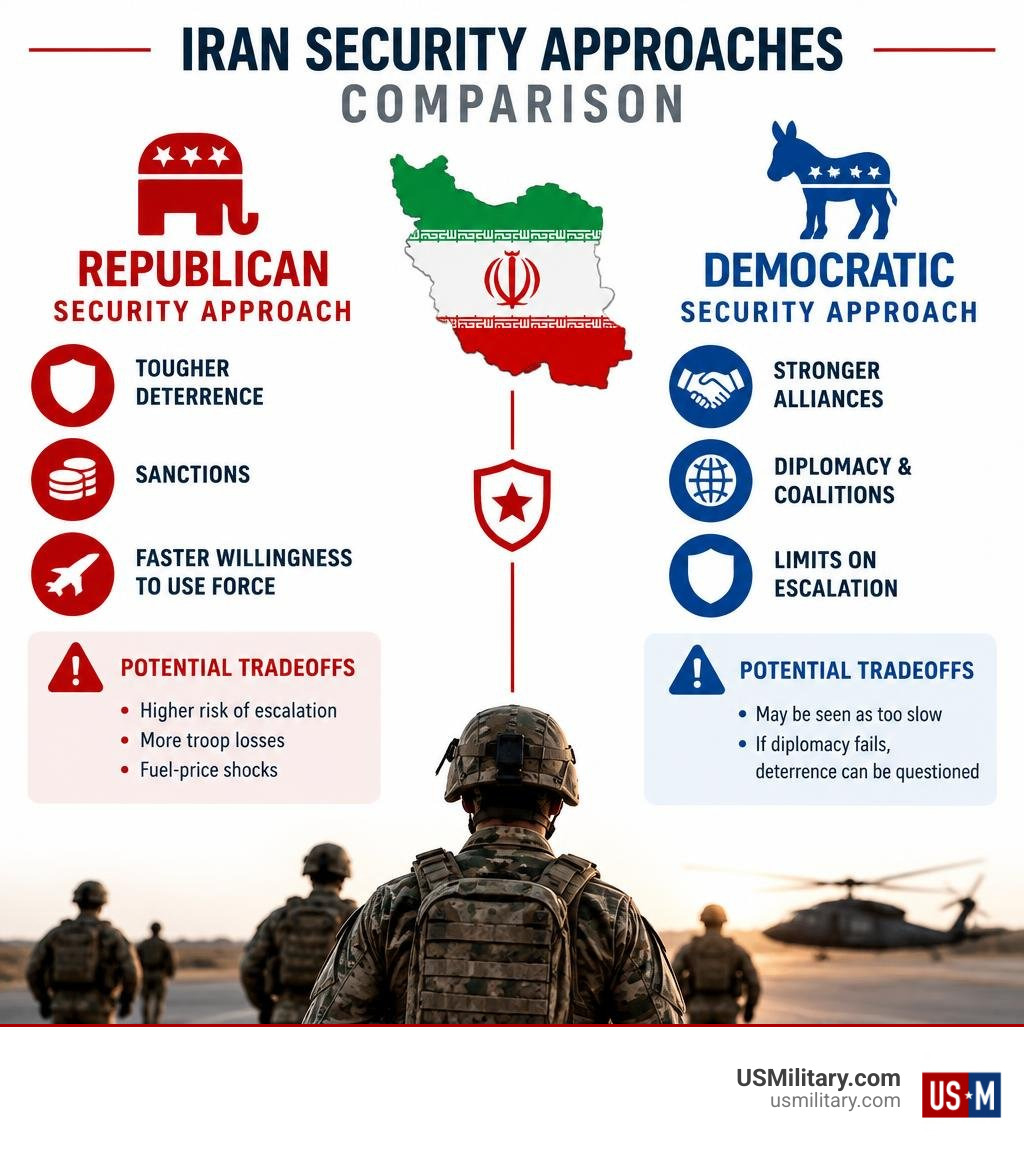
Republican presidents generally favor tougher deterrence, sanctions, and a faster willingness to use force. Democratic presidents generally put more weight on alliances, although weaker, with limited respect, diplomacy, sanctions coalitions, and limits on escalation. Each approach has real tradeoffs:
- A Republican-led response may project force quickly and deter follow-on attacks, but can carry a higher risk of escalation, troop losses, and fuel-price shocks. Although Trump has shown restraint when many have called – and even now – for further attacks on Iran.
- A Democratic-led response may build stronger international backing and reduce the risk of a wider war, but can be criticized if diplomacy appears too slow or fails to deter Iran.
- The best security outcome is a clear, lawful strategy that protects U.S. forces and the homeland, prevents Iranian nuclear weapons, maintains missile defense, and sets achievable military objectives.
Recent polling shows why this cannot be reduced to a simple party label. While Republicans were more likely to approve of U.S. strikes on Iran, majorities of Americans in several surveys opposed broader military action and sending ground troops. Concern about service member casualties, oil prices, and whether military action makes the country less safe crosses party lines.
I am LARRY FOWLER, publisher of the USMilitary.com Network since 2007, serving an audience of active-duty personnel, veterans, and military families. In this guide evaluating under what presidential political party America would be more secure if attacked by Iran, I focus on the practical factors that matter most to those who serve: readiness, lawful command decisions, force protection, alliances, and the cost of war.
Helpful related reading:
- Trump Calls Iran’s Bluff Proceeds To Hormuz Blockage Redirecting Ships To Strait Of America
- Iran war raises worry of a military draft
- Is The US Military Becoming More Confident & Stronger With President Trump
Under What Presidential Political Party Would America Be More Secure If Attacked by Iran: Comparing Doctrines
When assessing how the United States would respond to a major direct attack or surrogate aggression from Tehran, we have to look past campaign talking points and analyze institutional doctrines. The commander-in-chief sets the rules of engagement, directs intelligence assets, coordinates with allies, and signals red lines to adversaries.
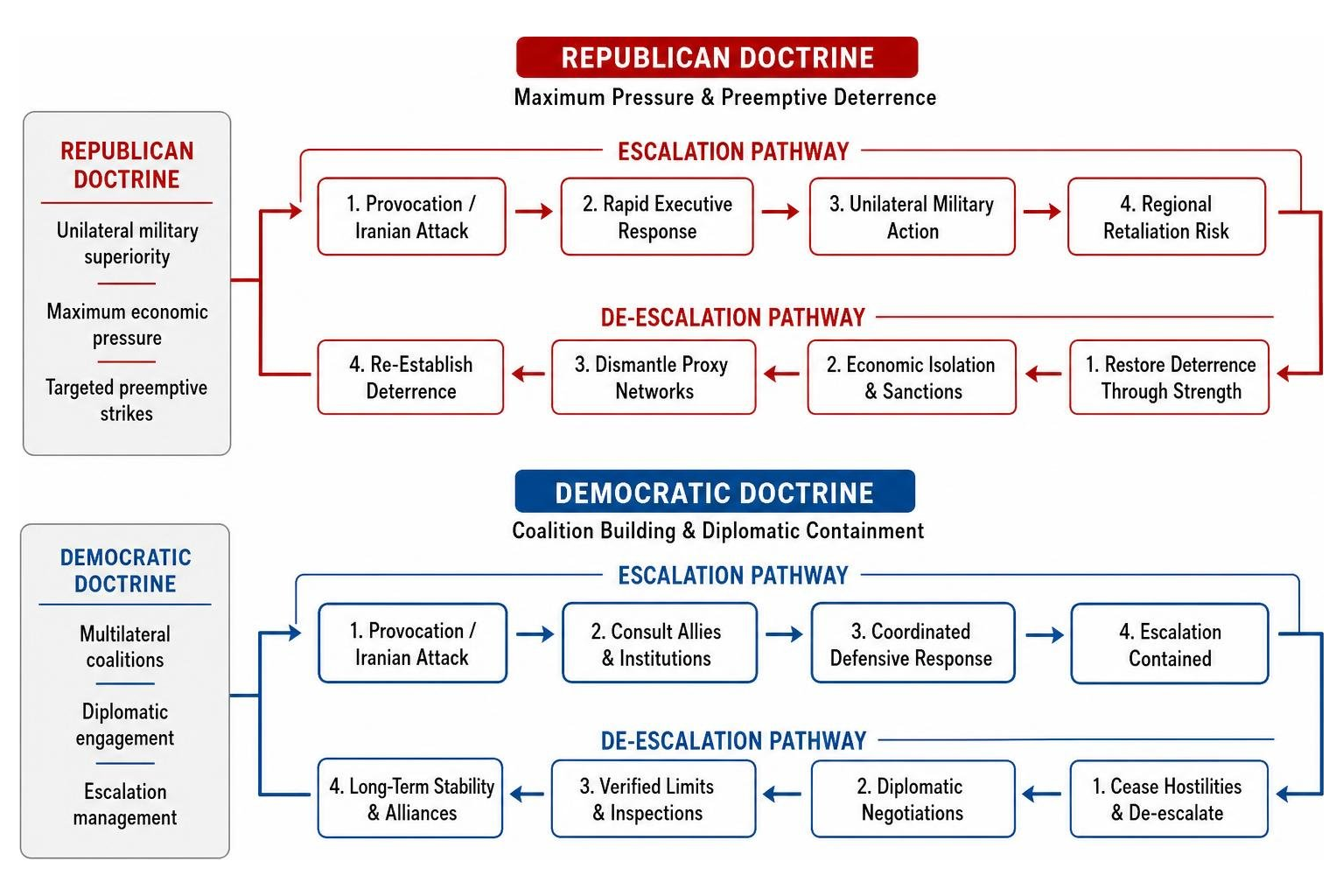
Historically, Republicans have approached Middle Eastern deterrence through two distinct lenses: “peace through strength” combined with unilateral kinetic options on the right, versus multilateral institutional containment and escalation management on the left.
| Strategic Element | Republican Doctrine (GOP) | Democratic Doctrine |
|---|---|---|
| Primary Deterrence Mechanism | Unilateral military superiority, maximum economic pressure, targeted preemptive strikes. | Multilateral coalitions, diplomatic engagement, targeted sanctions, international law frameworks. |
| Use of Military Force | Decisive, rapid, often executed via executive authority without prior congressional votes. | Calibrated, defensive, prioritized around de-escalation and coalition defense; emphasizes War Powers compliance. |
| Nuclear Strategy | Absolute denial of enrichment capacity; willingness to employ military force to destroy underground facilities. | Diplomatic containment, verified inspections, negotiated breakout limits, multilateral monitoring. |
| Regional Alliance Model | Bilateral focus (e.g., direct U.S.-Israel and U.S.-Gulf state cooperation); burden-sharing demands. | Integrated regional security pacts, United Nations coordination, joint European-Arab partner diplomacy. |
| Risk Profile | Faster escalation potential; higher risk of regional conflict and global energy shocks. | Slower response risk; vulnerability to adversary stalling tactics and incremental proxy aggression. |
Republican Security Posture: Maximum Pressure and Preemptive Deterrence
The Republican security platform regarding Iran centers on high-visibility deterrence and economic isolation. Under GOP leadership, executive power is treated as an agile tool meant to deliver rapid consequences for hostile actions. Proponents argue that an uncompromising military posture prevents adversaries from testing American resolve.
From this perspective, addressing Tehran requires dismantling its proxy networks and cutting off access to global capital. When kinetic options are authorized—such as high-profile strikes against military leadership or hardened infrastructure—the objective is to re-establish deterrence by demonstrating overwhelming capability. Proponents point to an analysis of decisive action against Iran’s nuclear capabilities to show that targeted military operations can set back adversarial programs and disrupt hostile regional coordination. However, this posture carries the strategic challenge of managing sudden retaliation, asymmetric attacks on commercial shipping lanes, and regional proxy mobilization.
Democratic Security Posture: Coalition Building and Diplomatic Containment
Democratic administrations generally frame national security through collective defense, verified diplomatic treaties, and alliance management. Rather than relying on unilateral force, Democratic doctrine emphasizes building unified diplomatic fronts with European allies, regional partners, and international institutions to isolate Tehran legally and economically. However, America’s international posture seems to have been weakened during the Biden term.
Public Sentiment and Trust in Wartime Executive Leadership
National security policies do not operate in a vacuum; they depend heavily on public backing and the trust citizens place in wartime leadership. When tensions flare in the Persian Gulf, American voters weigh the necessity of defending the homeland against the economic and human costs of extended foreign deployments.

Public Opinion on Which Presidential Political Party Would Make America More Secure If Attacked by Iran
Public opinion surveys reveal deep divisions among the American electorate when evaluating military actions against Iran. While 74% of Americans believe Iran must be prevented from acquiring nuclear weapons and 57% support strategic blockades, public willingness to sustain active military engagements remains sharply limited.
- Approval of Direct Strikes: In major polling, only 27% of respondents approved of direct U.S. strikes on Iranian targets, while 43% disapproved and 29% remained undecided.
- Partisan Splits on Force: 55% of Republicans approved of strikes against Iranian targets compared to only 13% of Democrats. Conversely, 56% of Americans overall—including 87% of Democrats and 23% of Republicans—expressed concern that military force is used too readily.
- Trust in Judgment: Approximately 6 in 10 U.S. adults expressed low confidence in executive decision-making regarding the use of force in the Middle East.
- Opposition to Ground Invasions: About three-quarters (75%) of registered voters oppose deploying American ground troops into Iran, a sentiment shared by 52% of Republicans.
- Domestic Safety Perceptions: About half of surveyed voters indicated that direct U.S. strikes made the nation less safe, while only roughly 30% believed military action increased domestic security.
For additional analysis on partisan viewpoints regarding executive resolve, readers often examine polling data on Iran conflict perspectives to see how differing camps interpret leadership strength during foreign crises.
Partisan Divides on War Powers and Military Interventions
The debate over presidential war powers remains one of Capitol Hill’s sharpest constitutional battlegrounds. Article I gives Congress the sole power to declare war, while Article II designates the president as Commander-in-Chief.
When strikes are launched without prior legislative approval, bipartisan coalitions often push back. Lawmakers across ideological aisles have introduced joint resolutions to enforce the War Powers Act of 1973, requiring explicit statutory authorization before committing American forces to prolonged hostilities. Progressive Democrats and non-interventionist Republicans frequently find common ground on these measures, demanding full intelligence briefings and votes before military actions expand into sustained regional warfare.
Strategic Escalation Risks and Regional Alliances
A direct confrontation with Iran involves complex geopolitical dynamics spanning air defense, cyber infrastructure, and key maritime chokepoints. Determining which party structure provides superior security requires evaluating how each administration manages regional defense networks and global deterrence.
Managing Threats from Nuclear Proliferation to Homeland Security
Preventing an adversary from obtaining deliverable nuclear weapons remains a primary national security imperative for both major parties. Intelligence assessments have long highlighted the risks of rapid uranium enrichment and shortened breakout timelines. A nuclear-capable adversary could dramatically shift the regional balance of power and challenge maritime stability.
Beyond nuclear assets, homeland security agencies track asymmetrical threats, including state-sponsored cyber operations targeting power grids, financial systems, and municipal water facilities, as well as potential maritime disruptions. Readers reviewing the strategic overview of Iranian threat vectors see why force protection protocols, missile defense shields, and port security screening remain foundational regardless of who occupies the Oval Office.
The China-Russia-Iran Axis and Global Power Balancing
Middle Eastern conflicts do not happen in isolation. Strategic cooperation between Beijing, Moscow, and Tehran introduces broader global challenges:
- Defense Technology Transfers: The supply of advanced air defense systems, radar equipment, and surveillance drones between these nations complicates allied air superiority and reconnaissance missions.
- Energy Supply Routes: Sanctioned energy trade routes provide alternative revenue streams, reducing the economic impact of Western financial restrictions.
- Maritime Security in the Chokepoints: Iran’s proximity to the Strait of Hormuz—through which roughly 20% of global petroleum passes—places international shipping at risk of drone harassment, fast-attack craft intercepts, and naval mining operations.
Securing these critical waterways requires continuous carrier strike group presence, mine-countermeasure readiness, and surface warfare operations. Service members interested in forward-deployed maritime missions can explore Persian Gulf maritime roles and operations to understand how our armed forces maintain freedom of navigation in contested waters.
Domestic Economic Fallout and Future Electoral Impacts
Military engagements carry immediate domestic economic consequences. Voter support for any foreign policy platform is heavily influenced by how wartime disruptions affect everyday living costs at home.
- Energy Market Shocks: 45% of poll respondents—including 34% of Republicans and 44% of independents—stated they would withdraw support for military campaigns if domestic gasoline and fuel prices spiked sharply as a result of Persian Gulf disruptions.
- Service Member Casualties: Force protection is a top domestic priority. Roughly 90% of Americans (86% of Republicans and 93% of Democrats) express deep concern regarding casualties among active-duty personnel, with 42% of Republicans noting they would oppose extended operations if U.S. troops were killed or injured.
- Defense Spending Priorities: Long-term commitments strain fiscal allocations, shifting resources away from domestic infrastructure, veteran benefits, and modernizing conventional weapon stockpiles.
Political analysts examining the electoral impact of the ongoing war with Iran on the 2028 election point out that unresolved foreign entanglements often erode public backing for the incumbent party, regardless of which banner they run under.
Evaluating Which Presidential Political Party Would Make America More Secure If Attacked by Iran in the Long Run
Looking at long-term security, both parties offer clear benefits alongside distinct risks:
- Republican Leadership: Can deliver fast, aggressive deterrence that disrupts immediate enemy planning and reassures frontline bilateral partners like Israel.
- Democratic Leadership: Excels at forming broad international sanction coalitions; however, it risks moving too slowly during sudden crises or allowing adversaries to exploit diplomatic timelines.
Long-term security relies less on partisan affiliation and more on maintaining combat readiness, clear strategic goals, and robust bipartisan oversight.
Frequently Asked Questions About U.S.-Iran Security Policies
What role does Congress play in authorizing military action against Iran?
Under the U.S. Constitution and the War Powers Resolution of 1973, Congress holds the authority to declare war and allocate military funding. While presidents routinely use executive power to order short-term defensive strikes, sustained military engagements require explicit congressional authorization or statutory approval to remain funded and legally compliant over time.
How would an Iranian attack impact U.S. domestic economic and energy security?
Hostilities near the Strait of Hormuz can disrupt commercial tanker traffic, leading to immediate spikes in global crude oil prices, domestic gasoline costs, and shipping insurance premiums. These disruptions can increase inflation across consumer goods and force adjustments in domestic economic policy.
Conclusion
When evaluating national security during major international crises, both major political parties present distinct strategic philosophies. The Republican approach prioritizes decisive executive deterrence, maximum economic pressure, and rapid force projection. Trump believes a strong American posture is important for ‘peace through strength.’
For active-duty service members, veterans, and military families, true national security is not defined by party rhetoric. It is built on comprehensive military readiness, cutting-edge defense systems, reliable intelligence, clear mission objectives, and unwavering care for those who wear the uniform. To stay informed on evolving defense policies, career opportunities across all service branches, and vital veteran benefits, explore our comprehensive military news and defense updates at USMilitary.com.
Free for Service Members & Veterans
Get the military benefits intel no one tells you about.
Weekly updates on VA benefits, pay changes, and money tips — free for service members and veterans.
No spam. Unsubscribe anytime. Your info is never shared.


