Why the Iran War Raises Worry of a Military Draft in 2026
The Iran war raises worry of a military draft among millions of Americans — and here’s what you need to know right now:
- No draft is currently planned. The White House confirmed it is “not the current plan.”
- But it’s not off the table. Press Secretary Karoline Leavitt stated the president “wisely does not remove options.”
- A draft requires Congress to act — the president cannot reinstate it alone.
- The military met all recruiting targets in FY2025, reducing immediate pressure for conscription.
- If a draft were activated, men aged 20-25 would be called first, with 18-19 year-olds last.
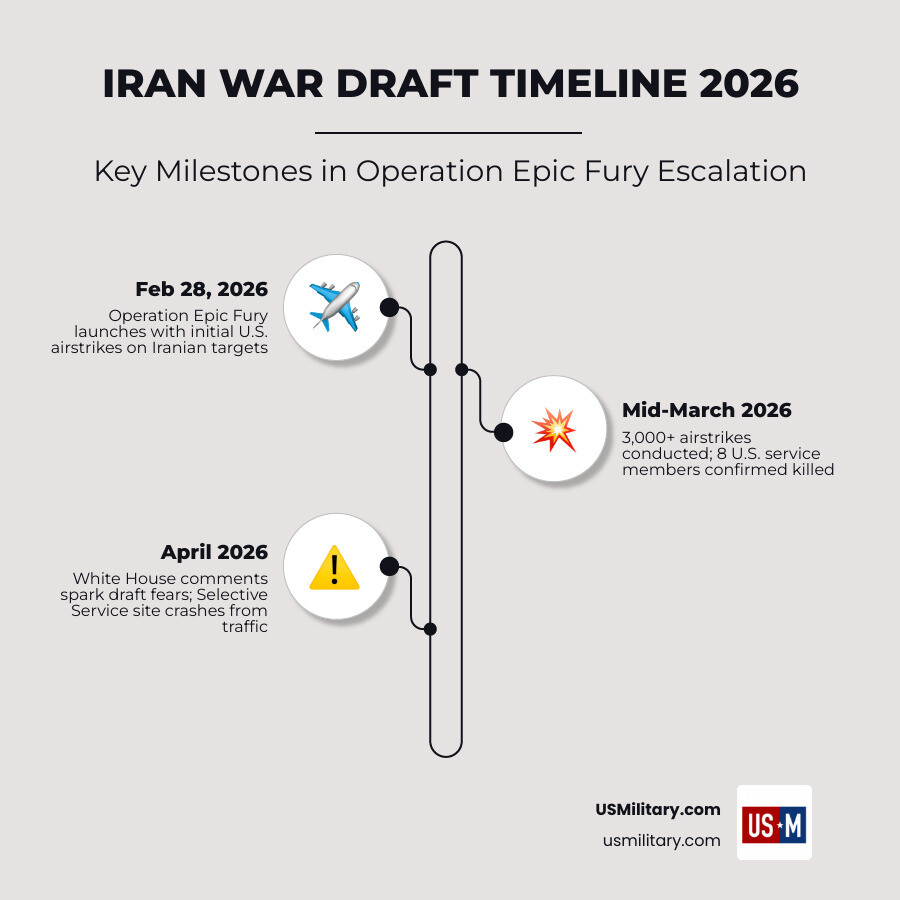
Since the U.S. launched Operation Epic Fury on February 28, 2026, American families have been asking one urgent question: could my son or daughter be drafted? More than 3,000 U.S. airstrikes have hit targets inside Iran. Eight service members have been confirmed killed as of mid-March 2026. And a vague answer from the White House press secretary on live television was all it took to send the Selective Service website crashing and draft-related searches skyrocketing overnight.
The anxiety is real — even if the threat of an actual draft remains distant.
I’m Larry Fowler, publisher of USMilitary.com and a longtime advocate for active-duty members and veterans navigating complex military policy — including the very real question of how the Iran war raises worry of a military draft for young Americans and their families. In this guide, I’ll break down exactly what the law says, what the government is actually doing, and what it would realistically take for conscription to return.
Iran war raises worry of a military draft word list:
- Latest Update Operation Epic Fury Including Three American Deaths
- US moves airborne troops, Marines as Iran rejects ceasefire, raising ground war potential
- Trump Announces Naval Blockade Strait of Hormuz
Current Status of Operation Epic Fury and the Iran War
As of April 2026, the United States remains locked in a high-intensity aerial conflict with Iran. Operation Epic Fury was triggered by intelligence regarding Iran’s accelerated nuclear ambitions and missile capabilities. Since the initial strikes on February 28, the U.S. has conducted over 3,000 airstrikes targeting nuclear facilities, missile silos, and command structures.
However, the human cost is mounting. By March 10, 2026, eight U.S. service members were confirmed killed in action, with the broader conflict claiming at least 1,332 lives inside Iran. Defense Secretary Pete Hegseth has maintained a policy of strategic ambiguity, refusing to rule out “boots on the ground” while emphasizing that the primary goal is to “wipe out” Iran’s nuclear potential.
While the administration insists there are no “overt or covert forces” currently operating inside Iran, the refusal to set hard limits has fueled Ongoing Iran War Raises Draft Fears — Could The US Reinstate Military Conscription In 2026?. For many, the memory of long-term ground wars in the Middle East makes the current situation feel like a prelude to something larger. We understand these fears at USMilitary.com, which is why we’ve compiled What You Absolutely Need To Know About If The Iran War Is Prolonged Should There Be A Military Draft/ to help clarify the legal reality.
Why the Iran war raises worry of a military draft in 2026
The current wave of “draft anxiety” didn’t appear out of thin air. It was sparked by a specific exchange between White House Press Secretary Karoline Leavitt and Fox News’ Maria Bartiromo. When asked about the possibility of a draft for the sons and daughters of worried American mothers, Leavitt responded that while a draft is “not part of the current plan,” the President “wisely keeps his options on the table.”
In social media, “not the current plan” was quickly translated by viral posts into “it’s happening soon.” This speculation was further amplified by Iranian influence operations using fake accounts to spread anti-war sentiment and draft rumors to destabilize American public opinion.
We’ve seen similar panics before, but the 2026 context is unique. You can read more about the administration’s stance in our article All About Can Trump Bring Back The Military Draft Amid Iran War/. Despite the chatter, military experts on platforms like Reddit have pointed out that the modern military often views draftees as a liability in tech-heavy warfare. You can see that perspective here: Can Trump bring back a military draft for the Iran war? Here’s how it works.
Legal hurdles for an Iran war military draft
The President of the United States cannot simply sign an executive order and start drafting citizens tomorrow. Under the Military Selective Service Act, only Congress has the power to authorize the induction of individuals into military service.
Even under the War Powers Resolution, which allows the President to use force for up to 60 days (plus a 30-day withdrawal period) without a formal declaration of war, the authority to draft is not included. Reinstating the draft would require a legislative amendment passed by both the House and the Senate. In today’s polarized political climate, such a move is widely considered “political suicide.” Furthermore, recent debates about whether to Automate Military Draft Passed By Congress/ have added to the confusion, though most of these provisions were aimed at administrative efficiency rather than active conscription.
Public opinion and the Iran war raises worry of a military draft
Public support for a draft is at historic lows. Recent polling shows that 77% of Americans either oppose conscription or are unsure, while only 23% support it. This lack of support is reflected within the ranks as well.
The Center on Conscience and War reported more than 80 new clients seeking discharge in March 2026 alone—nearly double the average annual rate. Military morale has been impacted by the “Secretary of Culture Wars” headlines and concerns over the ethical implications of the Iran strikes, such as the tragic bombing of a girls’ school that killed 165 civilians. While the Pentagon reported meeting recruitment targets for FY2025, retention is becoming a major concern. If you’re wondering about the long-term outlook, check out our analysis: Can We Now Forget About A Military Draft In 2026/.
How the Selective Service System and Draft Process Works
If the unthinkable happened and Congress authorized a draft, it wouldn’t happen overnight. The Selective Service System (SSS) estimates it would take approximately 193 days from the moment of authorization to deliver the first inductee to a MEPS (Military Entrance Processing Station).
The process follows a strict sequence:
- Congressional Action: Congress passes legislation; the President signs it.
- The Lottery: A televised, random lottery matches birthdates to numbers 1 through 366.
- Induction Orders: SSS sends orders based on lottery results.
- Evaluation: Potential draftees undergo medical, mental, and moral screening.
For a deeper dive into these mechanics, we recommend How The Military Draft Works/ and Everthing You Need To Know About The Military Draft/.
Who gets pulled first in a draft?
The draft doesn’t take everyone at once. It uses a “selection by age” system that prioritizes those who are most “mission-ready” while minimizing disruption to those just starting their adult lives.
- First Priority: Men in the calendar year of their 20th birthday.
- Second Priority: Men aged 21, then 22, 23, 24, and 25.
- Last Priority: Men aged 18 and 19.
This means if you are 20 years old in 2026, you are at the top of the list if a lottery is held. Once a man turns 26, his “age of liability” generally ends. For more details on the sequence, see Who Gets Pulled First In A Us Military Draft/ and Military Draft Age/.
Draft eligibility for women and older men
One of the biggest questions we get at USMilitary.com is: Will women be drafted? Currently, the law only requires “male persons” to register. While there have been several legislative attempts to include women in Selective Service registration, the FY2025 National Defense Authorization Act (NDAA) ultimately dropped those provisions. For now, the Women Draft/ remains a topic of debate rather than a legal reality.
As for older men, the cutoff remains your 26th birthday. While the Army recently raised its maximum enlistment age for volunteers to 42, this does not apply to the draft. If you’re wondering about the specifics for those later in life, read Can You Be Drafted Age 40/.
Exemptions, Deferments, and Alternatives to Conscription
Even if drafted, not everyone is required to serve. The SSS has a robust system for reclassification. Common deferments and exemptions include:
- Conscientious Objectors: For those with documented moral or religious opposition to war.
- Hardship Deferments: For those whose absence would cause extreme emotional or financial suffering for dependents.
- Ministerial Exemptions: For full-time ministers or divinity students.
- Medical Disqualifications: There is a long list of Medical Conditions That Keep You Out Of The Draft/, ranging from chronic physical issues to certain mental health conditions.
You can find a comprehensive list of these categories at Military Draft/.
Military alternatives to a draft
Before the government ever considers a draft, they have several “levers” they can pull to increase troop strength:
- Stop-Loss Orders: Forcing current service members to stay past their contract end date (used extensively during the Iraq war).
- IRR Recall: Calling back members of the Individual Ready Reserve who have left active duty but are still in their 8-year statutory window.
- National Guard/Reserve Mobilization: Increasing the deployment tempo of part-time forces.
- Recruitment Bonuses: Offering high cash incentives to attract new volunteers.
We discussed these strategies in our Military Draft 2023 2/ update, and they remain the military’s preferred methods for managing manpower.
Frequently Asked Questions about the Iran War Draft
Can the President reinstate the draft alone?
No. The President cannot unilaterally reinstate the draft. The authority to induct soldiers expired in 1973. Reinstating it requires an Act of Congress. While the President can order the Selective Service to prepare for a draft, the final “go” button belongs to the legislative branch.
What are the penalties for not registering?
Failure to register with the Selective Service is a felony. It can lead to a fine of up to $250,000 and up to five years in prison. More commonly, it results in permanent ineligibility for federal student loans, federal job training, and government employment. Most states also tie registration to getting a driver’s license.
Is a draft likely in 2026?
Most experts say no. The U.S. currently has 1.3 million active-duty troops and over 766,000 National Guard and Reserve members. With all five branches meeting their recruitment targets in FY2025 through innovative “preparatory courses,” the military has a healthy pipeline of volunteers. A draft is seen as a last resort that would only be triggered by a massive, multi-front global conflict or a direct invasion of the U.S. homeland.
Conclusion
The Iran war raises worry of a military draft because the stakes of modern conflict feel higher than they have in decades. However, when you look at the legal requirements, the 193-day timeline, and the current success of our all-volunteer force, the risk of a 2026 draft remains extremely low.
At USMilitary.com, we are committed to keeping you informed with the facts, not the viral hype. Whether you are looking for information on VA benefits, military loans, or Explore Navy Career Opportunities, we are your central hub for guidance.
The best way to stay prepared is to stay informed. Stay Updated with USMilitary.com for the latest news on Operation Epic Fury and how it impacts your family.
Free for Service Members & Veterans
Get the military benefits intel no one tells you about.
Weekly updates on VA benefits, pay changes, and money tips — free for service members and veterans.
No spam. Unsubscribe anytime. Your info is never shared.


