The 12 VA Disability Claims That Are Easiest & Most Simple to Win in 2026
The 12 VA Disability Claims That Are Easist & Most Simple to file and win are:
- Tinnitus – Flat 10% rating; approved based on noise exposure and personal statement
- Hearing Loss – Rated 0%-100% via objective audiogram results
- Knee/Joint Pain – Minimum 10% guaranteed under the VA Painful Motion Rule
- Spinal Injuries (Lumbosacral Strain) – Confirmed via MRI or X-ray
- Sciatica – Often secondary to back injuries; clear range-of-motion evidence
- PTSD and Mental Health Conditions – Average rating of 50%; well-documented approval path
- Scars – Rated 10%-80%; proven with photos and measurable size
- Sleep Apnea – Commonly rated 50% with CPAP use; often secondary to PTSD
- Migraines – Rated up to 50%; supported by symptom logs
- Sinusitis/Rhinitis – Presumptive under the PACT Act for burn pit exposure
- Hypertension – Presumptive for eligible Vietnam-era veterans
- Type 2 Diabetes – Automatically service-connected for Agent Orange exposure
These claims have higher approval rates because they rely on objective medical evidence, presumptive service connections, or well-established links to common military exposures.
Over 2.7 million veterans have already been approved for tinnitus alone — making it the single most claimed VA disability on record. And that’s just the start.
Whether you’re filing your first claim or adding to an existing rating, knowing which conditions are easiest to prove can save you months of frustration and thousands of dollars in back pay.
I’m Larry Fowler, publisher of USMilitary.com — a resource I’ve been building since 2007 to help active-duty service members and veterans navigate complex topics like the 12 VA Disability Claims That Are Easist & Most Simple. Over nearly two decades, I’ve helped connect veterans with the benefit trends, rating strategies, and trusted information they need to get the compensation they’ve earned.
Basic 12 VA Disability Claims That Are Easist & Most Simple terms:
Understanding What Makes a VA Claim Simple to Win

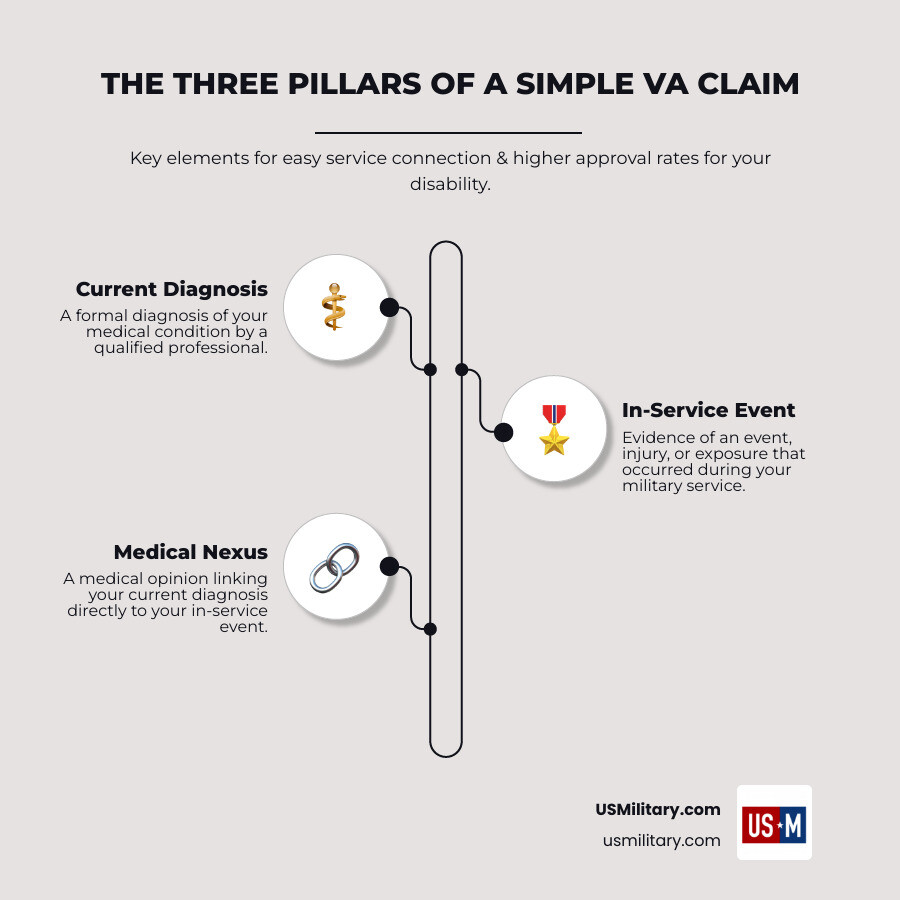
When we talk about the 12 VA Disability Claims That Are Easist & Most Simple, we aren’t saying the VA is just handing out money. What we mean is that the path to approval is more direct. For a standard claim, you usually need three things: a current medical diagnosis, an event that happened during your service, and a “nexus”—the medical link between the two.
However, some claims bypass the hardest part of that equation. Understanding the process for a VA disability claim is the first step in realizing why some conditions move through the system faster than others.
Presumptive Service Connection
This is the “Golden Ticket” of VA claims. For certain conditions, the VA legally assumes your military service caused your illness. If you served in a specific location (like Vietnam or the Southwest Asia theater) during a specific timeframe and developed a listed condition, you don’t need to prove a nexus. The PACT Act recently added dozens of respiratory conditions and cancers to this list, making it easier than ever for Gulf War and post-9/11 veterans to get approved.
Objective Medical Evidence
Claims are simpler when the evidence is “objective”—meaning it can be seen, measured, or tested with a machine. A scar can be measured with a ruler. Hearing loss can be measured with an audiogram. Spinal issues can be seen on an MRI. When the evidence isn’t open to interpretation, the VA has a harder time denying the claim.
High Prevalence and the Painful Motion Rule
Some conditions are so common that the VA has established clear patterns for approval. Tinnitus is the perfect example; because so many veterans were exposed to loud noises, the VA often accepts the claim based on your Military Occupational Specialty (MOS) and a credible personal statement.
Additionally, we have the “Painful Motion Rule.” This rule states that if a veteran has pain when moving a joint, the VA must award at least a 10% minimum compensable rating, even if the range of motion is technically within “normal” limits. This makes musculoskeletal claims some of the most straightforward to file.
12 VA Disability Claims That Are Easist & Most Simple
As we look at the VA disability ratings 2026 landscape, it is clear that certain conditions remain the “bread and butter” of successful claims. Filing for these can help you secure a baseline rating, which opens the door to secondary claims and higher monthly payments found on the VA disability pay chart 2026.
Tinnitus and Hearing Loss: The Foundation of the 12 VA Disability Claims That Are Easist & Most Simple
Hearing-related issues are the most common disabilities awarded by the VA.
- Tinnitus: Rated under Diagnostic Code 6260, this is a flat 10% rating. It is often called the “easiest” claim because there is no objective test to disprove that you hear ringing in your ears. If your MOS involved flight lines, firing ranges, or heavy machinery, the VA generally concedes noise exposure. To avoid seeing how is a VA claim for tinnitus denied, ensure you provide a clear statement about when the ringing started and how it persists. Note: Potential 2026 rule changes may require tinnitus to be claimed as a symptom of an underlying condition rather than a standalone 10% rating, so filing sooner rather than later is wise.
- Hearing Loss: Unlike tinnitus, hearing loss is strictly objective. You will undergo a pure-tone audiometry test and a speech discrimination test. While many veterans receive a 0% rating (meaning it’s service-connected but not compensable), severe cases can reach 100%. Even a 0% rating is a win because it covers your hearing aids and sets the stage for future increases.
Musculoskeletal and Skin Conditions in the 12 VA Disability Claims That Are Easist & Most Simple
If you spent years carrying a rucksack or jumping out of planes, your body likely has the “receipts” to prove it.
- Knee and Joint Pain: Using the Painful Motion Rule we mentioned earlier, conditions like “limitation of flexion of the knee” are very common. If it hurts when the doctor moves your knee during a C&P exam, you should qualify for at least 10%.
- Spinal Injuries (Lumbosacral Strain): Back pain is the 5th most common VA claim. Because the VA uses range of motion (ROM) to rate the spine, having an MRI or X-ray that shows degenerative disc disease or a strain makes the claim very simple to document.
- Scars: Scars are often overlooked but are incredibly simple to claim. They are rated based on size, location (head, face, and neck rate higher), and whether they are “unstable” or painful. If you have a surgical scar from a service-connected injury, it’s an easy add-on.
- Sciatica: This is the radiating pain that goes down your leg, often caused by a back injury. It is rated as “paralysis of the sciatic nerve.” Because it is so frequently linked to back issues, it is a common and simple secondary claim that can range from 10% to 80%.
Mental Health and Presumptive Conditions
Mental health claims have some of the highest average ratings, often starting at 30%, 50%, or 70%.
- PTSD and Mental Health: Whether it is combat-related PTSD or anxiety and depression linked to your service, these claims are highly successful when backed by a current diagnosis and a “stressor statement.” You can check the specific VA rating for PTSD to see where your symptoms fall. The VA is moving toward more inclusive rating criteria in 2026 that focuses on how these conditions impact your daily life and ability to work.
- Sinusitis and Rhinitis: Thanks to the PACT Act, if you served in eligible locations with burn pit exposure, these respiratory conditions are now presumptive. This means if you have a diagnosis of chronic sinusitis, the VA assumes it’s from the burn pits—no nexus letter required.
- Hypertension: For Vietnam veterans, high blood pressure is now a presumptive condition linked to Agent Orange exposure. It is a straightforward claim that requires only medical records showing high blood pressure readings.
- Type 2 Diabetes: Another Agent Orange presumptive, Type 2 Diabetes is automatically service-connected for veterans who served in specific locations like Vietnam, the Korean DMZ, or certain bases in Thailand.
Maximizing Your Combined Rating with Secondary Claims
One of the best ways to use the 12 VA Disability Claims That Are Easist & Most Simple is to use them as “anchors” for secondary conditions. A secondary condition is a disability that was caused or aggravated by a primary service-connected disability.
| Primary Condition | Potential Secondary Condition | Why It Works |
|---|---|---|
| Tinnitus | Anxiety/Depression | Constant ringing often leads to mental health strain. |
| Back Strain | Sciatica/Radiculopathy | Nerve damage is a direct result of spinal compression. |
| PTSD | Sleep Apnea | Weight gain from meds or “hyperarousal” affects sleep. |
| Knee Injury | Back Pain | An altered gait (limping) puts stress on the spine. |
Sleep Apnea
Currently, the sleep apnea VA rating is often 50% if you are required to use a CPAP machine. While it can be hard to prove sleep apnea started in service, it is much simpler to claim it as secondary to PTSD, a neck injury, or service-connected weight gain. Be aware that the VA has proposed changing this rating scale in 2026, so getting your claim in now is critical for a potential VA disability rate increase in your total percentage.
GERD and Migraines
Gastroesophageal Reflux Disease (GERD) is frequently claimed secondary to physical injuries because the NSAIDs (like Ibuprofen) veterans take for pain can wreck the stomach lining. Similarly, migraines are often linked to tinnitus or service-connected stress. If you experience “prostrating” attacks—meaning you have to lie down in a dark room—migraines can be rated up to 50%.
Frequently Asked Questions about Easy VA Claims
What is the fastest VA claim to get approved?
Tinnitus and hearing loss are generally the fastest. This is because the evidence is largely based on your military job (MOS) and a standard hearing test. There is less “gray area” for a rater to navigate compared to complex conditions like Gulf War Syndrome or TBI.
Can I get a rating for pain even if my range of motion is normal?
Yes! We cannot stress the Painful Motion Rule enough. If you have a “normal” range of motion but you experience pain during the C&P examiner’s test, you are entitled to a 10% rating for that joint. Never “push through the pain” during an exam; stop the moment it hurts so the doctor can document your functional limitation.
How do presumptive conditions simplify the filing process?
They remove the hardest hurdle: the medical nexus. Normally, you have to find a doctor to write a letter saying, “It is at least as likely as not that this condition was caused by service.” For presumptive conditions, the law already says it was. You only need to prove you were there (via your DD-214) and that you have the diagnosis now.
Conclusion
Navigating the VA can feel like a full-time job, but focusing on the 12 VA Disability Claims That Are Easist & Most Simple gives you a strategic advantage. By starting with these high-probability claims, you build a foundation of service connection that makes it easier to reach higher combined ratings.
Whether you are looking for a VA disability rating chart 2026 guide to estimate your monthly pay or you are aiming for the “finish line” of how to get 100 VA disability, the key is documentation.
Our Final Tip: Always submit a Fully Developed Claim (FDC). This means you gather all your private medical records, buddy statements, and nexus letters yourself and submit them all at once. This tells the VA, “I have everything you need to make a decision,” which can significantly cut down your wait time.
For more information on maximizing your benefits and staying up to date on 2026 rating changes, visit us at USMilitary.com. Your service was valuable, and you deserve to be compensated for every injury and illness that resulted from it.
Free for Service Members & Veterans
Get the military benefits intel no one tells you about.
Weekly updates on VA benefits, pay changes, and money tips — free for service members and veterans.
No spam. Unsubscribe anytime. Your info is never shared.


