Understanding Your 2026 VA Disability Benefits: What Every Veteran Needs to Know
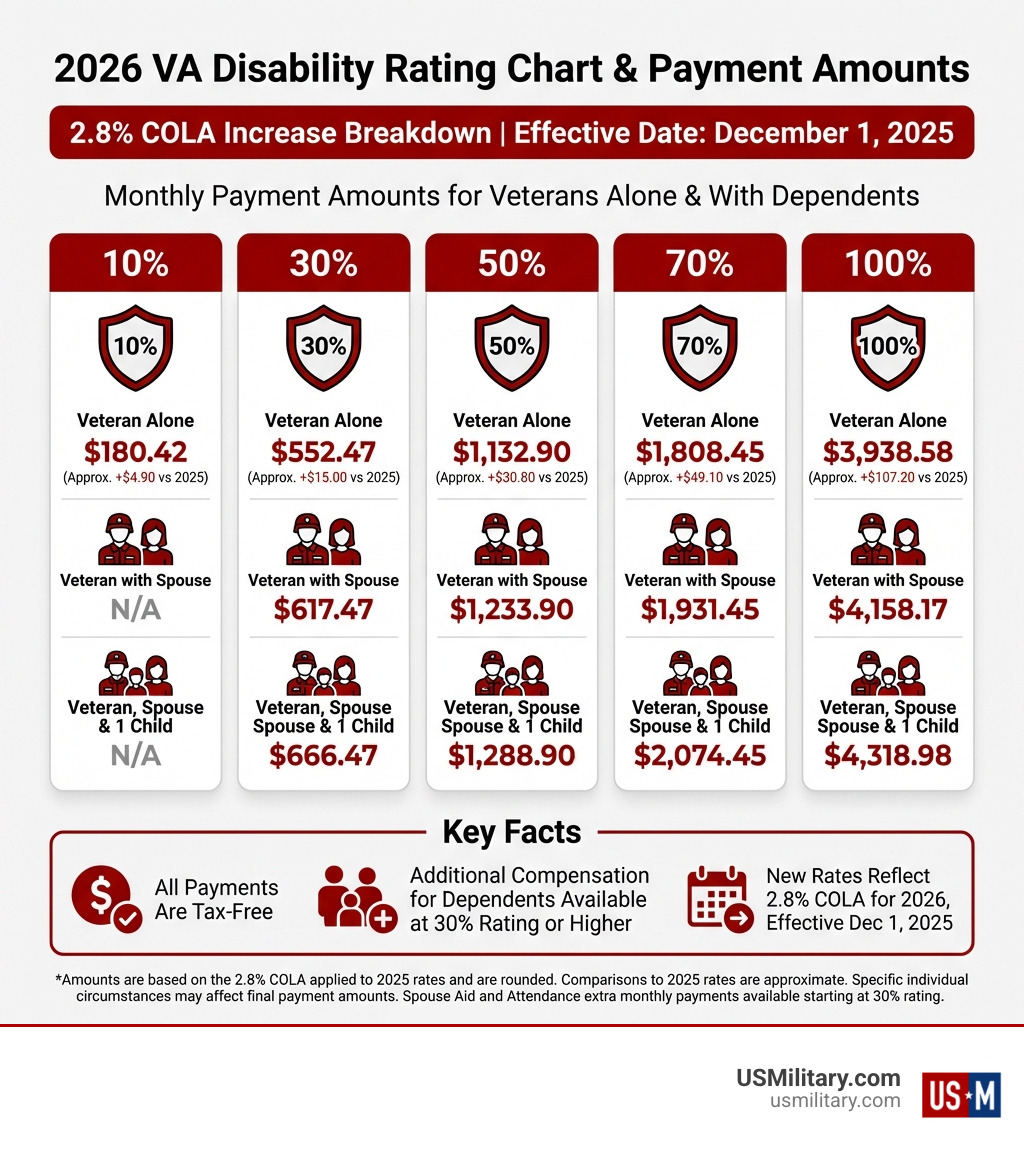
The VA disability rating chart for 2026 reflects a 2.8% cost-of-living adjustment (COLA), with new rates effective December 1, 2025. Here’s what you need to know right away:
Key 2026 VA Disability Pay Rates:
| Disability Rating | Veteran Alone | Veteran with Spouse | Veteran, Spouse & 1 Child |
|---|---|---|---|
| 10% | $180.42 | N/A | N/A |
| 30% | $552.47 | $617.47 | $666.47 |
| 50% | $1,132.90 | $1,233.90 | $1,288.90 |
| 70% | $1,808.45 | $1,931.45 | $2,074.45 |
| 100% | $3,938.58 | $4,158.17 | $4,318.98 |
Important Facts:
- All VA disability payments are tax-free
- Additional compensation available for dependents at 30% rating or higher
- Spouse receiving Aid and Attendance qualifies for extra monthly payment (ranging from $60.07 at 30% to $201.41 at 100%)
- Average claim processing time: approximately 85 days
If you’re a veteran trying to understand your disability benefits for 2026, you’re not alone. The VA disability system can feel overwhelming, with its complex rating schedules, combined rating calculations, and varying payment amounts based on your family situation. But understanding these rates is crucial for your financial planning and ensuring you receive every benefit you’ve earned through your service.
The 2026 rates represent more than just numbers on a chart. They reflect the government’s commitment to maintaining the purchasing power of veterans’ benefits through annual cost-of-living adjustments. Whether you’re filing your first claim, considering an appeal, or simply planning your household budget, knowing what to expect can make all the difference.
I’m Larry Fowler, and since 2007, I’ve been helping veterans steer the complexities of their benefits through the USMilitary.com Network. My experience working with thousands of veterans seeking information on the va disability rating chart for 2026 and related benefits has shown me that clear, straightforward information is what veterans need most. This guide will walk you through everything you need to know about the 2026 VA disability pay rates, how they’re calculated, and what steps you can take to maximize your benefits.
Key va disability rating chart for 2026 vocabulary:
The Official VA Disability Rating Chart for 2026
The VA disability rating chart for 2026 provides the foundational figures for understanding your monthly compensation. These rates are crucial for financial planning and reflect the government’s commitment to supporting our veterans. We’ll break down the specific payments you can expect, first for veterans without dependents, and then for those with spouses, children, and parents.
2026 VA Pay Rates: Veteran Alone
For veterans rated at 10% or 20% disability, the compensation is a flat rate regardless of dependents. However, for those rated at 30% or higher, the presence of dependents can significantly increase the monthly payment. Here’s a look at the 2026 monthly compensation for a veteran alone:
- 10% Disability Rating: A veteran alone with a 10% disability rating will receive $180.42 per month.
- 20% Disability Rating: A veteran alone with a 20% disability rating will receive $356.66 per month.
- 30% Disability Rating: A veteran alone with a 30% disability rating will receive $552.47 per month.
- 100% Disability Rating: For a veteran alone with a 100% disability rating, the monthly payment will be $3,938.58. This is a substantial amount, reflecting the severe impact of their service-connected conditions on their daily life and earning capacity. You can learn more about what this rating entails on our 100 Percent VA Disability page.
The difference in monthly payment between various rating levels can be quite significant. For example, let’s compare a veteran with a 90% rating to one with a 100% rating, both alone:
- 90% Disability Rating (Veteran Alone): The monthly payment is $2,362.30.
- 100% Disability Rating (Veteran Alone): The monthly payment is $3,938.58.
This means a veteran with a 100% disability rating receives $1,576.28 more per month than a veteran with a 90% rating, highlighting the considerable jump in compensation at the highest level.
Understanding the 2026 VA Disability Rating Chart for Veterans with Dependents
When a veteran has a disability rating of 30% or higher, the presence of dependents can lead to additional monthly compensation. This is a critical aspect of the VA disability rating chart for 2026 that many veterans find beneficial.

Here’s how dependents influence your monthly payment:
- Spouse Compensation: If you have a spouse, your monthly compensation will increase. For a veteran with a 100% disability rating, having a spouse increases the payment from $3,938.58 to $4,158.17. At a 40% rating, a spouse increases the payment from $795.84 to $883.30.
- Dependent Children Pay: The VA recognizes the financial responsibility of raising children.
- For each child under 18, the additional monthly amount varies by your disability rating. For instance, at a 100% rating, each child under 18 adds $109.11 to your monthly payment. At a 60% rating, each child under 18 adds $65.34.
- For each schoolchild over 18 (up to age 23), the additional compensation is even higher, reflecting the costs of higher education. At a 100% rating, this amounts to $352.45 per child. At a 40% rating, it’s $80.08.
- Dependent Parent Pay: Yes, veterans can receive additional compensation for dependent parents. If you provide more than 50% of your parent’s financial support, they can be considered a dependent.
- For a veteran with a 100% rating, one dependent parent adds $176.23 to the monthly payment, bringing the total for a veteran alone with one parent to $4,114.81. Two dependent parents would add $352.48, for a total of $4,291.06.
- For a veteran with a 70% disability rating, one dependent parent adds $123.00, resulting in a total of $1,931.45. If there are two dependent parents, the additional amount is $246.00, for a total of $2,054.45.
- Aid and Attendance (A/A) for Spouse: If your spouse requires the aid and attendance of another person for daily living activities, you may qualify for additional monthly compensation. This amount varies by your disability rating. At the 100% disability rating level, the additional monthly compensation for a spouse requiring Aid and Attendance is $201.41. At a 30% rating, this additional amount is $60.07. To learn more about this benefit, explore our VA Aid and Attendance Pay Chart for 2026.
Let’s look at a specific example to illustrate these additions.
Example: What is the monthly payment for a veteran with a 70% disability rating, a spouse, and one child?
Based on the 2026 rates, a veteran with a 70% disability rating, a spouse, and one child would receive $2,074.45 per month. This figure combines the base rate for a veteran with a spouse and accounts for the first child. If this veteran also had three children under 18, and their spouse needed Aid and Attendance, their total monthly payment would be $2,367.45. This includes the basic rate for a spouse and one child ($2,074.45), plus two additional children (2 x $76.00 = $152.00), and the Aid and Attendance amount for the spouse ($141.00).
To answer another specific question: What is the monthly payment for a veteran with a 40% disability rating, a spouse, and two parents?
A veteran with a 40% disability rating, a spouse, and two dependent parents would receive $1,022.38 per month. This is calculated by taking the base rate for a veteran with a spouse at 40% ($883.30) and adding the amounts for two dependent parents.
How VA Disability Compensation is Calculated
Understanding the va disability rating chart for 2026 isn’t just about knowing the numbers; it’s also about comprehending how those numbers are determined. Several factors come into play, from annual adjustments to how the VA assesses your service-connected conditions.
The 2026 Cost-of-Living Adjustment (COLA) Explained
Every year, VA disability compensation rates are adjusted to keep pace with inflation. This adjustment is known as the Cost-of-Living Adjustment, or COLA. For 2026, the VA disability pay rates reflect a 2.8% COLA increase.
This 2.8% COLA increase for VA disability pay is effective for payments starting in January 2026, with the adjustment applied from December 1, 2025. This means that the first payment reflecting the new rates is received at the beginning of the year. The VA is legally required to match the percentage of cost-of-living adjustments made to Social Security benefits. This ensures that the purchasing power of your benefits keeps up with inflation, protecting your financial stability.
Comparing the 2026 VA disability pay rate to the 2025 rates, we see a consistent 2.8% increase across the board, reflecting the COLA. This annual adjustment is vital for veterans, as it helps offset rising costs of living and ensures their benefits maintain their value over time. For more information on COLA, you can visit the Social Security Administration’s (SSA) website or our dedicated page on Cola Increase Va Disability.
How the VA Determines Your Disability Rating
The VA’s process for determining a veteran’s disability rating is thorough and based on established guidelines. This rating directly impacts your monthly compensation, so understanding how it’s calculated is key.
The VA determines your disability rating by evaluating the severity of your service-connected condition(s) and how they impact your ability to function and earn a living. This involves several steps:
- Service-Connected Disability: First and foremost, your condition must be service-connected, meaning it was incurred or aggravated during your military service. This connection is often established through medical records and evidence from your time in service.
- Medical Evidence: The VA reviews all available medical evidence, including your service treatment records, VA medical records, and any private medical records you submit. This documentation helps paint a comprehensive picture of your condition.
- C&P Exams: You may be required to undergo a Compensation and Pension (C&P) exam. These exams are conducted by VA-appointed medical professionals who assess the current severity of your condition and provide an opinion on its connection to your service. It’s crucial to be thorough and accurate in describing your symptoms and their impact during these exams.
- VA Schedule for Rating Disabilities (38 CFR Part 4): The VA uses a comprehensive guide called the VA Schedule for Rating Disabilities (VASRD) to assign percentages. This schedule lists hundreds of diagnostic codes for various conditions, each with specific criteria for different rating percentages (0% to 100% in 10% increments). The ratings are based on how much your condition reduces your earning capacity, not just the medical diagnosis itself.

Even if a condition meets multiple diagnostic codes, the VA generally assigns a rating based on a single code per condition. We have extensive resources on specific conditions and their ratings, including our VA Disability Conditions List.
Understanding “VA Math”: The Combined Rating System
Many veterans have multiple service-connected disabilities, which can make calculating their total disability rating seem complicated. The VA uses a specific method known as the “combined rating system,” often referred to as “VA Math,” which is not a simple addition of percentages.
✉ Get updates like this in your inbox
Weekly VA benefit changes, pay updates, and money tips for service members, veterans, and military families. Free, no spam.
The VA uses what’s called the “Whole Person Theory.” This theory states that a person cannot be more than 100% disabled. Instead of adding individual ratings, the VA calculates the impact of each disability on the “remaining efficiency” or “healthy” portion of the veteran. This means that as your overall disability increases, it becomes progressively harder to increase your rating further.
Here’s how it works:
- Order Disabilities: The VA arranges your disabilities from the highest rating to the lowest.
- Combine Highest Two: The highest disability rating is taken first. Then, the next highest disability is applied as a percentage of the remaining healthy portion. For example, if you have a 60% rating, you are considered 40% “healthy.” If your next highest rating is 30%, the VA calculates 30% of that remaining 40% (which is 12%). This 12% is then added to your initial 60%, resulting in a combined efficiency of 72%.
- Repeat: This process is repeated for any additional disabilities, applying each subsequent rating to the new “remaining efficiency.”
- Rounding: The final combined percentage is then rounded to the nearest 10%. For example, 72% would round down to 70%, while 75% would round up to 80%.
Let’s illustrate with an example:
- A veteran has a 60% rating for one condition, a 30% rating for another, and a 20% rating for a third.
- Start with 60%. Remaining healthy: 40%.
- Next, 30% of 40% = 12%. Add to 60% = 72%. Remaining healthy: 28%.
- Next, 20% of 28% = 5.6%. Add to 72% = 77.6%.
- Rounded to the nearest 10%, the final combined rating is 80%.
As you can see, this method often results in a combined rating that is lower than the sum of the individual ratings. This system directly affects your final payment, as your compensation is tied to this rounded combined rating. We offer a handy VA Disability Calculator to help you estimate your combined rating.
Beyond the Basic Rates: Special Claims and Additional Benefits
While the va disability rating chart for 2026 covers the majority of compensation scenarios, some veterans with particularly severe conditions or unique circumstances may qualify for additional benefits. These special claims can significantly increase monthly payments and provide crucial support.
Special Monthly Compensation (SMC)
Special Monthly Compensation (SMC) is an additional tax-free benefit paid to veterans, their spouses, surviving spouses, and parents. It’s paid in addition to regular VA disability compensation when a veteran has certain severe disabilities or a combination of serious conditions.
Who might qualify for SMC? It’s generally reserved for veterans with:
- Severe Disabilities: This includes conditions such as the loss or loss of use of specific organs or extremities (e.g., blindness, loss of a hand or foot).
- Specific Loss of Use: For example, the anatomical loss or loss of use of a creative organ, one or both breasts (for women), or certain combinations of disabilities.
- Aid and Attendance Need: If a veteran requires the aid and attendance of another person for daily living activities, they may qualify for SMC.
- Housebound Status: Veterans who are permanently and substantially confined to their home (or immediate premises) due to their service-connected disability may also qualify.
SMC has different levels (SMC-K, SMC-L, SMC-M, etc.), with each level providing a different additional monthly payment based on the specific type and severity of the qualifying condition. For more detailed information on eligibility for these improved benefits, you can visit our page on Who is Eligible for VA Aid and Attendance 2026.
Total Disability based on Individual Unemployability (TDIU)
Total Disability based on Individual Unemployability (TDIU) is a vital benefit for veterans whose service-connected conditions prevent them from maintaining steady, substantially gainful employment, even if their combined disability rating is less than 100%.
If granted, TDIU allows the VA to pay you at the 100% disability rate, regardless of your actual combined rating. This is a critical pathway to maximum compensation for many veterans.
There are two main ways to qualify for TDIU:
- Schedular TDIU: This is the most common path. To qualify, you generally need:
- One service-connected disability rated at 60% or more, OR
- Two or more service-connected disabilities with a combined rating of 70% or more, with at least one disability rated at 40% or more.
- Extraschedular TDIU: If you don’t meet the schedular requirements but can demonstrate that your service-connected conditions prevent you from working due to exceptional circumstances (e.g., frequent hospitalizations, inability to tolerate a work environment), the VA may still consider you for TDIU.
The key criterion for TDIU is the inability to maintain “substantially gainful employment.” This means employment that provides an annual income exceeding the federal poverty level for a single person. It generally excludes marginal employment or employment in a protected work environment.
If your service-connected conditions make it impossible to maintain steady employment, we strongly encourage you to explore this benefit. You can find more detailed information and the application form (VA Form 21-8940) directly on the VA’s website regarding Total Disability based on Individual Unemployability (TDIU).
Navigating the VA System: How to Apply and Appeal
Understanding the va disability rating chart for 2026 is only one piece of the puzzle. To receive these benefits, you need to steer the VA’s application and, sometimes, appeal processes. We’re here to help make that journey as clear as possible.
How to File Your VA Disability Claim
Applying for VA disability benefits can seem daunting, but with the right information and approach, it’s a manageable process.
Here’s how to file your claim:
- Gather Evidence: Before you apply, collect all relevant documentation. This includes your military service records (like your DD214), all medical records related to your service-connected conditions (both VA and private), and any other supporting evidence like buddy statements or lay evidence. Establishing care at a VA health facility can also help support your claims by generating VA medical records.
- Choose Your Application Method: The VA recommends applying for disability compensation benefits online through the VA’s portal. This is often the fastest and most efficient way. However, you can also apply by mail using VA Form 21-526EZ, in person at a regional benefits office, or with the help of a trained professional like a Veterans Service Officer (VSO). Our Applying for Va Disability Benefits page offers more detailed guidance.
- Consider Claim Types:
- Benefits Delivery at Discharge (BDD): If you are still on active duty but within 180 to 90 days of separation, you can apply through the BDD program. This allows you to receive a decision on your claim soon after leaving service.
- Fully Developed Claims (FDC): This is often the quickest path. If you have all your supporting evidence ready and submit it with your initial application, your claim may be processed faster. While the average time to complete VA disability-related claims is around 85 days as of November 2025, FDCs can sometimes receive decisions within 30 days.
- Standard Claims: If you need the VA’s help to gather evidence, you can file a standard claim. This typically takes longer.
How to Use the VA Disability Rating Chart for 2026 to Appeal a Decision
If you disagree with the VA’s decision on your disability claim or rating, you have the right to appeal. The va disability rating chart for 2026 is your benchmark for understanding what you believe you should be receiving.
Here are the main pathways for appealing a VA decision:
- Supplemental Claim: If you have new and relevant evidence that wasn’t previously submitted, you can file a Supplemental Claim. The VA will review this new evidence along with your original claim. This is a good option if your condition has worsened, and you believe you qualify for a higher rating. Our How to Increase Your VA Disability Rating page provides strategies for this.
- Higher-Level Review: If you believe the VA made an error based on the evidence already in your file, you can request a Higher-Level Review. A more senior reviewer will examine your case without new evidence.
- Board of Veterans’ Appeals (BVA): If you’re still not satisfied after a Supplemental Claim or Higher-Level Review, you can appeal directly to the Board of Veterans’ Appeals. The BVA is the highest level of appeal within the VA, and you can choose from different review options, including direct review, evidence submission, or a hearing with a Veterans Law Judge.
The appeals process can be complex, and success rates can vary. Consulting with a Veterans Service Officer (VSO) or an accredited attorney can significantly improve your chances. You can also gain insights into the success rates of appeals on our VA Disability Appeal Success Rate page.
Frequently Asked Questions about 2026 VA Pay Rates
We’ve covered a lot about the va disability rating chart for 2026, but some common questions often arise. Let’s address them directly.
Are VA disability payments taxable income?
One of the most important benefits of VA disability compensation is its tax-free status.
No, VA disability payments are not taxable income. This applies at both the federal and state levels. You do not need to report these payments on your tax returns. This is a significant financial advantage for veterans receiving these benefits, as it means the full amount of your monthly compensation goes directly to you. To learn more, visit our page Is Va Disability Taxable.
Can I work while receiving VA disability benefits?
Yes, in most cases, you can work while receiving VA disability benefits.
- For veterans with schedular ratings (10% to 100%): There are generally no restrictions on your income or ability to work. You can work and earn any amount of income without affecting your VA disability compensation.
- For veterans receiving Total Disability based on Individual Unemployability (TDIU): The situation is different. TDIU is specifically for veterans whose service-connected conditions prevent them from maintaining “substantially gainful employment.” If you are receiving TDIU, your ability to work is restricted to marginal employment or a protected work environment. If you begin to engage in substantially gainful employment, your TDIU status (and thus your 100% payment) may be re-evaluated.
How often are VA disability rates updated?
VA disability rates are updated annually. These updates are tied directly to the Cost-of-Living Adjustment (COLA) announced by the Social Security Administration. The new rates typically take effect on December 1st of each year, meaning the first payments reflecting the updated rates are received in January of the following year. For 2026, the 2.8% COLA means the new rates became effective on December 1, 2025.
Conclusion
Navigating the complexities of VA disability benefits can be challenging, but understanding the VA disability rating chart for 2026 is a crucial step towards securing the compensation you’ve earned. We’ve explored the specific monthly payments for veterans alone and with dependents, including additional amounts for spouses needing Aid and Attendance, and for dependent children and parents.
Remember the key takeaways: the 2026 rates reflect a 2.8% COLA, ensuring your benefits keep pace with inflation. The presence of dependents significantly increases your compensation, and special programs like Special Monthly Compensation (SMC) and Total Disability based on Individual Unemployability (TDIU) offer additional support for those with severe conditions or an inability to work. We’ve also demystified the VA’s combined rating system and outlined the steps for applying for benefits and appealing decisions.
At USMilitary.com, we are committed to empowering veterans with clear, accurate, and up-to-date information. Your service to our nation is deeply valued, and we believe you deserve every benefit you’re entitled to. If you have further questions or need personalized guidance, we encourage you to Get a Free VA Benefits Evaluation Assessment. We are here to help you understand and maximize your benefits.
Free for Service Members & Veterans
Get the military benefits intel no one tells you about.
Weekly updates on VA benefits, pay changes, and money tips — free for service members and veterans.
No spam. Unsubscribe anytime. Your info is never shared.


