Why ASVAB Scores Shape Your Military Career Options
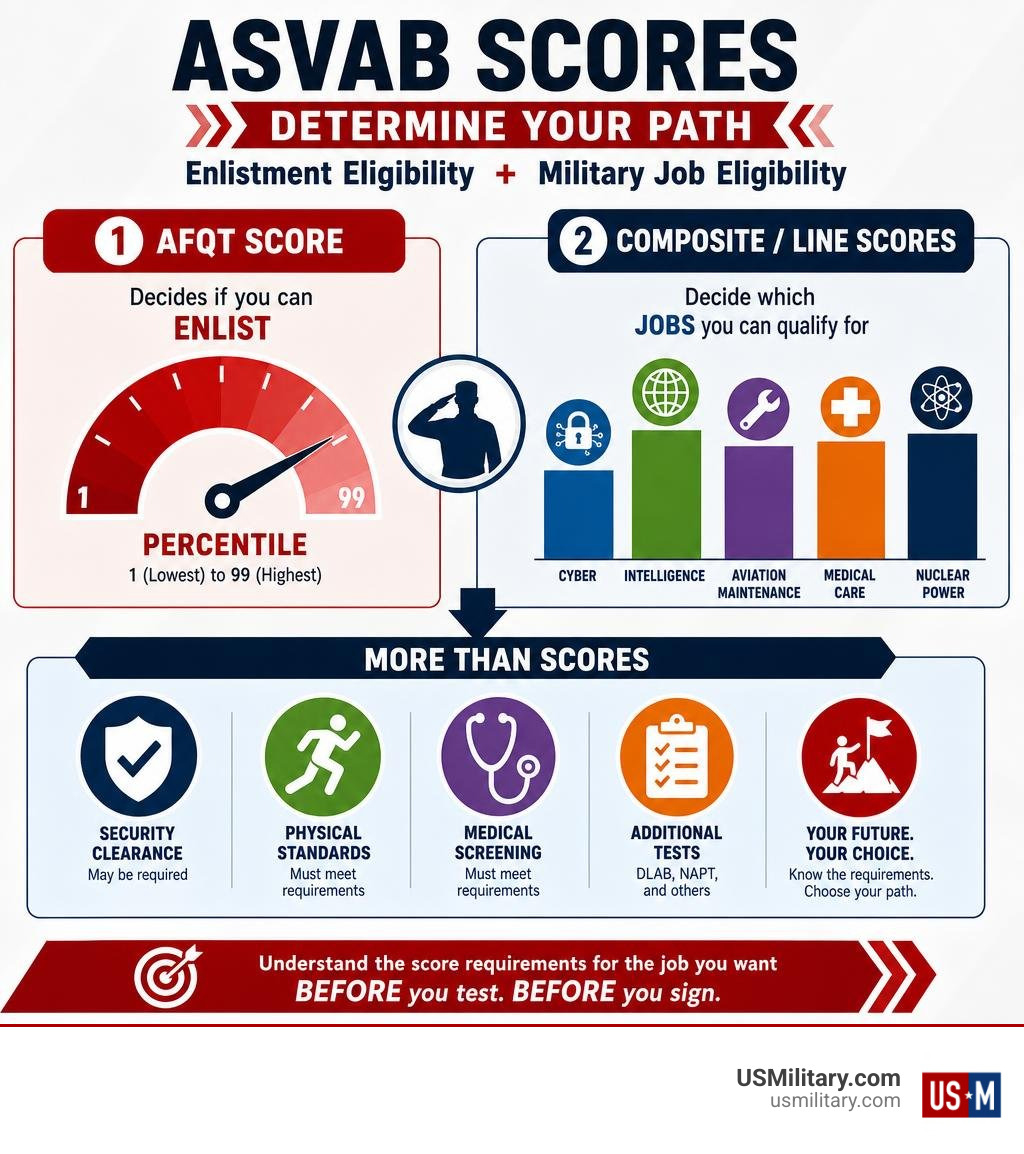
How Your ASVAB Scores Will Determine Your Military Job Success comes down to two results: your AFQT score helps decide whether you can enlist, while your branch’s composite or line scores decide which jobs you can qualify for.
| Score type | What it affects |
|---|---|
| AFQT score | Basic enlistment eligibility. It is a percentile from 1 to 99 based on verbal and math subtests. |
| Composite/line scores | Eligibility for specific jobs, such as cyber, intelligence, aviation maintenance, medical care, and nuclear power. |
| Other qualifications | Some careers also require a security clearance, physical standards, medical screening, or added tests such as the DLAB or NAPT. |
A higher AFQT can give you more enlistment options, but it does not guarantee a certain job. Two applicants with the same AFQT score may qualify for very different careers because their strengths on individual ASVAB subtests are different. Your best path is to understand the score requirements for the job you want before you test and before you sign an enlistment contract.
I am Larry Fowler, publisher of the USMilitary.com Network, which has helped connect prospective recruits, service members, and veterans with clear military information since 2007. In this guide to How Your ASVAB Scores Will Determine Your Military Job Success, I will break down what your results mean and how to use them to pursue a military career that supports your long-term goals.
Quick look at **How Your ASVAB Scores Will Determine Your Military Job Success **:
- military jobs
- security clearance disqualifications in the military
- Top 20 Career Jobs in the Space Force
Decoding the Scoring System: How Your ASVAB Scores Will Determine Your Military Job Success
To navigate your path into the Armed Forces, we must first unpack how the Armed Services Vocational Aptitude Battery (ASVAB) is scored. The ASVAB is not a simple pass-or-fail exam. Instead, it measures your developed abilities and predicts your academic and occupational success across various fields. When you complete the exam, your results are converted into two distinct sets of numbers: your Armed Forces Qualification Test (AFQT) percentile and your service-specific composite line scores. Understanding how these metrics work together is essential for taking control of your military career. For a deeper breakdown of test logistics, check out our guide on Military Asvab Placement Tests.
AFQT vs Composite Line Scores
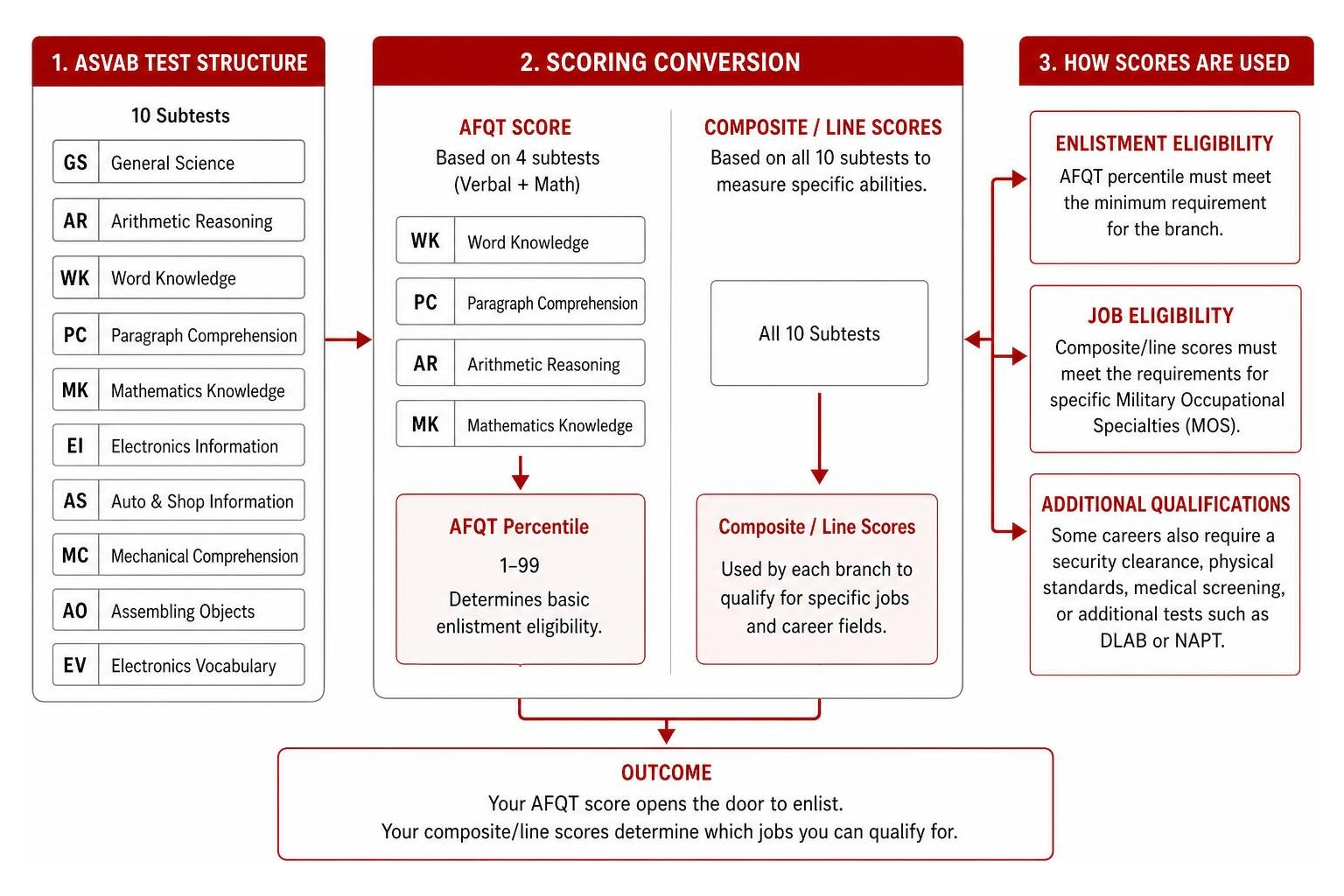
Your AFQT score is a single percentile ranking ranging from 1 to 99. Calculated by comparing your raw performance against a national reference group of American young adults, an AFQT score of 50 means you scored higher than 50% of test-takers in that reference group. This score serves as the primary gatekeeper: it strictly determines whether you meet the basic standard to step through the door and enlist in a given service branch.
However, your AFQT score alone does not dictate which job specialty you will hold. That responsibility falls on your composite line scores (also known as line scores, MAGE scores, or rating qualifiers depending on the service). While the AFQT uses only four math and verbal subtests, line scores combine results from all ten subtests to evaluate specific skill sets such as electrical aptitude, mechanical reasoning, spatial awareness, and administrative capability. You can review Official Army ASVAB details to see how individual branches evaluate testing profiles.
The 10 Subtests Breakdown
Whether you take the computer-adaptive CAT-ASVAB (10 subtests, ~135 questions in 154 minutes) at a Military Entrance Processing Station (MEPS) or the paper-and-pencil version (225 questions in 149 minutes) at a satellite location, your performance across ten distinct subtest areas shapes your line scores:
- Arithmetic Reasoning (AR): Evaluates your ability to solve word problems involving basic calculations, percentages, ratios, and practical math logic.
- Word Knowledge (WK): Measures vocabulary understanding through word definitions and context clues.
- Paragraph Comprehension (PC): Assesses reading comprehension and your ability to extract explicit details and implicit meanings from text passages.
- Mathematics Knowledge (MK): Tests knowledge of high school level geometry, algebra, and mathematical principles.
- General Science (GS): Covers fundamental concepts in physical, life, earth, and space sciences.
- Electronics Information (EI): Measures knowledge of electrical circuits, currents, transistors, radio signals, and electronic systems.
- Auto Information (AI): Tests familiarity with automotive mechanisms, engine systems, and vehicle repair tools.
- Shop Information (SI): Evaluates knowledge of common hand tools, woodworking, metalworking, and building practices.
- Mechanical Comprehension (MC): Assesses understanding of mechanical devices, structural mechanics, fluid dynamics, and physics principles.
- Assembling Objects (AO): Measures spatial visualization skills and the ability to determine how two-dimensional puzzle shapes fit together when rotated.
The four core subtests—Arithmetic Reasoning, Word Knowledge, Paragraph Comprehension, and Mathematics Knowledge—feed directly into your AFQT percentile via a specific mathematical formula:
$$\text{AFQT Formula} = 2(\text{VE}) + \text{AR} + \text{MK}$$
In this formula, Verbal Expression (VE) represents the combined score of Word Knowledge and Paragraph Comprehension. Because the VE score is multiplied by two, verbal skills carry a heavy weight in determining your overall enlistment eligibility!
Branch-Specific Enlistment Minimums and Line Score Calculations
Each branch of the United States military establishes its own baseline AFQT requirement for enlistment as well as unique line score formulas to assign recruits to specific jobs. Standard educational credentials, such as a high school diploma versus a GED, also directly impact the score threshold required to join.
The table below outlines current 2026 AFQT baseline standards alongside the primary composite score methodologies across all six active service branches:
| Military Branch | High School Diploma AFQT Min. | GED Requirement AFQT Min. | Primary Composite Scoring Method |
|---|---|---|---|
| U.S. Army | 31 | 50 | 10 Composite Line Scores (GT, ST, EL, CL, CO, FA, GM, MM, OF, SC) |
| U.S. Navy | 31 (or 35 standard) | 50 | Direct sum of specific subtests per rating (e.g., AR + MK + EI + GS) |
| U.S. Air Force | 36 | 65 | MAGE Composite Areas (Mechanical, Administrative, General, Electrical) |
| U.S. Space Force | 36 | 65 | MAGE Composite Areas (focusing heavily on General and Electrical) |
| U.S. Marine Corps | 32 | 50 | 4 Composite Line Scores (MM, CL, GT, EL) |
| U.S. Coast Guard | 32 (36–45 standard) | 47+ | Direct subtest combinations (or minimum GT thresholds) |
Army and Marine Corps Line Score Formulas
The Army classifies over 150 Military Occupational Specialties (MOS) using ten standardized line score combinations. Among these, the General Technical (GT) score—calculated by combining Verbal Expression (VE) and Arithmetic Reasoning (AR)—is widely considered the single most vital score on the test. A GT score of 110 or higher serves as the universal prerequisite for military leadership tracks, officer candidate programs, and specialized career paths. Explore more specific roles on our Army Jobs Based On Asvab Scores page.
Key Army line score areas include:
- General Technical (GT): $VE + AR$
- Skilled Technical (ST): $GS + VE + MK + MC$
- Electronics (EL): $GS + AR + MK + EI$
- Clerical (CL): $VE + AR + MK$
- Combat (CO): $AR + CS + AS + MC$ (where CS/AS combine Auto & Shop)
- Mechanical Maintenance (MM): $NO + AS + MC + EI$
The Marine Corps streamlines its job placement system using four core line scores:
- General Technical (GT): $VE + AR$
- Clerical (CL): $VE + AR + MK$
- Electronics (EL): $GS + AR + MK + EI$
- Mechanical Maintenance (MM): $AR + EI + MC + AS$
Air Force, Space Force, Navy, and Coast Guard Composite Calculations
The Air Force and Space Force organize Air Force Specialty Codes (AFSCs) around four primary composite score categories known as MAGE:
- Mechanical (M): Evaluates mechanical comprehension and shop/auto knowledge.
- Administrative (A): Focuses heavily on verbal skills and mathematics logic.
- General (G): Driven by Verbal Expression (VE) and Arithmetic Reasoning (AR).
- Electrical (E): Combines Math Knowledge, Arithmetic Reasoning, General Science, and Electronics Information.
You can review high-demand Air Force specialties using our Best Air Force Jobs 2025 resource.
The Navy and Coast Guard do not group subtests into stylized line categories like the Army or Air Force. Instead, Navy Ratings specify direct mathematical sums of 3 to 5 subtests. For example, qualifying for a Navy Cryptologic Technician role might require a combined sum of $AR + MK + EI + GS = 220$. Resources on ASVAB Jobs by Score 2026: Line Scores to Careers (FREE) | OpenExamPrep provide extensive mapping tools to match individual subtest sums against current naval ratings.
Career Placement Across AFQT Score Ranges
Understanding how your percentile places you into enlistment categories gives you an immediate picture of your potential career trajectories and bargaining leverage with military recruiters.
Entry-Level to Advanced Careers: How Your ASVAB Scores Will Determine Your Military Job Success
Your overall AFQT score places you into specific percentile tiers that dictate your initial entry qualifications:
- AFQT Tier 31–49 (Category IIIB): This range secures basic enlistment eligibility for branches like the Army, Navy, and Marine Corps. Careers in this tier typically focus on combat arms, basic logistics, field support, and motor transport. Examples include Army Infantry (11B), Combat Engineer (12B), or Marine Corps Field Artillery (0811). These roles offer hands-on experience, discipline, and core military skills.
- AFQT Tier 50–64 (Category IIIA): Achieving an average AFQT score opens a broader set of technical, clerical, and support fields across all branches. Recruits in this tier qualify for positions like Military Police, Supply Logistics Specialists, Aircraft Structural Maintenance, and General Field Medics. This range provides a balanced foundation of practical technical experience and post-service employment opportunities.
High-Tier and Elite Military Career Options
- AFQT Tier 65–84 (Category II): Scoring above 65 puts you in high demand. Branches actively compete for applicants in this tier, offering preferred career choice guarantees and initial enlistment bonuses. Qualified jobs include Cyber Operations Specialists, Intelligence Analysts, Avionics Technicians, and Advanced Signal Corps Technicians.
- AFQT Tier 85–99 (Category I): Demonstrating top-tier performance on the ASVAB grants you access to the military’s most technical and elite fields. Applicants in Category I meet the line score thresholds for Nuclear Power Operators, Special Warfare Communications, Cyber Network Defenders, and Space Operations Specialists. Furthermore, Category I candidates frequently qualify for maximum monetary enlistment incentives (often ranging up to $40,000–$50,000 depending on active branch incentives).
To compare top-tier specialties, visit our detailed guides on the Best Army Jobs and Best Navy Jobs. Additional breakdown guides on What Jobs Can I Get With My ASVAB Score – ASVAB Advantage offer valuable context on score distribution.
Specialized Roles, Secondary Screening, and Post-Military Value
While a strong ASVAB performance provides the baseline credential for technical careers, specialized fields often require extra qualification steps beyond the initial written exam.

Specialized Roles: How Your ASVAB Scores Will Determine Your Military Job Success in High-Demand Fields
High-demand and technical careers mandate strict line score minimums along with mandatory secondary screenings:
- Army Combat Medic (68W): Requires a General Technical (GT) score of 107 and a Skilled Technical (ST) score of 101. Candidates must also meet high physical fitness standards and complete rigorous emergency medical training.
- Navy Nuclear Field: Unlocks one of the highest-paying technical enlistment paths in the armed forces. Applicants must earn exceptional composite scores on math, science, and electronics subtests and pass the Navy Advanced Computer Test (NAPT) or hold exceptional high school STEM credentials.
- Cryptologic Linguists: Requires outstanding verbal scores combined with a passing grade on the Defense Language Aptitude Battery (DLAB), which measures your capability to learn foreign languages quickly.
- Cyber Operations and Intelligence: Demands exceptional GT and EL scores as well as an extensive background check to earn a Top Secret / Sensitive Compartmented Information (TS/SCI) security clearance.
Reference manuals like United States Military Jobs and which ASVAB Scores Qualify provide exhaustive listings of secondary requirements.
Translating Military Specialties to Civilian Career Success
The military specialty you qualify for through your ASVAB scores establishes the framework for your long-term earnings potential after service. High-tech fields in cyber warfare, nuclear propulsion, intelligence analysis, and aviation maintenance translate directly into lucrative civilian roles. Veterans leaving these specialties frequently transition into lucrative government contracting, civilian aviation, software security, and private engineering positions.
For comprehensive strategies on maximizing your post-military earning potential, read our guides on Best Military Careers That Pay Big In Civilian Life and the Top 10 Military Jobs Six Figures Guide. You can also use the official ASVAB Career Exploration Program: What career is right for … portal to map military skill sets to civilian occupations.
Retake Policies, PiCAT Verification, and Strategic Test Preparation
If your initial test results fall short of the requirements for your target job, you do not have to settle for a secondary career field. Taking advantage of standard retest policies allows you to study strategically and retake the exam to boost your scores.

Understanding Retake Rules and Score Expiration
Before scheduling a retest, keep these official regulations in mind:
- Mandatory Retake Waiting Periods:
- First retest: You must wait 1 calendar month from your initial testing date.
- Second retest: You must wait 1 calendar month from your second testing date.
- Third and subsequent retests: You must wait 6 calendar months between every attempt thereafter.
- Score Overwrite Policy: Your most recent score is your official score of record—not your highest score. If you retake the exam and earn lower marks, your lower score replaces your previous result.
- Score Expiration: ASVAB scores remain valid for 2 calendar years from the date the exam was administered.
For actionable test-taking advice, review our Tips For Taking And Passing The Asvab Test.
Utilizing the PiCAT and Verification Test
The Pending Internet Computerized Adaptive Test (PiCAT) is an unproctored online prescreening ASVAB version offered through military recruiters. It allows you to take the full exam on a computer or tablet from home.
The PiCAT process follows these operational steps:
- Recruiter Registration: A recruiter issues you a unique 30-day access code. Once launched, you have 48 hours to complete the exam.
- Verification Test (Vtest): To turn your unproctored score into an official ASVAB score, you must attend a proctored session at MEPS or a Military Entrance Test (MET) site within 45 days.
- Validation Session: At the testing center, you will complete a 25-to-30-minute Verification Test. If your answers match your home performance, your PiCAT score is validated as your official score. If performance inconsistencies arise, you will automatically be rolled into taking a full proctored CAT-ASVAB on the spot.
Targeted Preparation Strategies for Maximum Scores
To maximize your performance and qualify for your desired MOS or Rating:
- Reverse-Engineer Your Goal: Determine the exact line score formula for your target job. If you are aiming for an Army GT score of 110+, dedicate the majority of your review time to Arithmetic Reasoning and Verbal Expression.
- Prioritize Verbal Expression (VE): Because Verbal Expression (Word Knowledge + Paragraph Comprehension) is doubled in the AFQT calculation ($2VE + AR + MK$) and serves as a core component for GT, CL, ST, and OF line scores, improving your vocabulary and reading comprehension yields the highest overall score increase!
- Simulate Real Test Conditions: Practice math word problems without a calculator, as calculators are strictly forbidden during all official ASVAB administrations.
For a structured study plan, read How To Ace The Asvab Test And Get The Best Military Career.
Frequently Asked Questions About ASVAB Scores
What is considered a good ASVAB score for getting the best military jobs?
An AFQT score of 50 is considered average, but aiming for an AFQT score of 65 or higher places you in Category II and unlocks high-demand career fields across every military branch. Furthermore, maintaining a General Technical (GT) score of 110 or higher serves as the primary benchmark for technical specialties, cyber roles, officer candidate programs, and large enlistment bonuses.
Can I choose my military job if I score high on the ASVAB?
Scoring high gives you strong leverage, but it does not automatically mean a job is guaranteed on the day you enlist. Career availability depends on your qualifying composite line scores, current branch openings, security clearance eligibility, medical qualification, and contract negotiation. To secure your desired specialty, make sure your specific MOS, Rating, or AFSC is written directly into your enlistment contract before signing. Avoid signing “Open” or unassigned enlistment contracts whenever possible!
What happens if I score high overall but fail one specific subtest?
Because individual jobs rely on composite line scores rather than your overall AFQT percentile, underperforming on a single subtest can disqualify you from specialized roles even with a high overall score. For instance, if you achieve an AFQT score of 80 but earn a low score on Electronics Information (EI), you may be disqualified from radar or avionics jobs. If this occurs, you can work with your recruiter to study that specific topic and retake the ASVAB after the mandatory one-month waiting period.
Conclusion
Your ASVAB scores serve as the gateway to your military career path. Your overall AFQT score determines basic enlistment eligibility, while your performance across specific subtests creates the composite line scores that qualify you for high-tech, medical, intelligence, or leadership roles.
By researching exact job requirements, focusing your study time on high-leverage areas like Verbal Expression and Mathematics, and securing your preferred career field in writing on your enlistment contract, you take direct ownership of your military journey and long-term civilian career prospects.
Ready to explore your options and find the military path that best fits your goals? Visit the USMilitary.com homepage to review comprehensive branch guides, or explore our detailed Military Career and Training Options to start preparing for your military career today!
Free for Service Members & Veterans
Get the military benefits intel no one tells you about.
Weekly updates on VA benefits, pay changes, and money tips — free for service members and veterans.
No spam. Unsubscribe anytime. Your info is never shared.


