Selective Service and Draft Physical Requirements Overview
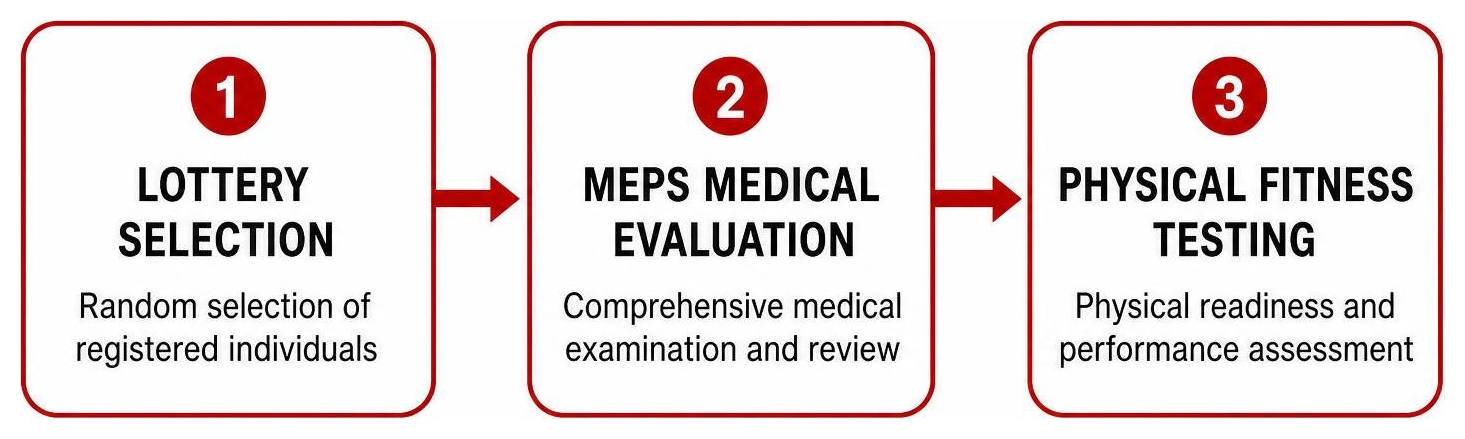
Conscription standards are the legal and operational rules that determine who can be inducted into military service during a national emergency. While the United States has relied on an all-volunteer force since 1973, the underlying machinery of the Selective Service System remains active. Under current federal law, male U.S. citizens and male immigrants residing in the country between the ages of 18 and 25 are required to register.
When people talk about draft physical requirements, they are referring to a two-step qualification process: first, passing a comprehensive medical evaluation to ensure general health, and second, meeting physical readiness and performance standards once inducted.
MEPS Medical Screening vs Draft Physical Requirements
If Congress and the President were to reactivate conscription, selected individuals would not immediately report to basic training. Instead, they would be ordered to report to a Military Entrance Processing Station (MEPS).
At MEPS, recruits undergo an extensive battery of medical assessments before any fitness testing takes place:
- Full Physical Examination: Inspection of joints, spinal alignment, skin condition, and internal organ health.
- Visual Acuity & Color Vision: Testing uncorrected and corrected vision (typically 20/30 or better corrected, with uncorrected vision no worse than 20/100) alongside Ishihara color plate testing.
- Audiometric Hearing Screening: Evaluating pure-tone thresholds to ensure single hearing levels do not exceed 25 dB at key speech frequencies.
- Cardiovascular Checks: Assessing resting heart rate and verifying resting blood pressure does not exceed 140/90 mmHg across multiple readings.
- Urinalysis & Blood Diagnostics: Screening for drug usage, metabolic issues, and underlying blood conditions.
Only individuals who pass this medical baseline advance to military training. Understanding US Military Draft In 2026 requires recognizing that physical entry standards prioritize medical stability before athletic capability. Today, Department of Defense estimates indicate that only 23 percent of young Americans meet basic enlistment standards without needing a waiver. In a hypothetical draft, a birthdate lottery system prioritizing 20-year-olds first would call up millions, but the majority would be disqualified at MEPS during initial screening.
Health Disqualifiers and Selective Service Eligibility
The main obstacle to meeting military entry standards in the modern era is physical health. The most common disqualifying factors facing potential inductees include:
- Obesity and Elevated Body Fat: Exceeding maximum weight-for-height and body fat limits without a waiver.
- Pre-existing Chronic Conditions: Severe asthma, cardiovascular disorders, type 1 or type 2 diabetes, or structural joint issues.
- Substance Abuse: Failing drug screenings conducted during MEPS processing.
- Psychological Disorders: Untreated depression, severe anxiety disorders, or histories of self-harm.
Learning what disqualifies you from the military draft helps clarify why so few candidates qualify outright. While medical waivers exist for minor or resolved historical issues, conscription processing relies on strict baseline criteria to ensure inductees can handle the rigors of service. To see who must legally register and who holds exemptions, review who is eligible for the US draft.
Branch-Specific Fitness Standards and Performance Tests
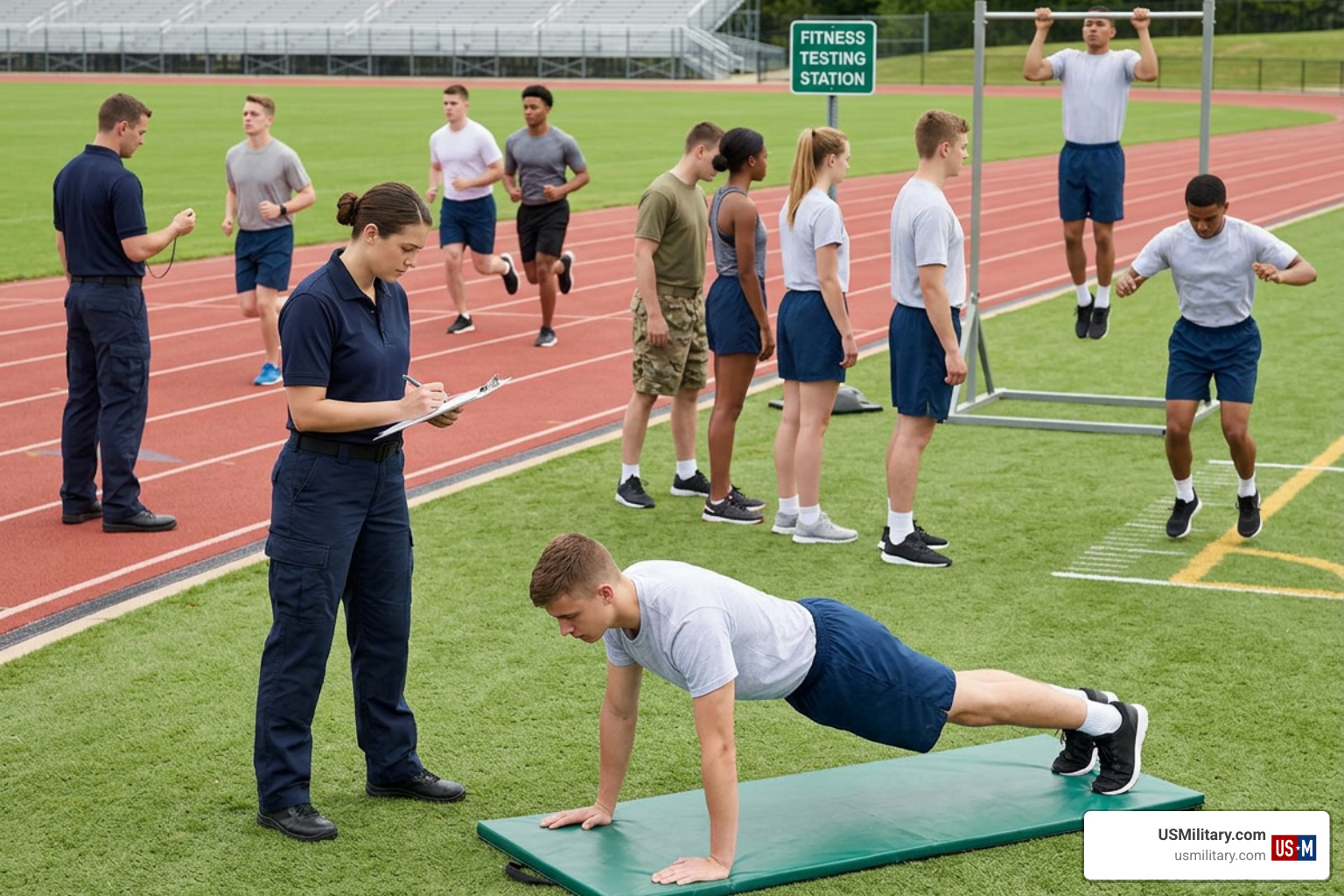
Once a candidate passes MEPS medical screening, they must meet the physical readiness standards established by their assigned branch. Active duty physical tests evaluate cardiovascular endurance, muscular strength, and operational stamina.
| Branch | Primary Fitness Assessment | Core Components | Scoring Format |
|---|---|---|---|
| Army | Army Fitness Test (AFT) | Deadlift, Push-Up, Sprint-Drag-Carry, Plank, 2-Mile Run | Point scale (Sex-neutral for combat MOS, min 350 total) |
| Navy | Physical Readiness Test (PRT) | Push-Ups, Plank, 1.5-Mile Run (or alternate cardio) | Category scoring by age/sex |
| Air Force | Physical Fitness Assessment | Push-Ups, Sit-Ups, 1.5-Mile Run | Composite score (Min 75/100) |
| Marine Corps | PFT & Combat Fitness Test (CFT) | Pull-ups/Plank, 3-Mile Run; 880-Yard Sprint, Ammo Lift, Maneuver Under Fire | Point scale by age/sex |
| Space Force | Human Performance Assessment (HPA) | 2-Mile Run/Shuttle Run, core/strength events, waist-to-height ratio | Annual health-focused scoring |
| Coast Guard | Physical Fitness Assessment | Push-Ups, Sit-Ups, 1.5-Mile Run, Sit-and-Reach | Strict Pass/Fail |
Army Fitness Test, Combat Field Test, and Combat MOS Standards
The Army transitioned to the official Army Fitness Test (AFT) on June 1, 2025, replacing the older ACFT. The AFT evaluates physical capability across five key events:
- 3 Repetition Maximum Deadlift (MDL): Requires lifting between 120 and 420 pounds using a 60-pound hex bar for 3 continuous repetitions.
- Hand-Release Push-Up (HRP): Measures upper-body push strength with full arm extension on the ground between reps.
- Sprint-Drag-Carry (SDC): Five 50-meter shuttles involving a 90-pound sled drag and carrying two 40-pound kettlebells across a 25-meter lane.
- Plank (PLK): Assesses isometric core strength.
- Two-Mile Run (2MR): Evaluates cardiovascular endurance.
Additionally, the Army utilizes the Combat Field Test (CFT) for operational readiness. The CFT consists of seven functional events completed in 30 minutes or less, including a one-mile run, 30 dead-stop push-ups, and a 100-meter sprint.
The Army enforces a sex-neutral, age-normed standard for 24 combat Military Occupational Specialties (MOSs). Personnel in these roles must achieve a total AFT score of at least 350, with a minimum of 60 points in every event. Review complete guidelines on the official Army Fitness Test & Requirements (AFT).
Key combat MOS roles requiring the CFT and the 350-point sex-neutral AFT standard include:
- Infantryman (MOS 11B)
- Indirect Fire Infantryman (MOS 11C)
- Combat Engineer (MOS 12B)
- Special Forces Candidate (MOS 18X)
- Cavalry Scout (MOS 19D)
- Field Artillery Cannon Crewmember (MOS 13B)
Navy PRT, Air Force Assessment, Marines, and Coast Guard
Each military branch customizes its physical assessment to match its primary operating environment:
- Navy Physical Readiness Test (PRT): Includes push-ups, a plank hold, and a 1.5-mile timed run. Commanding officers can approve alternate cardio events, such as a 500-yard timed swim or a 12-minute stationary cycle test (measuring calories burned).
- Marine Corps (PFT & CFT): Marines complete two distinct annual assessments. The Physical Fitness Test features pull-ups (or push-ups), an abdominal plank, and a 3-mile timed run. The Combat Fitness Test requires an 880-yard sprint in utility uniform and boots, repeatedly lifting a 30-pound ammunition can overhead for two minutes, and a maneuver-under-fire drill.
- Air Force Physical Fitness Assessment: Requires airmen to achieve a minimum composite score of 75 out of 100 points across push-ups, sit-ups, and a 1.5-mile run, while passing minimum cutoffs in each individual event.
- Space Force Human Performance Assessment (HPA): Focuses on continuous holistic wellness. Guardians complete two HPAs per year, incorporating a 2-mile run or 20-meter High Aerobic Multi-Shuttle Run alongside waist-to-height ratio tracking.
- Coast Guard Fitness Test: Administered on a strict pass/fail basis to support maritime search and rescue demands. Events include maximum push-ups in one minute, maximum sit-ups in one minute, a sit-and-reach flexibility test, and a 1.5-mile run.
ROTC Cadet Benchmarks vs Draft Physical Requirements
Prospective officers in ROTC programs face strict conditioning requirements early in their training. Air Force ROTC (AFROTC) scholarship cadets, for example, must pass the AFROTC Physical Fitness Test containing four parts: an abdominal measurement, one minute of push-ups, one minute of sit-ups, and a 2.0-mile run.
Cadets must earn at least 75 points overall with up to 5 minutes of rest between events. Non-scholarship cadets attempt the test twice a year, but failing to meet body mass or fitness standards can cause scholarship offers to be withdrawn prior to commissioning.
Body Composition, Weight Standards, and OPAT Categories
Physical readiness goes beyond exercise performance; service members must also maintain strict body composition standards.
Height, Weight, and Waist-to-Height Ratios
All branches utilize allowable weight tables based on height. If an individual exceeds their maximum allowable weight on the scale, they undergo a circumference body fat evaluation (commonly known as the tape test).
- Standard Weight Limits: Allowable weights range from roughly 119 lbs for a 4’10” individual up to 227 lbs for a 6’8″ individual, depending on service branch charts.
- Tape Test Evaluation: Measures neck, waist, and hip circumferences to estimate total body fat percentage. Exceeding body fat ceilings results in entry into body composition program monitoring.
- Modern Body Composition Metrics: Branches like the Space Force utilize waist-to-height ratio tracking to evaluate health risks more accurately than traditional BMI calculations.
OPAT Screening and Enlisted Physical Demand Categories
Before an enlisted recruit or drafted inductee is assigned a specific job, the Army administers the Occupational Physical Assessment Test (OPAT). The OPAT measures standing long jump distance, seated power throw distance, strength deadlift capability, and interval shuttle run endurance.
Based on OPAT results, military occupational specialties are divided into three physical demand categories:
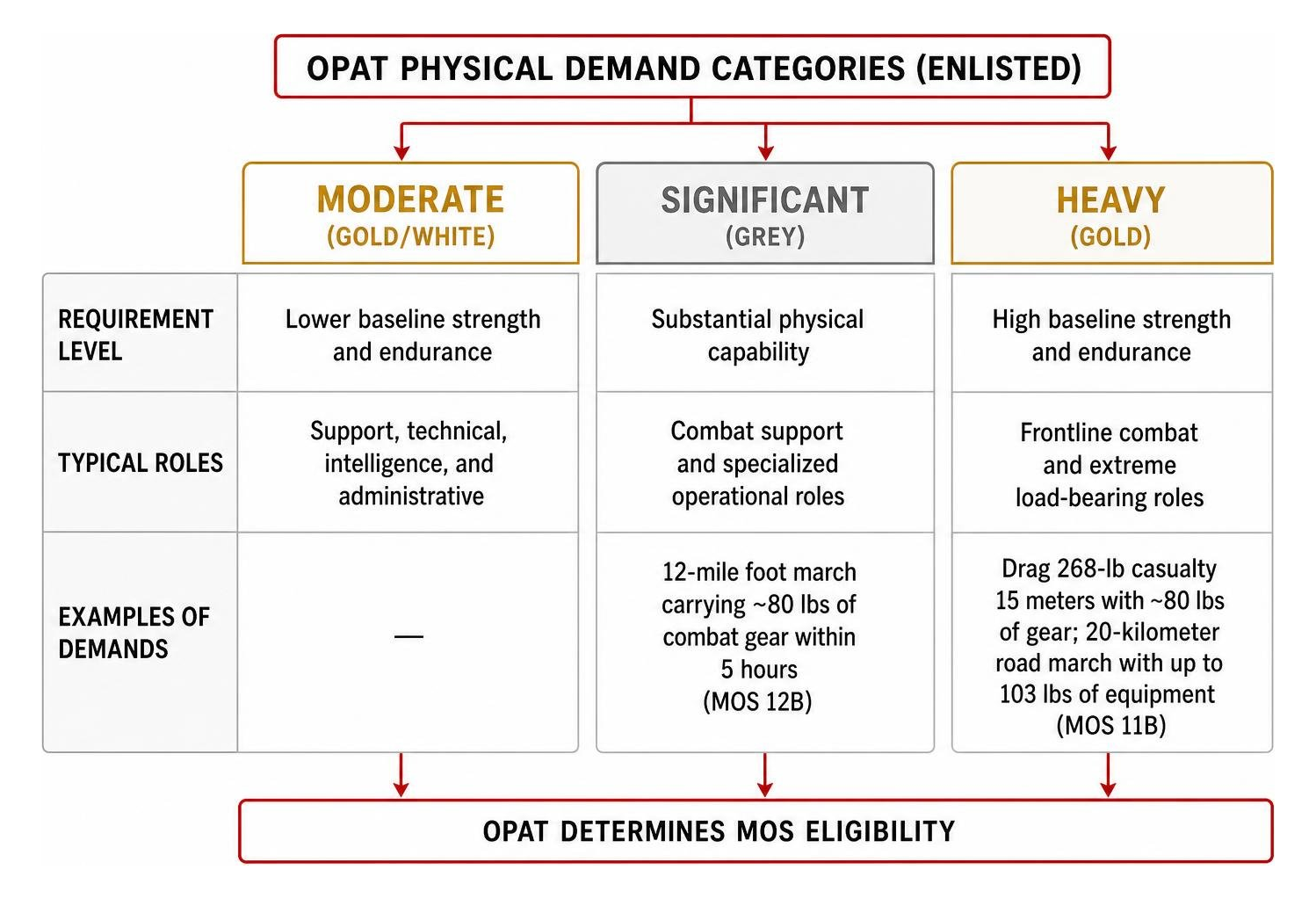
- Heavy (Gold): Demands high baseline strength and endurance. Recruits must qualify for roles requiring extreme load bearing. For example, Infantrymen (MOS 11B) are required to drag a 268-pound casualty 15 meters while wearing approximately 80 pounds of gear, and execute 20-kilometer road marches carrying up to 103 pounds of equipment.
- Significant (Grey): Requires substantial physical capability. Roles like Combat Engineer (MOS 12B) demand completing a 12-mile foot march carrying roughly 80 pounds of combat gear within 5 hours.
- Moderate (Gold/White): Encompasses support, technical, intelligence, and administrative specialties.
For detailed job classifications, consult the official Specifications for Enlisted Physical Demands.
Preparation, Hydration, and Reclassification Rules
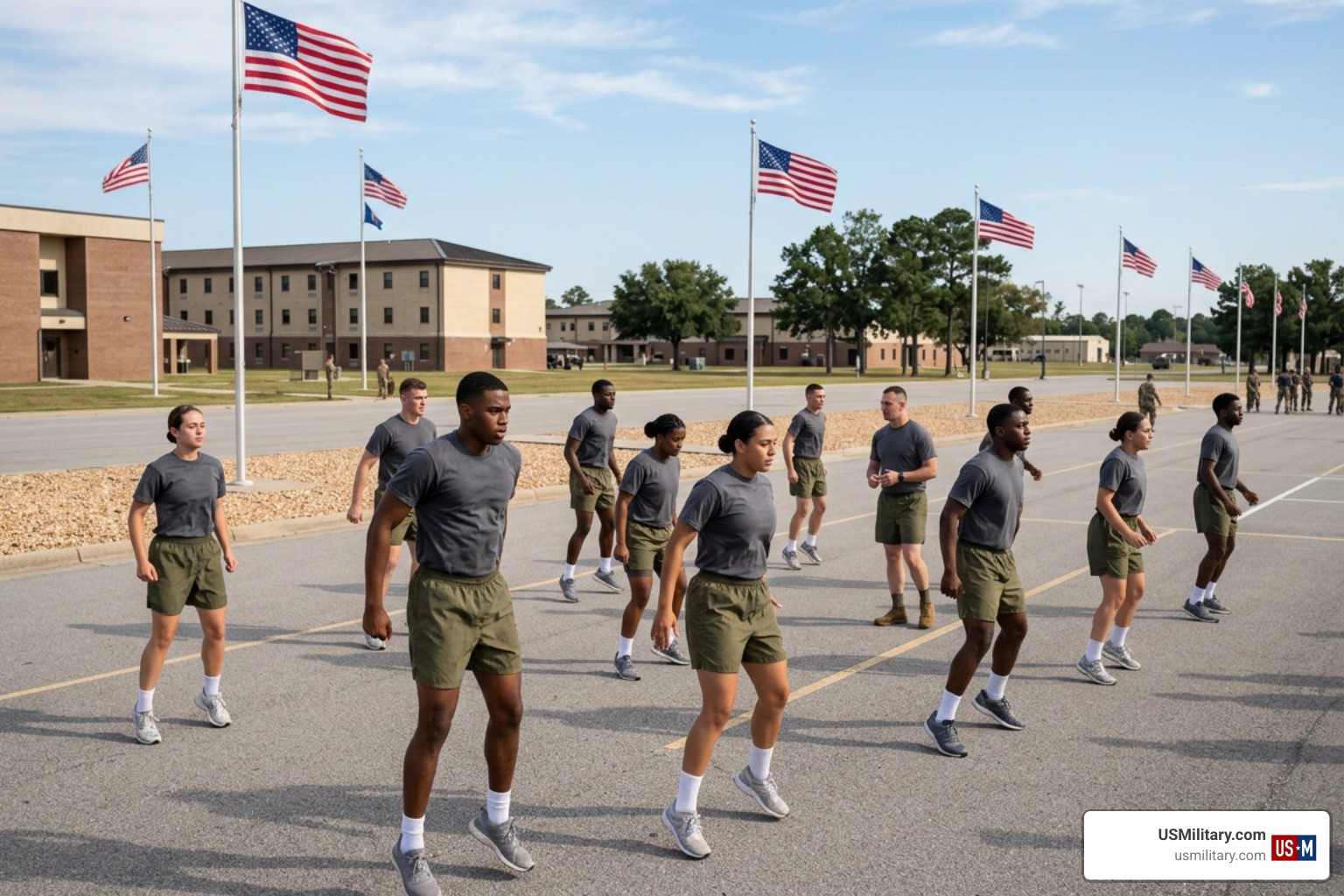
Preparing for military physical assessments requires a disciplined, progressive approach rather than last-minute cramming.
Training Timeline, Hydration, and Test-Day Nutrition
Establishing a 6-week preparation program helps build foundational strength and aerobic capacity safely:
- Weeks 1–2: Focus on core form, bodyweight calisthenics, and light aerobic runs 3 times per week.
- Weeks 3–4: Introduce weighted deadlifts, timed shuttle sprints, and practice 1.5-mile or 2-mile run efforts.
- Weeks 5–6: Perform weekly self-assessments under test timing rules. Taper physical effort 2 days before testing (or 5 days for individuals over age 40) to ensure muscle recovery.
Prior to testing, proper hydration is essential:
- Pre-Test Hydration: Drink 2 to 3 cups of water 2 to 3 hours prior to testing, and 1 cup immediately before starting.
- Nutrition: Consume light, easily digestible carbohydrates 2 hours before testing; avoid heavy fats or high-sugar meals right before physical events.
- Warmup & Cooldown: Perform dynamic warmups before starting, and complete light walking and stretching post-test to safely lower heart rates.
For more training guidance, review Tips for Meeting Military Fitness Standards.
Test Failure Consequences and MOS Reclassification
Failing an official fitness assessment carries real administrative consequences for active personnel and recruits alike:
- Re-Test Window: Personnel who fail a test are generally placed on a mandatory physical training protocol and given a structured re-test window (typically 30 to 90 days).
- MOS Reclassification: Army personnel in combat roles who cannot meet the sex-neutral 350 AFT combat standard may face voluntary or involuntary reclassification out of their combat specialty into a lower physical demand MOS.
- Administrative Discharge: Persistent failure to meet physical fitness or body composition standards leads to administrative separation from military service.
To understand how administrative procedures apply during conscription, explore how the military draft works 2026.
Frequently Asked Questions about Draft Physical Requirements
What happens if you fail a military draft physical exam?
If an inductee fails the initial MEPS medical physical exam during draft processing, they receive a medical classification based on the nature of the issue. Temporary conditions (such as a temporary injury or elevated blood pressure) result in a temporary disqualification and a scheduled re-evaluation. Permanent medical conditions result in a 4-F classification, exempting the individual from military service unless medical standards are formally revised.
Are military draft physical requirements different for men and women?
Initial MEPS medical screening standards apply to all inductees based on biological health criteria. For physical fitness testing, branches use age-normed scoring scales for standard physical readiness tests. However, for operational combat roles—such as Infantry or Combat Engineer—the military uses sex-neutral standards. Anyone serving in a combat MOS must meet identical physical performance scores on tests like the Army Fitness Test regardless of sex.
What age group is called first in a military draft?
If a military draft were reactivated, conscription would begin via a national birthdate lottery prioritizing 20-year-olds first. If additional personnel were required, the selection order would proceed to 21-year-olds, followed by 22- to 25-year-olds, and finally 18- and 19-year-olds.
Conclusion
Passing draft physical requirements requires meeting two clear standards: clean medical eligibility at MEPS and functional physical fitness performance. Whether evaluating standard fitness tests across the Army, Navy, Air Force, Marine Corps, Space Force, or Coast Guard, physical readiness remains the core baseline of military service.
By maintaining clean health habits, understanding body composition standards, and building functional cardiovascular and muscular strength, candidates can ensure they are prepared for the demands of military training.
Learn more about military draft rules at USMilitary.com to explore current eligibility standards, draft legislation updates, and comprehensive military career guides.
Free for Service Members & Veterans
Get the military benefits intel no one tells you about.
Weekly updates on VA benefits, pay changes, and money tips — free for service members and veterans.
No spam. Unsubscribe anytime. Your info is never shared.


