Understanding Draft Eligibility and What Can Keep You Out of Service
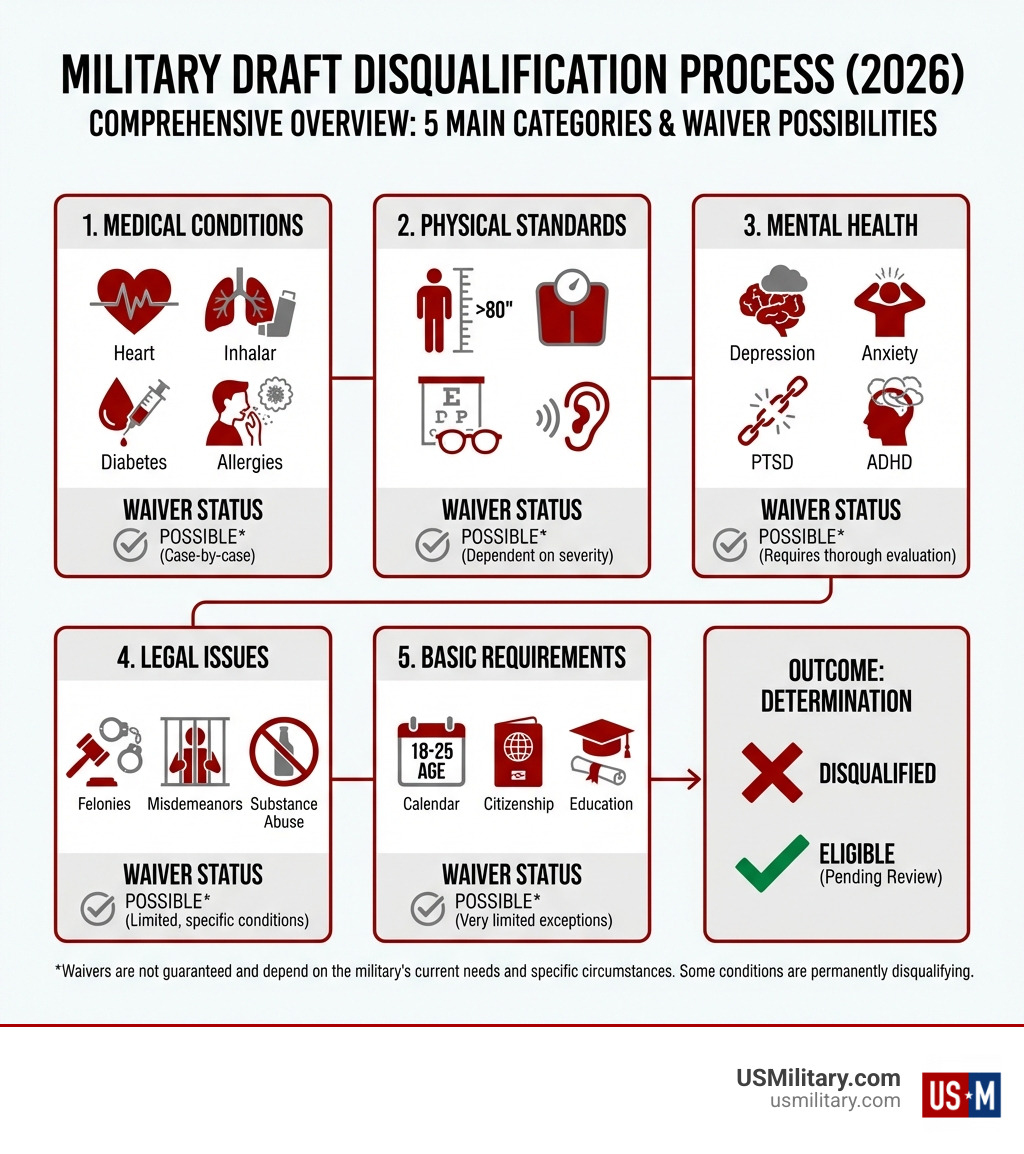
What disqualifies you from the military draft includes medical conditions, legal issues, age restrictions, and mental health disorders that prevent individuals from meeting the rigorous standards required for military service.
Key Disqualifying Factors:
- Medical Conditions: Asthma (diagnosed after age 13), diabetes, heart problems, severe allergies, chronic illnesses, significant physical disabilities
- Physical Standards: Height over 80 inches, severe vision or hearing problems, obesity, scoliosis exceeding 30 degrees
- Mental Health: Schizophrenia, bipolar disorder, severe depression or anxiety, PTSD, autism spectrum disorders
- Legal History: Felony convictions, certain misdemeanors (especially violent or drug-related), being under judicial restraint
- Age and Education: Outside the 18-25 age range for registration, lacking a high school diploma or GED
- Other Factors: Non-citizenship (with limited exceptions), conscientious objector status, dependency situations
While the United States hasn’t had an active draft since 1973, all men aged 18-25 are still required to register with the Selective Service System. Understanding what could disqualify you from service is important whether you’re considering voluntary enlistment or simply fulfilling your legal registration requirements.
The standards for military service are comprehensive. According to the Pentagon, a significant portion of young Americans would not qualify for military service due to obesity, lack of education, or mental health problems. These disqualifications exist because military service demands exceptional physical fitness and mental resilience.
Disqualifications fall into several major categories: medical and physical conditions outlined in Department of Defense Instruction 6130.03, mental health disorders, legal history, and basic eligibility requirements like age and citizenship. Some conditions are permanently disqualifying, while others may be eligible for waivers depending on the military’s current needs.
I’m Larry Fowler, publisher of the USMilitary.com Network since 2007. I’ve helped hundreds of thousands of service members and potential recruits steer complex military eligibility requirements. This guide breaks down each disqualifying category in clear terms.
Terms related to What disqualifies you from the military draft:
Selective Service and Current Draft Eligibility
Even though the U.S. currently operates with an all-volunteer military, the Selective Service System remains active. This independent agency ensures that the Department of Defense could rapidly provide personnel in a national emergency. Its mission is to register men and maintain a system for a potential draft.
Currently, almost all male U.S. citizens and immigrants between 18 and 25 are legally required to register. This registration is a civic duty, not an enlistment. It simply means your name is on a list should a draft ever be reinstated. While there’s no concrete indication of a draft in 2025, discussions about national service mandates do arise occasionally.
If a draft were implemented, a classification program would go into effect. Historically, this involved a lottery system based on birth dates. Those whose birth dates were drawn first would be called, with priority typically given to 20-year-olds, decreasing each year until age 26.
Global geopolitical events influence discussions about conscription. With increasing military spending by adversaries and concerns about NATO vulnerabilities, some countries are revisiting their military policies. While the U.S. maintains its all-volunteer force, these trends highlight the importance of the Selective Service System. For more on the Selective Service System, you can visit their official site or read about a Return to the Draft scenario.
What disqualifies you from the military draft: Age and Citizenship
Age and citizenship are fundamental criteria for military service. For Selective Service registration, the age limits are generally 18 to 25 for men. If a draft were reinstated, this range would be the primary pool. Historical draft parameters have sometimes extended up to age 45 during national emergencies, though this is rare.
Regarding citizenship, individuals must generally be U.S. citizens to serve. Lawful permanent residents (green card holders) may be eligible for enlistment, and waivers can be granted for vital skills. However, dual nationals, particularly those with ties to adversarial countries, might face additional scrutiny or disqualification due to potential security concerns.
The Selective Service System explicitly states that male U.S. citizens and immigrants are required to register, ensuring a broad pool of potential service members if needed.
Education and Aptitude Requirements
Education and aptitude also determine eligibility. A high school diploma or GED is generally the minimum requirement. While some waivers exist for non-graduates, they are often limited.
Aptitude is assessed through the Armed Forces Qualification Test (AFQT), part of the ASVAB. Individuals scoring in AFQT Category V (percentiles 1-9) are generally ineligible. Additionally, there are limits on the number of recruits from AFQT Category IV (percentiles 10-30). These standards ensure recruits possess the cognitive abilities necessary for modern warfare.
Medical and Physical Factors: What Disqualifies You From the Military Draft
The physical demands of military service require robust health. Medical and physical factors are among the most common reasons for disqualification. The Department of Defense Instruction 6130.03 outlines the medical standards for military accession, ensuring service members can withstand the rigors of training and combat.
General physical fitness is crucial, including meeting body fat standards. Practical considerations like height also apply; the military generally doesn’t accept candidates over 80 inches tall due to equipment and vehicle design. Obesity is a major disqualifier, contributing to high rates of ineligibility among young Americans.
✉ Get updates like this in your inbox
Weekly VA benefit changes, pay updates, and money tips for service members, veterans, and military families. Free, no spam.
Common medical conditions that can disqualify individuals are outlined below. For more specifics, refer to the Medical Disqualifications – Air Force Academy Admissions page.
| Condition Category | Examples of Disqualifying Conditions | Notes & Waivability |
|---|---|---|
| Respiratory | Asthma (diagnosed after age 13), chronic bronchitis | Often disqualifying; waivers possible if symptom-free for years. |
| Endocrine | Diabetes (requiring medication), thyroid disorders | Generally disqualifying due to need for ongoing management. |
| Cardiovascular | Congenital heart defects, symptomatic arrhythmias | Many heart conditions are disqualifying; some minor conditions may be waivable. |
| Gastrointestinal | Inflammatory Bowel Disease, Celiac disease | Often disqualifying, though stance on Celiac may evolve with gluten-free MREs. |
| Neurological | Epilepsy, multiple sclerosis, severe migraines | Disqualifying due to impact on duty and unpredictability. |
| Musculoskeletal | Severe scoliosis (> 30 degrees), joint instability | ACL reconstruction is disqualifying but usually waivable. |
| Mental Health | Schizophrenia, bipolar disorder, severe PTSD | Disqualifying if current or severe; waivers depend on stability. |
| Allergies | Severe allergies (anaphylaxis), certain food allergies | Food allergies causing moderate to severe reactions are disqualifying. |
Primary medical conditions and chronic illnesses
- Asthma: A history of asthma diagnosed after age 13 or requiring medication is generally disqualifying due to the unpredictable nature of attacks in remote environments.
- Diabetes: Individuals requiring daily medication like insulin are typically disqualified, as the military requires members to function without constant medical supervision.
- Severe Allergies: Allergies that could lead to anaphylaxis are significant disqualifiers. The military defines allergies as a reliable history of moderate to severe reactions to common foods.
- Celiac Disease: This has historically been disqualifying due to logistical challenges in providing specialized diets, though policy may evolve with more gluten-free MRE options.
- Heart Problems: Serious conditions like congenital anomalies or uncontrolled hypertension are typically disqualifying.
- Autoimmune Disorders: Chronic disorders like lupus or Crohn’s disease are generally disqualifying as they require ongoing treatment and can flare up unpredictably.
Orthopedic, vision, and hearing standards
- Orthopedic Conditions: Conditions like un-united fractures, joint instability, or severe scoliosis are disqualifying. Even a history of ACL reconstruction is disqualifying but usually waivable if stable. For more details, see Musculoskeletal disqualification.
- Vision: Disqualifying factors include uncorrected distant visual acuity worse than 20/40 in each eye or specific refractive errors exceeding +/- 8.00 diopters.
- Hearing: Clear hearing is essential. Threshold levels exceeding specific decibel limits at various frequencies (e.g., average loss > 25 dB at 500, 1000, and 2000 Hz) lead to disqualification.
Mental Health, Moral, and Legal Disqualifications
Mental resilience and a clean record are as important as physical strength. Mental health, moral character, and legal history are significant factors in determining what disqualifies you from the military draft.
The military is increasingly recognizing the importance of mental health. Conditions like depression, anxiety, and PTSD can be disqualifying, but the landscape is evolving. In 2023, the Brandon Act was implemented, allowing service members to request mental health evaluations confidentially. According to the National Alliance on Mental Illness, about 1 in 4 active duty members show signs of a mental health condition.
Beyond mental health, legal standing is scrutinized. Felony convictions are typically automatic disqualifiers, and certain misdemeanors involving violence or drugs can also lead to ineligibility.
Mental health conditions and the Brandon Act
- Psychiatric Disorders: Severe disorders such as schizophrenia or bipolar disorder are generally disqualifying as they affect judgment and emotional regulation.
- Depression and Anxiety: A history of severe or recurrent disorders requiring extensive treatment can be disqualifying. The military looks for stability and the ability to cope with stress without medication.
- PTSD: Post-Traumatic Stress Disorder is typically disqualifying, especially if symptoms interfere with daily functioning.
- ADHD and Learning Disabilities: These can be disqualifying if they required significant accommodations or medication recently. However, many cases are waivable if the individual is stable without medication.
- The Brandon Act: This 2023 legislation allows service members to request confidential mental health evaluations. While it primarily impacts those already serving, it signals a shift toward better mental health support for all recruits.
Legal history and what disqualifies you from the military draft
- Criminal Records: Felony convictions for serious offenses like assault or robbery are almost always grounds for disqualification. Waivers are rarely granted for these.
- Misdemeanors: Certain misdemeanors, especially those involving violence, drug possession, or domestic abuse, can be disqualifying. Repeated minor offenses may indicate a pattern incompatible with military discipline.
- Judicial Restraint: Being on probation, parole, or awaiting trial will disqualify an individual. You must be free of legal obligations to enlist.
- Sexual Offenses: Any conviction for sexual offenses is an absolute disqualifier. The Department of Defense Instruction 1304.26 states that waivers are not allowed for these crimes.
The Army Directive 2020-09 outlines the waiver process for various disqualifying factors. It is crucial to be honest with your recruiter; failure to disclose legal history can lead to charges of fraudulent enlistment.
Classifications, Deferments, and the Future of Conscription
Historically, the Selective Service System used a classification system to determine eligibility and deferments. While not currently in use, these classifications provide insight into how a future draft might operate.
Historical classifications included:
- 1-A: Available for military service.
- 4-F: Not qualified for service (medical, physical, or mental disqualifications).
- 3-A: Deferred due to family hardship.
- 1-O: Conscientious Objector available for civilian work.
- 1-S: Student deferred until the end of the academic year.
Other deferments included those for sole surviving sons whose parent or sibling was killed in service. You can learn more about Historical Classifications on the Selective Service website.
Global Geopolitics and Conscription Trends
The global geopolitical landscape influences recruitment worldwide. Global military expenditure reached $2443 billion in 2023, reflecting a perception of increased danger. As some prepare for potential conflicts, governments are rethinking military policies. For example, NATO countries are waking up to their vulnerabilities and adversaries’ soaring spending.
This environment has led to recruitment challenges for some militaries. For instance, experts have discussed the state of Canada’s armed forces, where more people are leaving than entering. This has even prompted discussions about Conscription in Canada, though it remains unlikely.
These challenges highlight why the U.S. military maintains stringent standards. Our modern military requires capable individuals who can endure the physical and mental demands of service. The rigorous training processes, like the Basic Military Qualification (BMQ) in other nations, are designed to transition civilians into effective service members.
Women and the Draft
Currently, U.S. law specifically refers to “male persons” for Selective Service registration. Therefore, women are not required to register. However, this is a subject of debate, especially since women now serve in all combat roles. Many policymakers argue that excluding women could face legal challenges if a draft were reinstated. If a national emergency necessitated a draft, Congress would likely consider changing the law to include women, reflecting a commitment to gender equality in service.
Frequently Asked Questions about Draft Disqualification
Can you get a waiver for a disqualifying condition?
Yes, in many cases, you can get a waiver! Many medical, conduct, or dependency issues can be waived depending on the severity, how long ago it occurred, and the military’s current needs. The waiver process involves a “whole person” review of your background, including academic achievements and character.
The Army Directive 2020-09 outlines the rules for the waiver process. Other branches have similar directives. The best first step is to be honest with your recruiter. Not disclosing a condition can lead to fraudulent enlistment charges.
Are women currently required to register for the draft?
No, women are not currently required to register in the United States. The law states that “male persons” must register. Despite the integration of women into combat roles, the law has not been changed. However, this topic is frequently debated in Congress, and women could be included in future mandates if the law is amended.
What happens if you fail to register for the Selective Service?
Failing to register is a serious matter. It is considered a felony offense, punishable by a fine of up to $250,000 or a prison term of up to five years. While prosecutions are rare, there are significant practical consequences for non-registrants after age 26:
- Student Aid: You may be ineligible for federal student financial aid, including Pell Grants and federal loans.
- Government Jobs: You could be denied employment with federal, state, and local governments.
- Job Training: You may be ineligible for training under the Workforce Innovation and Opportunity Act.
- Citizenship: For immigrant men, failure to register can complicate the naturalization process.
Registering is a simple process that can be done online, at the post office, or when getting a driver’s license.
Conclusion
Understanding what disqualifies you from the military draft is crucial for every American man between 18 and 25, and for anyone considering military service. The stringent requirements for military service are designed to ensure that our armed forces are composed of individuals who are physically, mentally, and morally capable of defending our nation.
While many conditions can be disqualifying, not all disqualifications are permanent, and waivers are often a possibility. Honesty with recruiters and thorough documentation of your medical and legal history are your best tools in navigating these complex requirements.
At USMilitary.com, we’re dedicated to providing comprehensive resources for those interested in military service, veterans, and their families. We encourage you to stay informed, ask questions, and explore all your options. For more detailed information on the draft, visit our guide: What is the US Military Draft?
Free for Service Members & Veterans
Get the military benefits intel no one tells you about.
Weekly updates on VA benefits, pay changes, and money tips — free for service members and veterans.
No spam. Unsubscribe anytime. Your info is never shared.


