What Are the 10 Life Lessons That William McRaven Learned in Navy SEAL BUD/S Training?

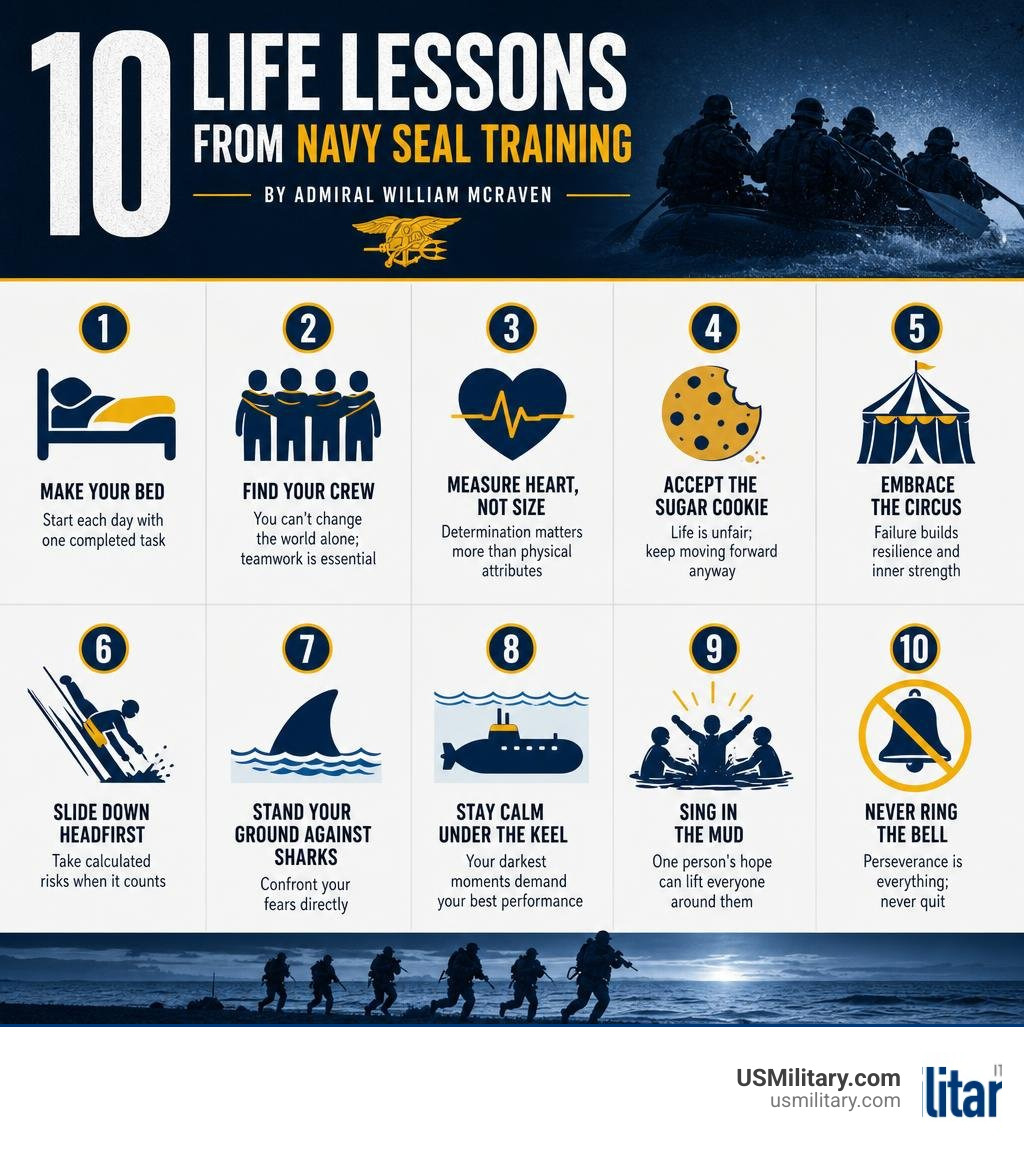
The 10 life lessons that William McRaven learned in Navy SEAL training are:
- Make your bed — Start each day with one completed task
- Find your crew — You can’t change the world alone; teamwork is essential
- Measure heart, not size — Determination matters more than physical attributes
- Accept the sugar cookie — Life is unfair; keep moving forward anyway
- Embrace the circus — Failure builds resilience and inner strength
- Slide down headfirst — Take calculated risks when it counts
- Stand your ground against sharks — Confront your fears directly
- Stay calm under the keel — Your darkest moments demand your best performance
- Sing in the mud — One person’s hope can lift everyone around them
- Never ring the bell — Perseverance is everything; never quit
On May 15, 2014, Admiral William H. McRaven stood before nearly 8,000 graduating students at the University of Texas at Austin. He could have delivered a typical commencement speech. Instead, he shared ten raw, battle-tested lessons drawn from his own experience in Navy SEAL training — lessons so universal that the speech has since been viewed over 16 million times on YouTube.
His core message was simple but striking:
If every one of you changed the lives of just 10 people, and each of those people changed 10 more, within five generations the class of 2014 would have changed the lives of 800 million people.
These aren’t abstract motivational ideas. Each lesson comes directly from a specific, grueling moment inside Basic Underwater Demolition/SEAL (BUD/S) training — one of the most demanding military programs in the world.
I’m Larry Fowler, publisher of the USMilitary.com Network, and I’ve spent nearly two decades helping active-duty service members and veterans navigate military life and career decisions. The 10 life lessons that William McRaven learned in Navy SEAL training are among the most practical and widely applicable principles I’ve encountered in that time. Let’s break down each one so you can put them to work in your own life.
Know your 10 life lessons that William McRaven learned in Navy SEAL training terms:
- A Day In The Life Of A Navy SEAL Operator
- What is Navy SEAL Training 3 Phases And WHy is it so tough
- the only easy day was yesterday
The Origin of the 10 Life Lessons That William McRaven Learned in Navy SEAL Training

Before Admiral McRaven became a four-star admiral and commander of the U.S. Special Operations Command (USSOCOM), and before he oversaw historic operations like the raid that killed Osama bin Laden, he was just another wet, cold, and exhausted trainee in Coronado, California.
After graduating from the University of Texas at Austin in 1977, McRaven immediately received his commission into the United States Navy. This marked the beginning of a distinguished 37-year military career. However, before he could lead tens of thousands of special operations personnel, he had to survive the crucible of Basic Underwater Demolition/SEAL (BUD/S) training.
BUD/S is designed to push human beings past their physical and mental breaking points. Located at the Naval Special Warfare Center in Coronado, the program subjects candidates to soft-sand runs, miles of open-ocean swims, bone-chilling surf passages, and relentless sleep deprivation. It is a systematic process that strips away ego and exposes a candidate’s true character.
To understand how to prepare for this extreme environment, check out our BUD/S requirements guide. While physical fitness is a baseline requirement, we have found that survival depends far more on psychological traits.
The key traits required to survive BUD/S include:
- Unwavering Desire: An internal fire that values success over immediate physical comfort.
- Absolute Humility: The willingness to accept correction, learn from failure, and put the team first.
- Mental Adaptability: The capacity to maintain focus and composure when plans fall apart.
- Attention to Detail: Recognizing that small, tedious tasks directly impact survival in the field.
The 77% Attrition Rate of BUD/S Class 95
To put the difficulty of this training into perspective, consider McRaven’s own class. BUD/S Class 95 began with 150 eager candidates. After just a few weeks of grueling physical and mental conditioning, only 35 men remained to graduate.
This staggering 77% attrition rate is not unusual. The training is deliberately designed to encourage those without absolute commitment to weed themselves out. Every evolution is a test of resolve, which McRaven later articulated so beautifully in his speech transcript. The lessons he learned were not taught in a comfortable classroom; they were forged in the freezing Pacific surf and the mud flats of the Tijuana Estuary.
The 10 Life Lessons for Everyday Success
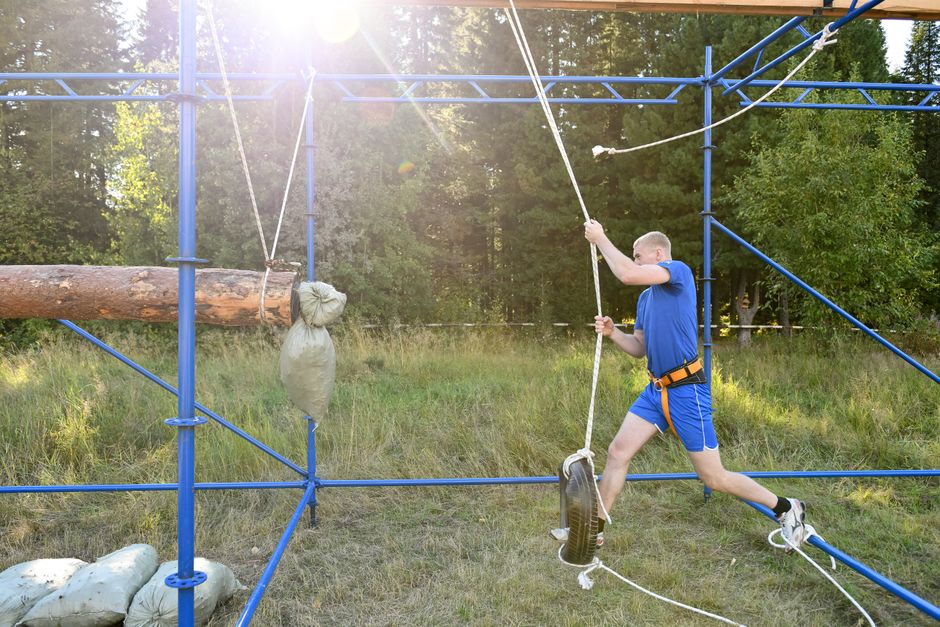
The beauty of McRaven’s philosophy is that you do not need to dive into freezing water or run miles in wet boots to benefit from SEAL training. The physical challenges that candidates endure serve as perfect metaphors for the mental and emotional trials we all face in civilian life, careers, and relationships.
To help visualize how these grueling military trials translate into practical mental tools, we have mapped them out below:
| BUD/S Physical Challenge | The Everyday Life Lesson | Core Mental Concept |
|---|---|---|
| Morning Bed Inspection | Make Your Bed | Daily discipline and starting the day with momentum. |
| Paddling the IBS (Inflatable Boat) | Find Your Crew | Relying on teamwork and collective effort to survive. |
| Flipper-to-Flipper Swim Tests | Measure Heart, Not Size | Valuing character, determination, and grit over appearances. |
| The “Sugar Cookie” Drill | Accept the Sugar Cookie | Understanding that life is unfair and moving past setbacks. |
| “The Circus” (Extra Physical Punishment) | Embrace the Circus | Viewing failure as a tool to build greater strength. |
| The Slide for Life Obstacle | Slide Down Headfirst | Taking calculated risks to achieve breakthrough success. |
| Night Swims with Sharks | Stand Your Ground Against Sharks | Confronting intimidators, fears, and bullies directly. |
| Under-the-Keel Ship Attack | Composure in Darkest Moments | Staying calm and focused when conditions are at their worst. |
| Hell Week Mud Flats Drill | Sing in the Mud | Recognizing the power of hope and collective morale. |
| The Brass Quitting Bell | Never Ring the Bell | Practicing ultimate perseverance; refusing to give up. |
By viewing our daily struggles through this lens, we can begin to understand The Only Easy Day Was Yesterday Meaning and apply it to our personal growth.
1. Make Your Bed: How This Simple Habit Reflects the 10 Life Lessons That William McRaven Learned in Navy SEAL Training
Every morning during BUD/S, the first task was a meticulous inspection of the barracks. The instructors demanded that the bed be made perfectly: square corners, tight sheets, and a pillow centered just right. To a young trainee eager to learn combat tactics, this felt like pointless busywork.
But as McRaven realized, this simple chore is the foundation of daily discipline. Making your bed to perfection requires attention to detail. It serves as your very first completed task of the day, delivering a small, subconscious dose of pride and satisfaction.
This small win builds immediate momentum. It proves that the little things in life matter. If you cannot do the small tasks correctly, you will never be able to execute the big ones when the stakes are high. Furthermore, if you happen to have a miserable, exhausting day, you will come home to a bed that is neatly made—by you. That simple sight offers encouragement that tomorrow will be better.
2. Find Your Crew: Why Teamwork is Essential to Change the World
During SEAL training, students are assigned to boat crews consisting of seven men. Together, they must carry a heavy rubber inflatable boat on their heads, run through the sand, and paddle through 8-to-10-foot ocean surf.
If even one crew member slackens their effort, the boat will stall, capsize, or be thrown back onto the beach by the waves. To make it through the surf passage, every single person must dig their paddle deep into the water and work in perfect, synchronized rhythm.
No individual, no matter how physically gifted, can survive SEAL training alone. The same is true in the civilian world. Whether you are launching a business, raising a family, or navigating a career transition, you cannot change your circumstances in isolation. You need a crew of people who share your values and are willing to paddle alongside you when the water gets rough. To learn more about the collaborative mindset required for this level of elite performance, read about the Navy SEAL Training Success Traits.
3. Measure Heart, Not Size: The Story of the Munchkin Crew
One of the most inspiring anecdotes from McRaven’s BUD/S class involves the “Munchkin crew.” This was the nickname given to the boat crew made up of the shortest candidates in the class, all of whom were under 5-foot-5. They represented a highly diverse group of men from various backgrounds.
The taller, more physically imposing boat crews often poked lighthearted fun at the Munchkins. However, when it came to actual performance, the Munchkin crew consistently out-swam, out-ran, and out-paddled everyone else.
While the bigger men relied on raw physical size, the Munchkins succeeded through sheer determination, synchronized effort, and heart. In SEAL training—and in life—your background, physical stature, or social status do not dictate your success. The true measure of a person is the size of their heart and their willingness to endure.
4. Accept the Sugar Cookie: Overcoming Unfairness and Setbacks
In BUD/S, uniform inspections are notoriously brutal. Instructors will find a flaw no matter how much effort you put into starching your hat, polishing your belt buckle, or pressing your uniform.
When you failed inspection, the punishment was the “sugar cookie” drill. You were ordered to run fully clothed into the cold ocean surf, get soaking wet, and then roll around in the dry sand until every inch of your body was covered. You had to remain in that cold, wet, and incredibly abrasive sandy uniform for the rest of the day.
The most frustrating part of the sugar cookie drill was that sometimes you did everything perfectly, yet you were still punished. It was a deliberate lesson designed to teach trainees a harsh truth: life is not fair. You can prepare meticulously, execute flawlessly, and still end up cold, wet, and sandy. When this happens, complaining is useless. You must accept the setback, dust yourself off, and keep moving forward.
5. Embrace the Circus: Building Resilience Through Failure
Whenever a trainee or a boat crew failed to meet the rigorous daily physical standards, their names were posted on a list for “the circus.” The circus was an extra two hours of grueling physical calisthenics held at the end of an already exhausting day. It was designed to wear candidates down both physically and mentally.
Because the circus was so demanding, those who had to participate were even more exhausted the following day. This made them more likely to fail standards again, trapping them in a brutal cycle of extra punishment.
However, an interesting psychological and physical shift occurred over time. Those who constantly had to endure the circus actually became stronger, faster, and more resilient because of the extra workouts. The very punishment designed to break them ended up building their inner strength. When life throws extra challenges and failures your way, do not fear them. Embrace them as “circuses” that are quietly forging you into a stronger version of yourself.
6. Take Calculated Risks: Sliding Down the Rope Headfirst
To pass the BUD/S obstacle course, candidates must conquer the “slide for life.” This obstacle features a 30-foot-high tower connected to another tower by a 200-foot-long rope. The conventional, safe way to cross is to hang underneath the rope and slowly pull yourself across hand-over-hand.
For years, the obstacle course record stood unbroken because candidates used this cautious method. However, during McRaven’s training, one student decided to take a bold, calculated risk. He mounted the top of the rope and slid down headfirst.
It was a dangerous maneuver that could have resulted in a severe injury if he lost his balance. But his risk paid off, and he shattered the long-standing course record. If you want to break through barriers and achieve extraordinary goals in your career or personal life, you cannot always play it safe. You must be willing to take calculated risks, face the danger, and slide down headfirst. You can explore the physical reality of these challenges in our guide to the Navy SEAL Training Obstacle Course.
7. Stand Your Ground Against Sharks: Confronting Fears and Bullies
As part of their ocean training, SEAL candidates must complete long, grueling night swims in the waters off San Clemente Island. These dark waters are well-known breeding grounds for great white sharks.
Before the swim, the instructors would always “reassure” the trainees by telling them that no student had ever been eaten by a shark—at least not recently. But they also gave crucial survival advice: if a shark begins to circle you, do not swim away in fear. Stand your ground. And if the shark rushes at you, summon all your strength and punch it directly in the snout, and it will swim away.
In life, you will encounter metaphorical sharks—bullies, intimidating opponents, and terrifying circumstances. If you show fear or try to run away, they will exploit your weakness. To survive, you must stand your ground, look the threat in the eye, and confront it directly.
8. Composure in Darkest Moments: Performing Under the Keel
One of the most mentally taxing operations in SEAL training is the underwater ship attack. Trainees are dropped off in pitch-black harbor waters and must swim over two miles underwater using only a depth gauge and a small compass to guide them toward an enemy vessel.
As you swim underneath the target ship, the light is completely blocked out. You find yourself in total, disorienting darkness under the keel. The noise of the ship’s machinery is deafening, and you must attach your explosive charge while staying calm enough to manage your breathing apparatus. If you panic, you die.
It is in these absolute darkest moments—when you are exhausted, disoriented, and surrounded by chaos—that you must remain completely composed. You must quiet your mind, rely on your training, and bring all your inner strength to bear. To get a sense of how operators maintain this level of composure daily, read The Definitive Guide to a Day in the Life of a Navy SEAL Operator.
9. Sing in the Mud: The Power of Hope During Hell Week
The toughest part of BUD/S is “Hell Week”—six days of continuous training with virtually no sleep, constant physical exertion, and relentless psychological harassment. A major portion of Hell Week is spent in the Mud Flats, a swampy, freezing patch of terrain located between San Diego and Tijuana.
During McRaven’s Hell Week, his class was ordered into the freezing mud, where they sat buried up to their necks for hours. The cold was so intense that several candidates were on the verge of quitting.
But then, in the middle of the pitch-black night, one voice began to sing. The instructors threatened the class with more mud time if the singing continued, but the trainee kept going. Soon, another voice joined in, and then another, until the entire class was singing in unison. The freezing mud suddenly felt a little warmer, and the despair turned into collective hope. One person’s decision to maintain hope can lift an entire group of people out of the darkest situations. Learn more about surviving this phase in our breakdown of What is Navy SEAL Hell Week.
10. Never Ring the Bell: Why Perseverance is the Ultimate of the 10 Life Lessons That William McRaven Learned in Navy SEAL Training
In the center of the BUD/S compound hangs a polished brass bell. It is visible to every trainee at all times. If the cold, the mud, the runs, or the sleep deprivation ever become too much to bear, quitting is incredibly easy. All you have to do is walk up to the bell and ring it three times.
Once you ring that bell, you are immediately excused from the hardships of training. You get a warm shower, a hot meal, a clean bed, and a ticket out of the program. But as the instructors always warn, if you quit, you will regret it for the rest of your life.
This is the ultimate lesson of the 10 life lessons that William McRaven learned in Navy SEAL training. Life will test your resolve, and there will be moments when continuing seems completely impossible. But no matter how painful, cold, or unfair things get, you must never, ever ring the bell. If you want to explore more about how this perseverance translates to civilian life, read this excellent analysis on Ten Life Lessons From a Navy SEAL.
Applying Navy SEAL Lessons to Everyday Life and Leadership
These ten lessons are not just inspiring stories; they are highly practical rules for life. In the years since McRaven’s speech, researchers and psychologists have looked closely at why these principles are so effective.
In her groundbreaking research, psychologist Angela Duckworth discovered that “grit”—defined as passion and perseverance for long-term goals—is a much more reliable predictor of success than high IQ or raw talent. Grittier individuals achieve higher levels of education, perform better in high-stress careers, and are far less likely to quit when faced with obstacles.
This scientific finding perfectly aligns with the lessons McRaven learned in the surf at Coronado. You can read more about this connection in our article Revisiting Admiral McRaven’s 10 Lessons for Life.
Whether you are leading a corporate team, navigating a personal crisis, or planning your post-military career, you can apply these lessons daily by:
- Building Momentum: Start your morning by completing one small, disciplined task.
- Fostering Teamwork: Don’t try to carry the heavy lifting alone; build a trusted support network.
- Maintaining Composure: When setbacks occur, accept them without complaining and keep moving forward.
- Refusing to Quit: Keep pushing toward your long-term goals, even when ringing the bell feels like the easiest option.
For more inspiration on how to build this elite mindset, check out our guide on Life Lessons from Navy SEALs.
Frequently Asked Questions About William McRaven’s SEAL Lessons
What does “ringing the bell” mean in Navy SEAL training?
In Navy SEAL training (BUD/S), a brass bell hangs in the center of the compound. If a candidate decides that they want to quit the program, they must walk up to the bell and ring it three times. Once they ring the bell, they have officially self-eliminated (Dropped on Request) and cannot return to training.
How does the “sugar cookie” punishment teach resilience?
The “sugar cookie” punishment involves a trainee being ordered to jump into the cold ocean surf and then roll around in the sand until they are completely covered. Because this punishment is often handed out randomly—even when a trainee’s uniform is perfect—it teaches candidates to accept that life is inherently unfair and that they must maintain their focus and drive despite unfair setbacks.
What was the attrition rate of Admiral McRaven’s BUD/S class?
Admiral McRaven’s BUD/S Class 95 started with 150 candidates. By the time graduation arrived, only 35 men remained to complete the training. This represents a 77% attrition rate, which is typical for the incredibly demanding Navy SEAL selection process.
Conclusion
The 10 life lessons that William McRaven learned in Navy SEAL training remind us that success is not built on luck, privilege, or raw physical talent. It is built on daily discipline, a willingness to rely on others, and the courage to keep moving forward when life is unfair.
At USMilitary.com, we are proud to serve as a central hub for military information and resources. Whether you are looking to start your own journey of service, transition back to civilian life, or maximize your VA home and educational benefits, we are here to guide you every step of the way.
Are you ready to build the discipline, grit, and resilience of an elite military leader? Explore our comprehensive resources and career paths by visiting our Navy SEALs Complete Guide today.
Free for Service Members & Veterans
Get the military benefits intel no one tells you about.
Weekly updates on VA benefits, pay changes, and money tips — free for service members and veterans.
No spam. Unsubscribe anytime. Your info is never shared.


