What the Draft for Women Actually Means Right Now
Draft for women is one of the most searched military policy questions in America today — and for good reason. Here’s the short answer:
Current status of women and the U.S. draft:
| Question | Answer |
|---|---|
| Are women required to register for Selective Service? | No |
| Can women be drafted under current law? | No |
| Does the December 2026 automatic registration include women? | No |
| Has Congress tried to change this? | Yes, multiple times |
| Could this change in the future? | Possibly |
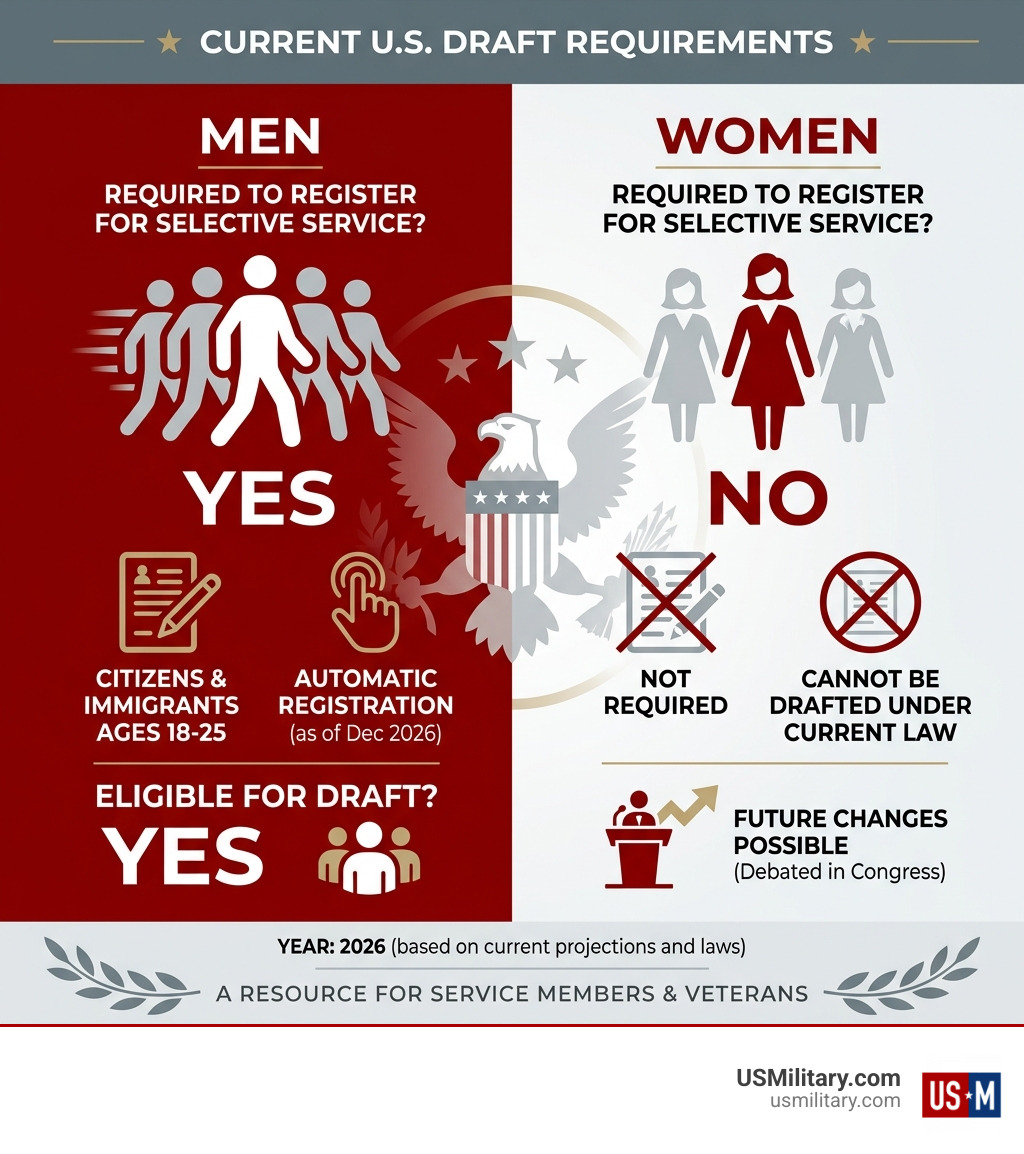
Women are not required to register with the Selective Service System, and they cannot be drafted under current U.S. law. Only male citizens and male immigrants between the ages of 18 and 25 must register. That said, Congress has come very close to changing this — and the debate is far from over.
In recent years, geopolitical tensions, declining military recruitment, and questions about gender equality have pushed this issue back into the spotlight. A bipartisan majority on the House Armed Services Committee actually voted 35-24 to require all Americans ages 18 to 24 — including women — to register. The measure was later dropped from the final defense bill, but the conversation hasn’t stopped.
I’m Larry Fowler, publisher of the USMilitary.com Network since 2007 and a longtime resource for service members, veterans, and anyone navigating military policy — including evolving questions around the draft for women. In this guide, I’ll walk you through everything you need to know, from the current law to what a reinstated draft would actually look like.
Basic Draft for women terms:
- Who gets pulled first in a draft?
- What Disqualifies You From A Military Draft?
- exemptions military draft
Introduction
The image of the 1969 draft lottery drum remains a powerful symbol in American history. Back then, the Selective Service System operated on a clear, gender-based line: men were called to serve, and women were not. Conscription history in the U.S. has always been a male-only affair, rooted in an era when women were legally barred from the front lines.
However, the modern military looks very different. Today, women make up nearly 18% of the active-duty force—that’s over 200,000 service members. They serve as fighter pilots, lead battalions, and earn the prestigious Army Ranger tab. This shift has sparked a national debate: if women have the equal right to serve in every role, do they also have the equal responsibility to register for a potential draft? As we explore the Draft for women, we have to look at how gender equality in the military is clashing with long-standing legal precedents.
Current Legal Status: Do Women Have to Register?
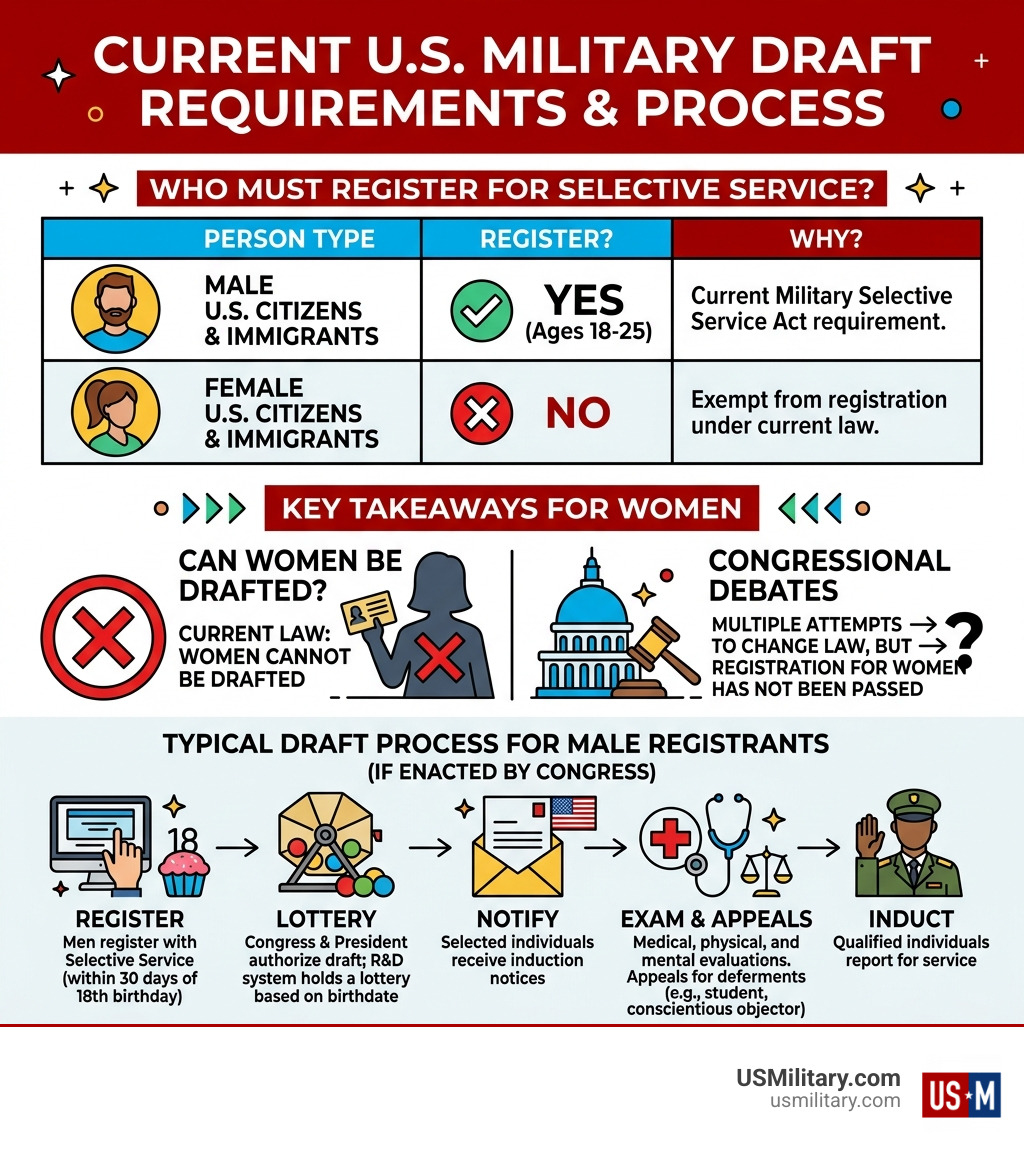
Right now, the law is straightforward. Under the Military Selective Service Act, only “male persons” are required to register. This means that if you were assigned male at birth, you must register within 30 days of your 18th birthday. This applies to U.S. citizens and most immigrants living in the country.
For women, the Draft for women is currently a non-issue in a legal sense. The Selective Service System does not even accept voluntary registrations from women. If you try to sign up as a woman, the system simply won’t process it. To understand who exactly needs to keep an eye on their mailbox, you can check out our guide on Who Is Eligible For The Us Draft.
The 2026 Automatic Registration Update
A major change is coming to how the government handles registration, but it still maintains the gender divide. Starting December 18, 2026, the federal government will begin automatic registration for the Selective Service. Using federal databases like the Social Security Administration, the system will automatically identify and register eligible individuals.
However, this update—authorized by the FY2026 National Defense Authorization Act (NDAA)—only applies to men ages 18 to 25. Women will remain excluded from this automatic process. While this move aims to streamline the system and ensure high compliance (which varies wildly by state, with California at 74% and DC at 99%), it does not expand the pool of registrants to include women. For more on how the landscape is shifting, see our breakdown of the Us Military Draft 2024.
Current Exemptions and Voluntary Service
Even if a draft were activated today, not every man would be headed to boot camp. There are several exemptions. Men on active duty are already serving, so they don’t need to register. Those hospitalized in long-term care or confined to institutions are also exempt, as are non-citizens on valid non-immigrant visas (like international students).
Women, while exempt from the draft, have never been more vital to our voluntary force. They serve in every single capacity, proving that the lack of a registration requirement isn’t a lack of willingness to serve. For a deeper look at who stays and who goes, read our Military Draft 2024 Guide.
The Legislative Battle Over a Draft for women
The halls of Congress have seen fierce battles over the Draft for women. Proponents, including Rep. Chrissy Houlahan (an Air Force veteran), argue that excluding women is a form of unconstitutional gender discrimination. They believe that in a modern national emergency, the country should be able to call upon its best and brightest, regardless of gender.
In 2021, the House Armed Services Committee made headlines when it Moves Closer to Making Women Register for the Draft by advancing a measure in the defense bill. While it had bipartisan support, it faced a “vocal minority” of conservative opposition. Critics often use the phrase “draft our daughters” to argue that forcing women into ground combat is a bridge too far for American society.
Why the Supreme Court Upheld the Male-Only Draft for women
The legal backbone of the male-only draft is the 1981 Supreme Court case Rostker v. Goldberg. At the time, the Court ruled that because women were excluded from combat roles, they were not “similarly situated” to men for the purposes of a draft. Since the draft’s primary goal was to raise a pool of combat troops, excluding women was deemed constitutional.
However, the world changed in December 2015 when the Department of Defense lifted all combat exclusions for women. This move effectively pulled the rug out from under the Rostker justification. Legal experts and even some Supreme Court justices have noted that the Selective Service System and Draft Registration may now be vulnerable to constitutional challenges. In 2021, three justices suggested they might revisit the issue if Congress doesn’t act first.
Recent Congressional Votes and Proposals
The legislative “yo-yo” continues. In the FY2025 NDAA cycle, the Senate Armed Services Committee voted 20-6 to include women in registration. The House committee had a similar 35-24 vote. Yet, in both instances, the provision was stripped out during final negotiations to ensure the broader defense bill would pass. This pattern shows that while there is significant bipartisan push for a Draft for women, it remains a “third rail” of politics that many lawmakers are hesitant to touch in an election year.
How a Reinstated Military Draft Would Work
If a draft were actually reinstated, it wouldn’t happen overnight. It requires an Act of Congress signed by the President. Once authorized, the Selective Service would activate its reserve officers and local boards. The centerpiece of this process is the National Draft Lottery—a televised, random drawing of birthdays to determine the order of induction.
The goal is to deliver the first “inductees” to a Military Entrance Processing Station (MEPS) within 193 days of the crisis onset. To understand the nuts and bolts of this “what if” scenario, check out What Is The Us Military Draft.
Age Priorities and Classifications in a Draft for women
The draft doesn’t just grab everyone at once. It follows a very specific “age-first” order. If you think 18-year-olds are the first to go, think again. The priority is actually:
- 20-year-olds (those turning 20 in the calendar year of the lottery)
- 21, 22, 23, 24, and 25-year-olds
- 19-year-olds
- 18-year-olds
Registrants are initially classified as 1-A (available for military service). From there, you can apply for deferments or exemptions. Common reasons include being a student (postponement until the end of the semester), hardship, or being a conscientious objector. You can learn more about the specific Age To Be Drafted and what might keep you home, such as the 10 Disqualifying Disabilities For Military Draft.
The Medical Draft (HCPDS) and Women
Here is a “did you know” fact: there is already a plan on the books that could include women without a change in the general law. The Health Care Personnel Delivery System (HCPDS) is a standby plan to draft medical professionals if a crisis exceeds the military’s medical capacity.
This “Medical Draft” targets professionals aged 20 to 45. Crucially, the Selective Service has stated that this draft would likely be gender-neutral—meaning female doctors, nurses, and specialists could be called up alongside their male colleagues, unless Congress specifically directs otherwise.
Arguments For and Against Requiring Registration
The debate over the Draft for women isn’t just about law; it’s about what we value as a society. A 2020 National Commission on Military, National, and Public Service recommended expanding registration to women, calling it a “necessary and fair step” that reinforces the rights and responsibilities of citizenship.
On the other hand, organizations like the Heritage Foundation argue that the draft itself is an anachronism. They point out that 70% of American youth are currently unqualified for service due to health, education, or moral issues. Adding women, they argue, wouldn’t solve the military’s readiness problems and might even distract from core defense goals.
The NAACP has also raised concerns, specifically about how a mandatory draft might disproportionately affect minority communities and low-income families who may lack the resources to navigate the complex deferment process.
Women in Combat Roles and Military Readiness
One of the strongest arguments for the Draft for women is the simple fact that women are already doing the job. With over 160 women having earned the Army’s Ranger tab and nearly 5,000 serving in infantry, armor, and artillery positions, the “women can’t fight” argument has largely been retired.
From a readiness standpoint, proponents argue that doubling the pool of potential draftees ensures the military gets the most qualified individuals. When only 29% of youth are qualified to serve, excluding 50% of the population seems like a strategic mistake to many experts. For a deeper dive into these qualifications, see Can women be drafted or qualify for the draft? Here’s what you need to know..
Historical Context of Women and Conscription
We have been here before. During World War II, a severe shortage of nurses led President Franklin D. Roosevelt to consider a “nurse draft.” It was only averted when thousands of women volunteered. In 1992, a Presidential Commission found that 52% of adults supported drafting women in a national emergency.
Throughout the Vietnam War, while not drafted, women served in vital support roles as nurses, air traffic controllers, and intelligence officers. Their service laid the groundwork for the fully integrated force we see today.
Frequently Asked Questions about Women and the Draft
Can women be drafted into combat roles today?
No. Under current law, women cannot be drafted at all. However, if the law were changed to require women to register for Selective Service, they would be eligible for all roles, including combat, because the military lifted all gender-based role restrictions in 2015.
What are the penalties for men who do not register for Selective Service?
Failing to register is a federal felony. While prosecutions are rare, the “silent penalties” are severe. Non-registrants can be permanently barred from federal student loans, federal job training, and federal employment. For immigrants, it can lead to a denial of U.S. citizenship.
Does the medical draft include women?
Yes, the HCPDS (Medical Draft) plan is designed to be gender-neutral. If activated, it would likely include women in the healthcare field, as their participation is considered vital to national security in a medical emergency.
Conclusion
The future of the Draft for women remains in the hands of Congress and the courts. While women are currently exempt from registration, the shift toward full combat integration has made the male-only requirement a legal outlier. Legislative trends suggest that as the military faces recruitment challenges, the push for a gender-neutral Selective Service will only grow stronger.
At USMilitary.com, we are committed to providing you with the most accurate, non-biased information to help you navigate these complex topics. Whether you are looking for a Military Draft 2024 Guide or simply want to understand What is the US Military Draft, we are here to serve as your central hub for military guidance.
The conversation about equality and obligation is evolving. Stay informed, stay prepared, and remember that our voluntary force remains the strongest in the world because of the brave men and women who choose to serve every day.
Free for Service Members & Veterans
Get the military benefits intel no one tells you about.
Weekly updates on VA benefits, pay changes, and money tips — free for service members and veterans.
No spam. Unsubscribe anytime. Your info is never shared.


