What You Need to Know About 2026 VA Home Loan Requirements

The 2026 VA Home Loan Requirements give eligible veterans, active-duty service members, and qualifying surviving spouses a powerful path to homeownership — often with zero down payment and no private mortgage insurance (PMI).
Here is a quick summary of the core requirements:
| Requirement | 2026 Standard |
|---|---|
| Minimum active duty (current service) | 90 continuous days |
| Minimum active duty (post-Aug 2, 1990) | 24 months or full period (at least 90 days) |
| National Guard / Reserve | 6 creditable years or 90 days active under federal orders |
| Credit score (lender guideline) | Typically 620–670 FICO |
| Debt-to-income ratio | 41% or lower preferred |
| Down payment | 0% (with full entitlement) |
| 2026 baseline loan limit | $806,500 |
| VA funding fee (first use, 0% down) | 2.15% |
| Discharge status required | Other than dishonorable |
In short: Meet the service requirements, get your Certificate of Eligibility (COE), and satisfy your lender’s credit and income standards. That is the core of qualifying in 2026.
Since 1944, the VA program has helped over 28 million veterans and service members become homeowners. In 2026, updated loan limits and a new Partial Claim Program make the benefit even stronger.
I’m Larry Fowler, publisher of the USMilitary.com Network since 2007 and a longtime resource on VA benefits for active military and veterans — including everything related to 2026 VA Home Loan Requirements. In the sections below, I’ll break down every requirement in plain language so you know exactly where you stand.
VA Home Loan
See If You Qualify for a $0-Down VA Loan
Check your VA loan eligibility in a few minutes. It's free, with no obligation.
What is a VA Loan and Its Key Benefits?
Before we dive into the specific rules, let’s talk about why this benefit is so highly regarded. A VA loan is a mortgage loan issued by private lenders but backed by the U.S. Department of Veterans Affairs. Because the government guarantees a portion of the loan (typically 25%), lenders face significantly less risk. This backing allows them to offer highly competitive terms that are tough to find in the conventional market.
Here are the primary advantages of utilizing your military home loan benefit:
- Zero Down Payment: For most homebuyers, saving up a 5% to 20% down payment is the hardest part of buying a house. With a VA loan, you can purchase a home with 0% down, provided you have full entitlement.
- No Private Mortgage Insurance (PMI): Conventional buyers who put down less than 20% are forced to pay monthly PMI, which easily adds $100 to $300 to their monthly payment. VA loans do not require PMI, saving you thousands over the life of your mortgage.
- Lower Interest Rates: Because of the government guarantee, VA loans typically carry interest rates that are 0.25% to 0.5% lower than conventional loans. Over a 30-year term, this interest rate gap can save you a small fortune.
- Flexible Credit Guidelines: While conventional and FHA loans have rigid credit rules, VA-backed loans are designed to be more forgiving of past financial bumps.
To see how this benefit stacks up against other options, check out our breakdown of the pros and cons of VA loan vs conventional loan as well as our head-to-head comparison of VA loan vs FHA vs conventional.
Understanding the 2026 VA Home Loan Requirements
Qualifying for a VA home loan in 2026 involves meeting two sets of standards: the minimum service requirements set by the federal government, and the financial underwriting guidelines established by your private lender.
The VA sets the baseline eligibility, but private mortgage companies handle the actual underwriting. This means that even if you are 100% eligible according to the government, you must still prove to your lender that you have the income and credit necessary to make your monthly mortgage payments.

For a comprehensive overview of the program’s structure, you can refer to the official VA Home Loan Guide | Veterans Affairs. Let’s break down these requirements into service, financial, and property categories.
Service Eligibility Criteria for 2026 VA Home Loan Requirements
To earn your homebuying benefit, you must meet minimum active-duty service requirements, which vary depending on when and how you served. The VA looks at your service era, duty status, and the length of your service.
Here is how the service criteria break down for different eras:
- Active-Duty Service Members: If you are currently on active duty, you meet the minimum service requirement once you have served for at least 90 continuous days.
- Gulf War Veteran Era (August 2, 1990, to Present): If you served during this period, you must have completed 24 continuous months of active duty, or the full period (at least 90 days) for which you were called to active duty.
- Peacetime Eras: For older peacetime service periods, the requirement is generally 181 continuous days of active service.
- National Guard and Reserve Members: To qualify under normal conditions, you must have completed six creditable years in the Selected Reserve or National Guard. However, you also qualify if you served at least 90 days of active service, including at least 30 consecutive days under Title 32 federal orders.
- Surviving Spouses: You may qualify for a VA loan if you are an unmarried surviving spouse of a service member who died in the line of duty, or died as a result of a service-connected disability.
For a deeper dive into how your military background translates to home loan benefits, read our guide on from service to savings: understanding your VA home loan eligibility or check out the official Eligibility For VA Home Loan Programs | Veterans Affairs page.
Financial Guidelines Under 2026 VA Home Loan Requirements
Once your service eligibility is established, your lender will evaluate your financial profile. While the VA does not enforce a rigid minimum credit score, lenders use their own “overlays” (internal rules) to manage risk.
Under the federal underwriting rules outlined in 38 CFR § 36.4340 Underwriting standards, processing procedures, lender responsibility, and lender certification – Code of Federal Regulations, lenders must verify that you are a satisfactory credit risk and have a stable income.
Here are the key financial benchmarks for 2026:
- Credit Score: Most VA lenders look for a minimum FICO score between 620 and 670. However, some lenders may approve borrowers with scores in the high 500s if they have strong compensating factors, though this may come with slightly higher interest rates.
- Debt-to-Income (DTI) Ratio: The VA’s preferred DTI ratio threshold is 41%. This represents the percentage of your gross monthly income that goes toward paying debts. If your DTI exceeds 41%, your lender can still approve the loan, but they must document compensating factors (such as excellent credit or significant savings) to justify the approval.
- Residual Income: This is a unique and vital safety net for VA loans. Residual income is the amount of discretionary cash you have left over each month after paying all major bills, taxes, and your new mortgage payment. The exact residual requirement varies by geographic region and family size. For example, in 2026, a family of two in the Northeast must show at least $755 in residual income, while a family of four in the same region needs $1,025. If your residual income exceeds the guideline by 20% or more, lenders have more flexibility to approve higher DTI ratios.
- Employment History: Lenders generally want to see a stable two-year employment history, preferably within the same line of work. If you have recently transitioned from active duty to a civilian career, your military experience will usually count toward this two-year requirement.
To prepare your finances for the underwriting stage, take a look at our expert tips on how to qualify for a VA home loan.
Property and Occupancy Standards
The VA loan benefit is strictly reserved for primary residences. You cannot use a VA loan to purchase a dedicated investment property or a seasonal vacation home.
By signing the loan paperwork, you certify that you intend to personally occupy the home. Typically, you must move into the property within 60 days of closing, though exceptions are sometimes granted for active-duty service members on deployment or during a PCS move.
Additionally, the home must meet the VA’s Minimum Property Requirements (MPRs). These standards ensure the home is safe, structurally sound, and sanitary. The VA appraisal is not a detailed home inspection, but it does check for major issues like:
✉ Get updates like this in your inbox
Weekly VA benefit changes, pay updates, and money tips for service members, veterans, and military families. Free, no spam.
- Working heating, electrical, and plumbing systems.
- A solid roof with no active leaks.
- No dry rot or active wood-destroying insect infestations.
- Safe, lead-free paint on older homes.
- Proper ventilation and drainage.
If you are looking to purchase a non-traditional home, keep in mind that you can use a VA loan for mobile home purchases, provided the home is permanently attached to land you own and meets local building codes.
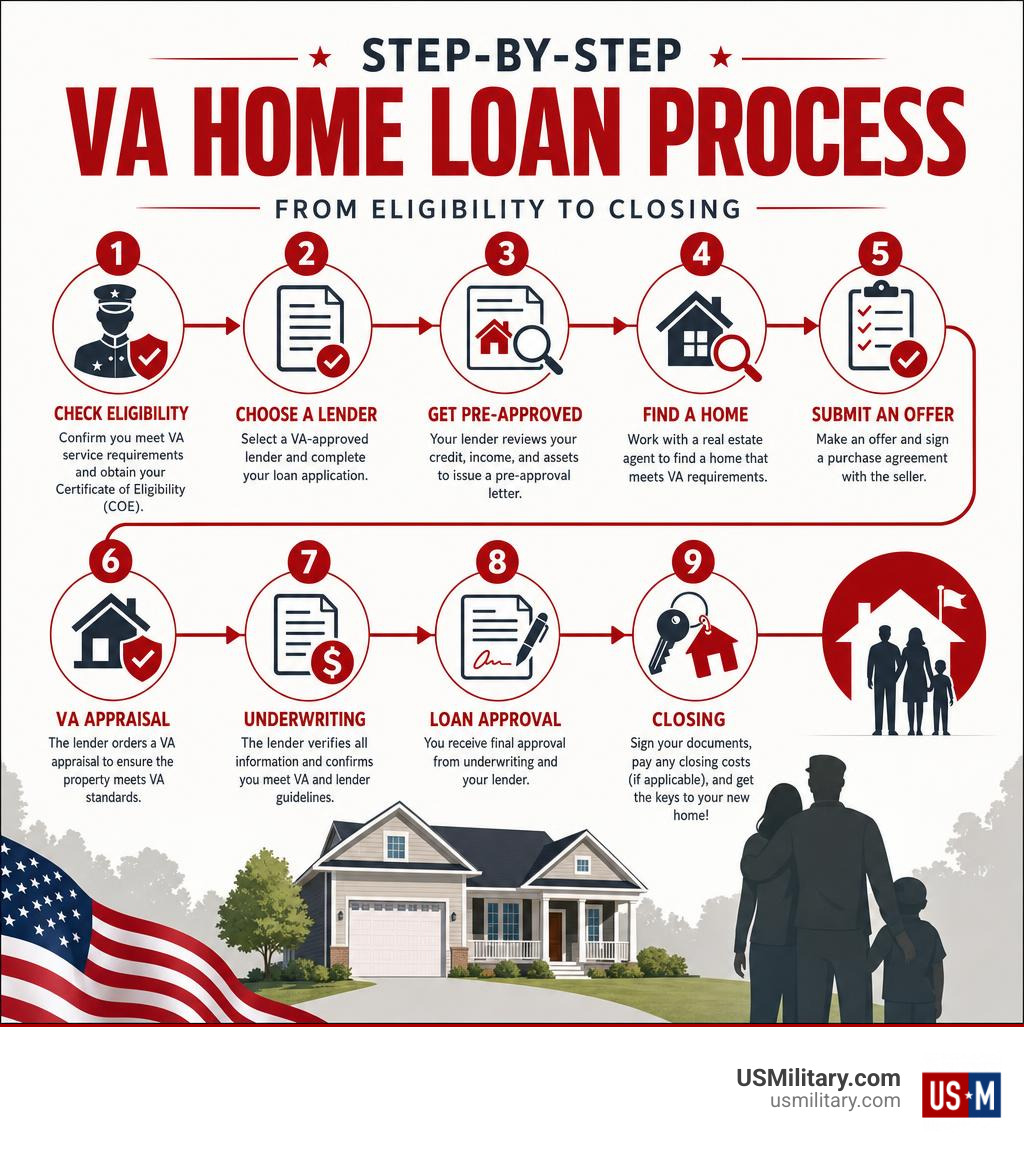
How to Obtain Your Certificate of Eligibility (COE)
The very first step in the VA homebuying process is obtaining your Certificate of Eligibility (COE). This document is the official proof your lender needs to verify that you have earned the VA home loan benefit.

Fortunately, getting your COE is faster and easier than ever. Today, nearly all COE requests are submitted electronically, and about two-thirds are issued immediately through the VA’s online portal.
There are three main pathways to secure your COE:
- Through Your Lender: This is the easiest method. Most VA-approved lenders can instantly pull your COE through the VA’s secure online database using only your Social Security number and date of birth.
- Online via the VA Portal: You can request your COE directly through the official VA benefits website.
- By Mail: If you prefer the traditional route, you can print and mail VA Form 26-1880 (Request for a Certificate of Eligibility) directly to the VA, though this method will take several weeks to process.
To get your COE processed quickly, you should gather your military discharge or service verification documents ahead of time:
- Veterans: You will need your DD Form 214 (Member Copy 4), which shows your character of service and dates of active duty.
- Active-Duty Members: You will need a current Statement of Service signed by your commander or personnel officer.
- National Guard/Reserve: You will need your NGB Form 22 (Report of Separation) or your latest annual retirement points statement (NGB Form 23).
2026 VA Loan Limits and Entitlement Rules
One of the most common points of confusion for military homebuyers is how VA loan limits and entitlement rules work.
Your “entitlement” is the specific dollar amount the VA guarantees to pay your lender if you default on your mortgage. On your COE, you will see a basic entitlement of $36,000. This is a legacy figure based on historical home prices and does not limit your borrowing power. In practice, the VA provides a “bonus entitlement” that covers 25% of your loan amount.
Here is how entitlement impacts your loan limits in 2026:
- Full Entitlement: If you have never used your VA loan benefit, or if you have fully paid off and restored your entitlement from a previous VA loan, you have full entitlement. Since 2020, borrowers with full entitlement face no VA loan limits. You can borrow as much as your lender is willing to approve without being forced to make a down payment.
- Partial (Remaining) Entitlement: If you currently have an active VA loan on a home you own, or if you had a past foreclosure and didn’t fully repay the VA, you have partial entitlement. In this scenario, you are subject to 2026 county loan limits. If you want to buy a second home using your remaining entitlement, you may need to make a down payment if the purchase price exceeds your remaining bonus entitlement.
If you find yourself needing to free up your entitlement for a future move, you might want to read about how to manage your current mortgage in our guide on can you refinance a VA loan.
What’s New in 2026? Loan Limits, Funding Fees, and the Partial Claim Program
The VA home loan program is constantly evolving to meet the needs of modern military families. In 2026, several significant updates have taken effect to increase borrowing power and protect homeowners facing financial hardships.
Higher Conforming Loan Limits
For borrowers with partial entitlement, the standard conforming loan limit has increased to $806,500 for 2026 (up from $766,550 in 2025). In designated high-cost housing markets (such as parts of California, Hawaii, or the New York City metro area), the limit rises to $1,209,750. This adjustment allows veterans to purchase homes in competitive markets without being forced to make a down payment.
The 2026 VA Funding Fee
The VA funding fee is a one-time fee paid directly to the government to help keep the home loan program running for future generations. The fee is typically rolled into your total loan amount, so you do not have to pay it out of pocket at closing.
For 2026, the standard funding fee for a first-time home purchase with 0% down is 2.15%. If you choose to use your benefit a subsequent time with 0% down, the fee increases to 3.30%. You can reduce this fee by making a down payment of 5% or 10%.
Note: The VA funding fee is completely waived for veterans who receive compensation for a service-connected disability, as well as qualifying surviving spouses.
The New VA Partial Claim Program (VAPCP)
In early 2026, the VA introduced a major foreclosure prevention tool called the VA Partial Claim Program. This initiative is designed to assist veterans who have fallen behind on their mortgage payments due to temporary financial hardships (such as medical emergencies or short-term job loss).
Under this program, the VA can advance funds directly to your lender to cure your missed payments and bring your loan current. The advanced amount is then recorded as a zero-interest subordinate lien on your home. You do not have to make monthly payments on this partial claim; instead, the balance is simply repaid when you sell your home, refinance, or pay off your primary mortgage.
Here is a quick snapshot of how key program parameters have shifted over the last year:
| Feature | 2025 | 2026 |
|---|---|---|
| Baseline Conforming Limit | $766,550 | $806,500 |
| High-Cost Area Limit | $1,149,825 | $1,209,750 |
| First-Use Funding Fee (0% Down) | 2.15% | 2.15% |
| Subsequent-Use Funding Fee (0% Down) | 3.30% | 3.30% |
| Foreclosure Assistance | Standard Loss Mitigation | New Partial Claim Program (VAPCP) |
To stay informed on how these program modernizations are rolling out nationwide, read the official update on Modernizing VA home loans – VA News.
VA Home Loan
See If You Qualify for a $0-Down VA Loan
Check your VA loan eligibility in a few minutes. It's free, with no obligation.
Frequently Asked Questions About VA Loans
Buying a home is a massive financial milestone, and it is completely normal to have questions about how the rules apply to your specific situation. Here are answers to some of the most common questions we receive regarding the 2026 VA Home Loan Requirements.
Can I use my VA loan benefit more than once?
Yes! The VA home loan is a lifetime benefit, and you can use it as many times as you like. There is no limit to how many times you can use the program, provided you pay off your previous loan and restore your entitlement. You can even have more than one active VA loan at the same time under specific circumstances, such as a Permanent Change of Station (PCS) move.
What is the minimum credit score for a VA loan in 2026?
The VA does not establish a minimum credit score requirement. However, individual lenders set their own credit score minimums, which typically range from 620 to 670. Because credit overlays vary significantly from one financial institution to the next, it is highly recommended to compare options from the best VA loan lenders to find one that fits your credit profile.
Are surviving spouses eligible for the VA home loan?
Yes. An unmarried surviving spouse of a veteran who died on active duty or from a service-connected disability can qualify for a VA home loan. Eligible surviving spouses also enjoy the added benefit of being exempt from paying the VA funding fee.
Conclusion
Navigating the homebuying process can feel overwhelming, but understanding the 2026 VA Home Loan Requirements is the best way to set yourself up for a smooth and successful purchase. By taking advantage of your hard-earned military benefits — including zero down payment, no monthly PMI, and competitive interest rates — you can secure a stable financial future for you and your family.
At USMilitary.com, we are dedicated to providing the military community with the trusted resources, benefits information, and financial guidance they need. When you are ready to take the next step on your homeownership journey, we invite you to Apply for a VA Home Loan and connect with a specialist who can help turn your housing goals into reality.
Free for Service Members & Veterans
Get the military benefits intel no one tells you about.
Weekly updates on VA benefits, pay changes, and money tips — free for service members and veterans.
No spam. Unsubscribe anytime. Your info is never shared.