Who is Eligible and How to Qualify for a VA Loan

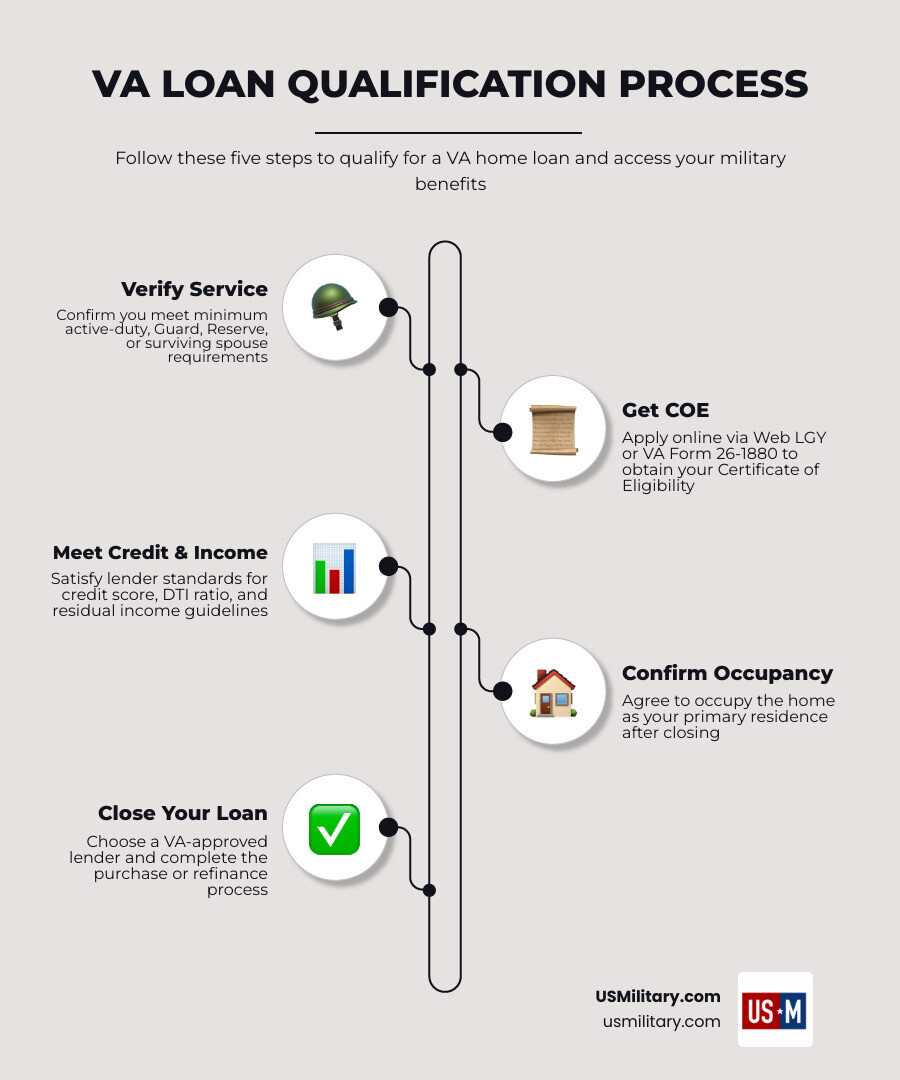
How to qualify for a VA loan comes down to four core requirements:
- Meet minimum military service requirements (based on your service period and branch)
- Obtain a Certificate of Eligibility (COE) to prove your eligibility to a lender
- Satisfy your lender’s credit and income standards (credit history, debt-to-income ratio, residual income)
- Intend to occupy the home as your primary residence
VA home loans are one of the most powerful homeownership tools available to U.S. military members and veterans — yet many eligible people never use them. No down payment. No private mortgage insurance. Competitive interest rates. And it’s a benefit you can use more than once.
Nearly 3,400 veterans start a VA loan quote online every single day. If you haven’t explored this benefit yet, you’re likely leaving money on the table.
The program is open to a wide range of people — veterans, active-duty service members, National Guard and Reserve members, and certain surviving spouses. But the rules around who qualifies and how can feel confusing fast.
This guide breaks it all down in plain language.
I’m Larry Fowler, publisher of the USMilitary.com Network since 2007 and a longtime advocate for helping veterans and service members navigate VA benefits — including understanding how to qualify for a VA loan and access the benefits they’ve earned. Let’s walk through exactly what you need to know.
The VA home loan program, established under the original G.I. Bill of 1944, has helped millions of military families buy, build, or improve their homes. However, the Department of Veterans Affairs does not issue the loans directly. Instead, private lenders provide the financing while the VA guarantees a portion of the loan. This guarantee lowers the risk for lenders, allowing them to offer highly favorable terms to those who meet the basic service criteria.
To figure out if you qualify, we must first look at your service record. The rules vary depending on whether you served during wartime or peacetime, and whether you are an active-duty member, a veteran, a National Guard soldier, a Reservist, or a surviving spouse.
If you want to understand the big picture of your military benefits, you can start by reading From Service to Savings: Understanding Your VA Home Loan Eligibility. For a formal breakdown of government rules, check out the official Eligibility For VA Home Loan Programs – Veterans Affairs page.
Minimum Service Requirements for Veterans and Active-Duty
The minimum active-duty service requirements for veterans are strictly tied to the era in which you served. The VA divides these requirements into distinct wartime and peacetime periods.
- Active-Duty Service Members: If you are currently serving on regular active duty, you generally become eligible after serving 90 continuous days.
- Gulf War Era Veterans (August 2, 1990, to Present): To qualify, you must have completed at least 24 continuous months of active duty, or the full period (at least 90 days) for which you were called or ordered to active duty.
- Post-Vietnam Peacetime Era (May 8, 1975, to September 7, 1980): You must have served at least 181 continuous days of active duty.
- Other Peacetime Eras: Generally require at least 181 days of continuous active service.
- Other Wartime Eras (such as the Vietnam War or Korean War): Generally require at least 90 days of active service.
If you were discharged before reaching these minimums, you may still qualify if your discharge was due to a service-connected disability, a hardship, a reduction in force, or certain medical conditions. For a comprehensive look at how these eras affect your application today, refer to the official Eligibility For VA Home Loan Programs – Veterans Affairs page.
National Guard, Reserves, and Surviving Spouse Eligibility
The path to eligibility is slightly different for non-regular active-duty branches:
- National Guard and Reserve Members: Historically, Guard and Reserve members needed to complete at least 6 years of honorable service in the Selected Reserve or National Guard. However, rules have expanded. You now also qualify if you have at least 90 days of active-duty service, which must include at least one consecutive period of 30 days under specific Title 32 orders.
- Surviving Spouses: You can qualify for a VA loan if you are an unremarried spouse of a service member who died in the line of duty or from a service-connected disability. Spouses of service members who are missing in action (MIA) or prisoners of war (POW) are also eligible.
For those balancing active duty or Guard service with home buying, checking out the Top 5 Military Home Loans for Active Duty Service Members is a great way to compare your options.
VA Home Loan
See If You Qualify for a $0-Down VA Loan
Check your VA loan eligibility in a few minutes. It's free, with no obligation.
Understanding the Certificate of Eligibility (COE)

Before you can officially apply for a VA loan, you must obtain your Certificate of Eligibility (COE). This is the official document issued by the VA that proves to your lender that you meet the minimum service requirements to utilize the home loan benefit.
To learn more about what this benefit entails, read our guide on What Are VA Loans?. For detailed instructions on the certificate itself, you can visit the Certificate of Eligibility – VA Home Loans page.
It is a common misconception that you must have your COE in hand before you can even talk to a mortgage lender. In reality, you can start shopping for homes and comparing lenders without it. However, the lender will absolutely require the COE before they can formally approve and close your loan.
How to Obtain Your COE to Prove How to Qualify for a VA Loan
Getting your COE is faster and easier than it used to be. In fact, nearly all COE requests are submitted electronically, and about two-thirds are issued instantly because the VA already has sufficient digital records of your service.
There are three primary ways to request your COE:
- Through a VA-Approved Lender: This is the fastest route. Most lenders have access to the VA’s Web LGY portal. They can log in, enter your Social Security number and service dates, and often download your COE in a matter of seconds.
- Online via the VA Portal: You can apply directly through the official eBenefits or VA.gov portals.
- By Mail: You can fill out VA Form 26-1880 (Request for a Certificate of Eligibility) and mail it to the Atlanta Eligibility Center along with physical copies of your proof of service. This method takes the longest, so we highly recommend going the digital route if possible.
To begin gathering your records, check out the resources on VA Home Loans.
Depending on your status, you will need to provide specific documentation to verify your service:
- Veterans: A copy of your DD Form 214 (specifically Copy 4), which shows your character of service and the narrative reason for your discharge.
- Active-Duty Members: A current statement of service signed by your commander, adjutant, or personnel officer. It must include your full name, Social Security number, date of entry, and verify that you have no lost time.
- National Guard/Reserve Members: There is no single form equivalent to a DD214. You will need to provide your latest annual points statement and evidence of honorable service, or NGB Form 22.
Advertising disclosure: USMilitary.com may be compensated when you request quotes from lenders in this table.
✉ Get updates like this in your inbox
Weekly VA benefit changes, pay updates, and money tips for service members, veterans, and military families. Free, no spam.
Financial and Property Requirements Beyond Service
Meeting the military service requirements is only the first half of the battle. Because the VA does not lend you the money directly, you must also qualify financially with a private mortgage lender. Lenders look at your credit history, income stability, and overall financial health to ensure you can afford the monthly payments.
| Feature | VA Loan | Conventional Loan |
|---|---|---|
| Minimum Down Payment | 0% (No down payment required) | Typically 3% to 5% |
| Private Mortgage Insurance (PMI) | None | Required if down payment is under 20% |
| Credit Score Requirement | Flexible (No official VA minimum) | Typically 620 minimum |
| Upfront Fees | One-time VA Funding Fee (can be waived) | Lender origination fees, appraisal, etc. |
| Property Requirements | Must meet strict Minimum Property Requirements | Standard appraisal guidelines |
To compare how these programs stack up against other government options, read our detailed breakdown of VA Loan vs FHA vs Conventional. For a complete look at the purchase process, refer to the VA Home Loan Guaranty Buyer’s Guide.
Credit, Income, and Occupancy Guidelines
While the VA provides flexible underwriting guidelines, lenders will still verify your ability to repay the debt:
- Credit History: The VA itself does not mandate a minimum credit score. However, most private lenders enforce their own “lender overlays,” which typically require a credit score of at least 580 to 620. Lenders will look at your overall credit history to ensure you don’t have recent defaults or active bankruptcies.
- Stable Income and DTI: Lenders will verify that you have stable, reliable income to cover your mortgage. While there is no rigid limit on your Debt-to-Income (DTI) ratio, the VA prefers a DTI of 41% or lower. If your DTI is higher, you may need to show strong compensating factors, such as high residual income.
- Residual Income: This is a unique and highly beneficial VA requirement. Residual income is the amount of money you have left over each month after paying all of your major bills (including your new mortgage, taxes, insurance, and credit cards) to cover basic living expenses like food, gas, and clothing. The minimum residual income required varies by your family size and geographic region.
- Occupancy: You must certify that you intend to personally occupy the home as your primary residence. You generally cannot use a standard VA loan to buy a investment property or a vacation home. You must move into the home within a reasonable timeframe, usually 60 days after closing.
To get a better idea of how your income translates to a home budget, check out How Much House Can I Afford VA Loan?. You can also read about the Pros and Cons of VA Loan vs Conventional Loan and what sellers need to know in VA Loan Requirements for Sellers.
VA Funding Fee Exemptions and Waivers
While VA loans do not require monthly private mortgage insurance (PMI), they do require a one-time, upfront payment called the VA Funding Fee. This fee helps offset the cost of the program to U.S. taxpayers. The fee is a percentage of your total loan amount and varies based on your down payment size and whether it is your first time using the benefit.
Fortunately, many borrowers are exempt from paying this fee entirely. You may qualify for a waiver if you fall into one of these categories:
- You receive VA compensation for a service-connected disability.
- You are eligible to receive disability compensation but receive retirement or active-duty pay instead.
- You are an active-duty service member who has received the Purple Heart.
- You are a surviving spouse receiving Dependency and Indemnity Compensation (DIC).
For veterans with a high disability rating, this fee waiver represents thousands of dollars in savings. Learn more about these specific benefits in our article on the 100 Percent Disabled Veteran Home Loan.
Types of VA Loans and Reusing Your Benefit
The VA home loan program is not a one-size-fits-all product. There are several different types of loans designed to meet different financial goals, whether you are buying your very first home, building a new one, or refinancing an existing mortgage.
To understand the step-by-step process of closing on a home, read Buying A Home With A VA-Backed Loan | Veterans Affairs. If you are wondering about the long-term value of this benefit, you can read How Many Times Can You Use a VA Loan?.
Choosing the Right Loan Type for Your Goals
Depending on your current housing situation, you can choose from several loan paths:
- VA Purchase Loan: The standard loan used to buy an existing single-family home, condo, or multi-family property (up to four units, as long as you occupy one of them). You can also use this option to buy a manufactured home or a fixer-upper. Learn more about unique properties in VA Loan for Mobile Home and VA Loan for a Foreclosure.
- Interest Rate Reduction Refinance Loan (IRRRL): Also known as a VA Streamline Refinance. If you already have a VA loan, an IRRRL allows you to lower your interest rate with minimal paperwork, often without requiring a new appraisal or income verification. Find out more at Can You Refinance a VA Loan?.
- VA Cash-Out Refinance: This option allows you to replace your current mortgage (whether it is a VA loan or a conventional loan) with a new VA loan, allowing you to take cash out of your home’s equity to pay off debt, make home improvements, or cover emergency expenses.
- Native American Direct Loan (NADL): A specialized program that helps eligible Native American veterans buy, build, or improve homes on federal trust land.
Reusing Your Entitlement and How to Qualify for a VA Loan Again
Your VA loan benefit is a lifetime benefit. It does not expire, and you do not lose it after using it once. You can use it multiple times to buy successive homes.
The system relies on “entitlement,” which is the dollar amount the VA guarantees to your lender. If you have full entitlement (meaning you have never used a VA loan before, or you have fully paid off and sold your previous VA-backed home), there are no loan limits. You can borrow as much as your lender is willing to approve without a down payment.
If you currently have an active VA loan and want to buy another home, you may still have partial entitlement remaining. This allows you to hold two VA loans at the exact same time, provided you have enough remaining entitlement to cover the new purchase.
Once you sell your original home and pay off the first mortgage in full, you can submit a request to restore your full entitlement and use the benefit again with no restrictions. To manage your active benefits, visit VA Home Loans.
VA Home Loan
See If You Qualify for a $0-Down VA Loan
Check your VA loan eligibility in a few minutes. It's free, with no obligation.
Frequently Asked Questions About VA Loans
What is the minimum credit score to qualify for a VA loan?
The Department of Veterans Affairs does not set a minimum credit score requirement. However, private mortgage lenders establish their own requirements, known as “lender overlays.” Most lenders require a minimum credit score of 580 to 620 to qualify.
Because underwriting guidelines are highly flexible, lenders will review your entire credit profile rather than focusing solely on a single number. If you are looking for a lender that understands these guidelines, check out our guide to the Best Lenders for VA Home Loans.
Can I get a VA loan with a dishonorable discharge?
Generally, a dishonorable discharge disqualifies you from receiving a VA home loan. The VA requires your character of service to be “other than dishonorable” (such as Honorable, Under Honorable Conditions, or General).
If you received a Bad Conduct or Other Than Honorable discharge, you may still be able to qualify by applying for a discharge upgrade or requesting a VA Character of Character Determination. For more details on these exceptions, read the official Eligibility – VA Home Loans guidelines.
Are there loan limits on VA home loans?
For borrowers with full entitlement, there are no loan limits on VA loans. This means you can buy a home of any price with $0 down, as long as you meet your lender’s credit and income requirements.
Loan limits (which align with conforming loan limits set by the Federal Housing Finance Agency) only apply if you have remaining or partial entitlement because you currently have another active VA loan or have previously defaulted on a VA loan. To learn more about how entitlement limits work, read our resource on VA Loans.
Conclusion
Learning how to qualify for a VA loan is the first step toward securing one of the most valuable financial benefits you earned through your military service. By understanding your service requirements, securing your Certificate of Eligibility (COE) early, and maintaining a healthy financial profile, you can navigate the home-buying process with confidence.
At USMilitary.com, we are committed to helping active-duty service members, veterans, and military families make the most of their hard-earned benefits. From career guidance to financial planning, we serve as your central hub for military resources.
When you are ready to take the next step toward homeownership, explore our comprehensive resources on VA Home Loans to find calculators, trusted lenders, and expert advice tailored to your military journey.
Free for Service Members & Veterans
Get the military benefits intel no one tells you about.
Weekly updates on VA benefits, pay changes, and money tips — free for service members and veterans.
No spam. Unsubscribe anytime. Your info is never shared.