What the 2027 Pay Raise Means for Veterans and Retirees

The 2027 cost-of-living adjustment is 3.6%. That means a veteran with a 100% disability rating and no dependents is expected to receive $4,080.37 a month, up $141.79 from the 2026 rate. Standard military retired pay will also rise by 3.6%; retirees who chose REDUX generally receive a smaller increase.
The new VA rates are set to take effect December 1, 2026. Because VA pays benefits after the month ends and January 1 is a holiday, the first higher payment is expected December 31, 2026. Unlike military retired pay, the VA increase still requires Congress to pass its annual COLA bill.
I’m Larry Fowler, publisher of the USMilitary.com Network, where I’ve covered VA benefits and military issues since 2007. Here is the 2027 pay raise for disabled veterans and military retirees at a glance, before we break down the rates and rules.
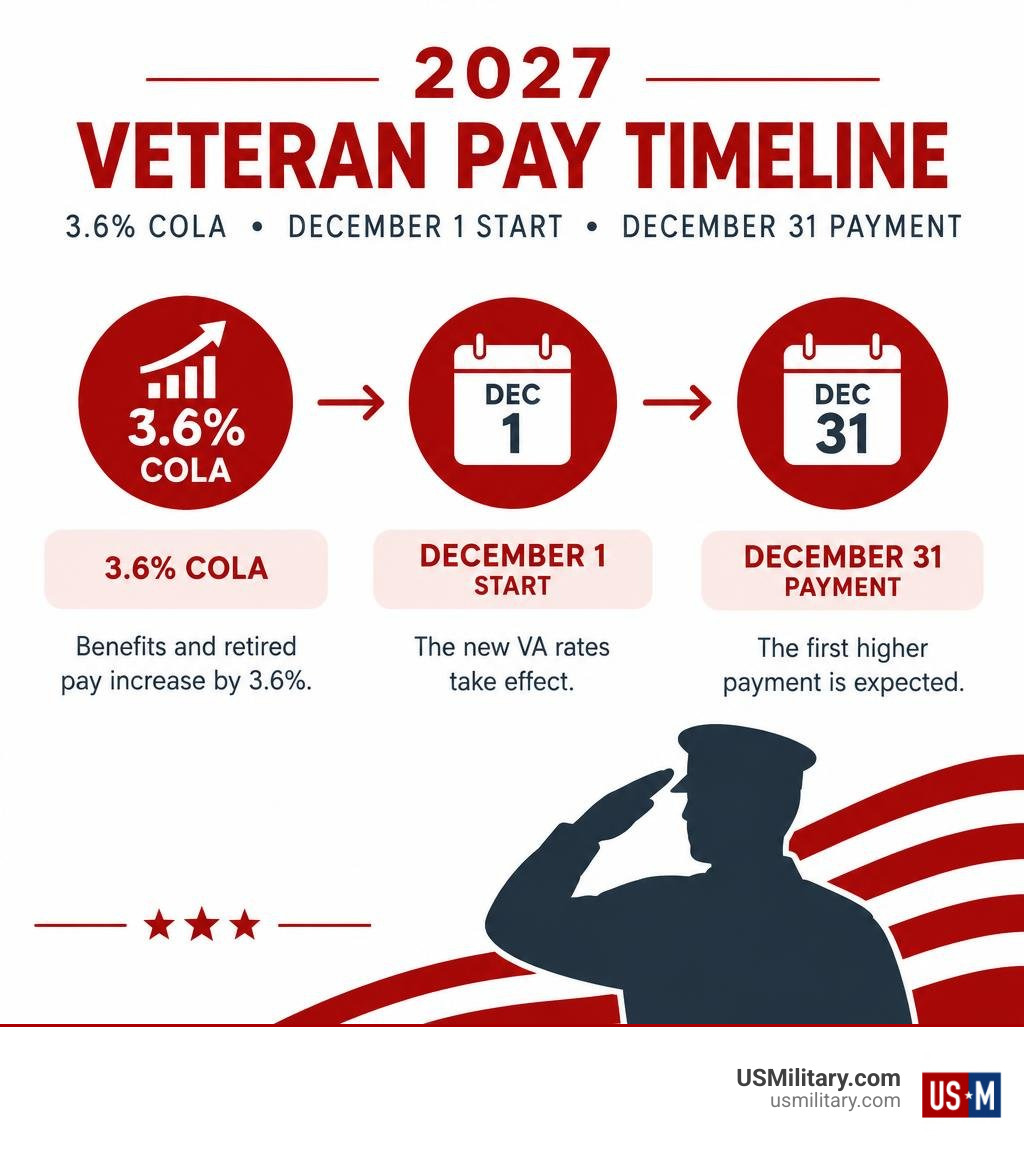
Here is the 2027 Pay Raise for Disabled Veterans and Military Retirees

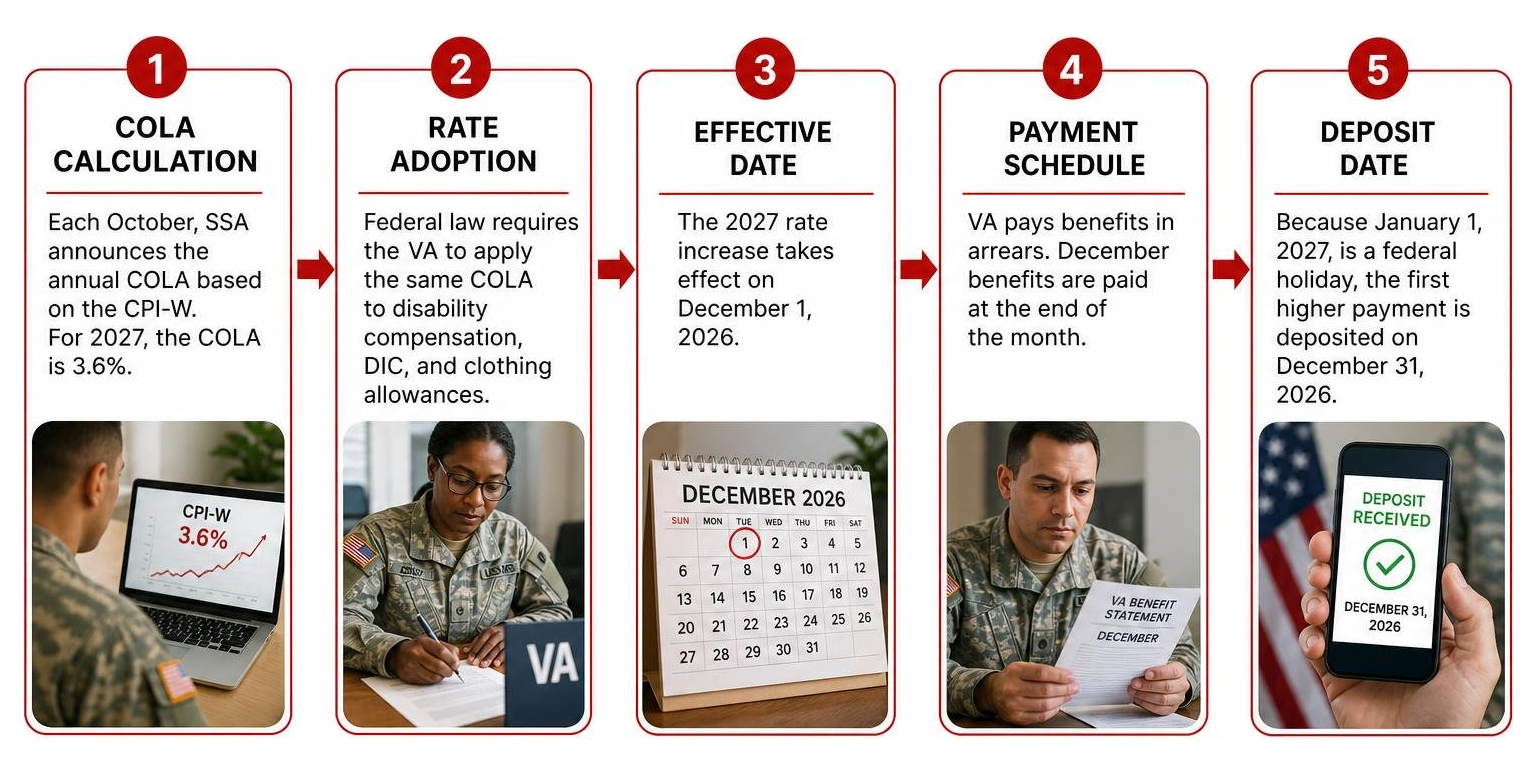
Each year in mid-October, the Social Security Administration (SSA) publishes the annual Cost-of-Living Adjustment (COLA). This percentage is calculated directly by the Bureau of Labor Statistics using the Consumer Price Index for Urban Wage Earners and Clerical Workers (CPI-W). Specifically, analysts compare the average index for the third quarter (July, August, and September) of the current year against the third quarter of the previous year.
For the 2027 cycle, the baseline established during the third quarter of 2025 was 317.265. Continued economic inflation across grocery, housing, and healthcare sectors pushed the 2026 third-quarter metrics higher, resulting in an official 3.6% COLA. This is notably higher than the 2.8% boost seen in previous 2026 VA disability rates.
Federal law mandates that the Department of Veterans Affairs match this identical percentage for disability compensation, dependency and indemnity compensation (DIC), and clothing allowances. When looking across different economic models earlier in the year, projected economic models for 2027 VA rates ranged from 3.2% to 3.5%, but the finalized CPI-W figures solidified the adjustment at 3.6%.
1. Official 3.6% COLA Calculation and Deposit Dates
Understanding the calendar timing prevents confusion during the holiday season. The formal effective date for the 2027 rate increase is December 1, 2026.
Because federal disability and retirement benefits are paid in arrears—meaning your December benefit pays out on the first business day of January—the payment cycle aligns with the start of the new calendar year. However, since January 1, 2027, is a federal holiday, financial institutions and the Department of the Treasury will process direct deposits on Thursday, December 31, 2026.
2. Here is the 2027 Pay Raise for Disabled Veterans and Military Retirees with 100% Ratings

A veteran with a permanent and total (P&T) or standard 100% disability rating receives the largest dollar increase under the 3.6% COLA.
For a veteran with no dependents:
- 2026 Monthly Base Rate: $3,938.58
- 2027 Monthly Base Rate: $4,080.37
- Monthly Increase: $141.79
- Annualized Increase: $1,701.48 per year
This substantial adjustment provides extra financial breathing room for disabled service members facing rising living expenses. To see how these calculations impact broader household budgets, review our 100% VA disability rating monthly compensation guide.
3. Pay Rate Changes for 30% to 90% Ratings and Dependents
Veterans with service-connected disability ratings of 30% or higher are legally entitled to additional monthly allowances for qualifying dependents, including spouses, dependent children under age 18, children in school (ages 18–23), and dependent parents. Veterans rated at 10% or 20% receive a flat base rate with no dependent add-ons.
| Disability Rating | 2026 Monthly Rate (Veteran Alone) | 2027 Monthly Rate (3.6% COLA) | Net Monthly Increase |
|---|---|---|---|
| 10% | $171.23 | $177.39 | +$6.16 |
| 20% | $338.49 | $350.68 | +$12.19 |
| 30% | $552.47 | $572.36 | +$19.89 |
| 40% | $795.84 | $824.49 | +$28.65 |
| 50% | $1,133.00 | $1,173.79 | +$40.79 |
| 60% | $1,436.00 | $1,487.70 | +$51.70 |
| 70% | $1,809.61 | $1,874.76 | +$65.15 |
| 80% | $2,103.55 | $2,179.28 | +$75.73 |
| 90% | $2,363.95 | $2,449.05 | +$85.10 |
| 100% | $3,938.58 | $4,080.37 | +$141.79 |
When dependents are included, the numbers scale upward:
- A 70% disabled veteran with a spouse and one child will see monthly pay rise from $2,074.45 to $2,149.13 (+$74.68/month).
- A 100% disabled veteran with a spouse and one child will see compensation increase from $4,318.99 to $4,474.47 (+$155.48/month).
If your family circumstances have changed or you wish to estimate combined award ratings, try using an online VA COLA calculator for custom household estimates or explore our guide on Aid and Attendance payment updates.
Military Retired Pay and Legislative COLA Requirements
Under federal law (specifically 10 U.S.C. 1401a), Cost-of-Living Adjustments for military retired pay are automatic. Uniformed service retirees from the Army, Navy, Air Force, Marine Corps, Space Force, and Coast Guard do not have to wait for separate congressional legislation each session to receive their inflation adjustments.
To explore your long-term retirement calculations, see our breakdown of military retirement pension eligibility criteria as well as our early look at active duty and retirement pay chart projections.
4. Why VA COLA Requires Annual Congressional Action
Unlike military retirement and Social Security benefits, VA disability compensation does not have a statutory automatic adjustment mechanism written into permanent law.
Instead, Congress must pass an annual bill—such as S. 4487 and H.R. 8552—authorizing the Department of Veterans Affairs to increase disability compensation rates to match the SSA COLA. While this procedural step is routinely handled with broad bipartisan support, it remains a legislative requirement before the VA can officially publish updated rating tables. For a full breakdown of this process, consult our complete guide to navigating annual VA disability policy changes.
5. Impact on Military Retired Pay, REDUX, and First-Year Retirees
The 3.6% COLA applies across the board to traditional military retirement systems, including the High-3 (Final Pay / High-36) and the Blended Retirement System (BRS). However, specific subsets of retirees experience different calculations:
- Standard Retirees (High-3 / BRS): Receive the full 3.6% adjustment on their gross retirement pay.
- REDUX / Career Status Bonus (CSB) Retirees: Under the REDUX program, retirees who accepted a $30,000 career status bonus at their 15-year mark receive a COLA calculated as CPI-W minus 1%. Therefore, REDUX retirees will receive a 2.4% pay increase for 2027.
- First-Year Retirees: Service members who retired during the 2026 calendar year will receive a prorated COLA for their first year on the retirement rolls, depending on the specific quarter in which they separated.
6. Benefit Protections: Tinnitus and Sleep Apnea Proposals
Throughout 2026, veterans service organizations like the Disabled American Veterans (DAV) have maintained heavy advocacy on Capitol Hill regarding proposed changes to the VA Schedule for Rating Disabilities (VASRD).
Recent regulatory proposals have considered altering the rating criteria for sleep apnea and tinnitus—potentially eliminating standalone percentages for tinnitus or requiring service-connected physical damage before awarding sleep apnea ratings. Veterans currently receiving benefits for these conditions are protected under statutory grandfather clauses, but staying alert to legislative debates ensures you protect your hard-earned benefits.
Veteran Health Innovations and Community Highlights
Beyond compensation numbers, advanced medical procedures are transforming veteran care inside the VA health system.
At several major VA medical centers, neurosurgeons are successfully deploying Visualase laser ablation for veterans living with drug-resistant focal epilepsy. Army veteran Robert Lindemann, who suffered from debilitating seizures following his 33 years of service, recently underwent this minimally invasive procedure. By inserting a microscopic laser catheter directly into the seizure focus using real-time MRI guidance, surgeons eliminate damaged brain tissue without open-skull surgery. Studies show up to 60% of patients achieve complete seizure freedom, showcasing remarkable technological advancements in VA healthcare.
7. Inspiring Veteran Stories: Ed T. Solomon’s 90-Year-Old Cookbook
Our veteran community is full of remarkable resilience and entrepreneurial spirit. Ed T. Solomon, a 90-year-old Navy veteran, recently published a lighthearted cookbook tailored for veterans and seniors “who don’t like to cook.”
Filled with quick culinary fixes—including his infamous, tongue-in-cheek recipe for a peanut-butter-and-mayo sandwich—Solomon directs 100% of his book royalties to charities supporting homeless and disabled veterans. His work reminds us that camaraderie and service never end after taking off the uniform.
Frequently Asked Questions About the 2027 Veterans Pay Raise
Is the 2027 pay raise for disabled veterans and military retirees taxable under federal law?
No. Under 38 U.S.C. 5301, VA disability compensation is completely exempt from federal and state income taxes. It is not reported on IRS Form 1040. In contrast, standard military retired pay is subject to federal income tax (and state tax depending on your residency), and is reported annually via Defense Finance and Accounting Service (DFAS) Form 1099-R.
When will the higher 2027 payment appear in bank accounts?
The 2027 rate officially takes effect December 1, 2026. Because benefits are paid in arrears and January 1 is a federal holiday, your first increased benefit payment will arrive on December 31, 2026.
Do disabled veterans need to file a claim to get the 3.6% COLA increase?
No. The 3.6% cost-of-living increase is applied automatically across all disability rating tiers (10% to 100%) and dependent tiers. You do not need to contact the VA or submit any supplemental paperwork unless you are filing for an increased rating based on worsened medical conditions.
Conclusion
The 2027 pay raise delivers a solid 3.6% cost-of-living adjustment, ensuring your monthly compensation keeps pace with rising household expenses. We encourage you to review your annual VA benefit summary letters and DFAS statements as the December 31 deposit date approaches.
For continuous updates on retirement options, veteran benefits, and compensation tables, explore our comprehensive military pay chart resources right here on USMilitary.com.
Free for Service Members & Veterans
Get the military benefits intel no one tells you about.
Weekly updates on VA benefits, pay changes, and money tips — free for service members and veterans.
No spam. Unsubscribe anytime. Your info is never shared.



Leave a Reply