What You Need to Know About Army Pension Eligibility
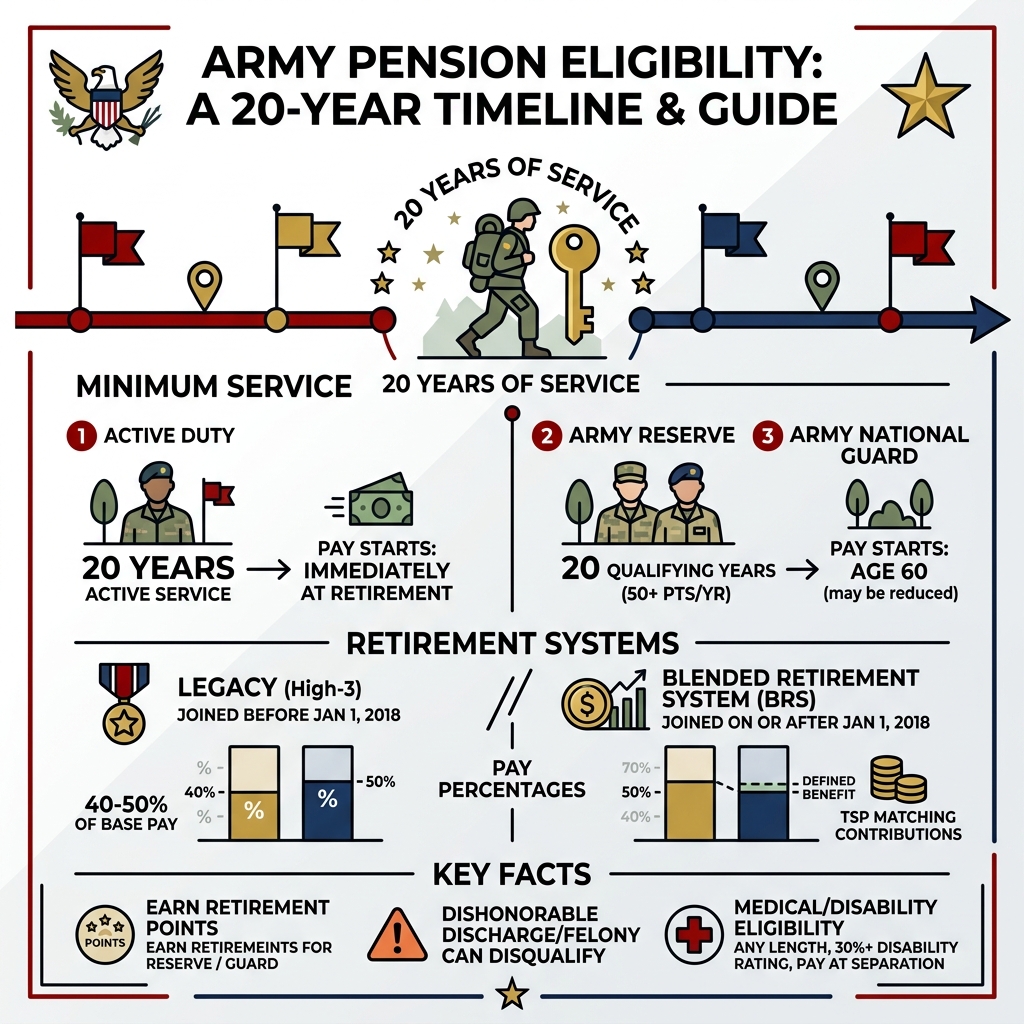
Army pension eligibility requires a minimum of 20 years of qualifying service. Here is a quick breakdown:
| Component | Minimum Service | When Pay Starts |
|---|---|---|
| Active Duty | 20 years active service | Immediately at retirement |
| Army Reserve | 20 qualifying years (50 pts/year) | Age 60 (may be reduced) |
| Army National Guard | 20 qualifying years (50 pts/year) | Age 60 (may be reduced) |
| Medical/Disability | Any length, 30%+ disability rating | At separation |
Key facts at a glance:
- Active duty retirees receive roughly 40-50% of their base pay depending on their retirement plan
- The Blended Retirement System (BRS) applies to anyone who joined on or after January 1, 2018
- Reservists and Guard members earn retirement points, not simply years, toward their pension
- A dishonorable discharge or felony conviction can disqualify you from benefits
Figuring out whether you qualify for an Army pension can feel overwhelming. The rules differ based on when you joined, how you served, and which retirement system applies to you. Active duty soldiers, Reserve members, and National Guard soldiers all follow different paths to the same goal — a monthly retirement check for life.
This guide breaks it all down in plain language so you can understand exactly where you stand and what steps to take next.
I’m Larry Fowler, publisher of the USMilitary.com Network since 2007 and a longtime resource for veterans and service members navigating army pension eligibility and VA benefits. In the sections ahead, I’ll walk you through every major eligibility rule, retirement plan, and calculation method you need to know.
Army pension eligibility vocabulary:
Core Requirements for Army Pension Eligibility

At its most basic level, army pension eligibility is built on the “20-year rule.” Whether you are jumping out of planes in the 82nd Airborne or managing logistics at a desk, the Army generally requires two decades of service before they start cutting you a retirement check.
For Active Duty Soldiers, this means 20 years of active service. Once you hit that 20-year mark and retire, your pension payments can begin immediately, regardless of your age. This is one of the most significant “perks” of a military career—the ability to retire in your late 30s or early 40s with a guaranteed monthly income.
However, simply putting in the time isn’t enough. To maintain military pension eligibility 101, you must receive an honorable discharge. Your conduct throughout those 20 years matters; a court-martial or certain legal troubles can jeopardize everything you’ve worked for.
Understanding Your DIEMS Date
Your “Date of Initial Entry into Military Service” (DIEMS) is the most important date in your file. It determines which retirement system you fall under.
- Pre-September 8, 1980: Final Pay Plan.
- September 8, 1980, to July 31, 1986: High-36 Plan.
- August 1, 1986, to December 31, 2017: Choice of High-36 or REDUX.
- January 1, 2018, or later: Blended Retirement System (BRS).
The official eligibility criteria used by the Defense Finance and Accounting Service (DFAS) focus on your “Retired Pay Base.” This is usually the average of your highest 36 months of basic pay. By staying in longer than 20 years, you increase your “multiplier,” which means a bigger percentage of that pay base ends up in your pocket every month.
Comparing Active Duty vs. Reserve and Guard Retirement
The path to army pension eligibility looks very different for our “Citizen Soldiers” in the Army Reserve and National Guard. While Active Duty Soldiers get paid the moment they hang up the uniform, Reserve and Guard members usually have to wait.
| Feature | Active Duty | Reserve / National Guard |
|---|---|---|
| Service Requirement | 20 Years Active Service | 20 Qualifying Years |
| Payment Start Age | Any age (upon retirement) | Age 60 (standard) |
| Calculation Basis | Years and Months | Retirement Points |
| Health Benefits | Immediate TRICARE | TRICARE Retired Reserve (until age 60) |
For the Reserve and Guard, you must complete 20 “qualifying years.” A qualifying year is a year in which you earn at least 50 retirement points. Once you hit 20 qualifying years, you receive your “20-Year Letter,” which confirms your eligibility for retired pay at age 60.
The NDAA 2008 Age Reduction
There is a way to get paid sooner. Thanks to the National Defense Authorization Act (NDAA) of 2008, Reservists and Guard members can reduce that age 60 requirement. For every 90 days of “specified duty” (usually deployments or certain active duty mobilizations) performed within a fiscal year after January 28, 2008, the age at which you can receive pension pay is reduced by three months. Some Soldiers have successfully lowered their payout age to 50!
These reserve retirement mechanics create what we call “Gray Area Retirees.” These are Soldiers who have finished their 20 years but haven’t yet reached the age to start drawing pay. During this time, it is vital to keep your contact information updated in myPay so the Army knows where to send your check when the time comes.
Qualifying Years for Army Pension Eligibility
How do you make sure your year “counts”? It all comes down to points. You earn points through:
- Active Duty/ADT: 1 point for every day served.
- Inactive Duty Training (Drill): 1 point per unit training assembly (usually 4 per weekend).
- Membership: 15 points just for being in an active status for a full year.
- Correspondence Courses: Points earned for completing approved military education.
We often give advice on preparing for retirement by telling Reserve Soldiers to maximize their points. While you only need 50 points for the year to count toward the 20-year requirement, your actual pay amount is calculated by dividing your total career points by 360. More points = more money.
Understanding Retirement Systems: BRS vs. Legacy Plans
If you’ve talked to “old timers,” they probably mention the High-36 system. But if you’re new to the ranks, you’re likely in the Blended Retirement System (BRS). Understanding the difference is key to projecting your future wealth.
The Legacy High-36 Plan
Under this plan, there is no government “401(k)” match. You serve 20 years, and the Army gives you a pension equal to 50% of your average highest 36 months of basic pay. For every year you stay past 20, that multiplier increases by 2.5%. If you stay for 40 years, you could technically retire with 100% of your base pay!
The Blended Retirement System (BRS)
The BRS is a modern approach. It lowered the pension multiplier from 2.5% to 2.0%. This means at 20 years, your pension is 40% of your base pay instead of 50%.
Wait—why would anyone want less? Because the BRS adds a “Blended” component:
- Automatic Contribution: The Army puts 1% of your basic pay into your Thrift Savings Plan (TSP) automatically.
- Matching: The government matches your TSP contributions up to an additional 4%.
- Vesting: You own that 1% after two years, and you own the matching funds immediately.
This is a huge win for the 80% of Soldiers who don’t stay for 20 years. Under the old system, if you left at year 12, you got nothing. Under BRS, you take your TSP and the government’s matching money with you. We cover more on retirement savings benefits here, but the takeaway is: if you’re in BRS, contribute at least 5% to get that “free” money!
For those looking for the Blended Retirement System details, it also includes a “Continuation Bonus” (a one-time mid-career payment) and the option to take a portion of your pension as a lump sum at retirement.
Calculating Your Pay Under Army Pension Eligibility Rules
To get a ballpark figure, you can use the military pension calculator. Here is the basic math:
Legacy (High-36) Formula:
(Years of Service x 2.5%) x (Average of Highest 36 Months Basic Pay) = Monthly Pension
BRS Formula:
(Years of Service x 2.0%) x (Average of Highest 36 Months Basic Pay) = Monthly Pension
Don’t forget the Cost-of-Living Adjustment (COLA). Every year, the government adjusts your pension to keep up with inflation, ensuring your buying power doesn’t disappear as you get older.
Special Circumstances: Disability and VA Pensions
Sometimes, a career is cut short by injury or illness. In these cases, army pension eligibility rules change significantly.
Medical Retirement (Chapter 61)
If the Army determines you are no longer fit for duty due to a physical disability, you may qualify for a medical retirement under “Chapter 61.” To qualify for a permanent medical pension, you generally need a disability rating of at least 30% from the Department of Defense.
The unique thing about medical retirement is that you don’t need to hit the 20-year mark. If you are 100% disabled after only 5 years of service, you can still receive a monthly retirement check. You can find more in this disability retirement guide.
VA Veterans Pension vs. Military Retirement Pay
It is very common to confuse “Military Retirement” with the “VA Pension.” They are not the same thing.
- Military Retirement: Based on your service length or medical disability. It is an “earned” benefit.
- VA Veterans Pension: This is a “needs-based” benefit for low-income wartime veterans.
According to VA pension eligibility rules, to qualify for a VA Pension, you must have served during a recognized wartime period (like the Gulf War or Vietnam), have a low net worth, and be either over age 65 or permanently disabled. For 2024, the Maximum Annual Pension Rate (MAPR) for a veteran with no dependents is $16,965.
If you are a veteran who requires the help of another person for daily activities, you might also qualify for Aid and Attendance, which provides an even higher monthly payment.
Frequently Asked Questions about Army Pensions
What disqualifies a Soldier from receiving a pension?
The most common disqualifier is a Dishonorable Discharge. If you do not complete your service with at least an “Under Honorable Conditions” (General) or “Honorable” discharge, you will likely lose your retirement benefits.
Additionally, your pension can be terminated if you are incarcerated. If you are convicted of a felony or misdemeanor and spend more than 60 days in prison, your retirement pay stops. It may resume once you are released, but those lost months of pay are gone forever. Certain “crimes against the United States,” such as treason or espionage, can result in a permanent loss of all military retired pay.
Can I retire early from the Army?
Generally, no. However, during times when the Army needs to reduce its size (force drawdowns), they may authorize the Temporary Early Retirement Authority (TERA). This allows certain Soldiers with at least 15 years of service to retire early with a reduced pension.
Check our update on the 15-year early retirement plan to see if any current authorizations are active. These are rare and usually only available for specific MOSs or year groups.
How do I apply for my retirement pay?
Retirement pay does not start automatically! You must apply.
- Active Duty: You will work with your Transition Assistance Program (TAP) and your Retirement Services Office (RSO) to complete DD Form 2656.
- Reserve/Guard: You must submit an application to the Human Resources Command (HRC) at Fort Knox once you approach your eligibility age (usually 60).
- Update myPay: Before you leave, ensure your email address in myPay is a personal one, not your .mil address. You will need access to your Retiree Account Statement (RAS) for years to come.
Conclusion
Securing your army pension eligibility is a marathon, not a sprint. Whether you are an active duty “lifer” or a dedicated Reservist, the benefits waiting for you at the finish line are some of the most stable and valuable in the United States.
At USMilitary.com, we are dedicated to helping you navigate these complex waters. From understanding the BRS matching to helping you calculate your points, our goal is to ensure you maximize the rewards of your service. Your career milestones deserve a financial future that is just as strong as your commitment to our country.
Ready to take the next step in your financial planning? Secure your military retirement benefits today by staying informed and taking full advantage of the Thrift Savings Plan and transition resources available to you. Thank you for your service!
Free for Service Members & Veterans
Get the military benefits intel no one tells you about.
Weekly updates on VA benefits, pay changes, and money tips — free for service members and veterans.
No spam. Unsubscribe anytime. Your info is never shared.


