What You Need to Know About the 2026 VA Disability Rate Increase
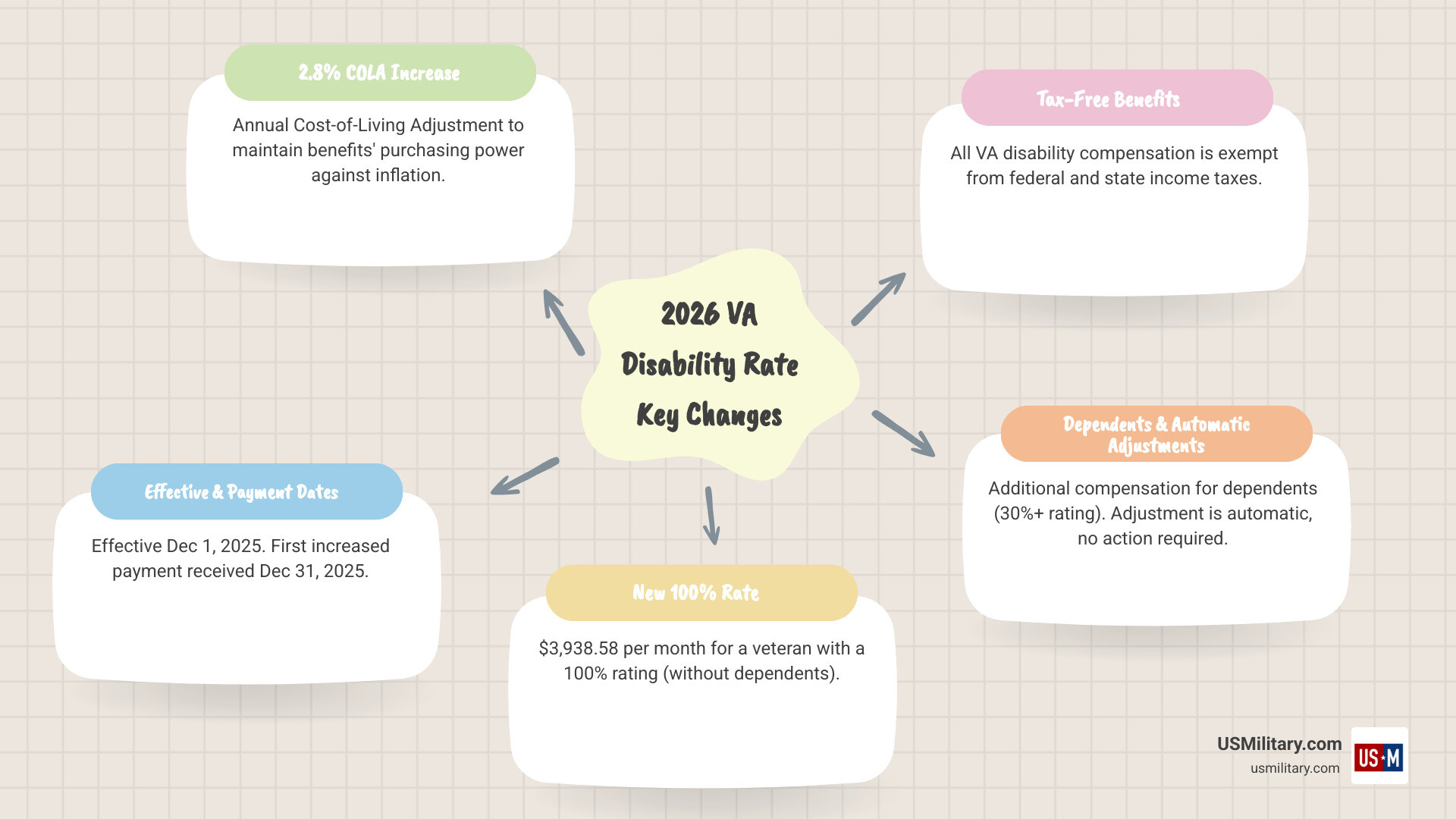
2026 VA disability rates reflect a 2.8% cost-of-living adjustment (COLA), bringing meaningful increases to monthly payments for veterans with service-connected disabilities. Here’s what matters most:
Key Facts:
- COLA Increase: 2.8% adjustment for 2026
- Effective Date: December 1, 2025
- First Payment: December 31, 2025
- 100% Rating (No Dependents): $3,938.58 per month (up from $3,831.30 in 2025)
- Who’s Affected: All veterans receiving VA disability compensation
- Tax Status: Completely tax-free at federal and state levels
The increase applies automatically to all disability ratings from 10% to 100%. Veterans with dependents (spouse, children, or parents) receive additional compensation if their rating is 30% or higher.
Understanding your benefits is crucial for financial planning. These rates represent real money that can help you and your family maintain your quality of life. Whether you’re already receiving benefits or considering applying for the first time, knowing what you’re entitled to matters.
The 2026 adjustment continues the VA’s legal requirement to match Social Security’s COLA, which is based on inflation measured by the Consumer Price Index for Urban Wage Earners and Clerical Workers (CPI-W). This ensures your benefits don’t lose purchasing power as costs rise.
I’m Larry Fowler, publisher of the USMilitary.com Network since 2007, and I’ve helped hundreds of thousands of active military members and veterans understand their benefits, including tracking 2026 VA disability rates and changes that affect your financial future. In this guide, I’ll break down everything you need to know about the new rates, how they’re calculated, and what they mean for you.
The 2026 VA Disability COLA Increase Explained
The Cost of Living Adjustment (COLA) is a critical factor in ensuring that your VA disability benefits maintain their purchasing power against the relentless march of inflation. For 2026, we’re seeing a 2.8% increase, which, while not as dramatic as some recent years, is a welcome boost for veterans and their families. This adjustment is directly tied to the Social Security Administration’s (SSA) COLA, a connection mandated by law to protect your financial stability.
The primary goal of COLA is inflation protection. As the cost of consumer goods and services rises, so too do the expenses for veterans and their families. Without these annual adjustments, the real value of your benefits would diminish over time. The VA’s commitment to matching the Social Security COLA means that your disability payments are designed to keep pace with the broader economic landscape, helping you manage daily living costs.
Key Changes to the 2026 VA disability rates
The most important takeaway for veterans regarding the 2026 VA disability rates is the confirmed 2.8% COLA. This percentage might seem small, but it translates into tangible increases in your monthly payments.
- What is the percentage of the Cost of Living Adjustment (COLA) for 2026 VA disability rates?
The COLA for 2026 VA disability rates is 2.8%. This is a direct match to the increase announced by the Social Security Administration. - When do the 2026 VA disability rates take effect?
The new 2026 VA disability rates officially take effect on December 1, 2025. This means that the first increased payment reflecting the 2.8% COLA will be deposited on December 31, 2025. It’s an automatic adjustment, so you don’t need to lift a finger—no forms, no phone calls, just an increased payment hitting your account. - How does the 2026 COLA increase compare to previous years?
The 2.8% COLA for 2026 is slightly higher than the previous year’s 2.5% COLA. While it’s a positive step, it’s also important to look at the broader historical context. For instance, we’ve seen larger adjustments in recent memory due to higher inflation, such as the 8.7% COLA in 2022 and 5.9% in 2021. The average COLA increase over the last decade has been approximately 2.6%. This 2.8% increase is a solid, above-average adjustment that continues to help bridge the gap between your benefits and the rising cost of living. It reflects the ongoing commitment to ensuring your benefits keep up with economic realities.
How the VA COLA is Calculated
- How is the VA disability COLA calculated?
The calculation of the VA disability COLA is directly tied to how the Social Security Administration determines its annual Cost of Living Adjustment. By law, the VA is required to match the percentage of COLA applied to Social Security benefits.The SSA bases its COLA on the Consumer Price Index for Urban Wage Earners and Clerical Workers (CPI-W). This index measures the average change over time in the prices paid by urban wage earners and clerical workers for a market basket of consumer goods and services. Essentially, it’s a broad measure of inflation.The SSA compares the average CPI-W for the third quarter of the current year (July, August, and September) with the average CPI-W for the third quarter of the last year in which a COLA was payable. The percentage increase between these two periods, if any, becomes the COLA for the upcoming year. This annual calculation ensures that benefits are adjusted to reflect changes in the cost of living, helping to preserve the purchasing power of your well-deserved compensation.
For official information and further details on how these adjustments are made, we encourage you to visit the Get the latest cost-of-living adjustment (COLA) information on the Social Security Administration’s (SSA) website.
Understanding the Official 2026 VA Disability Rates and Pay Charts

Navigating the various tables and figures for VA disability compensation can sometimes feel like deciphering ancient texts, but we’re here to help make it clear. The 2026 va disability rates are structured around your VA rating percentage and can be significantly influenced by your dependent status. These benefits are completely tax-free, offering a crucial financial lifeline to many veterans.
2026 VA Pay Rates: 10% to 100% (Veteran Alone)
Let’s start with the basic monthly rates for a veteran with no dependents. These figures represent the baseline compensation you can expect based on your disability rating, reflecting the 2.8% COLA increase.
- What is the monthly disability payment for a veteran with a 100% rating and no dependents in 2026?
For 2026, a veteran with a 100% rating and no dependents will receive $3,938.58 per month. This is a substantial increase from the previous year, directly reflecting the COLA.
Here’s a snapshot of the monthly disability payments for veterans with various ratings, without dependents:
- 10% disability rating: $180.42 per month
- 20% disability rating: $356.66 per month
- 30% disability rating: $552.47 per month
- 40% disability rating: $795.84 per month
- 50% disability rating: $1,132.90 per month
- 60% disability rating: $1,435.02 per month
- 70% disability rating: $1,808.45 per month
- 80% disability rating: $2,102.15 per month
- 90% disability rating: $2,362.30 per month
- 100% disability rating: $3,938.58 per month
These rates are designed to provide a steady, tax-free income stream for your service-connected conditions.
How Dependents Impact the 2026 VA disability rates
One of the most significant factors that can increase your VA disability payment is having dependents. However, this additional compensation only kicks in if your disability rating is 30% or higher. Veterans with 10% or 20% ratings receive a flat rate regardless of dependents.
- How do dependents (spouse, children, parents) affect the 2026 VA disability payment amounts?
If you have a disability rating of 30% or higher, you are eligible for additional compensation for qualifying dependents. This includes:- A spouse: Your marital status can increase your monthly pay.
- Children: Both children under 18 and children over 18 (up to age 23) who are attending school can qualify. Dependent children aged 18-23 attending school and considered a dependent for tax purposes qualify for increased benefits.
- Dependent parents: If you provide over 50% of their financial support, your parents may also be considered dependents.
The additional monthly amounts for dependents vary significantly based on your disability rating and the number of dependents. For example:
✉ Get updates like this in your inbox
Weekly VA benefit changes, pay updates, and money tips for service members, veterans, and military families. Free, no spam.
- For a 30% rating:
- Veteran with spouse: $617.79
- Veteran with spouse and one parent: $670.48
- Veteran with spouse and two parents: $723.16
- Each Additional Child Under 18: $32.00
- Each Additional Schoolchild Over 18: $105.00
- For a 70% rating:
- Veteran with spouse: $1,961.23
- Veteran with spouse and one parent: $2,084.51
- Veteran with spouse and two parents: $2,207.80
- Each Additional Child Under 18: $75.87
- Each Additional Schoolchild Over 18: $246.57
- For a 100% rating:
- Veteran with spouse: $4,158.16
- Veteran with spouse and one parent: $4,334.41
- Veteran with spouse and two parents: $4,510.65
- Each Additional Child Under 18: $109.11
- Each Additional Schoolchild Over 18: $352.45
These added amounts ensure that your compensation better supports your entire household. To ensure you receive all the benefits you’re entitled to, it’s crucial to keep your dependent information updated with the VA.
Special Circumstances and Additional Compensation
Beyond basic dependency, certain circumstances can lead to further increases in your VA disability payments. These are designed to provide extra support for veterans facing severe challenges.
- Are there additional benefits for specific circumstances, such as Aid and Attendance or severe disabilities?
Yes, the VA offers additional benefits for specific circumstances:- Aid and Attendance (A&A): If your spouse requires the aid and attendance of another person for daily living activities due to their own disabilities, you may qualify for an additional monthly allowance. For example, the additional amount for a spouse receiving A&A can range from $61.00 at a 30% rating to $201.41 at a 100% rating. This benefit is intended to help cover the costs associated with necessary care.
- Special Monthly Compensation (SMC): This is a higher rate of compensation paid to veterans with certain severe disabilities, or combinations of disabilities, that are exceptionally debilitating. SMC is paid in addition to the standard disability compensation and covers conditions such as:
- Loss or loss of use of specific organs or extremities (e.g., blindness, loss of a limb).
- Being housebound or requiring the aid and attendance of another person.
- Combinations of severe disabilities.
SMC is categorized by different “levels” (e.g., SMC-K, SMC-S, SMC-L, etc.), each with its own specific criteria and payment rates. These rates can significantly exceed the standard 100% disability payment, reflecting the profound impact these conditions have on a veteran’s life.
We encourage you to explore the official VA resources to understand all potential benefits you may be eligible for. You can find your official compensation rate and detailed tables on the VA’s website.
How Your VA Benefits Are Calculated and How to Apply
Understanding how the VA arrives at your disability rating and payment amount can sometimes feel like trying to solve a puzzle. It’s not always straightforward, especially when dealing with multiple conditions. However, knowing the process can empower you to ensure you receive the compensation you deserve.
“VA Math”: Calculating a Combined Disability Rating
If you have multiple service-connected conditions, the VA doesn’t simply add the percentages together. This is where “VA Math” comes into play, a system that often confuses veterans.
- How does the VA calculate combined disability ratings for veterans with multiple service-connected conditions?
The VA uses a combined ratings table and a “percentage of health” method. Instead of adding ratings, the VA calculates the impact of each disability on the “remaining efficiency” or “healthy” percentage of the veteran. This means that as your overall disability increases, each subsequent disability has a proportionally smaller impact on your final combined rating.Here’s how it works:- Order Disabilities: List your disability ratings from highest to lowest.
- Start with the Highest: Take the highest disability rating.
- Calculate Remaining Efficiency: Determine the percentage of “health” remaining. For example, a 50% disability means 50% health remaining.
- Combine Next Rating: Apply the next highest disability rating to the remaining efficiency. So, if you have a 50% rating (50% healthy) and a 30% rating, the 30% is applied to the remaining 50% health (30% of 50% = 15%).
- Add and Round: Add this calculated percentage to the first disability rating (50% + 15% = 65%). Then, round the result to the nearest 10% (65% rounds to 70%).
- Repeat: If you have more disabilities, repeat the process, applying the next disability to the new remaining efficiency.
Example Calculation: Let’s say a veteran has three service-connected conditions rated at 50%, 30%, and 10%.
- Start with the highest: 50% disability. This leaves 50% “healthy.”
- Next highest: 30%. Apply 30% to the remaining 50% healthy. (0.30 * 50%) = 15%.
- Combine: 50% + 15% = 65%.
- Round to nearest 10%: 70%. So, the combined rating for the first two conditions is 70%. This leaves 30% “healthy.”
- Next highest: 10%. Apply 10% to the remaining 30% healthy. (0.10 * 30%) = 3%.
- Combine: 70% + 3% = 73%.
- Round to nearest 10%: 70%.
- Therefore, a veteran with 50%, 30%, and 10% ratings would have a combined rating of 70%, not 90% (which would be simple addition).
It’s a bit like trying to fit all your gear into an already packed duffel bag—each new item takes up a smaller percentage of the remaining space, not the total original space. This system is designed to provide a more accurate reflection of a veteran’s overall impairment, but it definitely requires a calculator to figure out!
Total Disability Individual Unemployability (TDIU)
Sometimes, a veteran’s service-connected conditions make it impossible to maintain steady employment, even if their combined schedular rating is less than 100%. This is where Total Disability Individual Unemployability (TDIU) comes in.
- What is Total Disability Individual Unemployability (TDIU) and how does it relate to 2026 rates?
TDIU is a special benefit that allows the VA to pay you at the 100% disability rate, even if your combined schedular rating is less than 100%. The key criterion is that your service-connected conditions prevent you from maintaining “substantially gainful employment.”This means if your disabilities are so severe that you cannot work a regular job that provides a living wage, the VA acknowledges that your economic impact is equivalent to a 100% disabled veteran.Eligibility requirements for TDIU typically include:
- One service-connected disability rated at 60% or more, OR
- Two or more service-connected disabilities, with one rated at 40% or more, and a combined rating of 70% or more.
- Crucially, you must be unable to secure or follow substantially gainful employment as a result of your service-connected conditions.
For 2026, if you qualify for TDIU, you would receive the same monthly payment as a veteran with a 100% rating and no dependents: $3,938.58 (plus any additional amounts for dependents). This benefit is vital for veterans whose ability to earn a living has been severely impacted by their service.
To learn more about this crucial benefit, we recommend visiting the official page: Learn more about Total Disability based on Individual Unemployability (TDIU).
How to Apply for Benefits or an Increased Rating
Whether you’re applying for VA disability benefits for the first time or seeking an increased rating, the process involves submitting evidence and following specific steps.

- How can a veteran apply for VA disability benefits or an increased rating?
There are several ways to apply for VA disability benefits or to request an increased rating if your service-connected condition has worsened:- Online via VA.gov: This is often the quickest and most recommended method. You can apply directly through the VA’s portal. The online system guides you through the necessary steps and allows you to upload supporting documents electronically.
- By Mail: You can download and complete VA Form 21-526EZ, “Application for Disability Compensation and Related Compensation Benefits,” and mail it to the VA.
- In Person: Visit your regional VA benefits office. You can find your nearest location at the VA health facility locator. Staff there can assist you with the application process.
- With Professional Assistance: A Veterans Service Officer (VSO) from organizations like the DAV (Disabled American Veterans) or VFW (Veterans of Foreign Wars) can help you prepare and submit your claim. They offer free assistance and can be invaluable in navigating the complexities of the VA system.
Tips for a smoother application process:
- Fully Developed Claim (FDC): If you submit all necessary evidence and documentation upfront with your initial application, you can file a Fully Developed Claim. This often leads to faster processing times, sometimes within 30 days, compared to the average 85 days for standard claims (as of November 2025).
- Benefits Delivery at Discharge (BDD): If you are still on active duty but within 90 to 180 days of separation, you can apply through the Benefits Delivery at Discharge (BDD) program. This allows you to receive a decision on your claim much sooner after discharge.
- Nexus Letter: A crucial piece of evidence is often a “nexus letter” from a medical professional. This letter explicitly links your current medical condition to your military service. It helps establish the service connection required for compensation.
- Medical Records: Ensure you have comprehensive medical records (VA and private) that clearly document your condition and its progression.
- Service Records: Provide your DD-214 and any relevant service treatment records (STRs).
- Attend C&P Exams: If the VA schedules a Compensation and Pension (C&P) exam, attend it. This exam is a critical part of the VA’s evaluation of your disability.
- Increased Rating: If your service-connected condition has worsened, you can apply for an increased rating at any time. Submit new medical evidence documenting the change in your condition with VA Form 21-526EZ.
- Priority Processing: In specific situations, such as terminal illness, extreme financial hardship, or being age 85 or older, you may qualify for faster review by submitting VA Form 20-10207 for a Priority Processing Request.
USMilitary.com is here to provide nonbiased information and resources to guide you through these processes.
Frequently Asked Questions About 2026 VA Pay
We know you’ve got questions, and we’re here to provide clear, concise answers about your 2026 va disability rates and related benefits.
Are 2026 VA disability payments taxable?
- Are VA disability payments taxable?
This is one of the best parts about VA disability compensation: it is completely tax-free at both the federal and state levels. You do not need to report these payments on your tax returns. This makes your VA benefits a particularly valuable and stable source of income.
Can I work while receiving VA disability compensation?
- Can I work while receiving VA disability compensation?
In most cases, yes! If you receive a schedular disability rating (meaning a rating based purely on the severity of your condition, from 10% to 100%), there are generally no restrictions on your employment or income. You can work full-time, part-time, or not at all, and it will not affect your disability payments.The primary exception is if you are receiving Total Disability Individual Unemployability (TDIU). TDIU is specifically for veterans whose service-connected conditions prevent them from maintaining substantially gainful employment. If you are on TDIU, there are income limitations because the benefit is based on your inability to work. If your work income exceeds the poverty threshold for a single individual (or a slightly higher amount for sheltered employment), it could impact your TDIU eligibility. If you’re on TDIU and considering employment, we highly recommend consulting with the VA or a VSO first to understand any potential implications.
Will I receive my VA pay during a government shutdown?
- Will I still receive VA disability pay during a government shutdown?
Yes, absolutely. This is a common concern, but you can rest easy. VA disability compensation is considered a mandatory appropriation. This means that unlike some discretionary government spending, the funds for VA disability payments are allocated automatically and are not subject to the annual appropriations process that can be affected by government shutdowns. Your payments will continue on schedule, even if other parts of the government temporarily close.
When can veterans expect to receive their increased 2026 disability payments?
- When can veterans expect to receive their increased 2026 disability payments?
The increased 2026 va disability rates officially took effect on December 1, 2025. This means that the first payment reflecting the new 2.8% COLA will be deposited on December 31, 2025. VA disability payments are typically deposited on the first business day of the month for the preceding month. If the first of the month falls on a weekend or federal holiday, the payment is usually issued on the preceding business day. We always recommend checking your bank account or payment statements to verify the correct amounts.
Where can veterans find the official 2026 VA disability pay charts and calculators?
- Where can veterans find the official 2026 VA disability pay charts and calculators?
For the most accurate and up-to-date information, we always direct veterans to the official sources:- VA.gov: The Department of Veterans Affairs website is the primary source for official disability compensation rates and detailed charts. You can find comprehensive tables that break down rates by disability percentage and dependent status.
- Veterans Service Organizations (VSOs): Organizations like the DAV, VFW, and American Legion have VSOs who are trained experts. They can provide personalized assistance, help you understand the charts, and even calculate your estimated payments.
- Online Calculators: Many reputable veteran advocacy sites and disability law firms offer online calculators that can help you estimate your monthly compensation based on your rating and dependents. While these can be helpful tools, always cross-reference with official VA data or a VSO for confirmation.
USMilitary.com also provides valuable, nonbiased information and resources to help you understand your benefits.
Conclusion
The 2.8% COLA for 2026 VA disability rates is a vital adjustment, ensuring that your hard-earned benefits keep pace with the cost of living. We’ve explored how these rates are calculated, how dependents can increase your compensation, and what special circumstances might lead to additional payments. We’ve also demystified the “VA Math” behind combined ratings and clarified the process for applying for benefits or an increased rating.
Understanding your VA disability benefits is not just about knowing a number; it’s about securing your financial future and recognizing the sacrifices you made for our nation. We at USMilitary.com are committed to providing you with comprehensive, nonbiased information to help you steer your benefits with confidence.
For more detailed information and to continue exploring resources designed for military members and veterans, we invite you to Explore more about your disabled veteran benefits. Thank you for your service.
Free for Service Members & Veterans
Get the military benefits intel no one tells you about.
Weekly updates on VA benefits, pay changes, and money tips — free for service members and veterans.
No spam. Unsubscribe anytime. Your info is never shared.


