Understanding Military Enlistment Age Today
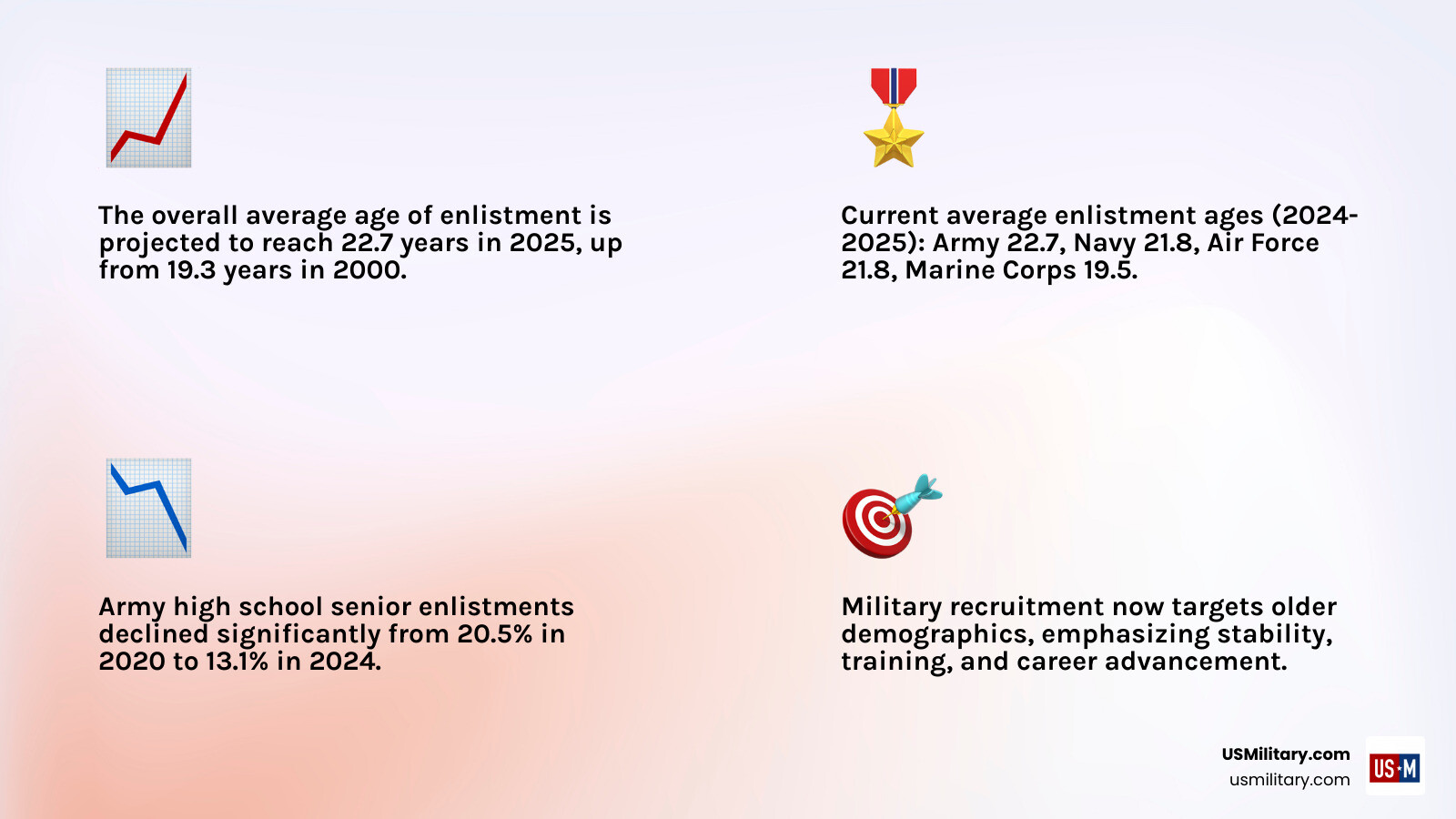
The average age of enlistment in the U.S. military has been steadily rising, shifting from traditional post-high school recruitment to a broader demographic. Here’s what you need to know:
Current Average Enlistment Ages by Branch (2024-2025):
- Army: 22.7 years old (up from 21.4 in 2020)
- Navy: 21.8 years old (up from 21.2 in 2020)
- Air Force: 21.8 years old (up from 21.2 in 2020)
- Marine Corps: 19.5 years old (consistently the youngest)
Overall Average: Approximately 20-22 years across all branches, with a notable upward trend.
Doniel Kennedy graduated from Texas State University in 2021 with big plans for a videography career. After getting laid off, he enlisted in the Army at age 26—a decision that reflects a growing trend in military recruitment.
The face of military enlistment is changing. Gone are the days when the military was almost exclusively an 18-year-old’s first step after high school. Today’s recruits are older, more educated, and often bring valuable life experience to their service.
This shift didn’t happen overnight. Since the pandemic, military branches have struggled to meet recruiting goals. The percentage of Army recruits enlisting during their senior year of high school dropped from 20.5% in 2020 to just 13.1% in 2024. Meanwhile, the military has adapted its message—moving from appeals to adventure for teens to emphasizing stability, training, and career advancement for those in their mid-20s.
Whether you’re 18 or 35, understanding these age demographics can help you determine if military service fits your life stage and goals.
The Changing Demographics: A Rising Average Age of Enlistment
We’ve observed a significant shift in who is joining the U.S. military. For years, the image of a fresh-faced 18-year-old stepping off the bus for basic training was almost iconic. While those eager young recruits are still very much a part of our force, the landscape is evolving. Today, the average age of enlistment is notably higher, reflecting broader societal changes and strategic adaptations by military recruiters.
The period following the pandemic brought considerable challenges to military recruiting across all services. The Army, for instance, along with most of its reserve components, faced difficulties in meeting its recruiting goals. This slump prompted a re-evaluation of recruiting strategies and a broader outreach to different demographics.
A key indicator of this shift is the declining number of high school seniors opting to enlist immediately after graduation. For the Army, the percentage of recruits signing up during their senior year of high school plummeted from 20.5% in 2020 to 13.1% in 2024. The Navy experienced a similar trend, with high school seniors making up 30% of enlistees in 2020, dropping to 21% in 2024. This means fewer individuals are choosing military service as their direct path out of high school.
In response, recruiting messages have become more custom, particularly to an older demographic. For individuals in their mid-20s, who might be married or have children, the appeal often shifts from the thrill of adventure to the promise of stability, valuable training, and clear paths for career advancement. These are compelling benefits for those seeking a secure future, especially after navigating the uncertainties of the civilian job market.
What is the average age of enlistment by branch?
The average age of enlistment varies across the different branches of the U.S. military, reflecting each service’s unique needs and recruiting strategies. Let’s break down the latest figures:
- Army: The Army has seen its average recruit age steadily climb. In 2020, the average was 21.4 years old, projected to rise to 22.7 years old by 2025. This makes the Army one of the branches attracting a slightly older demographic.
- Navy: Similar to the Air Force, the Navy’s average age of recruits moved from 21.2 in 2020 to 21.8 years old in 2024.
- Air Force: The Air Force’s average recruit age has also increased, moving from 21.2 in 2020 to 21.8 years old in 2024.
- Marine Corps: Consistently, the Marine Corps enlists the youngest recruits. Over the past five years, their average has hovered just over 19.5 years old, with more than 40% of recruits signing their contract while still seniors in high school. In FY 2000, their average was 18.5, and in FY 2004, it was 19.1, indicating a consistent trend of younger enlistees compared to other branches.
- Coast Guard: While specific average enlistment age data for the Coast Guard is less frequently published alongside the other branches, we know their active duty enlistees typically fall within the 18-27 age range, though the maximum age can go up to 31 for active duty and 39 for the Reserve.
Looking back, the overall average age of enlisted accessions in FY 2000 was 19.3 years, increasing slightly to 20.1 years in FY 2004. These historical figures underscore the ongoing upward trend we’re observing today.
Why is the average age of enlistment increasing?
Several interconnected factors are contributing to the rising average age of enlistment across the U.S. military:
- Decline in High School Senior Enlistments: As noted earlier, fewer high school seniors are choosing to enlist right after graduation. This demographic shift means recruiters must look to older populations to fill quotas.
- Changing Civilian Job Market: The civilian job market, especially post-pandemic, has been dynamic. Some individuals, like Doniel Kennedy, may find themselves laid off or seeking more stability and benefits than their current civilian roles offer. The military presents a compelling alternative with guaranteed employment, training, and comprehensive benefits.
- Decreased College Enrollment: While not a direct cause, the trend of decreasing college enrollment since its peak in 2010 (21 million students down to 19.2 million) means more young adults might be exploring pathways other than higher education. This creates a larger pool of potential recruits who are slightly older than traditional high school graduates but haven’t committed to a four-year college path.
- Custom Recruiting Messages for Older Candidates: Recruiters are actively tailoring their messages to resonate with older potential enlistees. Instead of focusing solely on adventure, they highlight the military’s robust training programs, opportunities for career advancement, and the stability that comes with service. For those in their mid-20s, perhaps with families, these benefits are particularly attractive.
- Increase in Dependency Waivers: An interesting statistic reflecting the older demographic is the rise in dependency waivers. These waivers are often requested by individuals who have dependents (like children) and traditionally might have been less likely to enlist. For the Army, the number of dependency waivers nearly doubled from 487 in 2020 to 840 in 2024. This indicates that more individuals with family responsibilities are choosing to serve.
- Youth Disconnection and Unfitness: Studies reveal a growing number of young Americans are unfit for military service due to factors like being overweight, drug use, or medical conditions. Additionally, some reports suggest youth are increasingly disconnected and less familiar with military service, partly due to a declining veteran population and a smaller military footprint in daily life. This scarcity of eligible and interested younger recruits naturally leads the military to seek out older, more qualified candidates.
These factors collectively paint a picture of a military that is adapting its recruitment strategies to a changing society, resulting in a higher average age of enlistment.
How does recruit age compare to the civilian population?
When we look at the age distribution of military recruits, it stands in stark contrast to the general civilian population, especially for young adults.
Historically, a significant concentration of new recruits falls within the 18-24 age range. For example, in both FY 2000 and FY 2004, approximately 87% of new recruits were 18- to 24-year-olds. This is a remarkably high concentration when compared to the civilian population of the same age group, where only about 36% (FY 2000) to 37% (FY 2004) fall within that bracket. This highlights that while the overall average age of enlistment is rising, the military still draws heavily from this younger adult demographic, albeit less exclusively than in the past.
The enlistment rate also shows a clear preference for younger individuals, even within this narrow age band. In FY 2000, roughly 15.5 of every 1,000 18-year-olds enlisted, compared to only 1.2 of every 1,000 24-year-olds. A similar trend was observed in FY 2004, with 13.3 of every 1,000 18-year-olds enlisting versus 1.4 of every 1,000 24-year-olds. This tells us that while the military is increasingly welcoming older recruits, the propensity to enlist is still highest immediately after high school.
For a broader perspective on the demographics of our active-duty members, including average ages across the entire force, we can consult official reports. The 2023 Demographics Profile of the Military Community indicates that the average age of all active-duty enlisted personnel is 27.4 years, and for officers, it’s 34.3 years. While these figures represent the average age of those serving (which naturally includes many who enlisted years ago), they provide context for the overall age structure of the force.
Enlistment Age Brackets: Minimums, Maximums, and Waivers
Navigating the age requirements for military service can sometimes feel a bit like trying to hit a moving target, but we’re here to clarify. The legal framework provides a general window, but specific branches and roles have their own nuances.
By law, Active Component recruits in the U.S. military must be between 17 and 35 years old. For those eager to serve at 17, parental permission is a mandatory requirement. This general window is often perceived as much narrower, leading many to believe they’ve missed their chance if they don’t enlist right out of high school. However, as we’ve seen, the reality is far more flexible.
✉ Get updates like this in your inbox
Weekly VA benefit changes, pay updates, and money tips for service members, veterans, and military families. Free, no spam.
Maximum Enlistment Age Limits by Branch
While the 17-35 range is a general guideline for active component enlistment, each branch has its own specific maximum age limits, which can sometimes be extended through waivers for qualified candidates. Here’s a breakdown of the typical maximum ages for active duty enlistment:
| Branch | Maximum Enlistment Age (Active Duty) |
|---|---|
| Army | 35 |
| Navy | 39 |
| Air Force | 39 |
| Marine Corps | 29 |
| Coast Guard | 27 (up to 31 for active duty, 39 for Reserve) |
Note: These are general guidelines, and specific situations or specialized programs may have different age requirements or waiver possibilities.
It’s clear that if you’re considering the Marine Corps or Coast Guard, the window closes a bit sooner than for the other branches. However, the Army, Navy, and Air Force offer opportunities well into one’s thirties.
Age Waivers for Older and Specialized Recruits
We often hear questions like, “Am I too old?” The answer, more often than not, is “not necessarily!” The military recognizes that maturity, life experience, and specialized skills are incredibly valuable assets. This is where age waivers come into play.
Age waivers are granted on a case-by-case basis for highly qualified candidates. If you possess valuable life, cultural, or work skills that are particularly useful to the military—especially for specialized units—you might be eligible for a waiver that allows you to enlist beyond the standard age limits. This means that if you’re a little older but bring something unique to the table, your age might not be a barrier.
This flexibility is particularly evident in Special Operations programs, which often have their own specific age limits, but also mechanisms for waivers. For example:
- Navy SEALs: While the general age range for civilians without waivers is 17-28, officers can enter the SEAL program up to age 42. We’ve seen numerous highly qualified applicants in their 30s successfully selected for SEAL training.
- Army Special Forces: The training pipeline generally has an age range of 20-36, but waivers are possible based on an individual’s qualifications.
- Air Force Special Warfare (e.g., Pararescue, Combat Controller): Some of these demanding roles have an age limit of 39.
- Army Rangers: The selection and Ranger School have an age range of 17-34. Interestingly, while age waivers are available for Ranger School, there is no age waiver process for candidates wishing to join the elite 75th Ranger Regiment itself.
So, if you’re an older candidate with a strong resume of life experience, an education, or specific skills, don’t let age be the first thing that stops you. Connect with a recruiter to discuss your unique situation and the possibility of an age waiver.
Weighing Your Options: Enlisting Younger vs. Older
Deciding when to enlist is a deeply personal choice, and frankly, there’s no single “best” age. The military welcomes individuals from a broad spectrum of ages, each bringing their own strengths and perspectives. It’s about balancing factors like physical readiness, life experience, and personal goals.
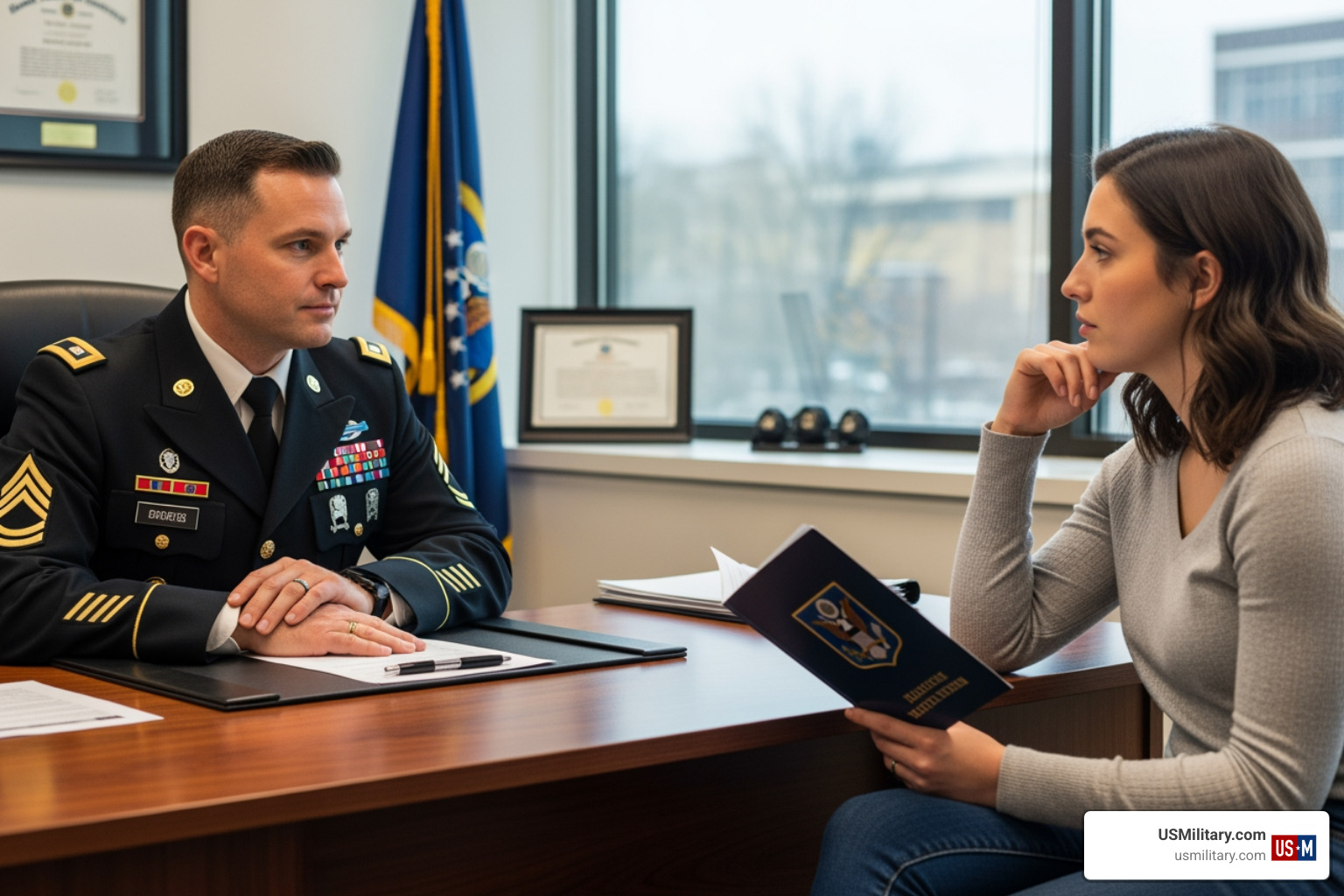
We understand that some might worry about being the “old man” or “old woman” in basic training, but the reality is that training groups are increasingly diverse in age. Sgt. Cody Kirkpatrick, who enlisted directly out of high school at 21, observed the presence of older trainees in his boot camp, noting that younger recruits often struggled more with homesickness. This diversity creates a richer training environment where different age groups can support and learn from each other.
Advantages of Joining Young (18-21)
Enlisting at a younger age, typically right out of high school, offers several distinct advantages that can set you up for a long and successful military career:
- Starting a Career Early: You get a head start on your military career, gaining valuable experience and building a foundation for your future sooner than many of your peers.
- Physical Resilience: Generally, younger individuals tend to be at their peak physical condition, which can make adapting to the rigors of basic training and subsequent physical demands of military life a bit easier.
- Rising Through the Ranks: Starting early means more time in service, providing ample opportunity to advance through the ranks, take on leadership roles, and build a distinguished career.
- Earlier Retirement Benefits: One of the most attractive aspects of military service is the retirement system. Enlisting young means you can complete your required service years sooner, potentially retiring with benefits in your late 30s or early 40s, opening up a “second career” opportunity.
- Fewer Family Obligations: Typically, younger recruits have fewer family responsibilities, which can make the initial transition to military life, deployments, and frequent moves less complicated.
Benefits of Enlisting with More Life Experience (22+)
While there are clear benefits to joining young, enlisting with more life experience, perhaps after some college or civilian work, brings its own set of significant advantages:
- Maturity and Discipline: Older recruits often bring a higher level of maturity, self-discipline, and a clearer sense of purpose. This can translate to better performance in basic training and a more focused approach to military duties. Research suggests that older recruits tend to perform better in basic training and their first enlistment.
- Leadership Potential: Life and work experience can equip you with leadership qualities, problem-solving skills, and a broader perspective that can be highly valued in military teams. Beth Asch, a military researcher, emphasizes that maturity, the ability to get along, and to follow instructions accurately and timely are crucial for success, qualities often honed with age.
- Handling Stress: Having steerd various life challenges and responsibilities, older recruits may be better equipped to handle the stresses and demands of military service. Doniel Kennedy, who enlisted at 26, reflected that his decision to join later gave him “more perspective, thicker skin, and better adaptability” to the military environment.
- Bringing Prior College or Work Experience: Many older recruits come with college degrees or valuable work experience. This can be a significant asset, potentially qualifying you for specific job roles, higher entry ranks, or even officer programs. For instance, a soldier with an associate’s degree who enlisted at 24 later became a commissioned officer.
- Clearer Career Goals: Often, those who enlist later have a more defined understanding of their career aspirations and what they hope to gain from military service. They might be seeking stability, specific training, or a path to a better life for their families, as exemplified by a 33-year-old mother who reenlisted for better schooling and housing for her children, or a 40-year-old father who sought a stable job with benefits.
The military values both the fresh energy of youth and the seasoned perspective of older recruits. Your journey is unique, and the “right” age is when you feel ready and committed.
Frequently Asked Questions about Military Enlistment Age
We often hear similar questions from individuals considering military service, particularly concerning age. Let’s tackle some of the most common ones.
What percentage of new recruits are between 18 and 24 years old?
Despite the rising average age of enlistment, the 18-24 age bracket remains a dominant demographic for new recruits. Historically, approximately 87% of new enlistees have fallen within this age range. This is a significantly higher concentration compared to the general civilian population, where only about 36-37% are in this age group.
So, while we’re seeing more older recruits, the military still heavily draws from this younger adult pool. If you’re in this age range, you’ll be among the majority of your peers when you enlist.
Am I too old to join a Special Operations unit?
This is a fantastic question, and one we hear often! The short answer is: possibly not, but it depends on the specific program and your qualifications. While Special Operations units are incredibly demanding and often have lower age limits than general enlistment, there’s often flexibility for exceptional candidates.
Here are some examples of age limits for specific Special Operations programs:
- Navy SEALs: For civilians without waivers, the age limit is typically 28. However, officers can enter the SEAL program up to age 42. We’ve seen highly qualified applicants in their 30s successfully selected.
- Army Special Forces: The training pipeline generally accepts candidates aged 20-36, with waivers possible based on qualifications.
- Air Force Special Warfare (e.g., Pararescue, Combat Controller): For some of these roles, the age limit can be up to 39.
- Army Rangers: The selection and Ranger School have an age range of 17-34, but Army Rangers can begin training at 41.
The key takeaway here is that age waivers are a possibility for many Special Operations roles. If you have exceptional physical fitness, relevant skills, prior military experience, or a valuable educational background, recruiters may be able to secure an age waiver for you. It will require extra effort on your part and with your recruiter, but it’s definitely worth exploring if it’s a dream of yours.
Does having a college degree affect my enlistment?
Absolutely! Having a college degree can significantly affect your enlistment in a positive way. In fact, it’s a contributing factor to the trend of older, more educated recruits joining the military.
Here’s how a college degree can be an advantage:
- Higher Entry Rank: Depending on the branch and your degree, you may qualify for a higher rank upon entry as an enlisted member, meaning you start with better pay and more responsibility.
- Officer Programs: A college degree is typically a prerequisite for commissioning as an officer. If you have a bachelor’s degree, you can explore Officer Candidate School (OCS) or similar programs, which lead to leadership roles and a different career path than enlisted service.
- Specialized Roles: Many military occupational specialties (MOS) or job roles benefit from, or even require, specific educational backgrounds. Your degree could open doors to more technical or specialized positions.
- Maturity and Skills: Beyond the piece of paper, a college education often comes with improved critical thinking, problem-solving, and communication skills, all of which are highly valued in the military.
The military actively seeks out educated individuals, recognizing the intellectual capital they bring to the force. So, if you’re a college graduate considering service, you’re in a great position to explore various opportunities.
Is Military Service the Right Path for You?
As we’ve explored, the window for military enlistment is far more like a barn door than a small window, accommodating a wide range of ages and backgrounds. The average age of enlistment is on the rise, reflecting a military that values not only youthful energy but also the maturity, diverse skill sets, and life experience that older recruits bring to the table.
The “right” age to join the military is a deeply personal decision. It’s when you are physically and mentally ready, and when your personal goals align with the unique challenges and rewards that military service offers. Whether you’re 18 with a clear vision or 35 with a wealth of life experience, your journey into service can be incredibly fulfilling.
We encourage you to consider all your options, speak with recruiters, and explore the vast resources available to help you make an informed decision. To dig deeper into specific age limits and requirements, we invite you to Learn more about the age limits to join the military on our website. USMilitary.com is dedicated to providing comprehensive information and guidance for all who consider serving our nation.
Free for Service Members & Veterans
Get the military benefits intel no one tells you about.
Weekly updates on VA benefits, pay changes, and money tips — free for service members and veterans.
No spam. Unsubscribe anytime. Your info is never shared.