Understanding the Age Limit to Join Military Service
The age limit to join military service is one of the first questions potential recruits ask, and for good reason—it determines whether your window of opportunity is open or closed. Here’s what you need to know right away:
Quick Answer: Military Age Limits by Branch
| Branch | Minimum Age | Maximum Age (Active Duty) |
|---|---|---|
| Army | 17 | 35 |
| Navy | 17 | 41 |
| Air Force | 17 | 42 |
| Marine Corps | 17 | 28 |
| Coast Guard | 17 | 41 |
| Space Force | 17 | 42 |
Note: 17-year-olds require parental consent. Limits vary for Reserve/National Guard and officer programs.
The good news? The age window is much wider than most people think. Many assume military service is only for recent high school graduates, but the reality is far different. Depending on which branch you choose and whether you’re enlisting or pursuing an officer commission, you could have anywhere from a decade to more than two decades to make your decision.
Age requirements also differ significantly between active duty, Reserve components, and the National Guard. Some branches accept recruits well into their early 40s, and the National Guard allows original enlistments up to age 45. Waivers can extend these limits even further for qualified candidates with prior service or specialized skills.
I’m Larry Fowler, publisher of USMilitary.com, and since 2007 I’ve helped hundreds of thousands of service members, veterans, and their families steer critical military decisions—including understanding age limit to join military requirements across all branches. My team and I maintain the most current eligibility information to ensure you have accurate answers when exploring your service options.
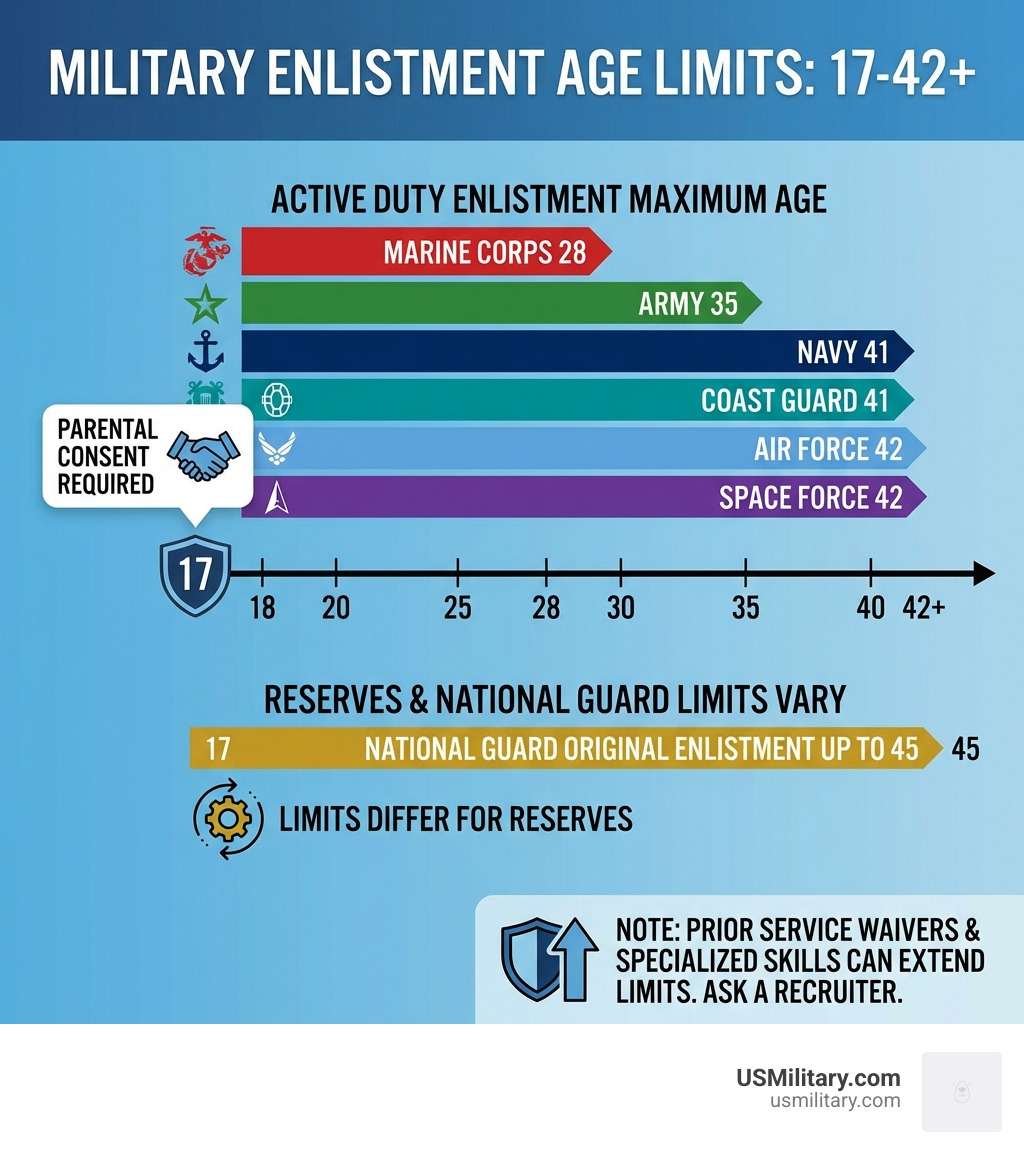
Military Enlistment Age Requirements by Branch
When considering joining the U.S. military, understanding the specific age requirements for each branch is crucial. While the minimum age to enlist is fairly consistent, the maximum age can vary significantly, opening up more opportunities than many might expect. Let’s explore the details for active duty, Reserves, and the National Guard.
Active Duty Enlistment Age Limits
The minimum age to enlist in any branch of the U.S. military for active duty is 17 years old. However, for those under 18, parental or legal guardian consent is absolutely required. Think of it as needing a co-signer for your commitment to serve our nation!
The maximum age limit to join military active duty service varies quite a bit across the different branches, reflecting their unique missions and demands. Here’s a breakdown:
| Branch | Minimum Age | Maximum Age (Active Duty) | Source |
|---|---|---|---|
| Army | 17 | 35 | The active duty ages for the U.S. Army are between 17-35 years old. |
| Navy | 17 | 41 | The active duty ages for the U.S. Navy are between 17-41 years old. |
| Air Force | 17 | 42 | The active duty ages for the U.S. Air Force are between 17-42 years old. |
| Marine Corps | 17 | 28 | The active duty ages for the U.S. Marine Corps are between 17-28 years old. |
| Coast Guard | 17 | 41 | The active duty ages for the U.S. Coast Guard are between 17-41 years old. |
| Space Force | 17 | 42 | The active duty ages for the U.S. Space Force are between 17-42 years old. |
As you can see, the maximum age for active duty enlistment ranges from 28 for the Marine Corps, which typically seeks younger recruits for its physically demanding roles, all the way up to 42 for the Air Force and Space Force. The Navy notably raised its maximum enlistment age from 39 to 41 in November 2022, a strategic move to broaden its recruiting pool amidst challenging environments. This change made the Navy willing to take some of the oldest recruits among the branches.
Reserve and National Guard Age Limits
If you’re interested in serving part-time, the age limits for joining the Reserves or National Guard often offer a bit more flexibility. This can be a fantastic option for individuals who want to serve their country while maintaining civilian careers or pursuing higher education.
For the National Guard, the federal law specifies that a person must be at least 17 years of age and under 45 for original enlistment. Interestingly, if you’re a former member of the Regular Army, Navy, Air Force, or Marine Corps, you might be eligible to enlist in the National Guard even if you’re under 64 years of age. For reenlistment in the National Guard, the age limit extends to under 64 years old. You can find more details on these specific age limitations in the U.S. Code 32 USC 313: Appointments and enlistments: age limitations.
The Reserve components of each branch also have their own age guidelines:
- Army Reserve: Generally aligns with active duty at 17-35 years old.
- Navy Reserve: Generally 17-41 years old.
- Air Force Reserve: Typically follows the active duty Air Force age range, up to 42.
- Marine Corps Reserve: Similar to active duty, usually 17-28 years old.
- Coast Guard Reserve: Generally 17-40 years old.
These extended age limits for Reserve and National Guard service acknowledge that individuals may develop valuable skills and experience in their civilian lives that are highly beneficial to military readiness. If you’re interested in part-time service, we highly recommend exploring opportunities, and you can find more information about Army Reserve services by visiting a local recruiting station.
Understanding the Age Limit to Join Military Officer Programs

Becoming an officer in the U.S. military is a distinct path from enlisted service, and it comes with its own set of age requirements, typically involving a four-year degree. Officers are the leaders, strategists, and decision-makers, and the selection process reflects the high level of responsibility they undertake.
General Requirements for Commissioning
To become a commissioned officer, the primary route involves earning a four-year college degree. From there, you can pursue commissioning through several avenues:
- Officer Candidate School (OCS) / Officer Training School (OTS): These programs are for college graduates who wish to commission directly into an officer role.
- Reserve Officers’ Training Corps (ROTC): Offered at many colleges and universities, ROTC allows you to earn your degree and commission simultaneously.
- Service Academies: Prestigious institutions like West Point (Army), Annapolis (Navy), and the Air Force Academy provide a full scholarship in exchange for a service commitment upon graduation and commissioning.
These paths emphasize leadership roles, academic achievement, and a strong sense of duty. You can learn how to join as an officer and explore these options further.
Officer Age Limits by Branch
Officer age limits can be a bit stricter than those for enlisted personnel, and they also vary by branch and even by specific program. This is because the military wants to ensure officers have a sufficient career span to justify the significant investment in their training and development.
Here’s a general overview of maximum age limits for commissioned officers:
- Army: Up to 35 years old.
- Navy: Up to 29 years old.
- Air Force: Up to 28 years old.
- Marine Corps: Up to 28 years old.
- Coast Guard: Up to 27 years old.
However, there are important exceptions! For specialized roles, particularly in medical fields (doctors, nurses), legal professions (JAG), or as chaplain candidates, the age limits can be significantly higher. These roles often require extensive prior education and professional experience, making older, qualified candidates highly valuable. For instance, the Department of Defense Instruction states that the maximum age qualification for initial appointment as a Reserve Officer will not be less than 47 years of age for individuals in a health profession specialty designated as critically needed in wartime.
If you’re considering the officer path, especially for a specialized field, it’s always best to speak directly with a recruiter for the most current and program-specific information. We also have more info about military scholarships that can help you achieve your educational goals on the path to becoming an officer.
Age Waivers and Special Considerations

While the U.S. military branches have established age limits, it’s important to understand that these are not always hard and fast rules set in stone. The military is a dynamic organization, and sometimes, for the right candidate, exceptions can be made. This is where age waivers come into play, along with other special considerations like prior service and specific job roles.
Can You Get an Age Waiver?
Yes, age waivers are a possibility, but they are generally granted on a case-by-case basis. Think of it like this: if you’re an exceptionally qualified candidate who brings unique skills or experiences that the military desperately needs, they might be willing to bend the age rule a little. It’s not a guarantee, but it’s definitely worth exploring if you’re just outside the standard limits.
When considering a waiver, the military often employs a “whole person” concept. This means they look at your entire profile, not just your age. Factors that can positively influence a waiver decision include:
- High-demand skills: Do you have specialized skills in cyber warfare, linguistics, or a particular technical field that is critical to national security?
- Exceptional ASVAB scores: A high score on the Armed Services Vocational Aptitude Battery (ASVAB) demonstrates strong aptitude and trainability.
- Outstanding physical fitness: Proving you can meet and exceed the rigorous physical fitness standards for your desired branch is crucial, especially for older applicants.
- Clean record: A strong moral character, free from criminal history or significant moral waivers, always helps.
Waivers are not automatic. They require extra effort, typically involving more paperwork and a thorough review process. But for those with a genuine desire to serve and a strong qualification profile, it’s a door that might open. You can find more waiver information and eligibility details on our site.
How Prior Service Affects the Age Limit to Join Military Branches
If you’ve previously served in any branch of the U.S. military, your prior service can significantly impact the maximum age limit to join military service again, either through reenlistment in your original branch or by joining a different one. This is one of the most common and impactful exceptions to standard age rules.
Generally, for individuals with prior service, the maximum age for reenlistment or joining a new branch is calculated differently. Instead of simply looking at your current age, your years of previous active duty service can be subtracted from your age to determine eligibility. For example, if a branch has a maximum age of 35 for new recruits, but you have 5 years of prior service, you might be eligible up to age 40 (35 + 5 years). This allows experienced veterans to continue their service or transition to new roles within the military structure.
This flexibility acknowledges the invaluable experience, training, and discipline that prior service members bring to the force. They often require less initial training and can be immediately effective. So, if you’re a veteran considering a return to service, don’t let the standard age limits deter you—your prior service could be your golden ticket. And while you’re exploring your options, remember to check out more info about VA home loans and other benefits you’ve earned.
Age Limits for Special Programs
Beyond general enlistment, certain specialized military roles and programs have their own unique age limits, which can sometimes be more stringent or, in specific cases, more flexible. These programs often demand exceptional physical, mental, and technical capabilities.
Here are some examples of age limits for special programs:
- Special Operations Forces (SOF): Elite units like the Navy SEALs, Army Special Forces, Army Rangers, Marine Reconnaissance, and Air Force Special Warfare often have lower maximum age limits for initial entry.
- Navy SEALs: For civilians, the age range is typically 17-28 years old without waivers. However, officers can enter the SEAL program up to the age of 42, though selection is highly competitive.
- Army Special Forces: The age range for joining and attending the Special Forces training pipeline is typically 20-36.
- Army Rangers: You can join and attend Ranger selection and Ranger School between 17-34 years old, with waivers possible for Ranger School on a case-by-case basis.
- Air Force Special Warfare (Pararescue, Combat Controller): Some roles may have age limits around 39 before a waiver is needed.
- Marine Reconnaissance: Typically 17-28, but waivers might be granted.
- Marine Raiders (MARSOC): Doesn’t have a specific age limit for Marines attending the Assessment and Selection phase, focusing more on overall qualifications.
- Coast Guard’s Deployable Specialized Forces (DSF): Applicants generally need to be between 20 and 34, with waivers possible.
- Medical Fields: As mentioned earlier, roles requiring advanced medical degrees (doctors, dentists, nurses) often have significantly higher age limits, sometimes into the late 40s or even early 50s, due to the critical need for their expertise.
- Cyber Warfare/Intelligence: Certain highly technical roles that demand specialized civilian experience might also allow for older entry, prioritizing expertise over youth.
Age waivers for these special programs are possible, but they are typically more difficult to obtain and require an even stronger justification based on your qualifications and the military’s specific needs. It truly is about what unique value you bring to the table. For a comprehensive look, we have a dedicated guide on the Age Ranges for Joining US Military Special Operations.
The Evolution of Military Age Policies
Military age requirements are far from static; they are dynamic policies that adapt to the nation’s strategic needs, demographic shifts, and the ever-present challenges of recruitment. Understanding this evolution helps us appreciate why certain limits exist and how they might change in the future.
Why Age Limits Exist
At its core, the age limit to join military service exists for several very practical and important reasons:
- Physical Demands: Military service, especially in combat roles, is incredibly physically demanding. Younger individuals generally have higher levels of physical endurance, faster recovery times, and fewer pre-existing medical conditions, which are crucial for the rigors of basic training and active duty.
- Training Investment: The military invests significantly in training each recruit. By enlisting individuals at a younger age, there’s a greater likelihood of a longer career span, allowing the military to maximize its return on that training investment. It ensures a servicemember can complete multiple tours and potentially move into leadership roles.
- Career Progression: Age limits facilitate a natural career progression pipeline, ensuring a steady flow of experienced personnel moving up the ranks and a fresh influx of new recruits.
- Ensuring a Ready Force: Age limits contribute to maintaining a highly capable and ready fighting force. The goal is to ensure that personnel are physically and mentally prepared to meet the challenges of military operations worldwide.
- Medical Readiness: As people age, the likelihood of developing medical conditions increases. Stricter age limits help manage the overall medical profile of the force and reduce the incidence of conditions that could lead to medical discharge or limit deployability. The Department of Defense Instruction on Qualification Standards provides a comprehensive look at all these factors.
Recent Changes and Recruiting Trends
Military age requirements are not just about physical fitness; they are also a reflection of the national recruiting landscape. Over time, these limits have been adjusted in response to various factors.
Historically, age limits were often lower, reflecting different military needs and societal norms. However, in recent decades, we’ve seen a trend towards slightly higher maximum age limits in some branches, largely driven by recruiting challenges and the recognition that older recruits can bring valuable life experience and maturity.
One of the most notable recent changes was the Navy’s decision in November 2022 to raise its maximum enlistment age from 39 to 41. This move was a direct response to a “challenging recruiting environment” where all branches have struggled to meet their goals. As one military outlet noted, the Navy implemented this change to “allow more civilians to join its ranks.” The Army also missed its recruitment goals, and while the Marine Corps met its targets, it noted it was “preparing for a ‘challenging 2023.'”
These adjustments highlight a strategic shift. While youth and physical prowess remain important, the military is increasingly open to attracting experienced professionals and individuals with diverse backgrounds to fill critical roles. The demands of modern warfare, particularly in areas like cyber warfare, intelligence, and specialized technical fields, sometimes prioritize intellectual maturity and civilian-acquired skills over sheer youth. This also ties into the broader discussion of military jobs and how those skills can transfer to civilian jobs after service.
The ongoing recruiting challenges, coupled with new medical screenings that can access more comprehensive medical histories, mean that while age limits might be higher, the physical and medical requirements for older recruits are often scrutinized more closely.
Frequently Asked Questions about Military Age Limits
We understand that the nuances of military age requirements can be confusing. Here are answers to some of the most common questions we receive about the age limit to join military service.
What is the absolute minimum age to join the military?
The absolute minimum age to join any branch of the U.S. military is 17 years old. However, there’s a critical caveat: no one can sign a contract and begin their service until they are 17 years old and have explicit, written consent from a parent or legal guardian. This means you cannot enlist before your 17th birthday. This parental consent ensures that young recruits have the support and understanding of their families as they start on this significant life decision.
Can I join the military at 45 years old?
For initial enlistment into active duty, directly joining at 45 years old is generally not possible, as most active duty branches have maximum age limits ranging from 28 to 42. However, there are important exceptions and alternative paths:
- National Guard: Under federal law, the National Guard allows for original enlistments up to age 45. This means a non-prior service individual who is 45 could potentially join the National Guard.
- Prior Service: If you have prior military service, you may be eligible to join a new branch or reenlist at an older age. Your years of previous service can often be added to the standard maximum age limit, effectively extending your eligibility. This is evaluated on a case-by-case basis and depends on the specific needs of the branch.
- Officer Programs (Specialized Fields): For highly specialized officer roles, particularly in medical, legal, or chaplain fields, age limits can extend significantly higher, sometimes into the late 40s or even early 50s, due to the demand for experienced professionals.
So, while active duty enlistment at 45 is unlikely without prior service, other avenues might still be open to you.
Is it harder to join the military if you’re older?
It can be harder to join the military if you’re older, but it’s certainly not impossible. While older recruits often bring valuable life experience, maturity, and sometimes specialized skills, they also face stricter medical screenings. As people age, they are more likely to have developed medical conditions that could be disqualifying. Additionally, older recruits must meet the same rigorous physical fitness standards as younger recruits. This means you need to be in excellent physical shape to qualify.
However, the military is increasingly recognizing the value of older, qualified candidates, especially given current recruiting challenges. Branches are more open to considering applicants who demonstrate exceptional fitness, strong academic or professional backgrounds, and a genuine commitment to service, even if they are at the higher end of the age spectrum. The key is to be proactive, ensure you’re in peak physical condition, and be prepared for a thorough medical evaluation.
Conclusion
Navigating the age limit to join military service can feel like a maze, but as we’ve explored, it’s often more flexible than many initially believe. The key takeaways are clear: age limits vary significantly by branch, whether you’re looking at active duty, the Reserves, or the National Guard, and between enlisted and officer paths. While the minimum age is consistently 17 (with parental consent), maximum ages span a wide range, often extending into the early 40s for some branches.
Crucially, waivers are a real possibility for exceptionally qualified individuals, especially those with prior military service or in-demand skills. Your past service can open doors for reenlistment or even cross-branch transfers at older ages.
The best first step is always to speak with a recruiter from your desired branch. They are the experts who can provide the most current, personalized information based on your unique qualifications, goals, and any potential waivers you might need. Don’t let perceived age barriers stop you from exploring a fulfilling career in military service.
For more resources and to connect with professionals who can guide you, explore USMilitary.com. You can also find a military recruiting station near you to start your journey today.
Free for Service Members & Veterans
Get the military benefits intel no one tells you about.
Weekly updates on VA benefits, pay changes, and money tips — free for service members and veterans.
No spam. Unsubscribe anytime. Your info is never shared.


