ROP Arizona Congressman Eli Crane Wins Reelection Amid the Blue Wave

Republican Rep. Eli Crane successfully won reelection in Arizona’s 2nd Congressional District, fending off a fierce challenge from Democrat Jonathan Nez by fewer than 4,000 votes. When the final tallies were certified across northern and eastern Arizona, Crane won 49.7% of the total ballots cast, compared with Nez’s 48.5%, and held on to a narrow 1.2-point lead. The result marked an extraordinarily tight rematch compared to the 2024 general election cycle, when Crane defeated Nez by a commanding nine-point margin.
Crane, a decorated combat veteran who served multiple deployments as a Navy SEAL, held his seat even as Democrats made significant inroads across other competitive regions of Arizona. Widespread public concerns about rising household costs, persistent inflation, national defense priorities, and expanding U.S. military involvement in the overseas conflict with Iran created a turbulent political backdrop throughout the campaign.
I’m Larry Fowler, a Navy veteran and proud graduate of BUD/S Class 89. As someone who walked the Naval Special Warfare path and remains dedicated to supporting our service community, I offer my support and congratulations to Eli, his family and staff, and above all, the people in Arizona.
How Arizona Congressman Eli Crane Wins Reelection By 4,000 Votes in a Tight Rematch
The contest for Arizona’s 2nd Congressional District became one of the country’s most closely watched congressional races during the November 2026 midterm elections. After Election Day, election officials spent nearly a full week painstakingly tabulating ballots across expansive rural counties, tribal lands, and high-desert communities before major news networks and the Associated Press officially declared Crane the winner. The nail-biting finish made it one of the tightest, most hard-fought federal showdowns in recent Southwestern political history.
| Election Year | Eli Crane (R) Vote Share | Jonathan Nez (D) Vote Share | Victory Margin |
|---|---|---|---|
| 2024 | ~54.0% | ~45.0% | +9.0% (~34,000 votes) |
| 2026 | 49.7% | 48.5% | +1.2% (3,834 votes) |
The final certified vote counts illustrate the razor-thin margin separating the two campaigns. Crane secured 49.7% of all valid votes, while Nez captured 48.5%, leaving a separation of just 3,834 votes out of hundreds of thousands cast. Detailed reports on how U.S. Rep. Eli Crane narrowly wins reelection, survives challenge from Nez emphasized that ballot processing took days due to the sheer size of the district, complex geography, and the high volume of late-arriving early ballots delivered on Election Day across remote precincts.
Why Arizona Congressman Eli Crane Wins Reelection By 4,000 Votes Over Jonathan Nez
Arizona’s 2nd Congressional District covers a sprawling, diverse geographic area that stretches from conservative bastions in Prescott and the Verde Valley, up through the mountain hub of Flagstaff, and across vast stretches of the Navajo Nation and Hopi Reservation. Successfully campaigning in this massive territory requires a candidate to build a coalition that balances rural conservative communities, suburban independents, and sovereign tribal nations.
Jonathan Nez, former president of the Navajo Nation, mounted an aggressive grassroots operation that generated historic turnout in Native American communities. Nez built substantial leads in Apache County and heavily populated portions of Coconino County. However, Crane effectively counterbalanced those Democratic margins by unleashing powerful voter mobilization efforts in Yavapai County, rural Gila County, and outlying conservative ranching communities across northern Arizona. That rural ground game provided Crane with just enough cushion to cross the finish line.
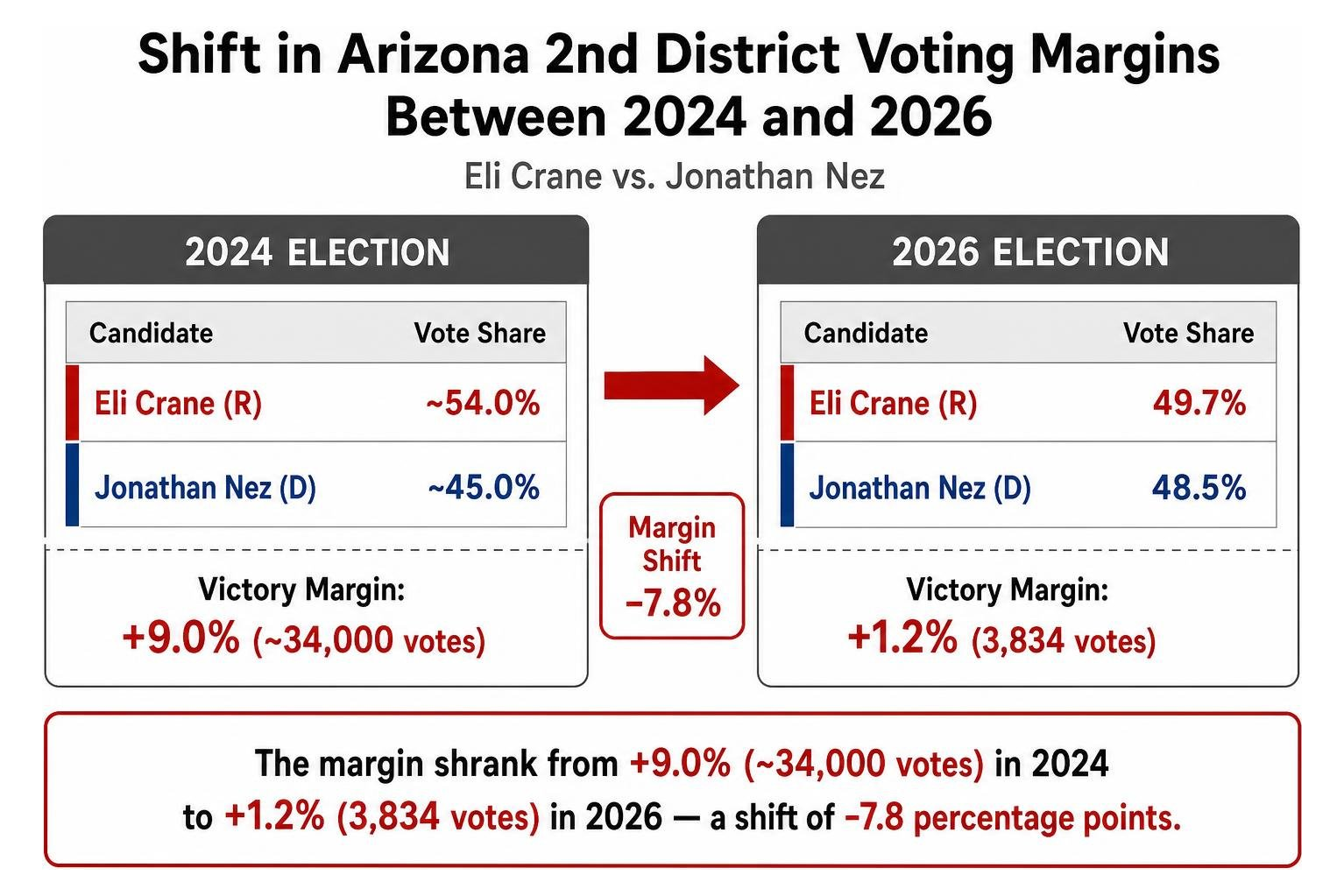
Analyzing the Shift: 2024 vs. 2026 Election Margins
In 2024, Crane won the district by roughly nine full percentage points, outperforming Nez by about 34,000 votes. Fast-forward two years to 2026, and that comfortable advantage shrank to an ultra-tight margin under 4,000 ballots. Political analysts point to a rapidly evolving midterm electorate in which independent voters grew fatigued with federal incumbency, economic anxiety heightened split-ticket voting, and localized grassroots organizing drastically compressed congressional margins throughout the Southwest.
Economic Pressures and Foreign Policy Issues That Tightened the Race
Domestic financial strains and complex international crises played a central role in shaping voter behavior across northern Arizona’s diverse communities. Families in rural towns and mountain cities expressed deep frustration over the unrelenting cost of everyday goods, higher fuel prices, grocery bills, and rising housing costs that affected both homeowners and local renters.
At the same time, major global developments added unexpected tension to the race. Deepening American commitments in international military theaters, notably the expanding conflict involving Iran, stirred significant debate among conservative and moderate voters who favored greater foreign policy restraint. Prominent political updates covering how Rep Eli Crane wins second term in tight Arizona rematch with Democrat Nez highlighted how overseas intervention worries combined with kitchen-table pocketbook issues to force Crane into a heavily localized, intense defense of his legislative record and conservative platform.
✉ Get updates like this in your inbox
Weekly VA benefit changes, pay updates, and money tips for service members, veterans, and military families. Free, no spam.
Campaign Ad Spending Across Digital Platforms
Financial disclosures and Federal Election Commission filings revealed contrasting digital advertising approaches between the two campaigns during the final stretch. On Meta’s advertising networks, Jonathan Nez’s campaign invested about $46,000 to reach younger voters, tribal communities, and suburban moderates. In contrast, Crane’s official campaign committee spent roughly $35,800 on targeted digital messaging centered on border security, economic growth, and military readiness.
Beyond direct candidate spending, external political action committees poured millions into broadcast television, radio, and digital channels across the Phoenix and northern Arizona media markets. While digital ad campaigns on Google, YouTube, and social media generated substantial visibility, face-to-face community outreach, rural town halls, and robust volunteer field operations ultimately decided the outcome in the rugged district.
The Veteran Factor: How Navy SEAL Background Shaped the Contest
Eli Crane’s background as a former Navy SEAL combat veteran served as the cornerstone of his political identity and public appeal throughout his reelection bid. First elected to the House of Representatives in 2022 and quickly aligning with the House Freedom Caucus, Crane consistently leaned into his reputation as a principled political outsider unafraid to challenge establishment leadership in both parties.
During his tenure in Washington, Crane introduced and sponsored 27 legislative measures, emphasizing stronger protections for disabled veterans, cutting bureaucratic waste within the Department of Veterans Affairs, and expanding tribal development opportunities. For those of us in the military community, reviewing comprehensive veteran resources and defense policy offers critical insight into how veteran lawmakers advocate for priorities such as VA disability compensation, military healthcare modernization, TRICARE reform, and competitive military pay scales.
Key Factors When Arizona Congressman Eli Crane Wins Reelection By 4,000 Votes
Several tactical elements enabled Crane to weather a formidable Democratic surge and defend his seat:
- Resilient Rural Base: Elevated turnout across staunchly conservative communities in Yavapai and Gila counties successfully neutralized Democratic surges in Flagstaff and tribal lands.
- Veteran Community Support: Widespread backing from military retirees, active-duty service members, and defense-oriented families in northern Arizona bolstered his grassroots network.
- Top-Tier Endorsements: High-profile endorsements from conservative figures, including former President Donald Trump, and energetic campaign rallies in Prescott Valley galvanized local volunteers.
- Focus on Core Constituencies: A disciplined campaign message centered on southern border security, individual tax relief, local economic growth, and expanded veteran healthcare access retained vital independent voters.
Broader Arizona Political Shifts and Congressional Balance of Power
Eli Crane’s narrow victory came against a backdrop of substantial political shifts sweeping Arizona during the 2026 midterms. Democrats won several significant statewide races, building momentum in state legislative races and flipping key competitive congressional districts in District 1 and District 6.
As reported when More Republicans Issue Concessions In Key Arizona Races, multiple conservative candidates faced tight margins and unexpected defeats across the Grand Canyon State. In an extraordinarily demanding midterm environment, Crane’s discipline, base support, and hold on Arizona’s 2nd District preserved a vital conservative seat in the U.S. House of Representatives.
Frequently Asked Questions about the Arizona 2nd District Election
What was the final vote margin between Eli Crane and Jonathan Nez in 2026?
Eli Crane secured his second term in Congress by a final certified margin of 3,834 votes. He finished with 49.7% of the vote compared to 48.5% for Democratic challenger Jonathan Nez, a tight 1.2-point margin.
How did Eli Crane’s 2026 victory compare to his 2024 campaign?
In 2024, Crane defeated Nez by about nine percentage points, or around 34,000 votes. In 2026, that margin shrank to just over one point because of strong Democratic turnout in tribal communities and broad midterm economic frustration.
What key issues influenced the tight race in Arizona’s 2nd Congressional District?
Voters across the district were driven by pressing economic concerns, including persistent inflation and housing affordability, alongside international tensions surrounding U.S. military involvement abroad. Heavy turnout on the Navajo Nation and shifting suburban voting patterns also played decisive roles.
Conclusion
Representative Eli Crane’s narrow reelection victory in Arizona’s 2nd Congressional District underscores the critical importance of maintaining a deeply engaged grassroots base during highly volatile midterm elections. By leveraging his military service as a Navy SEAL, connecting with rural and veteran communities, and consistently advocating for defense and veteran-focused legislation, Crane successfully defended his seat against an exceptionally strong campaign from Jonathan Nez.
At USMilitary.com, we provide active-duty personnel, veterans, and military families with transparent news, detailed benefit guides, and essential legislative updates. Whether you need information on military career opportunities, VA home loan programs, disability compensation, or military retirement planning, explore our trusted military guidance and veteran news to stay informed.
Free for Service Members & Veterans
Get the military benefits intel no one tells you about.
Weekly updates on VA benefits, pay changes, and money tips — free for service members and veterans.
No spam. Unsubscribe anytime. Your info is never shared.



Leave a Reply