Why Understanding the US Military Matters

The US military is the world’s most powerful armed force, consisting of six active-duty service branches that defend the nation and its interests around the globe. Whether you’re considering enlistment, exploring career options, or seeking to understand how America’s military operates, this guide breaks down everything you need to know.
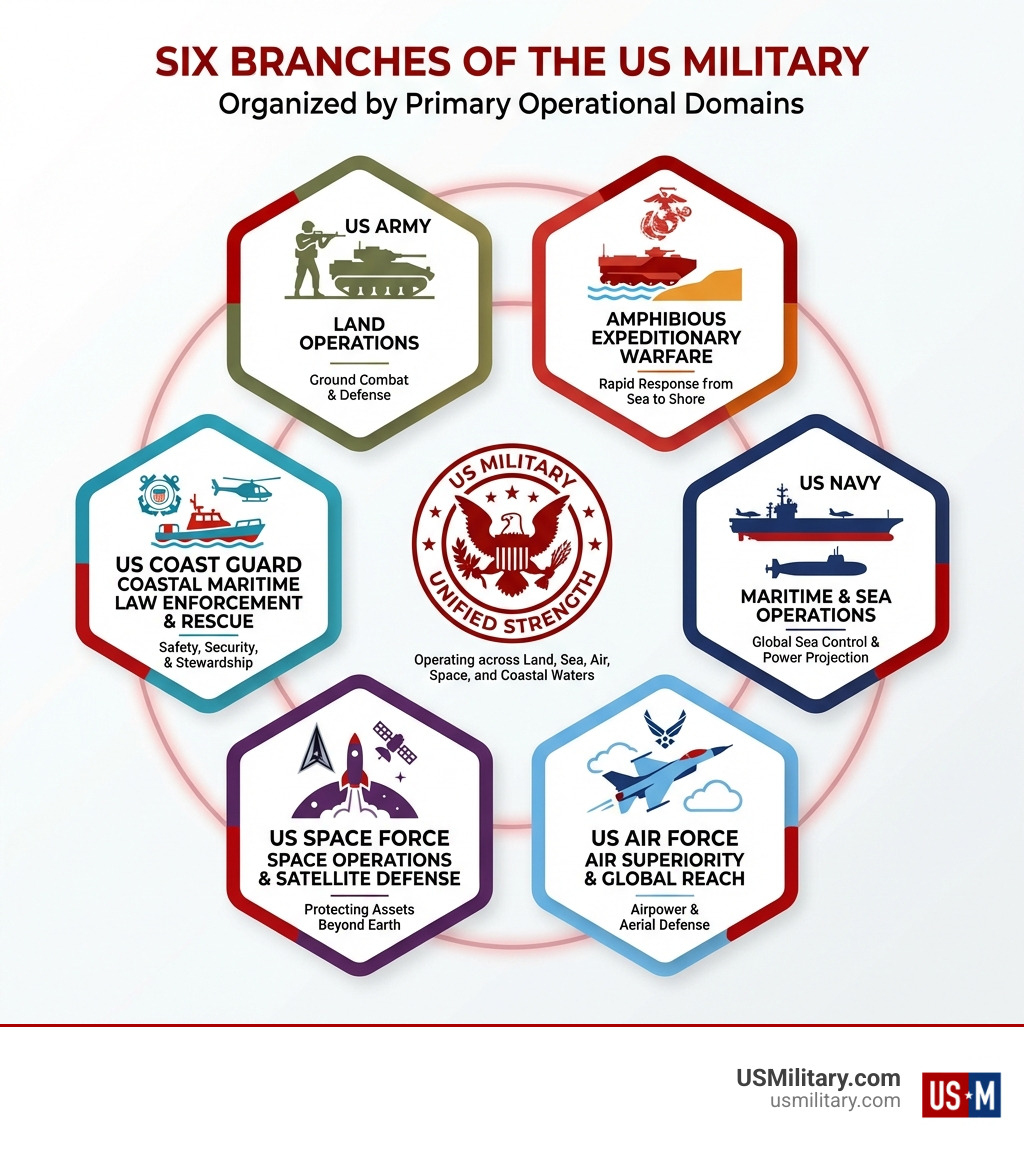
The Six Branches of the US Military:
- Army – Land-based combat operations (Est. 1775)
- Marine Corps – Expeditionary amphibious warfare (Est. 1798)
- Navy – Maritime operations and sea control (Est. 1794)
- Air Force – Air and space superiority (Est. 1947)
- Space Force – Space operations and satellite defense (Est. 2019)
- Coast Guard – Maritime law enforcement and rescue (Est. 1790)
Each branch has a distinct mission and operates across different domains—land, sea, air, space, and coastal waters. Together, they employ over 1.3 million active-duty personnel and 799,500 reserve members, all serving on an all-volunteer basis since 1973.
The US military offers more than just a job. It provides comprehensive benefits including free healthcare, housing allowances, education funding through the GI Bill, and a pension after 20 years of service. Service members gain advanced technical training, leadership experience, and skills that translate directly to civilian careers.
Understanding the structure, requirements, and opportunities within the military helps you make informed decisions about service. This guide covers everything from eligibility requirements and the ASVAB test to career paths and family support resources.
I’m Larry Fowler, publisher of the USMilitary.com Network, and since 2007 I’ve helped hundreds of thousands of people steer their journey with the US military through accurate, unbiased information about service options, benefits, and career opportunities. This guide draws on over 15 years of connecting Americans with the resources they need to make confident decisions about military service.
Us military terms at a glance:
- 1600 military time
- VA home loan
- TRICARE health plans
Understanding the Structure of the US Military
The US military is a complex and highly organized entity, designed to operate efficiently and effectively across various domains. At its core, it is overseen by civilian leadership, ensuring accountability and adherence to democratic principles.

The primary civilian organization responsible for the majority of the US military is the Department of Defense (DoD). The DoD oversees the Army, Marine Corps, Navy, Air Force, and Space Force. Its functions are broad, encompassing everything from developing military policy to managing resources and personnel, as detailed in the DIRECTIVE Functions of the Department of Defense and Its Major Components. The Coast Guard, while a military branch, typically operates under the Department of Homeland Security (DHS) during peacetime, giving it a unique dual role.
Leading the entire US military is the Commander-in-Chief, a title held by the President of the United States. This highlights the crucial principle of civilian control over the military. Supporting the Commander-in-Chief and the Secretary of Defense is the Joint Chiefs of Staff, the senior-most military body that provides expert advice on military matters.
The US military has been an all-volunteer force since 1973. This means individuals choose to serve, rather than being conscripted. This has shaped the culture and recruitment strategies of all branches.
The Chain of Command
The US military operates under a clear and defined chain of command, flowing from civilian leadership down to the individual service member. This structure is rooted in the Constitution. The President of the United States holds the ultimate authority as the Commander-in-Chief.
Directly below the President, the Secretary of Defense serves as the principal assistant to the President in all matters relating to the Department of Defense. This civilian leader is responsible for the overall management and operations of the military.
Beneath the Secretary of Defense are the Military Departments (Department of the Army, Department of the Navy, and Department of the Air Force). Each department is headed by a civilian secretary (e.g., Secretary of the Army) who oversees their respective service branches. This layered civilian oversight ensures the fundamental principle of civilian control over the military, a cornerstone of American democracy.
The Six Service Branches
As we’ve touched upon, the US military is comprised of six distinct service branches, each with a specialized role and domain:
- Army: The land warfare service branch.
- Marine Corps: An expeditionary force specializing in amphibious operations, often working closely with the Navy.
- Navy: The primary maritime warfare service, ensuring freedom of the seas.
- Air Force: Responsible for air and space superiority, conducting operations in the air and increasingly in space.
- Space Force: The newest branch, focused entirely on protecting US interests in space.
- Coast Guard: A unique branch that performs maritime law enforcement, search and rescue, and other critical functions.
These branches consist of both Active Duty personnel, who serve full-time, and Reserve Components (such as the Army National Guard, Air National Guard, Army Reserve, Marine Corps Reserve, Navy Reserve, Air Force Reserve, and Coast Guard Reserve) who serve part-time and can be called upon for federal or state missions.
Unified Combatant Commands
To ensure seamless coordination across the different service branches for major operations, the US military employs 11 Unified Combatant Commands. These commands are “joint operations,” meaning they consist of forces from multiple military departments (Army, Navy, Air Force, Marine Corps, Space Force). Their chain of command flows directly from the President, through the Secretary of Defense, to the combatant commander.
These commands are generally categorized into:
- Geographic commands: Responsible for military operations in a specific region of the world. Examples include U.S. Indo-Pacific Command (INDOPACOM) and U.S. European Command (EUCOM).
- Functional commands: Responsible for specific types of military operations worldwide, regardless of geographic location. Examples include U.S. Strategic Command (STRATCOM), which handles nuclear deterrence and space operations, and U.S. Cyber Command (CYBERCOM), which conducts cyberspace operations.
This structure allows the US military to integrate forces and capabilities effectively to address diverse global threats and challenges, as outlined in the Doctrine for the Armed Forces of the United States.
A Closer Look at the Six Branches
Each branch of the US military has a distinct identity, history, and set of responsibilities. Let’s dig deeper into their primary roles, domains of operation, core functions, and founding dates.

U.S. Army
The U.S. Army is the oldest and largest branch of the US military, established on June 14, 1775. Its primary role is to conduct prompt and sustained land combat operations. From infantry to artillery, aviation to cyber warfare, the Army’s mission is to fight and win our nation’s wars by providing ready, prompt, and sustained land dominance.
The Army’s core competencies include combined arms maneuver, wide area security, and flexible mission command. It fields a diverse range of units, from special operations forces like the Army Rangers and Green Berets to armored divisions and air defense artillery. The Army is also at the forefront of modernization, developing advanced weapon systems like hypersonic missiles.
The Army also includes the Army National Guard and the Army Reserve, which provide critical support and capabilities while allowing members to serve closer to home part-time.
U.S. Marine Corps
The U.S. Marine Corps, established on November 10, 1775 (re-established in 1798), is an expeditionary force-in-readiness. It specializes in amphibious operations, rapidly deploying by sea to conduct land combat. The Marine Corps operates as a naval land force, often spearheading operations alongside the Navy, and is administratively part of the Department of the Navy.
Marines are organized into self-sustaining, combined-arms units known as Marine Air-Ground Task Forces (MAGTFs). These flexible units, ranging from the small Marine Expeditionary Unit (MEU) to the larger Marine Expeditionary Force (MEF), integrate ground, aviation, and logistics elements to conduct a wide range of missions. The Marine Corps is currently adapting its structure with new concepts like Marine Littoral Regiments, designed for operations in contested maritime environments.
Learn more about the Marine Corps
U.S. Navy
The U.S. Navy, founded on October 13, 1775 (re-established in 1794), is the principal maritime service, responsible for maintaining global maritime dominance and ensuring freedom of the seas. It is the world’s largest navy by tonnage and plays a critical role in projecting power across the globe.
The Navy’s enduring functions include sea control, power projection, deterrence through its ballistic missile submarines, maritime security, and sealift. Its vast fleet includes 11 nuclear-powered aircraft carriers, 116 surface combatants, and a robust submarine force. Naval aviation, with its carrier-based aircraft, is a formidable component, as are its special operations forces like the Navy SEALs.
The Navy Reserve consists of part-time sailors who support active-duty operations and maintain critical skills.
U.S. Air Force
The U.S. Air Force, established as an independent service on September 18, 1947, is dedicated to achieving and maintaining air and space superiority to enable joint operations. Its mission encompasses global reach, global power, and global vigilance.
The Air Force operates a vast array of advanced aircraft, including fighter jets like the F-22 Raptor and F-35 Lightning II, strategic bombers such as the B-2 Spirit and B-52 Stratofortress, and various transport, tanker, and reconnaissance aircraft. It also maintains the nation’s intercontinental ballistic missile (ICBM) arsenal. The Air Force is continually modernizing its fleet and developing next-generation capabilities to stay ahead of threats.
The Air National Guard and Air Force Reserve provide essential support, with members serving part-time in their communities or across the nation.
Learn more about the Air Force
U.S. Space Force
The U.S. Space Force, established on December 20, 2019, is the newest branch of the US military, focused on organizing, training, and equipping forces to conduct global space operations. Its core mission is protecting U.S. interests in space and ensuring the freedom of operation for the United States and its allies in the space domain.
Guardians, as Space Force members are known, are responsible for developing and maintaining critical space capabilities, including satellite operations, space domain awareness (tracking objects in space), missile warning systems, and precise navigation (GPS). They also focus heavily on cyber capabilities within the space domain to protect against threats to space assets. The Space Force is pivotal in integrating space power into joint military operations.
Learn more about the Space Force
U.S. Coast Guard
The U.S. Coast Guard, tracing its origins to 1790, is a unique branch of the US military with a distinct dual role. While it is a military service, it operates under the Department of Homeland Security in peacetime, performing critical maritime law enforcement, search and rescue, marine environmental protection, and aids to navigation missions. In times of war, or when directed by the President, the Coast Guard can operate as a service within the Navy.
Coastguardsmen are responsible for securing waterways, preventing illegal immigration and drug trafficking, enforcing fishing laws, and responding to maritime disasters. Its diverse fleet includes cutters, boats, and aircraft capable of operating in various maritime environments, including ice-breaking on the Great Lakes. The Coast Guard Reserve supports these vital missions.
Learn more about the Coast Guard
Joining the Ranks: Paths and Requirements
Deciding to serve in the US military is a significant step, and understanding the paths and requirements is crucial. Since 1973, our military has been an all-volunteer force, meaning individuals choose to enlist or commission. However, males residing in the U.S. are required to register for the Selective Service System at age 18.
Basic Eligibility to Join the US Military
To join the US military, prospective service members must meet several fundamental requirements:
- Citizenship requirements: You must be a U.S. citizen or a U.S. Permanent Resident Card (Green Card) holder. Non-citizens must be fluent in English and cannot join solely to gain entry into the U.S. or obtain a visa.
- Age limits: Each branch has specific age requirements for enlistment, though exceptions can sometimes be made with a waiver.
- Education: A high school diploma or GED is generally required. While GED holders can enlist, there are often fewer available spots for them. Having college credits or a higher ASVAB score can improve a GED holder’s chances. To join as an officer, a degree from a four-year college is a prerequisite.
- Physical and medical standards: All recruits must pass a comprehensive medical exam to ensure they are physically and mentally fit for service. This includes a physical fitness test, with specific standards varying by branch and role.
Here’s a quick look at the enlistment age limits for each branch:
| Branch | Enlistment Age Limit |
|---|---|
| U.S. Army | 17-35 |
| U.S. Marine Corps | 17-28 |
| U.S. Navy | 17-41 |
| U.S. Air Force | 17-42 |
| U.S. Space Force | 17-42 |
| U.S. Coast Guard | 17-41 |
The ASVAB Test: Your Military Career Gateway
The Armed Services Vocational Aptitude Battery (ASVAB) is a mandatory test for anyone wishing to enlist in the US military. It’s not just a pass/fail exam; your scores are crucial for determining your eligibility for enlistment and, more importantly, which military jobs (known as Military Occupational Specialties or MOSs) you qualify for.
The ASVAB consists of several subtests covering areas like general science, arithmetic reasoning, word knowledge, paragraph comprehension, mathematics knowledge, electronics information, auto and shop information, and mechanical comprehension. Your overall score, known as the Armed Forces Qualification Test (AFQT) score, determines if you meet the minimum enlistment standards. Individual “line scores” from combinations of subtests determine your eligibility for specific career fields. Think of it as your resume for military jobs!
Preparing for the ASVAB is a smart move. You can find practice tests, study guides, and tips on how to interpret your scores through various online resources. To learn more and prepare, you can Use ASVAB online resources.
Enlisted vs. Officer: Choosing Your Path in the US Military
When joining the US military, you typically choose between two main career paths: enlisted or officer. While both are vital to the military’s success, they involve different roles, responsibilities, and entry requirements.
- Enlisted roles: Enlisted personnel make up the vast majority (about 80%) of the US military. They typically perform the hands-on, technical, and specialty jobs. Their path usually begins with basic training, followed by specialized job training. Enlisted members can advance through various ranks, gaining experience and expertise in their chosen field.
- Officer roles: Officers are generally responsible for leadership, management, and strategic planning. They lead enlisted personnel and manage operations. To become an officer, a four-year college degree is required. Officers typically enter through various commissioning sources, including military service academies (like West Point, which has a competitive 12% acceptance rate), Reserve Officer Training Corps (ROTC) programs at civilian colleges, or Officer Candidate School (OCS) after earning a degree.
The choice between enlisted and officer paths depends on your educational background, career aspirations, and leadership goals. Both offer unique opportunities for growth and service. If you’re considering an officer path, you can Learn about becoming an officer.
Ways to Serve: Active Duty, Reserve, and National Guard
Beyond choosing an enlisted or officer path, you also have options for the type of military service commitment you want to make:
- Active Duty: This is full-time military service, where you live and work on a military installation (or deploy globally) as your primary occupation. Active duty members are always ready to respond to missions worldwide.
- Reserve: The Reserve components (e.g., Army Reserve, Navy Reserve, Air Force Reserve) consist of part-time service members who typically train one weekend a month and two weeks a year. They are federal forces that support active-duty missions, providing specialized skills and backup when needed for national defense or emergencies.
- National Guard: The National Guard (Army National Guard and Air National Guard) is unique in its dual role. Members serve part-time, similar to the Reserves, but answer to both their state governor and the federal government. This means they can be activated for state-level emergencies (like natural disasters or civil unrest) as well as federal missions overseas.
Each option offers different levels of commitment, benefits, and deployment models, allowing individuals to choose a path that best fits their life circumstances.
A Fulfilling Career: Benefits, Training, and Growth
Serving in the US military is more than just a job; it’s a pathway to incredible personal and professional growth, offering a unique blend of tangible benefits and invaluable life skills. We’ve seen countless service members find immense fulfillment through making an impact, forming meaningful connections, and achieving individual growth.
Comprehensive Military Benefits
The US military provides a robust package of benefits designed to support service members and their families throughout their careers and beyond:
- Competitive salary: Service members receive regular pay, which increases with rank and years of service. For example, we look forward to the 2026 Military Pay Charts.
- Housing allowance (BAH): For those not living on base, a Basic Allowance for Housing (BAH) helps cover rent or mortgage costs, custom to local living expenses. We also keep an eye on the 2026 Basic Allowance for Housing (BAH) rates.
- Free healthcare: Through programs like Tricare, service members and their families receive comprehensive medical and dental care at little to no cost.
- Paid vacation: Active duty members typically earn 30 days of paid vacation per year.
- Retirement pension: After 20 years of service, members are eligible for a lifetime pension.
- Life insurance: The VA offers various life insurance options for service members, veterans, and their families.
These benefits provide financial stability and peace of mind, allowing service members to focus on their mission.
Best Education and Training
One of the most significant advantages of military service is the unparalleled education and training opportunities it provides.
- Job training: Every service member receives advanced job training in their chosen field, leading to highly specialized skills. Whether it’s cyber operations, aviation maintenance, medical services, or engineering, the military invests heavily in developing its personnel.
- Tuition Assistance: While serving, members can use Tuition Assistance to pursue college degrees.
- Post-9/11 GI Bill: This incredible benefit provides significant financial support for education or job training for service members and veterans, often covering tuition, housing, and books for up to 36 months. Many service members use this to earn degrees after their service, like the service member using their GI Bill in our image above.
- Professional certifications & Leadership schools: The military offers numerous opportunities for professional development, from technical certifications to world-class leadership training at various schools and academies.
Popular career fields in the military that offer excellent training include:
- Cyber: Roles like Cyber Warrior (as seen in the Space Force and Army Reserve) and cyber specialist are growing rapidly.
- Aviation: Pilots, mechanics, and air traffic controllers are in high demand across all air-centric branches.
- Medical: From combat medics to nurses, the military trains a wide range of medical professionals.
- Engineering: Engineers are crucial for infrastructure, technology development, and combat support.
Resources for Military Families
We understand that military service is a family affair. The US military provides extensive resources for military families to help them steer the unique challenges and opportunities of military life:
- Support for spouses and children: Various programs and services are available to help spouses find employment, continue their education, and connect with other military families. Children have access to specialized schools and youth programs.
- Family readiness groups: These groups provide essential communication and support networks for families, especially during deployments.
- Morale, Welfare, and Recreation (MWR): MWR programs offer a wide array of activities, facilities, and services to improve the quality of life for service members and their families on bases worldwide.
- Information for parents: For parents of potential recruits, there are resources available to help them understand what to expect and how to support their child’s decision to serve. We also offer Resources for Educators & Counselors to help guide young people.
Frequently Asked Questions about the US Military
We often hear similar questions from individuals exploring the US military. Here are some of the most common ones we address:
Who is the Commander-in-Chief of the military?
The President of the United States holds the title of Commander-in-Chief. This means the President, as an elected civilian official, exercises supreme operational command over all branches of the armed forces. This fundamental principle ensures civilian control over the military, a cornerstone of American democracy.
Can a non-citizen join the U.S. military?
Yes, in some cases. Legal permanent residents (i.e., Green Card holders) are generally eligible to enlist in the U.S. military. However, they must meet all other eligibility requirements, including age, education, and physical standards. Joining the military is not a direct path to U.S. citizenship or a guaranteed way to obtain a visa or enter the country. Non-citizens must also be fluent in English.
What is the difference between the Reserve and the National Guard?
While both the Reserve and the National Guard consist of part-time service members, their primary differences lie in their command structure and typical missions:
- The Reserve (e.g., Army Reserve, Navy Reserve) is a federal force. Its members are primarily tasked with supporting active-duty operations globally. They train regularly and can be called up for federal missions anywhere in the world.
- The National Guard (Army National Guard, Air National Guard) is a unique component that serves both the state governor and the federal government. This means Guard members can respond to domestic emergencies within their state (such as natural disasters or civil unrest) and can also be federalized for overseas missions alongside active-duty forces. This dual state-federal role distinguishes the Guard from the federal Reserve components.
Conclusion
The US military stands as a testament to service, honor, and commitment, operating as a sophisticated, all-volunteer force dedicated to defending our nation’s interests. We’ve explored its intricate structure, from the civilian oversight of the Department of Defense to the specialized missions of its six branches and the strategic coordination of its Unified Combatant Commands.
For those considering a path of service, we’ve outlined the clear requirements for joining, the importance of the ASVAB test, and the distinct opportunities available whether you choose an enlisted or officer career. Beyond the call to duty, military service offers a wealth of lifelong benefits, including comprehensive healthcare, educational funding, advanced training, and significant personal and professional growth.
At USMilitary.com, we are committed to providing you with accurate, nonbiased information to help you steer your journey, whether you’re a prospective recruit, a current service member, a veteran, or a family member. We believe that informed decisions lead to successful outcomes.
Explore Military Benefits and Career Opportunities
Free for Service Members & Veterans
Get the military benefits intel no one tells you about.
Weekly updates on VA benefits, pay changes, and money tips — free for service members and veterans.
No spam. Unsubscribe anytime. Your info is never shared.


