Understanding Military Compensation: What You’re Really Earning
Active duty pay is a comprehensive compensation package, not just a salary. It combines basic pay with tax-free allowances and special pays that vary based on your rank, years of service, and job assignment.
Quick Answer: Active Duty Pay Components
| Component | What It Is | Tax Status |
|---|---|---|
| Basic Pay | Based on rank (pay grade) and years of service | Taxable |
| BAH (Housing Allowance) | Covers housing costs, varies by location | Non-taxable |
| BAS (Food Allowance) | Covers meals ($328.48 for officers, $476.95 for enlisted in 2026) | Non-taxable |
| Special Pays | Job-specific bonuses (flight pay, hazardous duty, etc.) | Taxable |
For example, in 2026, an E-1’s basic pay starts around $2,407 per month, while an O-4 with over 10 years of service receives about $9,419 monthly. However, these figures don’t include non-taxable allowances and special pays, which can add thousands more to your monthly income.
Understanding this unique pay structure is essential, whether you’re considering enlistment, planning a promotion, or just trying to decipher your paycheck. The interplay between taxable basic pay and non-taxable allowances is a key feature of military compensation.
Deconstructing Your Paycheck: The Core Components of Active Duty Pay
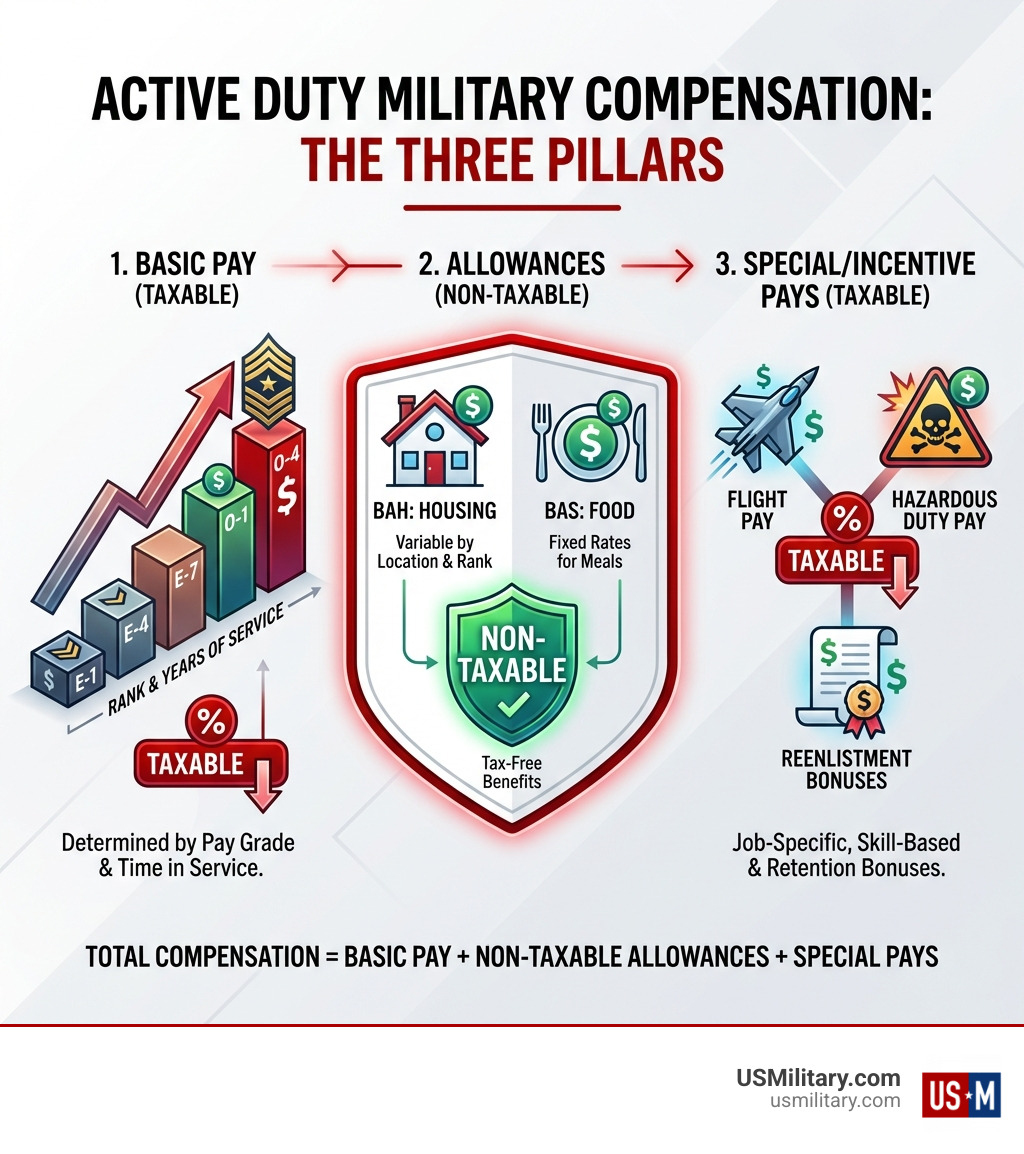
Active duty pay is a structured package with three core elements: basic pay, allowances, and special pays. Understanding how they work together is key to managing your finances.
- Basic Pay: This is the largest, most consistent part of your income. It’s taxable and determined by your pay grade (rank) and years of service. Your basic pay increases with promotions and time in service.
- Allowances: These are non-taxable funds for specific needs like housing and food. Their tax-free status significantly boosts your take-home pay.
- Special and Incentive Pays: These are taxable bonuses for specific skills, hazardous duties, or certain assignments. They reward unique contributions and expertise.
Together, these components form your total compensation. Differentiating between taxable and non-taxable income is crucial for understanding your net pay. For official details, refer to the Official Basic Pay information.

How is active duty pay determined?
Your basic pay is determined by two main factors: your pay grade (rank) and your years of service. As you gain experience and rank, your pay increases.
For example, an E-1 with less than 4 months of service might have a basic pay of $2,144.10 (as of April 1, 2025), while an E-6 with over a decade of service is projected to earn about $4,759 monthly in 2026. For officers, a new O-1’s basic pay starts around $4,150 in 2026, and an O-4 with over 10 years of service will receive about $9,419 monthly.
Promotions move you to a higher pay grade, providing a significant pay raise. Additionally, your pay increases incrementally based on time in service, rewarding your continued commitment even within the same rank.
For the most accurate figures, always consult the Official Pay Tables from DFAS, which are the definitive source for basic pay rates.
How do allowances affect total compensation?
Allowances are a critical, non-taxable part of your compensation, which significantly increases your take-home pay. The two primary allowances are for housing and food.
Basic Allowance for Housing (BAH): If you don’t live in government housing, BAH helps cover your housing costs. The amount is determined by your pay grade, dependency status, and the local housing market costs at your duty station. This location-based calculation ensures fair compensation relative to the local cost of living.
Basic Allowance for Subsistence (BAS): This allowance is for meals and is paid at a flat rate. It is also non-taxable. For 2026, the projected monthly BAS rates are $328.48 for officers and $476.95 for enlisted members.
In certain situations where government food facilities are unavailable, enlisted members may be eligible for BAS II, which is double the standard enlisted rate (projected at $953.90 for 2026). These allowances are integral to your total pay, not just supplemental income.
What are special and incentive pays?
The military offers a variety of special and incentive pays to compensate for hazardous duties, critical skills, and specific assignments. These taxable payments are job-specific incentives that can significantly increase total compensation.
Common types include:
- Hazardous Duty Pay (HDP): For inherently dangerous tasks like parachute jumping, demolition duty, or handling explosives.
- Flight Pay (ACIP): For aviators and flight crew members, compensating for the demands of flying.
- Sea Pay (SDP): For service members on ships or submarines, recognizing the challenges of extended time at sea.
- Enlistment Bonuses: Lump-sum payments for new recruits in high-demand jobs or for specific enlistment terms.
- Reenlistment Bonuses (SRB): Offered to experienced personnel to encourage retention in critical skill areas.
- Assignment Incentive Pay (AIP): For assignments in remote or difficult locations.
- Specialty Pays: Additional pay for professionals like doctors and lawyers to remain competitive with civilian salaries.
These pays recognize the unique skills and risks associated with certain military roles.
2026 Projections and Annual Pay Adjustments
Military pay is not static; it adjusts annually to keep pace with the cost of living and remain competitive. These changes are crucial for your financial planning.

The annual pay raise is typically based on the Employment Cost Index (ECI), a measure of labor cost changes. However, the final percentage requires Congressional approval as part of the National Defense Authorization Act (NDAA). While the figure can be adjusted during this legislative process, service members can generally expect an annual raise to help maintain their purchasing power.
What are the projected active duty pay rates for 2026?
Looking ahead, we have clear projections for active duty pay rates in 2026, based on an anticipated 3.8% military pay raise. While subject to final approval, this gives a strong indication of what’s to come.
This projected 3.8% increase over 2025 levels means a noticeable boost across all ranks:
- An enlisted service member with a paygrade of E-1 will receive about $2,407 per month in basic pay.
- A more senior enlisted person with a paygrade of E-6, who has more than a decade of service, will earn about $4,759 monthly throughout 2026.
- A new officer’s basic pay begins at about $4,150 in 2026.
- A more senior officer with a paygrade of O-4, having served more than 10 years, will receive about $9,419 monthly in 2026.
These figures represent basic pay only. Allowances like BAH and BAS, which also adjust annually, will add significantly to your total compensation. Always await the official pay charts from the Defense Finance and Accounting Service (DFAS) for confirmed numbers.
When do military pay rates change?
Military pay rates operate on a predictable schedule. You can generally count on an annual increase that becomes effective on January 1st of the new year. This adjustment will appear in your first paycheck of the new year, typically paid mid-January.
✉ Get updates like this in your inbox
Weekly VA benefit changes, pay updates, and money tips for service members, veterans, and military families. Free, no spam.
Mid-year adjustments are rare, providing stability for financial planning. However, it’s always wise to stay informed through official channels like DFAS and myPay for any announcements.
How does active duty pay compare to retired pay?
Active duty pay and retired pay serve different purposes. Active duty compensation is a complete package for current service, including basic pay, non-taxable allowances (BAH/BAS), and special pays. It’s a dynamic salary that changes with rank, location, and job duties.
Retired pay is a pension earned after a full career (typically 20+ years), providing long-term financial stability. It is calculated based on your years of service and basic pay.
The system has evolved. While many retirees are under the “High-36” system (a pension based on the average of their highest 36 months of basic pay), service members who joined after January 1, 2018, are under the Blended Retirement System (BRS). The BRS combines a smaller pension with a government-matched Thrift Savings Plan (TSP) account. This makes personal TSP contributions a critical part of retirement planning for newer service members.
In short, active duty pay is for now; retired pay is for the future you earned.
Your Financial Toolkit: Managing Pay, Savings, and Errors
Being a service member means being financially savvy. Your financial well-being is a crucial aspect of your overall readiness. This section covers the practical tools for effective pay management, smart retirement planning, and how to handle paycheck errors.
How do I understand my Leave and Earning Statement (LES)?
Your Leave and Earning Statement (LES) is your monthly pay stub, detailing your earnings, deductions, and leave balance. Regularly reviewing it is essential for managing your finances and catching errors. You can access your LES anytime via the myPay portal.
Key sections of the LES include:
- Entitlements: Lists all income earned, including basic pay, allowances (BAH/BAS), and special pays.
- Deductions: Shows all money withheld, such as taxes, Social Security (FICA), and SGLI premiums.
- Allotments: Details any automatic payments you’ve set up to be sent from your pay.
- Leave Balance: Tracks your accrued and used leave days.
- Remarks: Contains important administrative notes or explanations for pay changes.
Understanding your LES is the first step to taking control of your military pay.
What is the Thrift Savings Plan (TSP)?
The Thrift Savings Plan (TSP) is a retirement savings and investment plan for federal employees and service members, similar to a civilian 401(k). It is a critical tool for building long-term wealth.
Key features include:
- Automatic Enrollment: Most new service members are automatically enrolled with a 5% contribution from their basic pay after 60 days of service.
- Government Contribution Matching: Under the Blended Retirement System (BRS), the government matches your contributions up to 5% of your basic pay. Contributing at least 5% is highly recommended to receive the full match.
- Tax Advantages: You can choose between a Traditional TSP (pre-tax contributions) and a Roth TSP (after-tax contributions), offering flexibility for your tax strategy.
- Low-Cost Investment Options: The TSP provides several investment funds, from secure government bonds to diversified stock funds, allowing you to tailor your portfolio.
The TSP’s combination of automatic savings, government matching, and compound growth makes it a powerful retirement tool. You can manage your account and find more details at Managing your TSP contributions.
What should I do if my pay is incorrect?
If you find an error in your active duty pay, act quickly and systematically.
- Review Your LES: Immediately check your Leave and Earning Statement (LES) for discrepancies in entitlements, deductions, or leave.
- Contact Your Unit’s Finance/Personnel Office: This is your first stop. Your unit’s administrative office (S-1, orderly room) can investigate and often resolve pay issues. Bring your LES.
- Document Everything: Keep a log of who you spoke to, when, and what was discussed. Save all related emails and documents.
- Follow Up: Politely and persistently follow up with the finance office until the issue is resolved.
- Escalate to DFAS if Needed: If your unit cannot resolve the problem, contact the Defense Finance and Accounting Service (DFAS) directly. Use their askDFAS tool or customer service line (1-888-332-7411), providing all your documentation.
Being proactive is the best way to ensure your pay is corrected promptly.
VA Home Loan
Your Service Earns a $0-Down Home Loan Benefit
Eligible service members and veterans can buy a home with no down payment and no PMI. Check your VA loan eligibility in a few minutes.
USMilitary.com may be compensated when you request quotes from lenders through this link.
Frequently Asked Questions about Military Pay
We understand that military pay can be a complex topic. Here, we address some of the most common inquiries from service members.
What financial products are offered to military members?
Due to the unique nature of military life, many financial institutions offer products custom to service members. These are designed to support your financial well-being.
- Specialized Bank Accounts: Military-focused banks and credit unions often provide accounts with benefits like early access to direct deposits and waived fees for active-duty personnel.
- Low-Interest Loans and Credit Cards: Service members may qualify for lower interest rates on loans and credit cards, supported by protections like the Military Lending Act (MLA).
- VA Home Loans: A key benefit, the VA home loan program allows eligible members to buy a home with no down payment and no private mortgage insurance.
- Financial Counseling Services: Free financial counseling is available on most installations through the Personal Financial Management Program (PFMP) and from non-profits, helping with budgeting, debt, and investing.
Is all military income taxable?
No, a significant portion of military income is not taxable, which is a major financial benefit. It’s crucial to know the difference.
- Taxable Income: Your basic pay and most special pays are subject to federal and state income taxes.
- Non-Taxable Income: Your main allowances, the Basic Allowance for Housing (BAH) and Basic Allowance for Subsistence (BAS), are generally non-taxable at the federal level. This significantly increases your effective take-home pay.
- Tax-Exempt Income: Pay earned while serving in a designated combat zone is typically exempt from federal income tax. This provides substantial tax savings for deployed service members.
While allowances are federally non-taxable, they may be considered for other purposes like child support calculations. For personalized advice, consult a tax professional or your installation’s legal assistance office.
Where can I find official pay information?
For the most accurate and current information on your active duty pay, always use official sources.
- Defense Finance and Accounting Service (DFAS): The authoritative source for all military pay matters. Their website includes official pay tables for basic pay, BAH, and BAS. Find them at DFAS Military Pay Tables.
- myPay Portal: Your personal pay account at [mypay.dfas.mil/#/]. Use it to view your LES, manage your account, and download tax forms.
- Unit Finance/Personnel Office: Your first point of contact for specific questions or issues with your pay.
- MilitaryPay.Defense.gov: An official Department of Defense website with general pay information and resources like Basic Pay.
- Military OneSource: Offers free financial counseling to help you understand your pay and benefits.
Bookmark these sites to ensure you are getting information directly from the source.
Conclusion
Understanding your active duty pay is more than just knowing your monthly basic salary; it’s about grasping the full scope of your total compensation. We’ve explored how your pay is a dynamic package, built upon the foundation of basic pay, significantly improved by non-taxable allowances like BAH and BAS, and further boosted by various special and incentive pays. From the projected 2026 pay rates to the vital role of your Leave and Earning Statement (LES) and the power of the Thrift Savings Plan (TSP), we hope this guide has illuminated the intricate yet rewarding world of military finances.
Effective financial planning is a cornerstone of a successful military career and a secure future. By understanding each component of your pay, knowing when adjustments occur, and utilizing the resources available to you, you empower yourself to make informed decisions for your financial well-being. Whether you’re an E-1 just starting out or an O-4 looking toward retirement, mastering your military pay is a crucial step in maximizing your benefits and achieving your financial goals.
For more in-depth information and to continue building your financial literacy, we encourage you to explore the comprehensive resources available on USMilitary.com.
Learn more about the full range of military benefits
Free for Service Members & Veterans
Get the military benefits intel no one tells you about.
Weekly updates on VA benefits, pay changes, and money tips — free for service members and veterans.
No spam. Unsubscribe anytime. Your info is never shared.


