Do you really compare Trump to Hitler? Do you find yourself overwhelmed by hate rather than acknowledging hints of success? Like most democrat leaders, do you hate politics so much that it dictates every word spoken or vote in favor to minimize the positive popularity of another party or person? Hate politics and Trump derangement syndrome, downgrading America’s spirit, is one of the most pressing concerns facing the country today. This behavior, on the right or on the left, will sooner or later wreck America, as it would any relationship. Any relationship with husband, wife, coworker, or child requires seeing and acknowledging the good and bad in others, or becoming balanced. As with Trump or whoever is in power, placing America and its people first, not a political party. Today, hate is so thick that it can be easily predicted and so thick can even be cut through with a knife. We all know it but still we do nothing according to the polls. Here is a quick breakdown:
What you need to know at a glance:
- Trump Derangement Syndrome (TDS) is a term used to describe what some see as irrational, obsessive hatred of Donald Trump
- Critics of TDS argue the label is used to shut down legitimate political debate rather than address real concerns
- Both sides show signs of exhaustion – from outrage fatigue among Trump supporters to deep anxiety among his opponents
- The result: A country more divided, less trusting of institutions, and struggling to hold onto its democratic identity
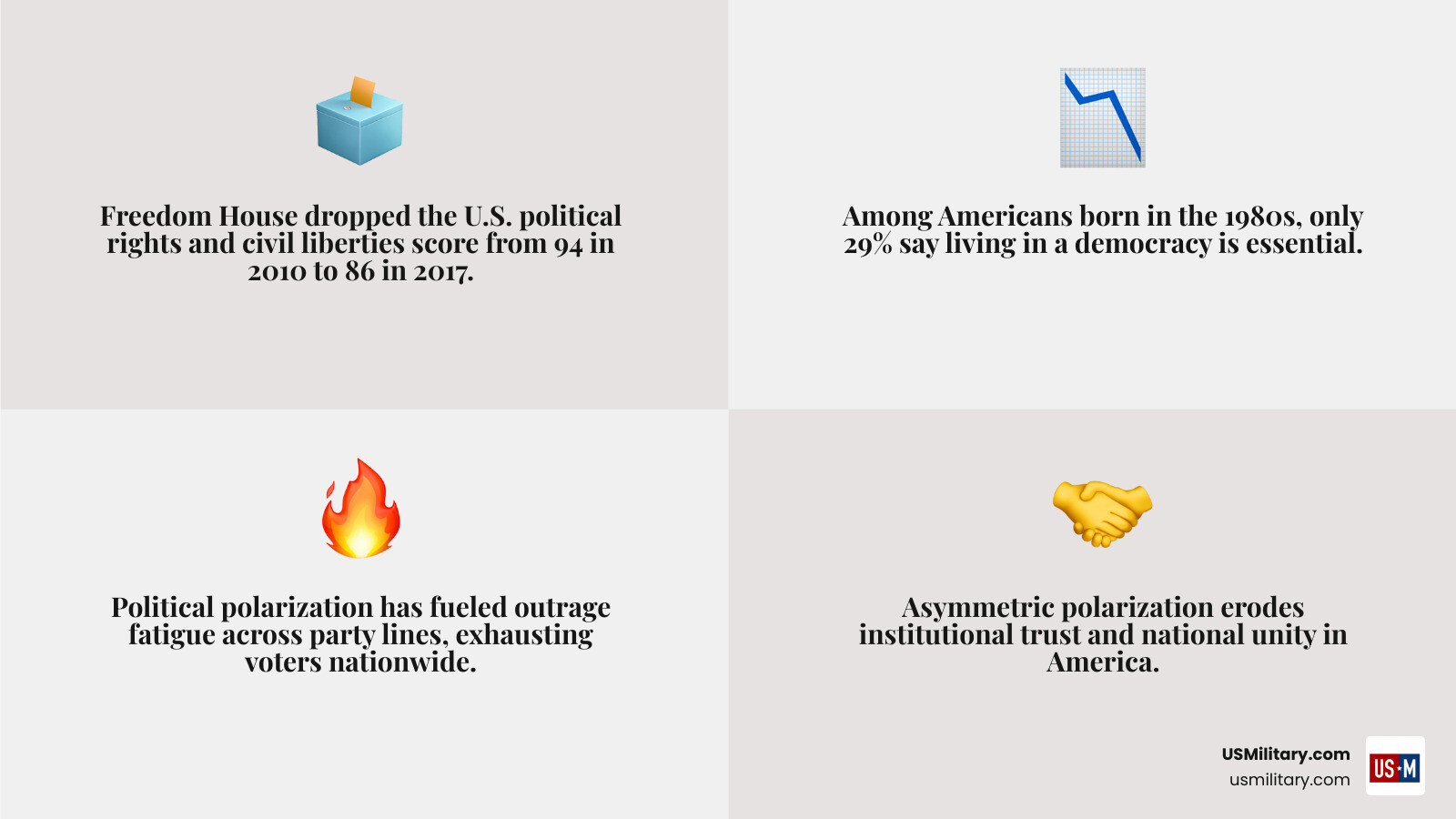
- Freedom House dropped the U.S. political rights and civil liberties score from 94 in 2010 to 86 in 2017 – a steeper fall than most other Western democracies
- Among Americans born in the 1980s, only 29% say living in a democracy is “essential” – compared to 71% of those born in the 1930s
This toxic cycle of political anger is not just exhausting. It is quietly eroding the shared values and civic pride that define what it means to be American.
Take the example of a 70-year-old lifelong Republican who voted for Trump twice, only to regret it and ultimately support the opposing candidate. Stories like this reveal that the damage runs deep – cutting across party lines and touching everyday Americans who simply want their country back.
The question is no longer just “who started it.” The question is: what is all this rage costing us?
I’m Larry Fowler, publisher of the USMilitary.com Network and a longtime advocate for active-duty service members and veterans since 2007 – communities that understand duty, sacrifice, and unity better than most, and who feel the weight of hate politics and Trump derangement syndrome downgrading America spirit on the front lines of everyday life. In the sections ahead, we will break down what TDS really means, where it comes from, and what it is doing to the American spirit.
Easy hate politics and Trump derangement syndrome downgrading America spirit glossary:
- Latest Update Operation Epic Fury Including Three American Deaths
- Update On Day 3 Operation Epic Fury 4 And Progress Made
- Day 4 Operation Epic Fury As Iran Ramps Up New Attacks
Defining the Phenomenon: Is TDS a Clinical Reality or Political Weapon?
When we talk about Trump Derangement Syndrome, we aren’t opening a medical textbook. Instead, we are stepping into a linguistic minefield. For proponents of the term, TDS describes a state of mind where an individual’s hatred for Donald Trump is so intense that it clouds their judgment, leading them to reject any policy or success associated with him, regardless of merit.
However, critics and some psychological experts suggest the term functions more as a “thought-terminating cliché.” By labeling a critic as “deranged,” supporters can effectively bypass a substantive argument. It becomes a defense mechanism that protects the supporter from engaging with uncomfortable facts. Some even argue that the “derangement” is a paradox; while critics are accused of it, some observers see a “cult-like lockstep obsession” within the MAGA movement itself. This creates a feedback loop where both sides view the other as mentally untethered from reality.
For a deeper look at how clinical perspectives view this, you can explore Is ‘Trump Derangement Syndrome’ a genuine mental illness? or read about The Paradox of “Trump Derangement Syndrome”.
The Psychological Impact of Hate politics and Trump derangement syndrome downgrading America spirit
The constant friction of hate politics and Trump derangement syndrome downgrading America spirit has a measurable psychological toll. We call this “negative partisanship”—a state where voters are driven more by their loathing of the “other side” than by their support for their own party’s platform. This isn’t just a headache for pollsters; it’s a weight on our national morale.
When politics becomes a zero-sum game of hatred, the “spirit of America”—that sense of shared purpose and neighborly respect—begins to fray. Veterans often tell us that the unity they felt in the service is harder to find at home. To understand how the American political landscape has shifted over time, check out our More info about political spectrum guide.
Proponents vs. Critics: A War of Definitions
The battle over the definition of TDS is essentially a war over who gets to define “truth.”
- Proponents see it as a “Truth Denial Syndrome,” where the media and the left refuse to acknowledge any positive outcomes of the Trump era.
- Critics argue the term is a projection. They suggest that the real “derangement” is the “cult-like” devotion that ignores traditional democratic norms and ethics.

The Authoritarian Playbook and the Roots of Outrage Fatigue
To understand why the temperature is so high, we have to look at the “authoritarian playbook.” As noted in the Harvard Law Review, many of the tactics used in modern American politics—attacking the press, questioning the judiciary, and undermining election integrity—mirror strategies used by autocratic leaders globally.
When leadership leans into these tactics, it fuels the very “derangement” it later mocks. This cycle is amplified by the Latest Congressional Record, which often reflects the same partisan vitriol seen on cable news.
How hate politics and Trump derangement syndrome downgrading America spirit affects voters
It isn’t just the “haters” who are suffering. There is a growing phenomenon known as “outrage fatigue” or being “traumatized by Trumpism.” Even the most devoted supporters can find the constant state of high-alert conflict exhausting. A recent Scientific research on Trumpism toll highlights how the relentless cycle of “us vs. them” narratives can lead to a sense of burnout. When everything is a “five-alarm fire,” eventually, people just want to stop smelling the smoke.
Media’s Role in Amplifying Derangement
We cannot ignore the role of the 24-hour news cycle and social media algorithms. These platforms are designed to reward the most extreme takes. If you post a nuanced, calm take on policy, you might get a few likes. If you post an “outraged” take about the latest political scandal, the algorithm pushes it to thousands.
This creates “echo chambers” where people only hear the most “deranged” versions of the other side’s arguments. For those who want to see the raw, unedited version of our government at work, watching the Clerk YouTube channel can be a sobering alternative to the filtered highlights seen on social media.
Hate politics and Trump derangement syndrome downgrading America spirit: The Cost to Democracy
The stakes of hate politics and Trump derangement syndrome downgrading America spirit go far beyond hurt feelings. Our democratic institutions are feeling the strain. Freedom House, an organization that tracks global liberty, has noted a significant decline in the U.S. score. This decline is tied to the erosion of norms that once kept political competition within healthy bounds.
When one side views the other not as a “loyal opposition” but as an existential threat, the “rules of the game” start to break. We see this in debates over Roll Call Votes and the increasing use of “constitutional hardball.” For more on how to spot manipulative political tactics, read our piece on More info about political wolves.
The Degradation of American Democracy
The degradation of our democracy is often linked to specific legal and social shifts. For example, the Supreme Court’s decision in Shelby County v. Holder led to immediate changes in voter ID laws in states like Texas and North Carolina. Critics argue these moves target specific demographics to preserve power, while proponents argue they protect electoral integrity.
Regardless of where you stand, the result is a lack of trust in the system. When citizens stop believing that the system is fair, the “spirit of America” takes a hit. You can track these legislative changes and government data through GPO govinfo.
Consequences for National Unity
The divide isn’t just partisan; it’s generational. We are seeing a massive shift in how Americans view the importance of democracy itself.
| Generation | % Who Believe Living in a Democracy is Essential |
|---|---|
| Born in the 1930s | 71% |
| Born in the 1980s | 29% |
This statistic is a wake-up call. If we don’t address the underlying “hate politics,” we risk losing the very foundation of our nation.
Beyond the Label: Fatigue and the Path to National Recovery
Is there a way out? We are starting to see signs of “political homelessness.” There are lifelong Republicans who are switching to Harris, and former Democrats who feel the left has moved too far away from them. These “switchers” often cite a desire for a return to normalcy and a rejection of the “derangement” on both sides.
Restoring the American spirit requires us to look past the labels. It means valuing More info about national spirit and remembering that our strength has always come from our ability to disagree without dehumanizing each other.
Restoring the American Spirit
Restoration starts with civic engagement that isn’t rooted in anger. It means participating in substantive debates rather than trading insults online. It means demanding that our leaders in the Senate legislative info work toward bipartisan solutions rather than scoring points for the next viral clip.
Frequently Asked Questions about Trump Derangement Syndrome
What is the origin of the term Trump Derangement Syndrome?
The term is a play on “Bush Derangement Syndrome,” which was coined in the early 2000s. It was adapted during the 2016 campaign to describe the intense, visceral reaction many had to Donald Trump’s rhetoric and political style.
How does TDS impact democratic institutions and electoral integrity?
When “derangement” (or the accusation of it) becomes the primary lens for politics, it undermines trust. It leads to the questioning of election results, the politicization of the justice department, and a general feeling that the “other side” is illegitimate, which is a direct threat to a functioning democracy.
Can the American spirit be restored amid such high political polarization?
Yes, but it requires a conscious effort to move away from “outrage fatigue.” Historically, America has gone through periods of intense division and emerged stronger. It requires a return to shared civic values and a focus on what unites us, such as the service and sacrifice seen in our military communities.
Conclusion
At USMilitary.com, we see the best of America every day in our veterans and active-duty members. These are men and women who put the mission and their fellow citizens above political labels. They remind us that the American spirit is resilient, even when hate politics and Trump derangement syndrome downgrading America spirit seem to be at an all-time high.
As we look toward the future, let’s take a page from the veteran’s handbook: focus on duty, respect the chain of command, and never forget that we are all on the same team. If you’re looking for a way to serve or a new career path that offers a sense of purpose, check out More info about Navy Jobs. Together, we can move past the derangement and get back to the business of being a “United” State.
Free for Service Members & Veterans
Get the military benefits intel no one tells you about.
Weekly updates on VA benefits, pay changes, and money tips — free for service members and veterans.
No spam. Unsubscribe anytime. Your info is never shared.


