Understanding the Core Formulas: High-36 Legacy vs. Blended Retirement System (BRS)

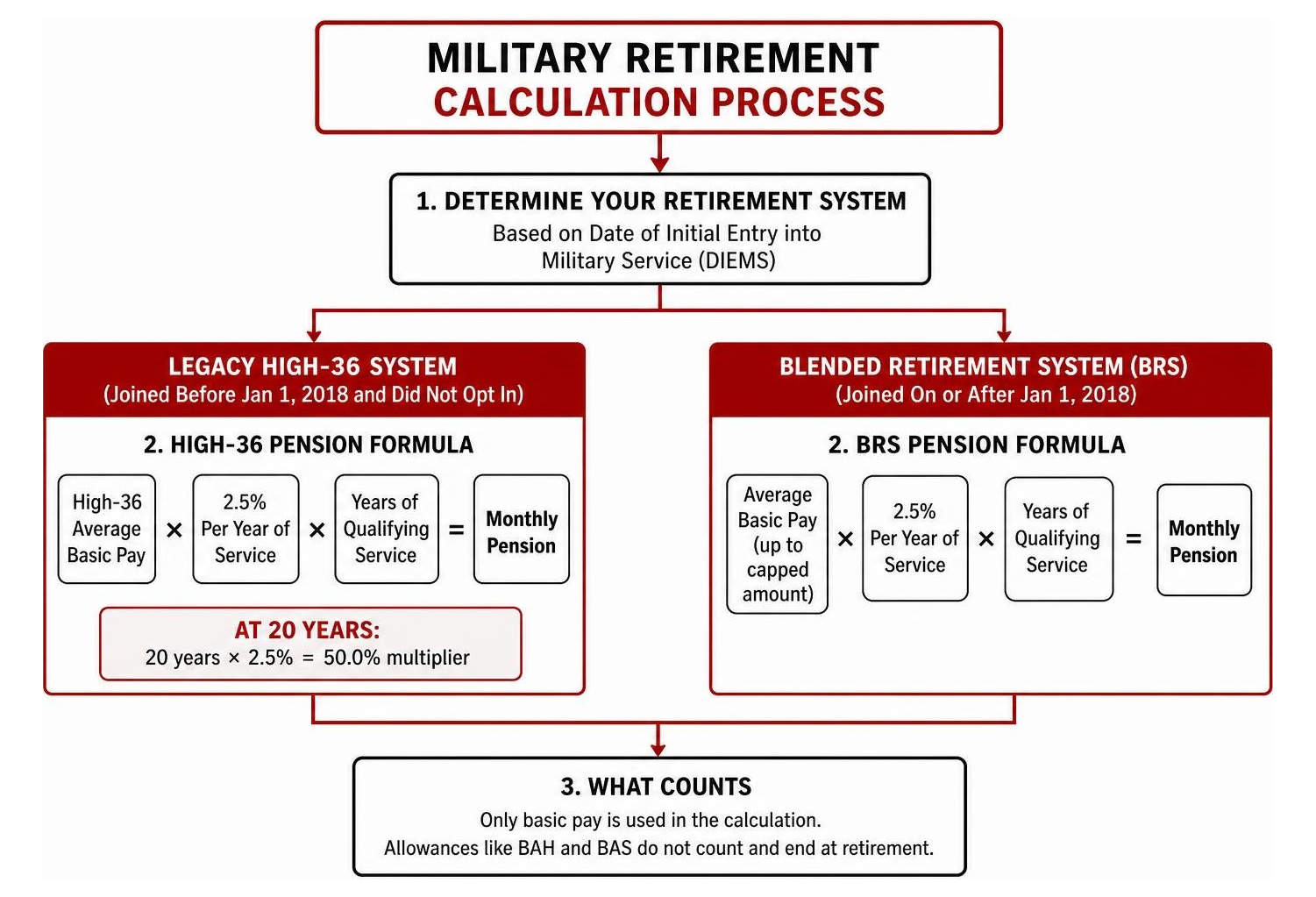
A 20-year active-duty military pension pays 50% of your High-36 average basic pay under the legacy High-36 system, or 40% under the Blended Retirement System (BRS), which also adds TSP matching. Allowances like Basic Allowance for Housing (BAH) and Basic Allowance for Subsistence (BAS) disappear the day you retire. To know where you stand, exploring active duty retirement options begins with knowing which system governs your career.
More Than 90% Of Clients Have Increased VA Disability Ratings! Why Settle For Less Than You Deserve? Expert Priority Help With Your VA Claim! Free Evaluation Call! Click Here For More Info.
Your retirement system is determined by your Date of Initial Entry into Military Service (DIEMS). If you joined the military before January 1, 2018, and did not opt into the Blended Retirement System, you fall under the legacy High-36 system. If you entered service on or after January 1, 2018, you are automatically enrolled in the Blended Retirement System (BRS). Understanding standard military pension eligibility rules ensures you hit your 20 qualifying active-duty years cleanly without administrative hiccups.
The 2.5% High-36 Multiplier Formula
The legacy High-36 system rewards longevity with a straightforward defined benefit. The formula relies on two components: your High-36 average basic pay and your longevity multiplier.
- Longevity Multiplier: You earn 2.5% for every year of active service. At exactly 20 years, your multiplier reaches 50% (20 years × 2.5% = 50.0%).
- High-36 Base Pay: This is the average of your highest 36 consecutive (or non-consecutive, if applicable) months of basic pay across your entire career.
If your 36-month average basic pay is $6,000, your gross monthly retirement check under High-36 is:
$$\text{Gross Monthly Pension} = \$6,000 \times 50\% = \$3,000\text{ per month}$$
The 2.0% BRS Defined Benefit and TSP Matching
The Blended Retirement System (BRS) adjusts the pension formula while providing portable wealth accumulation tools.
- Longevity Multiplier: Under BRS, the multiplier is reduced to 2.0% per year of service. At 20 years, your defined monthly pension pays 40% of your High-36 average basic pay (20 years × 2.0% = 40.0%).
- TSP Government Matching: In exchange for the 10% drop in pension multiplier (from 50% to 40%), the Department of Defense contributes an automatic 1% of your basic pay to your Thrift Savings Plan (TSP) and matches up to an additional 4% after two years of service (5% total).
- Continuation Pay: BRS members can receive a one-time cash payout between 8 and 12 years of service in exchange for an additional service commitment.
- Lump-Sum Option: Retiring BRS service members can elect to receive a 25% or 50% discounted lump-sum payment of their pension value at retirement in exchange for a reduced monthly check until reaching full Social Security retirement age (age 67).
Reviewing the overall financial structure of military retirement benefits shows that disciplined service members who maximize their TSP match often match or exceed the total lifetime value of the legacy pension.
Exact Calculations: How Much Is Military Pension After 20 Years by Rank and Plan
To see the exact dollar impact, we look at the 2026 military pay scale for enlisted and officers to determine the High-36 average basic pay across common 20-year retirement pay grades.
| Rank | Pay Grade | Estimated High-36 Monthly Base Pay | High-36 Monthly Pension (50%) | BRS Monthly Pension (40%) | Annual High-36 Pension | Annual BRS Pension |
|---|---|---|---|---|---|---|
| Staff Sergeant | E-6 | $5,412.30 | $2,706.15 | $2,164.92 | $32,473.80 | $25,979.04 |
| Sergeant First Class / Chief Petty Officer | E-7 | $6,245.70 | $3,122.85 | $2,498.28 | $37,474.20 | $29,979.36 |
| Master Sergeant / Senior Chief | E-8 | $7,025.10 | $3,512.55 | $2,810.04 | $42,150.60 | $33,720.48 |
| Major / Lieutenant Commander | O-4 | $9,859.00 | $4,929.50 | $3,943.60 | $59,154.00 | $47,323.20 |
| Lieutenant Colonel / Commander | O-5 | $10,882.20 | $5,441.10 | $4,352.88 | $65,293.20 | $52,234.56 |
| Colonel / Captain | O-6 | $13,105.80 | $6,552.90 | $5,242.32 | $78,634.80 | $62,907.84 |
Calculating How Much Is Military Pension After 20 Years for Enlisted Ranks
Enlisted members retiring at 20 years typically reach the rank of E-7 or E-8:
- E-7 (Sergeant First Class / Chief Petty Officer): With a High-36 average of $6,245.70 per month, an E-7 receives a gross monthly pension of $3,122.85 under High-36. Under BRS, that same 20-year service record yields $2,498.28 per month in defined benefit pay.
- E-6 (Staff Sergeant / Petty Officer First Class): Retiring at the 20-year mark with an average base pay of $5,412.30 results in $2,706.15 per month under High-36 and $2,164.92 per month under BRS.
- E-8 (Master Sergeant / First Sergeant): An E-8 retiring at 20 years with an average base pay of $7,025.10 collects $3,512.55 monthly under legacy High-36 and $2,810.04 monthly under BRS.
Calculating How Much Is Military Pension After 20 Years for Commissioned Officers
Commissioned officers commonly retire at the O-4 or O-5 pay grade:
- O-4 (Major / Lieutenant Commander): With a High-36 average of $9,859.00, an O-4 receives $4,929.50 per month ($59,154.00 annually) under High-36, or $3,943.60 per month ($47,323.20 annually) under BRS.
- O-5 (Lieutenant Colonel / Commander): An O-5 averaging $10,882.20 in basic pay receives $5,441.10 per month ($65,293.20 annually) under High-36, or $4,352.88 per month ($52,234.56 annually) under BRS.
Lifetime Value, COLA, and Real-World Net Take-Home Factors
Understanding your gross check is only the first step. The true financial power of a military retirement is revealed when analyzing the lifetime financial valuation of military pensions, compound cost-of-living adjustments, and common deductions.

Annual COLA Growth and Lifetime Asset Valuation
Unlike almost all private-sector retirement annuities, military pensions feature annual Cost-of-Living Adjustments (COLA) tied directly to the Consumer Price Index (CPI-U).
- Inflation Compounding: With an average annual COLA of 2.5%, an initial monthly pension of $3,059 for a 39-year-old E-7 will rise to over $6,200 per month by age 68.
- Nominal Lifetime Value: Over a 39-year retirement window (retiring at age 39 with a life expectancy of 78), total nominal payments exceed $2.1 million for an E-7 and $3.8 million for an O-5.
- Private Portfolio Equivalent: Using standard safe withdrawal benchmarks (the 4% rule), generating a guaranteed $3,059 per month ($36,708 annually) in civilian life requires an invested portfolio of approximately $918,000 at retirement day.
Deductions: Taxes, SBP, and VA Disability Offset (CRDP vs. CRSC)
Your gross pension is subject to specific reductions:
- Federal and State Taxes: Military retirement pay is treated as ordinary taxable income by the federal government. State tax treatment varies; many states exempt military pensions entirely, while others tax them as ordinary income.
- Survivor Benefit Plan (SBP): Electing full SBP coverage provides your surviving spouse with up to 55% of your gross pension. The premium costs 6.5% of your elected base amount, deducted automatically from your gross pay before taxes.
- VA Disability Offset and CRDP: If you receive VA disability compensation, federal law generally offsets your military retirement pay dollar-for-dollar by the amount of your tax-free VA compensation. However, under Concurrent Retirement and Disability Pay (CRDP), retirees with a service-connected disability rating of 50% or higher receive both their full military retirement pay and full VA disability compensation concurrently without offset. If your injuries are combat-related, Combat-Related Special Compensation (CRSC) restores offset retirement funds as a tax-free benefit.
Career Trade-Offs: 20-Year Active Duty vs. Reserve Points and Staying to 30 Years
Every service member at the 20-year milestone faces a strategic crossroad: separate into civilian life, transition to the Reserve component, or push forward to 30 years of service.
Non-Regular Reserve and National Guard Point Conversions
If you serve in the Reserve or Army National Guard, review military reserve pension rules to track your retirement points accurately. You must accumulate at least 20 “good years” (earning a minimum of 50 retirement points per year).
$$\text{Equivalent Active Years} = \frac{\text{Total Career Points}}{360}$$
$$\text{Monthly Reserve Pension} = \text{Equivalent Active Years} \times \text{Multiplier (2.5\% or 2.0\%)} \times \text{High-36 Base Pay}$$
For example, a traditional Guardsman who accumulates 3,600 points over 24 years achieves 10 equivalent active years ($3,600 \div 360 = 10$). Under the legacy 2.5% multiplier, their pension multiplier is 25%. If their High-36 base pay is $6,000, they will receive $1,500 per month.
Reserve pensions generally begin at age 60. However, under the National Defense Authorization Act (NDAA) of 2008, every 90 days of qualifying active-duty deployments in support of contingency operations reduces your pension age by 3 months, down to a minimum eligibility age of 50. If you are considering transitioning from regular service, moving from active duty to the reserves allows you to keep building points while starting a full civilian career.
The Financial Trade-Off: Retiring at 20 vs. Staying to 30 Years
Staying past 20 years increases your pension multiplier by 2.5% (High-36) or 2.0% (BRS) each year, reaching 75% (High-36) or 60% (BRS) at 30 years.
While staying to 30 years yields a much larger military pension, retiring at 20 years allows you to “double dip”—collecting an immediate pension while earning a full civilian salary and contributing to a second retirement plan for 10 prime working years. Evaluating the retirement math of staying to 20 years shows that transitioning at 20 frequently yields a higher cumulative net worth by age 60.
Frequently Asked Questions About 20-Year Military Pensions
Can I receive both military retired pay and VA disability compensation?
Yes. Under Concurrent Retirement and Disability Pay (CRDP), any military retiree with 20+ years of service and a VA disability rating of 50% or greater receives their full military retirement check and their full, tax-free VA disability compensation simultaneously. No manual application is required; DFAS and the VA coordinate payments automatically.
When do National Guard and Reserve members start receiving pension payments?
Standard non-regular retirement pay begins at age 60. However, eligible active-duty service performed after January 28, 2008, can reduce that age by 3-month increments for every aggregate 90 days served within a fiscal year, down to a statutory floor of age 50. TRICARE Prime/Select retiree healthcare benefits remain anchored to age 60 regardless of early pay eligibility.
How does the 2026 military pay raise affect my High-3 retirement calculation?
The 3.8% military basic pay raise increases your basic pay numbers in real-time. Because the High-36 is an average of your highest 36 months, an active-duty pay increase gradually pulls up that 3-year average with every month served under the higher pay chart.
Conclusion
Calculating your 20-year military pension comes down to your High-36 average basic pay, your multiplier (50% legacy vs. 40% BRS), and your long-term transition goals. Whether you plan to step immediately into a corporate role or build toward a second public-service pension, your military defined benefit remains one of the most stable financial foundations in the nation.
To dive deeper into service-specific payout rules, explore our comprehensive military pension eligibility and retirement pay guide at USMilitary.com to structure your post-service financial roadmap.
Free for Service Members & Veterans
Get the military benefits intel no one tells you about.
Weekly updates on VA benefits, pay changes, and money tips — free for service members and veterans.
No spam. Unsubscribe anytime. Your info is never shared.


