What You Need to Know About Military Pension Eligibility
Military pension eligibility depends on which retirement system applies to you, how long you’ve served, and what type of service you performed. Here’s a quick breakdown:
| Factor | Requirement |
|---|---|
| Active Duty Pension | 20+ years of active service |
| Reserve/National Guard Pension | 20+ qualifying years + age 60 |
| Blended Retirement System (BRS) | Entered service on or after Jan. 1, 2018 |
| High-36 / Final Pay (Legacy) | Entered service before Jan. 1, 2018 |
| Disability Retirement (Chapter 61) | At least 30% disability rating |
| VA Veterans Pension | Wartime service + income/net worth limits |
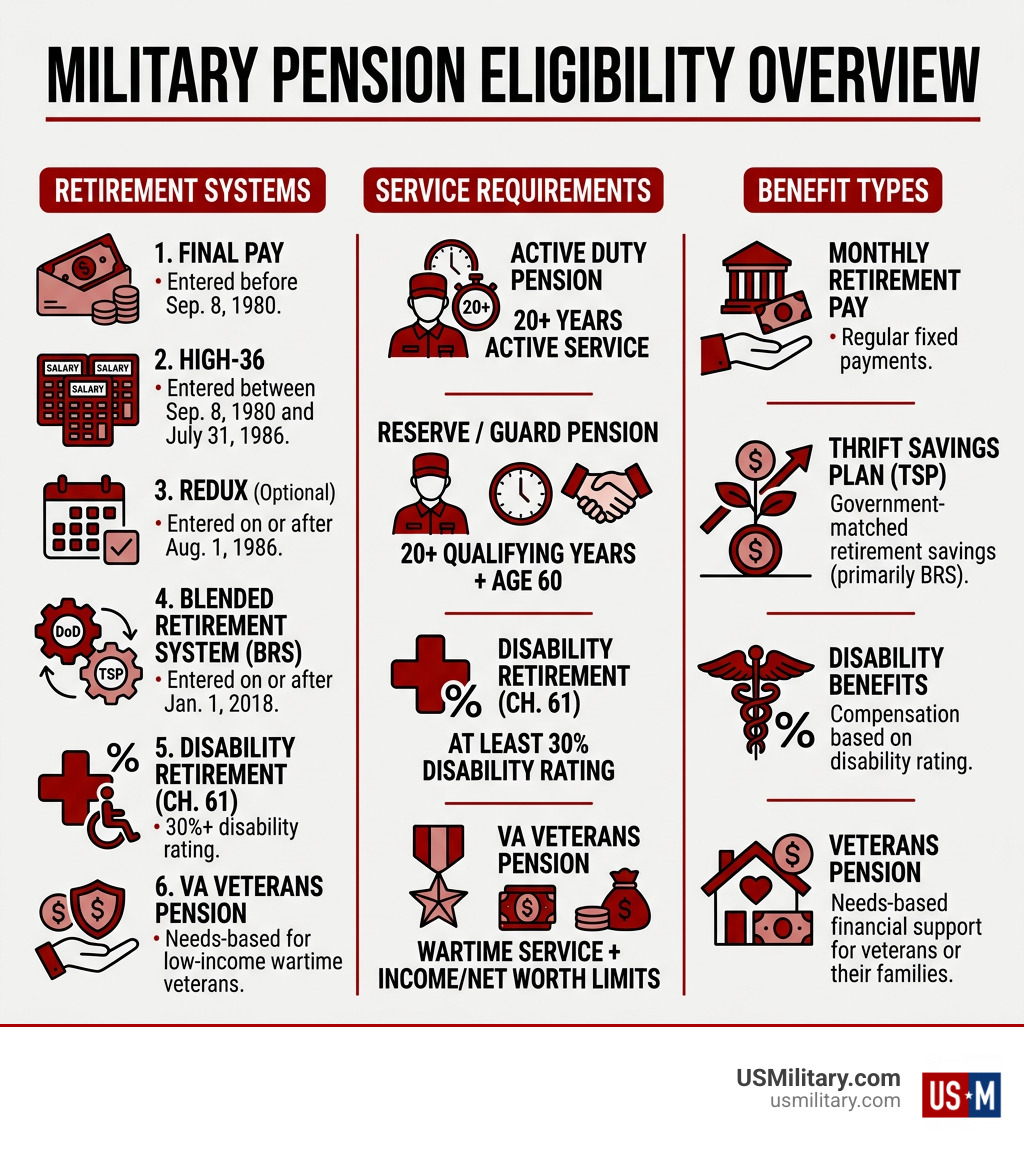
There are six main retirement systems to know:
- Final Pay – For those who entered service before Sept. 8, 1980
- High-36 – For those who entered between Sept. 8, 1980 and July 31, 1986
- REDUX – Optional plan for those who entered on or after Aug. 1, 1986
- Blended Retirement System (BRS) – For those who entered on or after Jan. 1, 2018
- Disability Retirement (Chapter 61) – For service members with a 30%+ disability rating
- VA Veterans Pension – A needs-based benefit for low-income wartime veterans
Military pension rules are complex. The plan you fall under, how much you’ll receive, and when you can start collecting all depend on when you joined, how long you served, and what type of service you performed.
I’m Larry Fowler, publisher of USMilitary.com since 2007, and I’ve spent nearly two decades helping active service members and veterans navigate the details of military pension eligibility and VA benefits. In the sections below, I’ll walk you through everything you need to know — clearly and without the jargon.
Understanding the Different Military Pension Plans
When we talk about military retirement, we aren’t talking about a “one size fits all” program. The Department of Defense has updated the retirement landscape several times over the last few decades. The most important factor in determining which plan you fall under is your Date of Initial Entry into Military Service (DIEMS). This date is “fixed”—it doesn’t change even if you have a break in service.
There are four primary “regular” retirement systems for those who serve a full career:
- Final Pay: This is the “grandfather” of plans. If you entered service before September 8, 1980, your pension is calculated using your final basic pay.
- High-36 (Legacy): For those who joined between September 8, 1980, and December 31, 2017, this is the standard. It uses the average of your highest 36 months of basic pay. You can learn more about the Legacy or High 36 Retirement System to see how it differs from newer models.
- REDUX: This was an optional choice for those who entered after August 1, 1986. It offered a $30,000 Career Status Bonus at the 15-year mark in exchange for a reduced pension multiplier.
- Blended Retirement System (BRS): This is the current system for everyone joining today. It combines a traditional pension with a 401(k)-style Thrift Savings Plan (TSP).
Multiplier Comparison Table
The “multiplier” is the percentage of your pay you receive for each year of service. Here is how they stack up at the 20-year mark:
| Retirement Plan | Multiplier at 20 Years | Payout Calculation |
|---|---|---|
| Final Pay | 50% | 2.5% x Years of Service |
| High-36 | 50% | 2.5% x Years of Service |
| REDUX | 40% | (2.5% x YOS) – 1% for each year under 30 |
| BRS | 40% | 2.0% x Years of Service |
Factors That Impact Military Pension Eligibility
The most significant hurdle for military pension eligibility is the 20-year requirement. For active duty members, this means 20 years of active service. For our brothers and sisters in the Guard and Reserve, it means 20 “qualifying” years.
To help you plan, you should Find your basic pay amount using current DFAS tables. Your rank and total years of service at the time of retirement will dictate your “Retired Pay Base,” which is the foundation of your monthly check.
Active Duty and Reserve Military Pension Eligibility
For active duty members, the math is relatively straightforward: serve 20 years, and you can retire the next day with a pension for life. However, for the Reserve Component (National Guard and Army Reserve), the rules are a bit more nuanced.
To earn a “qualifying year” in the Reserves, you must earn at least 50 retirement points in a single anniversary year. Points are earned through:
- Active duty service (1 point per day)
- Unit training assemblies/Drill (1 point per semi-drill)
- Membership (15 points per year just for being in)
- Correspondence courses
While you can earn your “20-year letter” (Notice of Eligibility) in your late 30s or 40s, you generally cannot begin collecting pay until age 60. However, the National Defense Authorization Act (NDAA) of 2008 introduced a way to lower that age. For every 90 days of “specified duty” (usually deployments) performed after January 28, 2008, you can reduce your pension start age by three months. You cannot reduce the age below 50.
We always tell our readers that military retirement requires long-range planning for best success. If you are in the Reserves, you must proactively Learn more about how reserve retirement benefits work because payments do not start automatically—you have to apply for them when you reach the eligible age.
Disqualification and Service Requirements
It is a tough reality to face, but not everyone who serves 20 years gets their pension. Certain actions can lead to disqualification.
- Dishonorable Discharge: Receiving a dishonorable discharge or a bad conduct discharge via a general court-martial will almost certainly strip you of retirement eligibility.
- Felony Incarceration: In the Army, for example, your pension can be terminated if you are incarcerated for more than two months following a felony or misdemeanor conviction. While payments can sometimes resume after release, it is a significant financial blow.
- Legal Issues: If you have an “Other Than Honorable” (OTH) discharge, you may be ineligible for many benefits. However, you can request a Character of Discharge review or apply for a discharge upgrade through your branch’s Board for Correction of Military Records.
The Blended Retirement System (BRS) and TSP
If you joined the service on or after January 1, 2018, you are automatically enrolled in the Blended Retirement System (BRS). If you joined between 2006 and 2017, you might have had the choice to opt into this system.
The BRS is a “blended” model because it offers two main components:
- A Defined Benefit (Pension): You still get a monthly check for life if you serve 20 years, but the multiplier is 2.0% instead of 2.5%. This means at 20 years, you get 40% of your pay instead of 50%.
- A Defined Contribution (TSP): The government puts money into your retirement account regardless of whether you do, and they match your contributions up to a certain point.
Thrift Savings Plan (TSP) and Military Pension Eligibility
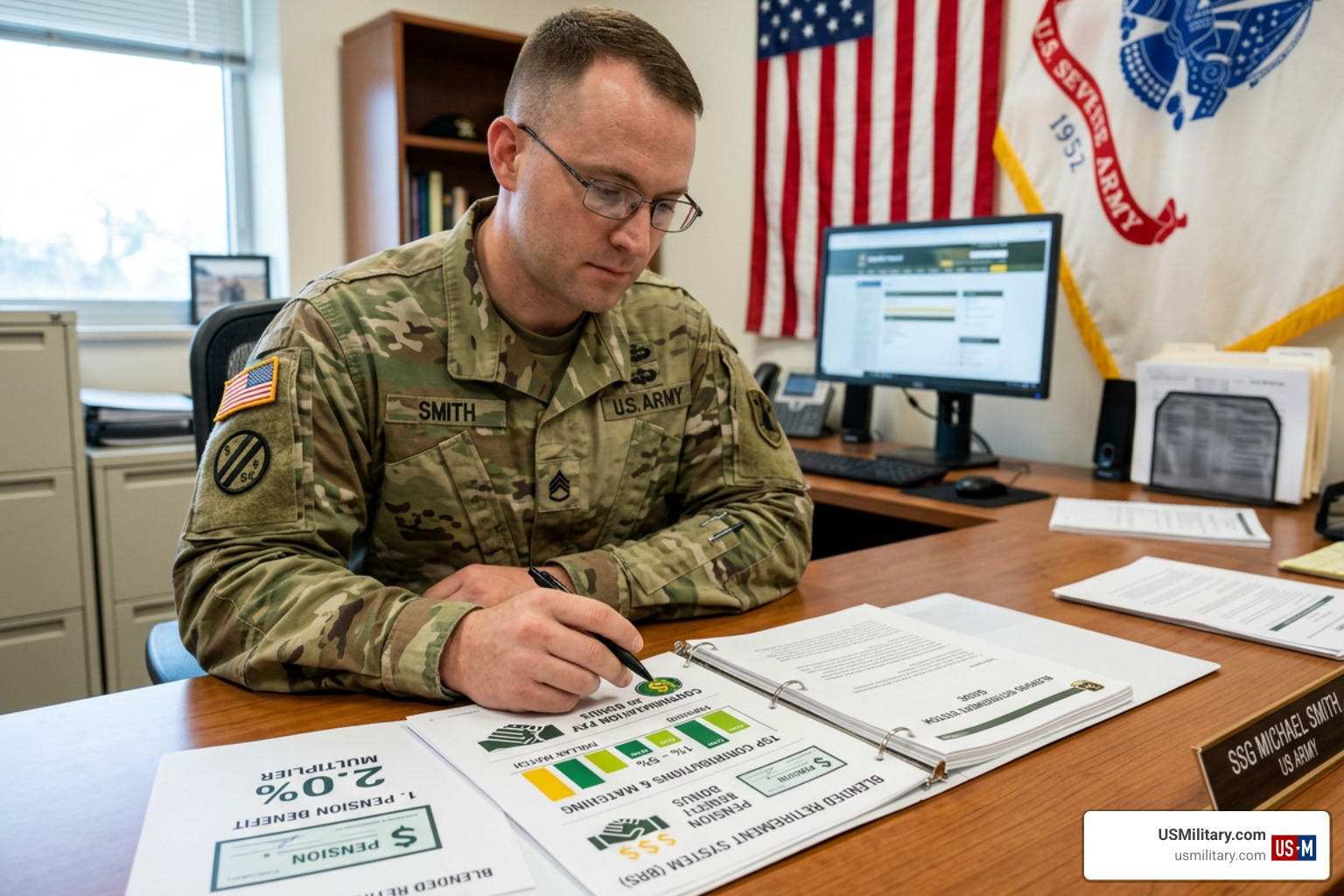
The Thrift Savings Plan (TSP) is essentially the military’s version of a 401(k). Under the BRS, the government provides a 1% automatic contribution after 60 days of service. After two years of service, you are “fully vested,” meaning the money the government put in is yours to keep even if you leave the military before 20 years.
✉ Get updates like this in your inbox
Weekly VA benefit changes, pay updates, and money tips for service members, veterans, and military families. Free, no spam.
The government will also match your contributions dollar-for-dollar on the first 3% you contribute, and 50 cents on the dollar for the next 2%. To get the full 5% “free money” match, you need to contribute at least 5% of your basic pay. This makes the BRS a great deal for the 80% of service members who don’t stay for a full 20 years, as they can take their TSP balance with them into the civilian world.
Disability Retirement and VA Pension Programs
Sometimes, a military career is cut short due to injury or illness. This is where Chapter 61 Disability Retirement comes into play. If you are found “unfit for duty” and have a disability rating of at least 30%, you may be eligible for a medical retirement pension, even if you haven’t served 20 years.
This is different from VA disability compensation. While the military focuses on whether you can still do your job, the VA focuses on how your service-connected disability affects your life as a civilian. One of the most common questions we get is, Can you receive 100% VA disability and military retirement pay? The answer is yes, through programs like Concurrent Receipt (CRDP), provided you meet certain criteria (usually 20 years of service and a 50% or higher VA rating).
You should Find out how military disability retirement works to understand the difference between “permanent” disability retirement and the Temporary Disability Retired List (TDRL).
VA Pension vs. Military Pension Eligibility
It is easy to confuse a “Military Retirement Pension” with a “VA Veterans Pension.” They are very different:
- Military Retirement: Earned by 20+ years of service or medical retirement. It is not based on financial need.
- VA Veterans Pension: A needs-based program for low-income wartime veterans who are either age 65 or older, or have a permanent and total non-service-connected disability.
To be eligible for the VA Pension, you must have served at least 90 days of active duty, with at least one day during a recognized wartime period (such as the Gulf War, which is still ongoing for VA purposes). There are also strict income and net worth limits. As of 2024, the net worth limit is around $155,356, which includes your annual income and your spouse’s assets but excludes your primary home and car.
Dependents and Discharge Status
If you qualify for a VA Pension, having dependents (a spouse or children) can significantly increase your monthly payment. The VA uses a “Maximum Annual Pension Rate” (MAPR), and that cap goes up for every qualifying dependent you have.
Furthermore, if you are a veteran who requires the daily help of another person, you may qualify for Aid and Attendance or Housebound benefits, which are additional payments added to the base pension.
For those who have lost a loved one, it is important to check the Eligibility rules and how to apply for a VA Survivors Pension. This provides a monthly payment to the un-remarried surviving spouse and/or unmarried children of a deceased wartime veteran.
How to Calculate and Apply for Your Benefits
Calculating your future check helps you bridge the gap between service and civilian life. For the High-36 plan, the formula is: 2.5% x Years of Service x Average of your highest 36 months of basic pay.
For example, if you retire after 24 years of service, your multiplier is 60% (2.5 x 24). If your average high-36 pay was $6,000, your pension would be $3,600 a month.
One of the best features of military retirement pay is the Cost of Living Adjustment (COLA). Every year, the government adjusts your pension based on the Consumer Price Index (CPI) to ensure your purchasing power isn’t eaten away by inflation.
We recommend you Use a military pension calculator to estimate retirement pay to get a more precise figure based on your specific DIEMS and expected retirement date. Also, don’t forget that retirement isn’t just about the check; Tricare: A primary source of military retirement health care benefits provides massive savings compared to civilian health insurance.
The Application Process
Your pension does not start automatically the day you hang up the uniform.
- For Military Retirement: You must apply through your branch’s personnel command (e.g., Human Resources Command for the Army). Once approved, your pay is managed through DFAS myPay. Ensure your contact information is updated with a personal email address before you leave.
- For VA Veterans Pension: You must fill out VA Form 21P-527EZ. You can submit this through a Pension Management Center (PMC), at a regional benefit office, or online.
You can Get the details of how to apply for a Veterans Pension through the official VA portal.
Frequently Asked Questions about Military Pension Eligibility
How many years do I need to serve to get a military pension?
For a standard non-disability retirement, you must serve at least 20 years. Under the BRS, you can keep government contributions to your TSP after just two years, but the monthly “pension” check still requires the 20-year milestone.
Can I get a military pension if I was in the Reserves?
Yes. You need 20 qualifying years (years where you earned at least 50 points). You generally start receiving pay at age 60, though deployments can lower that age to as young as 50.
What is the difference between military retirement pay and a VA pension?
Military retirement pay is a benefit earned through a 20-year career. A VA pension is a needs-based “safety net” for wartime veterans with low income and limited assets who are elderly or disabled.
Conclusion
Navigating military pension eligibility can feel like a full-time job, but understanding these rules is the key to your financial future. Whether you are just starting your career under the BRS or you are a “salty” veteran looking to claim a wartime pension, the benefits you’ve earned are a testament to your sacrifice.
At USMilitary.com, we are dedicated to being your central hub for all things military. From financial readiness to maximizing your VA benefits, we’ve got your back. We encourage you to Explore more military retirement benefits and stay informed as policies change. Thank you for your service!
Free for Service Members & Veterans
Get the military benefits intel no one tells you about.
Weekly updates on VA benefits, pay changes, and money tips — free for service members and veterans.
No spam. Unsubscribe anytime. Your info is never shared.


