Understanding Military Retirement Systems Before You Calculate
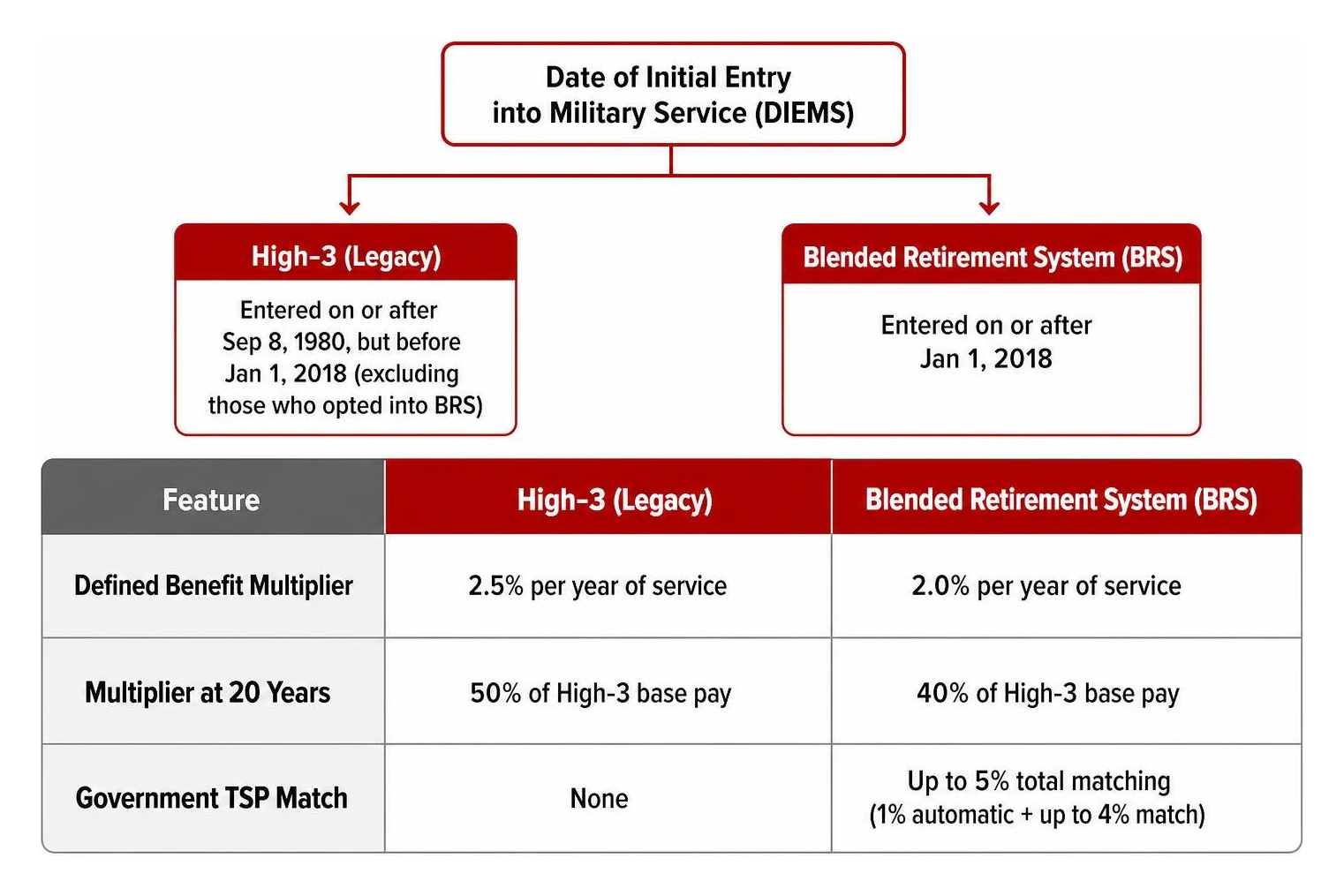
Before entering numbers into a military pension calculator, you must identify which retirement plan governs your service. Your Date of Initial Entry into Military Service (DIEMS) dictates your baseline rules, formulas, and options. For a deep dive into qualification requirements, review The Ultimate Guide to Army Pension Eligibility and Retirement Pay.
High-3 vs Blended Retirement System (BRS)
The legacy High-3 system applies to service members who entered on or after September 8, 1980, but before January 1, 2018 (excluding those who opted into BRS). High-3 uses a 2.5% multiplier per year of service. Reaching 20 years yields a 50% multiplier of your average base pay over your highest 36 months of earnings.
The Blended Retirement System (BRS) applies to everyone entering service on or after January 1, 2018. BRS reduces the defined pension multiplier to 2.0% per year (a 40% multiplier at 20 years). In exchange, BRS adds an automatic 1% government contribution to your Thrift Savings Plan (TSP) and up to a 4% matching contribution, along with a continuation pay option at mid-career.
| Feature | High-3 (Legacy) | Blended Retirement System (BRS) |
|---|---|---|
| Defined Benefit Multiplier | 2.5% per year of service | 2.0% per year of service |
| Multiplier at 20 Years | 50% of High-3 base pay | 40% of High-3 base pay |
| Government TSP Match | None | Up to 5% total matching |
| Continuation Pay | None | Yes (typically at 8-12 years) |
| Vesting for Retirement | 20 years for pension | 2 years for TSP match; 20 years for pension |
Final Pay and REDUX Eligibility Rules
Two additional systems exist for specific cohorts:
- Final Pay System: Applies to service members who entered service prior to September 8, 1980. The formula uses a 2.5% multiplier based strictly on your final monthly basic pay rate.
- REDUX System: Applied to members who entered service after August 1, 1986, and elected the $30,000 Career Status Bonus (CSB) at their 15-year milestone. REDUX features a lower multiplier prior to age 62 (2.0% per year minus 1% for each year under 30 years) with a growth re-adjustment at age 62.
For a clearer picture of historical entry windows, check our guide on Military Pension Eligibility 101.
Step-by-Step Guide: How to Use a Military Pension Calculator Effectively
Generating reliable results from a military pension calculator requires accurate data inputs. DFAS guidelines outline specific financial and military timeline metrics that dictate your monthly income. You can access direct official DoD tools on the official Calculators portal.
Key Inputs Needed for Your Military Pension Calculator Estimate
When preparing your estimate, keep these inputs ready:
- Pay Grade/Rank at Retirement: Your final rank or projected rank at retirement.
- Total Years of Service (YOS): Total active duty years and months.
- High-36 Base Pay Average: The exact average of your highest 36 months of basic pay. If unknown, entering your final rank and projected retirement date lets the tool estimate base pay using official military pay tables.
- Target Retirement Date: Sets the Cost-of-Living Adjustment (COLA) baseline and pay scale figures.
Comparing 20-Year vs 24-Year Career Projections
Staying beyond 20 years significantly boosts lifetime pension value. Under High-3:
- 20 Years of Service: 20 YOS × 2.5% = 50% multiplier
- 24 Years of Service: 24 YOS × 2.5% = 60% multiplier
- 30 Years of Service: 30 YOS × 2.5% = 75% cap
For a service member with a High-3 average base pay of $5,200:
- At 20 years: $5,200 × 50% = $2,600/month
- At 24 years: $5,200 × 60% = $3,120/month
An additional four years delivers a 20% increase in monthly gross retired pay. Explore career duration scenarios in detail at The Golden Years: Navigating Your Active Duty Retirement Options.
Custom vs Public Calculators and Specialized Military Retirement Tools

Service members can choose between login-protected tools and open public calculators depending on their access levels and security preferences.
Public Calculators vs CAC-Enabled Custom Calculators
Official service branch websites offer custom, CAC-enabled calculators (such as Air Force tools integrated with MilPDS data). Logging in with a Common Access Card auto-populates your active record details, including exact service history, pay entry dates, and dependent information.
By contrast, public calculators require manual entry. Official public tools hosted on defense portals strictly operate under zero-data-retention rules: no personal identifying data is requested, stored, or tracked, protecting operational security while delivering precise math.
Medical Disability Retirement and SCAADL Calculators
Not all military retirements follow standard active duty timelines. Specialized tools support medical and injury scenarios:
- Medical Retirement Calculators: Available across BRS, High-3, Final Pay, and REDUX systems. These evaluate benefits using either your total years of service multiplier or your assigned DoD disability rating percentage (up to a 75% max cap), granting the higher payout of the two.
- SCAADL Calculator: The Special Compensation for Assistance with Activities of Daily Living tool estimates extra monthly compensation for catastrophically injured or ill service members requiring permanent daily living assistance.
You can run independent scenarios using third-party tools like the Military Service Retirement & Pension Calculator | AgentCalc .
Factoring in SBP, RMC, and Supplemental Retirement Benefits
Gross pension is only part of your financial equation. Post-retirement deductions and active compensation benchmarks shape your true financial transition.
How SBP Premiums and Annuities Affect Monthly Pay
The Survivor Benefit Plan (SBP) protects family members by continuing a portion of your pension if you pass away.
- SBP Premium Cost: Estimated at 6.5% of your gross monthly pension.
- Survivor Annuity Value: Delivers 55% of your gross pension amount to your designated beneficiary.
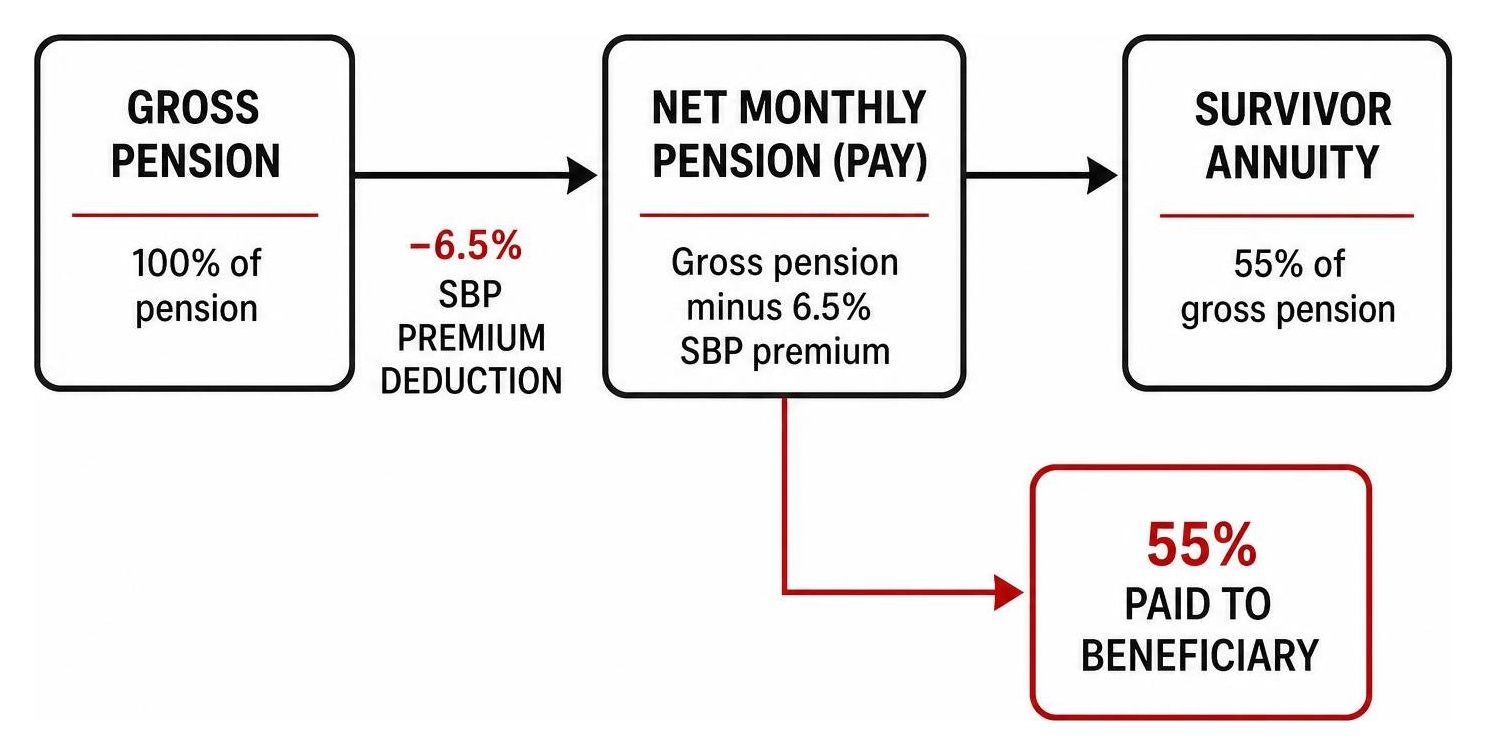
If your gross pension is $3,120 per month:
- Gross Monthly Pension: $3,120
- SBP Premium Deduction (6.5%): -$202.80
- Net Monthly Pension: $2,917.20
- Survivor Benefit Protection: $1,716/month paid to your spouse/beneficiary.
Regular Military Compensation (RMC) vs Pension Calculators
The Regular Military Compensation (RMC) calculator measures total current active duty compensation—combining Basic Pay, Allowance for Housing (BAH), Basic Allowance for Subsistence (BAS), and the federal tax advantage of non-taxable allowances.
Because military pensions apply only to basic pay, your active income (RMC) will always be substantially higher than your retirement pay. Running an RMC calculation alongside your pension calculation highlights the exact income gap you must address in civilian life.
Critical Limitations of an Online Military Pension Calculator
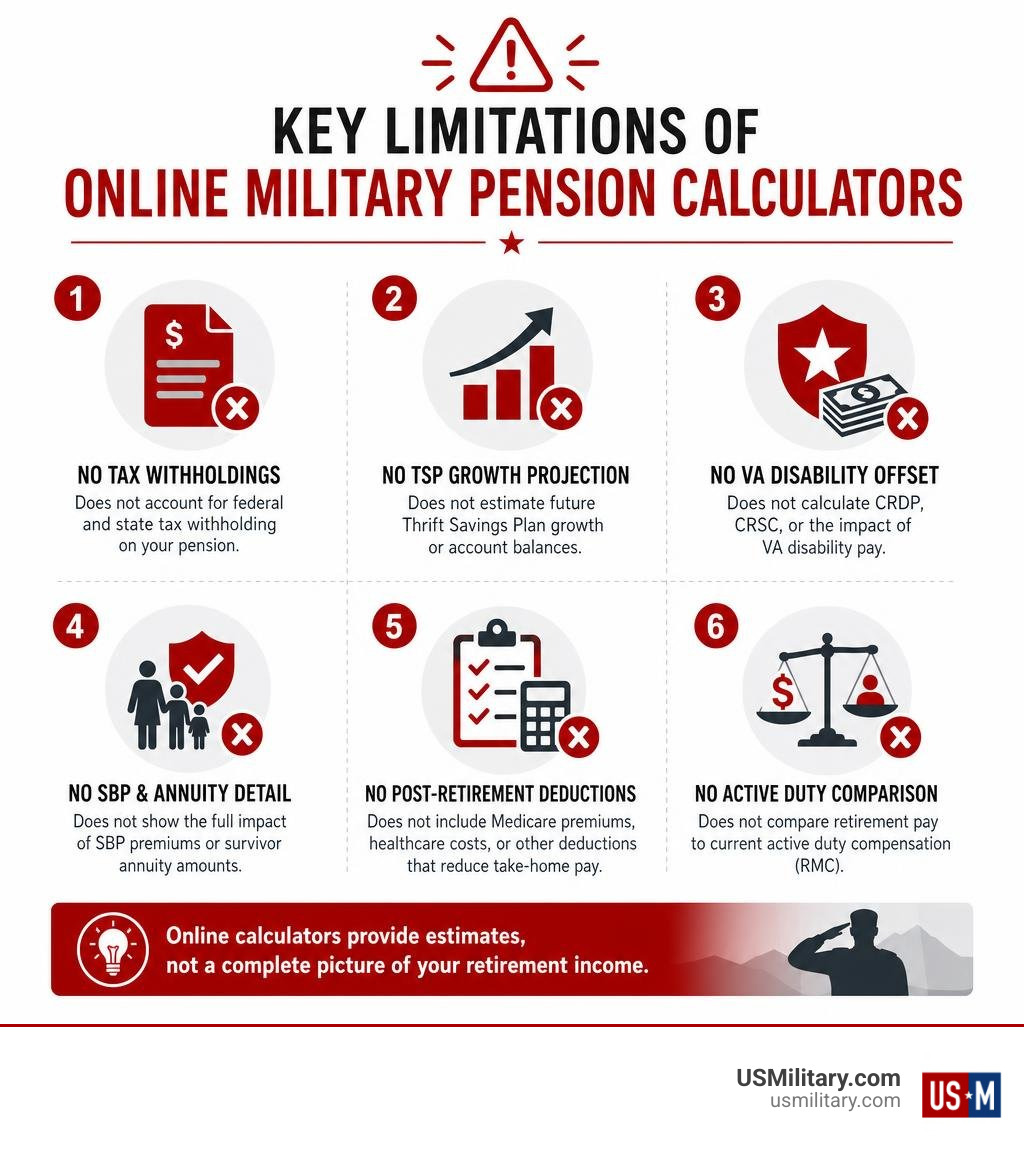
While an online military pension calculator offers useful baseline estimates, standard online scripts leave out several critical tax and benefit factors. You can review official planning resources at Military Retirement Calculator, Pay, Pension .
Tax Withholdings, TSP Growth, and VA Disability Adjustments
When reviewing calculator output, account for these major gaps:
- VA Disability Pay Offsets and Dual Receipt: Basic online estimators do not calculate Concurrent Receipt (CRDP) or Combat-Related Special Compensation (CRSC). If you receive a VA disability rating of 50% or higher, CRDP allows you to draw both full military retirement and full VA disability pay. Learn more about these interactions in our guide: Can You Receive 100% VA Disability and Military Retirement Pay?.
- State and Federal Tax Withholdings: Calculators display gross taxable pay. Military retirement is subject to federal income taxes, though state tax rules vary widely (some states exempt military pensions entirely).
- Thrift Savings Plan (TSP) Wealth Compound: Pension calculators ignore private investment balances. Under BRS, a significant portion of your net worth resides in your compounding TSP account, which requires separate financial projections.
Frequently Asked Questions about Military Retirement Pay
Does using an official military retirement calculator compromise my personal data?
No. Official Department of Defense public calculators do not request, track, or retain any personally identifiable information (PII). Custom CAC tools process data inside secure military databases without storing session entries externally.
What calculator should I use if I joined before September 8, 1980?
Use the Final Pay Calculator or Medical Final Pay Calculator. Under this legacy plan, pension math multiplies your years of service by 2.5% against your single final monthly basic pay figure.
How do reserve component retirement calculations differ from active duty?
Reserve Component (National Guard and Reserve) calculations base pension pay on accumulated retirement points rather than straight calendar years. Additionally, reserve pension checks typically begin at age 60 rather than immediately upon separation, subject to early eligibility reductions for qualifying deployment periods. Read our complete operational breakdown at The Crossover: Maximizing Your Retirement Benefits When Moving From Active Duty to Reserves.
Conclusion

A military pension calculator provides clear visibility into your future financial stability. By accurately identifying your retirement system, entering exact time-in-service benchmarks, accounting for SBP survivor costs, and factoring in external elements like VA disability pay and TSP balances, you can approach retirement with total confidence.
Take control of your future earnings by reviewing your service timeline and estimating your pension outcomes today. Visit USMilitary.com to explore our complete suite of financial guides, VA benefits advisors, and transition resources, or jump straight into our focused planning guide on Military Retirement Benefits. For personal inspiration on navigating major life transitions, check out Dare to Live Greatly.
Free for Service Members & Veterans
Get the military benefits intel no one tells you about.
Weekly updates on VA benefits, pay changes, and money tips — free for service members and veterans.
No spam. Unsubscribe anytime. Your info is never shared.


