What Is Military Time? (Quick Answer)
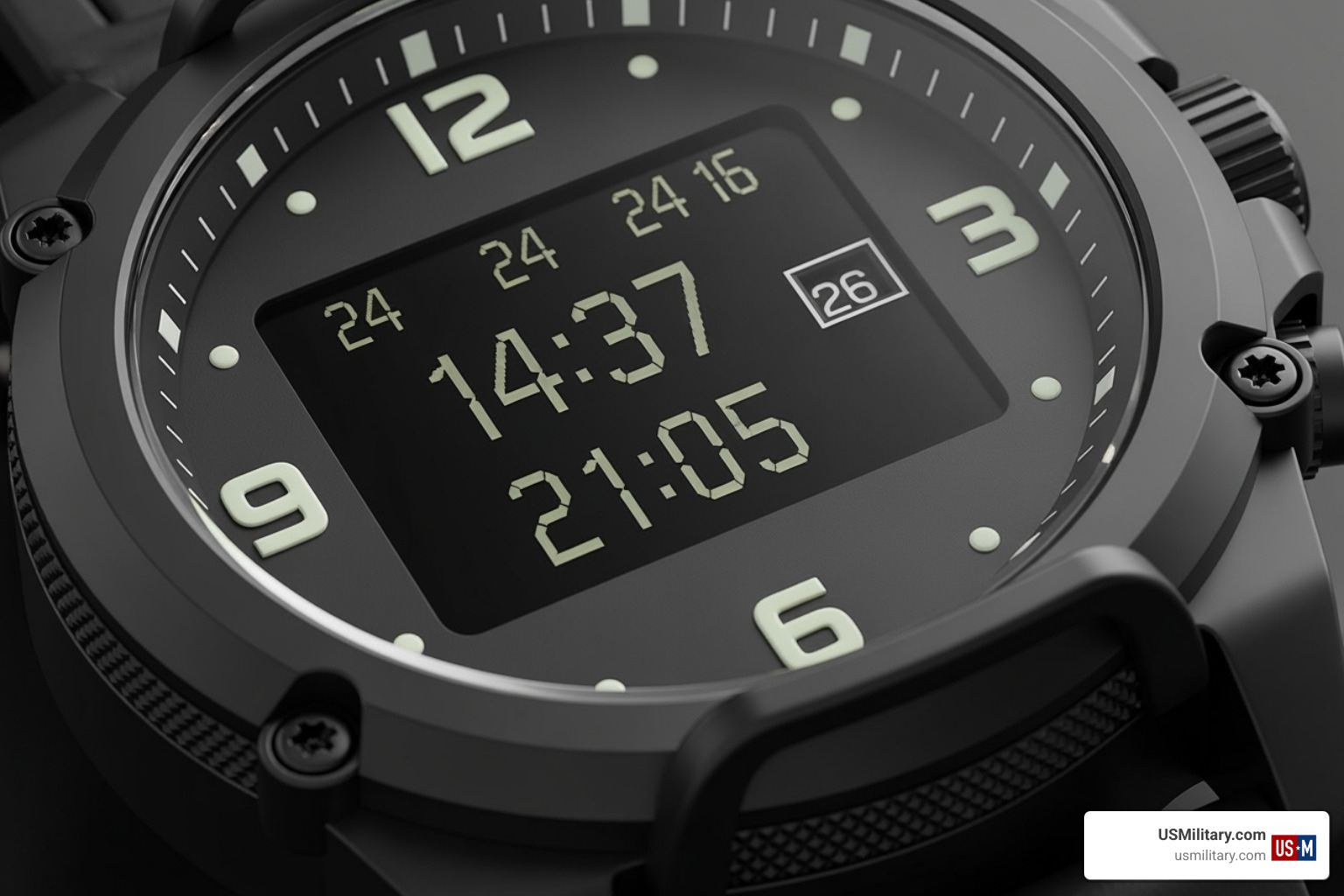
Military time is a 24-hour clock system that numbers each hour of the day from 0000 (midnight) to 2359 (one minute before the next midnight) — no AM or PM needed.
Here’s a quick-reference conversion at a glance:
| Standard Time | Military Time | Spoken As |
|---|---|---|
| 12:00 AM (midnight) | 0000 | Zero hundred hours |
| 6:00 AM | 0600 | Zero six hundred hours |
| 12:00 PM (noon) | 1200 | Twelve hundred hours |
| 3:00 PM | 1500 | Fifteen hundred hours |
| 9:00 PM | 2100 | Twenty-one hundred hours |
Two simple rules cover almost every conversion:
- Morning hours (12:01 AM–12:59 PM): The number stays the same — just use four digits. 7:00 AM = 0700.
- Afternoon and evening hours (1:00 PM–11:59 PM): Add 12 to the hour. 3:00 PM + 12 = 1500.
That’s really all there is to it. The rest of this guide covers pronunciation, writing conventions, time zones, and history — so you can use military time with full confidence.
The ambiguity of AM and PM might seem like a small problem — until it isn’t. Imagine a military pilot, an ER nurse, or an air traffic controller acting on the wrong half of the day. In high-stakes environments, that kind of confusion is simply not an option. Military time solves it completely by giving every hour of the day its own unique number.
I’m Larry Fowler, publisher of the USMilitary.com Network since 2007, and through years of supporting active-duty service members, veterans, and recruits, I’ve seen how understanding military time is one of the first practical skills anyone entering military life needs to master. This guide will walk you through everything — clearly and quickly.
What is Military Time and Why is it Used?
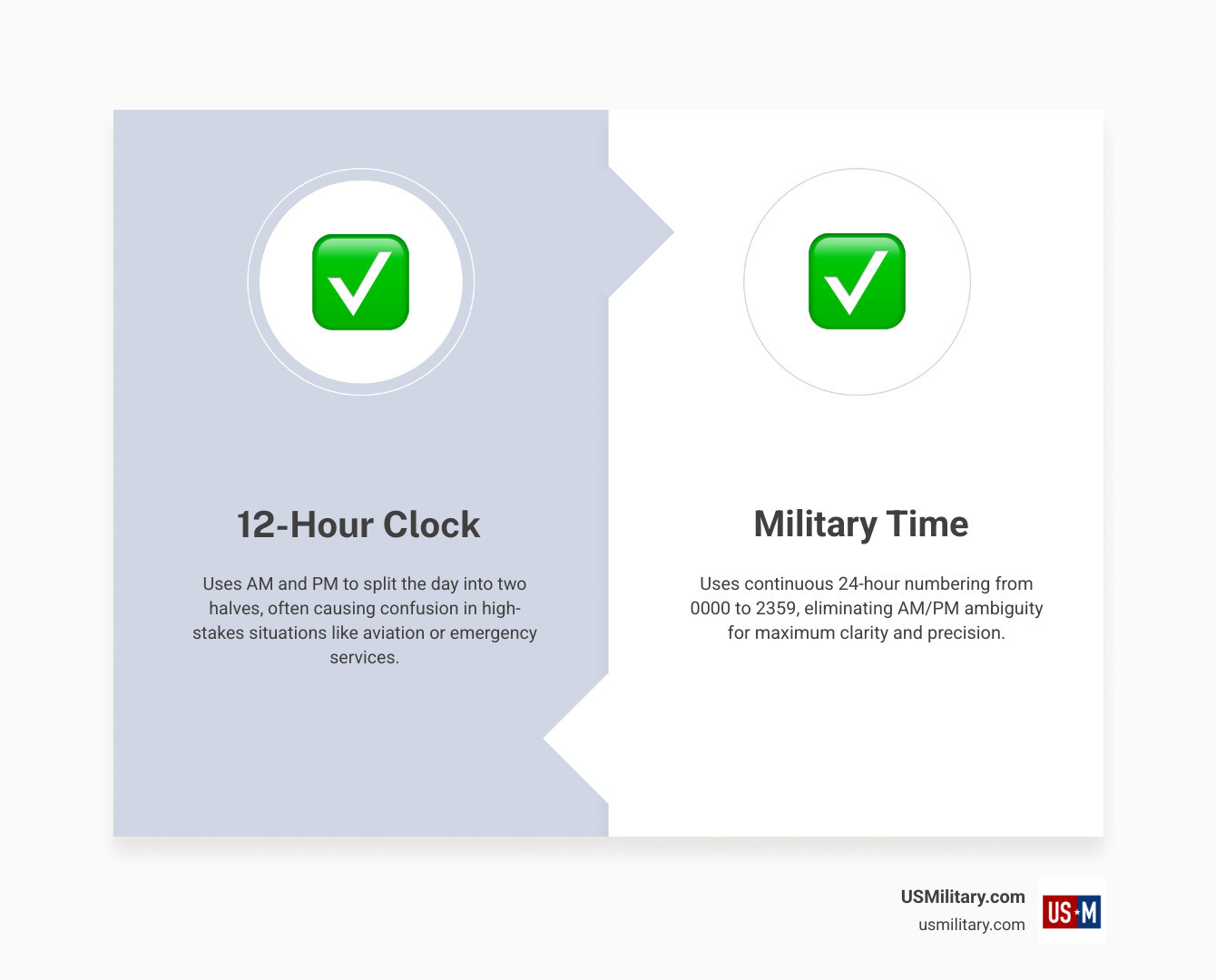
At its core, military time is the practice of using a 24-hour clock instead of the traditional 12-hour clock common in the United States. While most Americans are used to splitting the day into two 12-hour halves labeled AM (ante meridiem) and PM (post meridiem), the military and many international organizations prefer a continuous numbering system.
In this system, the day begins at midnight and runs through 23:59. There is no “reset” at lunchtime. Instead, the hours keep climbing. This eliminates the possibility of a critical error, such as a soldier showing up for a briefing at 0700 (7:00 AM) when the mission actually started at 1900 (7:00 PM).

Beyond the barracks, this system is a staple in high-stakes professions where precision is a matter of life and death. You will find it used extensively in:
- Aviation and Navigation: Pilots and air traffic controllers must synchronize across multiple time zones.
- Emergency Services: Paramedics, firefighters, and police officers use it to create unambiguous logs of events.
- Healthcare: Doctors and nurses use the 24-hour clock to prevent medication errors and accurately track patient history.
- Science and Astronomy: Researchers use “astronomical time” to document observations without the confusion of regional AM/PM conventions.
For a deeper dive into the mechanics, you can explore our resources on Understanding Military Time or check out the Military Time: The 24 Hour Clock breakdown.
Mastering Military Time Conversions
Learning to convert between standard and military time is like learning a simple mental shortcut. Once you grasp the “Add 12” rule, you’ll never have to look at a chart again.
The Conversion Table
To help you get started, here is a side-by-side comparison of the two systems:
| 12-Hour Clock | Military Time | 12-Hour Clock | Military Time |
|---|---|---|---|
| 12:00 AM | 0000 | 12:00 PM | 1200 |
| 1:00 AM | 0100 | 1:00 PM | 1300 |
| 2:00 AM | 0200 | 2:00 PM | 1400 |
| 3:00 AM | 0300 | 3:00 PM | 1500 |
| 4:00 AM | 0400 | 4:00 PM | 1600 |
| 5:00 AM | 0500 | 5:00 PM | 1700 |
| 6:00 AM | 0600 | 6:00 PM | 1800 |
| 7:00 AM | 0700 | 7:00 PM | 1900 |
| 8:00 AM | 0800 | 8:00 PM | 2000 |
| 9:00 AM | 0900 | 9:00 PM | 2100 |
| 10:00 AM | 1000 | 10:00 PM | 2200 |
| 11:00 AM | 1100 | 11:00 PM | 2300 |
The “Add 12” Rule for Afternoon Conversion
For any time from 1:00 PM to 11:59 PM, simply add 12 to the hour. For example, if it is 4:30 PM, you take 4 + 12 = 16. The time becomes 1630. If you are going the other way—converting 2100 to standard time—you just subtract 12 from the hour (21 – 12 = 9) to get 9:00 PM.
Morning and Midnight Nuances
Morning hours are even easier. From 1:00 AM to 12:59 PM, the hours remain the same; you just need to ensure you are using a four-digit format. For example, 8:15 AM becomes 0815.
Midnight is the only time that occasionally causes a double-take. In the military, the day begins at 0000. However, 2400 is sometimes used to denote the exact end of a day. On digital devices and computers, you will almost exclusively see 0000. If you’re ever stuck, a Military Time Converter can be a helpful tool for quick verification. You can also find more tips on How to Use Military Time on our site.
✉ Get updates like this in your inbox
Weekly VA benefit changes, pay updates, and money tips for service members, veterans, and military families. Free, no spam.
How to Speak and Write Like a Pro
In the civilian world, we use colons and AM/PM markers. In the military world, we strip away the fluff for maximum efficiency. Writing and speaking military time correctly is about following a strict, standardized format.
Writing Military Time Correct-ly
When writing, there are three golden rules:
- Use Four Digits: Always. 9:00 AM is 0900, not 900.
- No Colons: In official military usage, the colon is removed. Instead of 14:00, you write 1400.
- No AM/PM: The number itself tells you the time of day, so these markers are redundant.
For specific examples, see our guides on What is 1400 in Military Time or What is 1800 in Military Time.
Speaking Military Time with Confidence
Speaking the time is where most people get tripped up. The military doesn’t say “eight hundred,” they say “zero eight hundred” or “oh eight hundred.”
- Full Hours: These are spoken as “hundreds.” For instance, 1000 is “ten hundred hours.” 2000 is “twenty hundred hours.”
- Hours with Minutes: If there are minutes involved, you drop the “hundred.” 1630 is spoken as “sixteen thirty.” You don’t say “sixteen hundred and thirty.”
- Leading Zeros: Always pronounce the leading zero. 0500 is “zero five hundred.” Some people use “oh” instead of “zero,” which is generally accepted in casual military conversation but “zero” is the formal standard for radio clarity.
Military Time Zones and the NATO Phonetic Alphabet
When the military operates globally, “noon” doesn’t mean the same thing in Florida as it does in Iraq. To handle this, the military uses a system of 25 time zones, each assigned a letter from the NATO phonetic alphabet.
Zulu Time (The Universal Reference)
The most important time zone to know is Zulu Time. This refers to Greenwich Mean Time (GMT) or Coordinated Universal Time (UTC). Because the letter “Z” is at the end of the alphabet and represents the zero-meridian, it is called “Zulu” in the phonetic alphabet.
When a commander issues an order for an operation at “1400Z,” every unit involved—no matter where they are in the world—knows exactly when that is by adjusting their local clock to the Zulu reference. You can check current universal time at Time.gov.
Other Common Zones
- Juliet Time (J): This is often used to refer to the observer’s local time.
- Romeo Time (R): Commonly used for Eastern Standard Time in the U.S.
To understand how these letters are pronounced and used in communication, check out The Military Alphabet or our Beginners Guide to Alphabet Military.
The History and Global Adoption of the 24-Hour Clock
The 24-hour clock isn’t just a “military thing”—it’s actually the international standard (known as ISO 8601). While the U.S. is one of the few countries that still clings to the 12-hour clock for daily life, most of the world uses the 24-hour system for everything from train schedules to television listings.
The history of the 24-hour clock dates back much further than modern militaries. However, its adoption by the U.S. Armed Forces was a gradual process:
- 1920: The United States Navy became the first U.S. organization to officially adopt the 24-hour system after seeing its effectiveness during World War I.
- 1934: The British Broadcasting Corporation (BBC) began using it for broadcast announcements.
- 1942: On July 1, the United States Army officially adopted the 24-hour clock to ensure better coordination during the height of World War II.
By the late 1920s, countries like Germany, Spain, and Portugal had already made the switch. Today, it remains the most common time notation in the world, often referred to as “astronomical time” in scientific circles. You can read more about this evolution in the 24-hour clock history archives.
Frequently Asked Questions about Military Time
Is midnight 0000 or 2400?
Both can technically be used, but they represent different things. 0000 is the start of the day, while 2400 is the absolute end of the day. In practice, if you look at a digital watch or a computer log, you will almost always see 0000. Think of 2400 as the “finish line” and 0000 as the “starting block.”
Why doesn’t military time use colons?
Efficiency and clarity. In radio transmissions or quickly scribbled tactical logs, a colon is just one more character that could be misinterpreted or lost. The four-digit block (e.g., 1730) is unambiguous and faster to write. If you see a colon used with 24-hour time, it is usually in a scientific or civilian context, not a strict military one.
What are the most common conversion mistakes?
The most common error is forgetting to add 12 to the “12:00 PM” hour or the “12:00 AM” hour incorrectly.
- 12:00 PM (Noon) is 1200. People often try to add 12 to it and get 2400, which is incorrect.
- 12:00 AM (Midnight) is 0000.
- Another common mistake is saying “fourteen hundred and thirty” instead of “fourteen thirty.”
Conclusion
Mastering military time is more than just a party trick; it’s a fundamental skill for anyone in the military community or high-pressure professional fields. It replaces the confusion of AM and PM with a rock-solid, 24-hour cycle that ensures everyone is on the same page, whether they are in a hospital ward in New York or a flight deck in the Pacific.
At USMilitary.com, we are committed to providing you with the tools and knowledge you need to navigate every aspect of military life. From understanding VA home loans to mastering the basics of communication, we are here to serve as your central hub for guidance.
Ready to put your new skills to the test? Start using the 24-hour clock on your phone today and Master Military Time Today to ensure you’re always on schedule, every single time.
Free for Service Members & Veterans
Get the military benefits intel no one tells you about.
Weekly updates on VA benefits, pay changes, and money tips — free for service members and veterans.
No spam. Unsubscribe anytime. Your info is never shared.


