Why Understanding VA Disability Rates for 2026 Matters to You
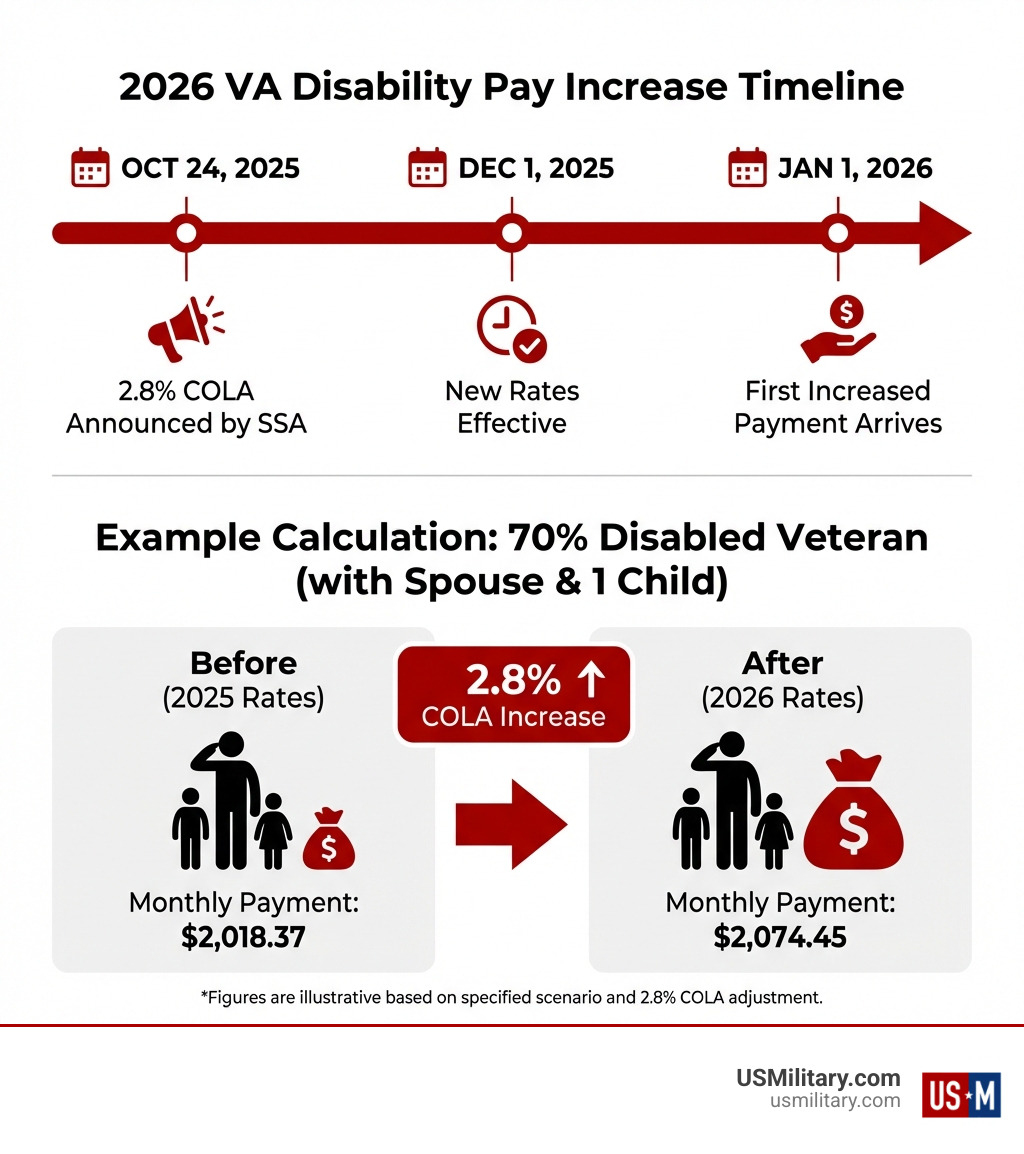
VA disability rates for 2026 increased by 2.8% due to the annual Cost-of-Living Adjustment (COLA), with new rates taking effect December 1, 2025. Here’s what you need to know:
Quick Reference: 2026 VA Disability Rates
| Disability Rating | Monthly Pay (Veteran Alone) | Monthly Pay (Veteran + Spouse + 1 Child) |
|---|---|---|
| 10% | $180.42 | No additional pay for dependents |
| 20% | $356.66 | No additional pay for dependents |
| 30% | $552.47 | $666.47 |
| 50% | $1,132.90 | $1,283.02 |
| 70% | $1,808.45 | $2,074.45 |
| 100% | $3,938.58 | $4,318.99 |
Key Facts:
- The 2.8% increase is effective from December 1, 2025 through December 2026
- All VA disability payments are tax-free
- Veterans with 30% or higher ratings receive additional compensation for dependents
- Average claim processing time is approximately 85 days
- The VA uses a “combined rating system” for veterans with multiple disabilities
If you’re a veteran with service-connected disabilities, understanding these rates helps you plan your finances and ensure you’re receiving the full compensation you’ve earned. The adjustment keeps pace with inflation and protects your purchasing power.
The process can seem complicated—from figuring out your combined rating to understanding dependent pay to navigating the claims system. Many veterans struggle with these complexities and miss out on benefits they deserve.
As Larry Fowler, I’ve been tracking VA disability rates and benefits through USMilitary.com since 2007, helping hundreds of thousands of veterans understand their VA disability rates for 2026 and maximize their earned benefits. I’ll walk you through everything you need to know in straightforward terms.
Va disability rates for 2026 vocab explained:
Understanding the 2026 VA Disability Pay Increase
We’re excited to share that VA disability rates for 2026 saw a 2.8% increase, a crucial adjustment designed to safeguard the purchasing power of your benefits. This annual increase, known as the Cost-of-Living Adjustment (COLA), is directly tied to the Social Security Administration’s (SSA) announcement. By law, the VA is required to match the percentage of COLA adjustments made to Social Security benefits. This ensures that as the cost of living rises due to inflation, your disability compensation keeps pace.
The 2.8% COLA for 2026 was officially announced by the Social Security Administration on October 24, 2025. This means the new, higher rates took effect on December 1, 2025, and will remain in place throughout December 2026. Because the VA pays benefits in arrears, the first payment veterans received reflecting this 2.8% increase arrived on January 1, 2026.
All VA disability payments are tax-free, making this increase even more significant for your financial well-being. This adjustment is a testament to the commitment to support our veterans, ensuring that the benefits you’ve earned continue to provide meaningful financial stability. For the most up-to-date information on COLA, you can always refer to the official SSA website. We encourage you to keep an eye on these announcements annually to stay informed about your benefits.
Get the latest COLA information on the SSA website
Complete VA Disability Rates for 2026
Understanding your specific monthly payment can feel like navigating a maze, but we’re here to help clarify the VA disability rates for 2026. Your basic monthly rate is determined by your assigned disability percentage, but that’s just the starting point. Additional amounts can be added based on your dependent status, which includes a spouse, children, and even dependent parents.

The VA’s compensation structure is designed to provide greater financial support for veterans with higher disability ratings and more dependents. We’ll break down the rates by disability percentage and then explain how dependents influence these amounts.
2026 Pay Rates for 10% – 20% Disability Rating
For veterans with a lower disability rating, the compensation is a flat rate regardless of dependents. If your service-connected conditions result in a 10% or 20% rating, your monthly pay for 2026 is as follows:
- 10% disability rating: $180.42 per month
- 20% disability rating: $356.66 per month
At these ratings, the VA does not provide additional compensation for dependents. This means a veteran with a 10% rating and no dependents receives the same amount as a veteran with a 10% rating, a spouse, and children.
2026 Pay Rates for 30% – 60% Disability Rating with Dependents
The picture changes significantly once your disability rating reaches 30% or higher. At this point, the VA recognizes the added financial responsibilities of dependents and provides additional compensation. This can include a spouse, children (under 18 or qualifying schoolchildren over 18), and dependent parents.
Let’s look at some examples of how dependents can affect your monthly payment for VA disability rates for 2026:
| Disability Rating | Veteran Alone | Veteran + Spouse | Veteran + Spouse + 1 Child | Veteran + Spouse + 2 Children | Veteran + Spouse + 1 Child + 1 Parent |
|---|---|---|---|---|---|
| 30% | $552.47 | $617.47 | $666.47 | $698.47 | $793.72 |
| 40% | $795.84 | $882.84 | $947.84 | $991.84 | $1,170.09 |
| 50% | $1,132.90 | $1,248.90 | $1,335.90 | $1,397.90 | $1,617.90 |
| 60% | $1,435.02 | $1,570.02 | $1,663.02 | $1,728.02 | $1,993.02 |
As you can see, the presence of dependents can substantially increase your monthly compensation. For instance, a veteran with a 70% disability rating, a spouse, and three dependent children under 18 would receive $2,367.45 per month. This highlights the importance of accurately reporting and maintaining your dependent information with the VA.
For a comprehensive breakdown of all dependent scenarios, we recommend consulting the official VA compensation rating tables.
View the official VA compensation rating tables
The new va disability rates for 2026 for 70% – 100% Ratings
When we look at the higher disability ratings, particularly from 70% to 100%, the monthly compensation significantly increases, reflecting the profound impact severe service-connected conditions have on a veteran’s life. These higher ratings also come with more substantial additional benefits for dependents.

Here’s a snapshot of the VA disability rates for 2026 for these higher ratings, including the impact of dependents:
| Disability Rating | Veteran Alone | Veteran + Spouse | Veteran + Spouse + 1 Child | Veteran + Spouse + 1 Child + 1 Parent |
|---|---|---|---|---|
| 70% | $1,808.45 | $1,971.45 | $2,074.45 | $2,296.45 |
| 80% | $2,102.15 | $2,285.15 | $2,403.15 | $2,656.15 |
| 90% | $2,362.30 | $2,563.30 | $2,698.30 | $2,982.30 |
| 100% | $3,938.58 | $4,158.17 | $4,318.99 | $4,582.44 |
Additional Benefits for Dependents:
Beyond the basic rates, veterans with a 30% or higher rating can receive extra compensation for:
- Each additional child under 18: This amount varies by disability rating. For a 100% disability rating, it’s an additional $109.11 per child.
- Each additional schoolchild over 18: If your child is between 18 and 23 and attending school, you can receive a higher additional amount. For a 100% rating, this is $352.45 per month.
- Dependent parents: If you financially support one or both of your parents, they can be claimed as dependents, increasing your monthly pay.
- Aid and Attendance (A&A) for spouse: If your spouse requires the aid and attendance of another person due to a disability, you may qualify for an additional allowance. For a 100% disability rating, this could add $201.41 per month.
These additional benefits are designed to provide comprehensive support for veterans and their families, acknowledging the increased financial burden that can come with severe service-connected disabilities.
How the VA Determines Your Disability Compensation
The journey to receiving VA disability compensation begins with a fundamental principle: proving a “service connection.” This means demonstrating that your illness or injury is directly linked to your military service. The VA carefully reviews all evidence to determine this connection.
Once service connection is established, the VA evaluates the severity of your disability. This assessment is based on a thorough review of medical evidence, including your service medical records, private medical records, and often, a Compensation and Pension (C&P) exam. During a C&P exam, a VA-appointed medical professional assesses your condition. They use a system of diagnostic codes, which are specific criteria for rating various conditions, to assign a percentage that reflects how much your service-connected condition impairs your overall health and ability to function.
✉ Get updates like this in your inbox
Weekly VA benefit changes, pay updates, and money tips for service members, veterans, and military families. Free, no spam.
Several factors influence your final monthly payment amount:
- Your assigned disability rating: This is the primary driver of your compensation.
- Number and type of dependents: As we’ve discussed, spouses, children, and dependent parents can increase your payment.
- Special monthly compensation (SMC): This is an additional benefit for certain severe disabilities or combinations of disabilities.
- Aid and Attendance (A&A): If you or a dependent requires assistance with daily living, this can add to your compensation.
- Total Disability based on Individual Unemployability (TDIU): This allows veterans unable to work due to service-connected conditions to receive compensation at the 100% rate, even if their combined rating is lower.
The VA’s goal is to provide fair and accurate compensation that reflects the true impact of your service-connected conditions.
The VA Combined Rating System (“VA Math”)
One of the most frequently asked questions we encounter at USMilitary.com is about how the VA calculates combined disability ratings, often affectionately (or not-so-affectionately) referred to as “VA Math.” It’s not as simple as adding percentages together, and this can be a source of confusion for many veterans.
The VA uses a “whole person” theory, meaning that each subsequent disability rating is applied to the remaining “healthy” portion of the veteran. This system ensures that a veteran cannot be more than 100% disabled.
Here’s how it works:
- Arrange from highest to lowest: List your individual service-connected disability ratings from the highest percentage to the lowest.
- Combine the top two: The VA combines the two highest ratings first. It does this by taking the highest rating and then calculating the percentage of the remaining efficiency for the next highest rating.
- For example, if you have a 40% rating and a 20% rating:
- Start with the highest: 40% (meaning you are 60% efficient).
- Take 20% of the remaining 60% efficiency: 0.20 * 60% = 12%.
- Add this to the highest rating: 40% + 12% = 52%.
- Round to the nearest 10%: The combined rating of 52% is then rounded to the nearest 10%, resulting in a 50% combined rating.
- Iterate for more disabilities: If you have more than two disabilities, you take the result from the previous combination (e.g., 50%) and combine it with the next highest rating, repeating steps 2 and 3.
- For instance, if you have ratings of 60%, 30%, and 20%:
- Combine 60% and 30%:
- 60% (40% efficient remaining).
- 30% of 40% = 12%.
- 60% + 12% = 72%.
- Now combine 72% with the next highest (20%):
- 72% (28% efficient remaining).
- 20% of 28% = 5.6%.
- 72% + 5.6% = 77.6%.
- Round 77.6% to the nearest 10%, which is 80%.
This method can be complex, but it’s crucial for understanding your overall disability rating and the corresponding VA disability rates for 2026.
Special Considerations: TDIU and Dependent Status
Beyond the standard disability ratings, there are special considerations that can significantly impact your compensation. Two of the most important are Total Disability based on Individual Unemployability (TDIU) and your dependent status.
Total Disability based on Individual Unemployability (TDIU)
TDIU is a lifeline for veterans whose service-connected conditions prevent them from maintaining substantially gainful employment, even if their combined disability rating is less than 100%. If you qualify for TDIU, the VA will pay you at the 100% disability rate, ensuring you receive the maximum compensation.
To be eligible for TDIU, you generally need:
- One service-connected disability rated at 60% or more, OR
- Two or more service-connected disabilities with at least one rated at 40% or more, and a combined rating of 70% or more.
The key factor is proving that your service-connected conditions, not other factors, make it impossible for you to work. We encourage any veteran struggling to maintain employment due to their disabilities to explore TDIU.
Dependent Status
We’ve touched on this before, but it bears repeating: your dependent status plays a significant role in your monthly VA disability compensation, especially if your rating is 30% or higher. The VA provides additional compensation for:
- Spouse: A legally married spouse is a primary dependent.
- Children under 18: Each child under the age of 18 qualifies for additional compensation.
- Dependent parents: If you provide more than 50% of a parent’s financial support, they can be claimed as a dependent.
- Schoolchildren over 18: Children between 18 and 23 who are attending school full-time and are financially dependent on you also qualify for additional compensation.
It’s vital to keep your dependent information updated with the VA. Failing to do so could mean you’re missing out on benefits you’re rightfully owed.
Navigating the VA Disability Claim Process
Applying for VA disability benefits can feel overwhelming, but understanding the application process, required evidence, and ways to speed up your claim can make a significant difference. We want to empower you with the knowledge to steer this system effectively.
Here’s an overview of the key steps and what you need to know:
How to Apply and What Documentation is Needed
The process for applying for VA disability benefits is designed to be accessible, with several methods available:
- Online: The Department of Veterans Affairs recommends applying online through the VA’s official portal. This is often the quickest and most efficient method.
Apply online through the VA’s portal - By Mail: You can also apply by mail using VA Form 21-526EZ, “Application for Disability Compensation and Related Compensation Benefits.”
Mail with VA Form 21-526EZ - In Person: Visit your regional VA benefits office for assistance with your application.
- With Professional Help: Many veterans choose to work with an accredited Veterans Service Officer (VSO), attorney, or claims agent. These professionals can provide invaluable guidance and help you gather necessary documentation.
Regardless of how you apply, gathering the right documentation is crucial. Here are the essential documents you’ll need:
- DD214 (Certificate of Release or Discharge from Active Duty): This document proves your military service.
- Medical Records: This includes both your service medical records and any private medical records related to your service-connected conditions. These records are vital evidence of your diagnosis, symptoms, and the impact of your disability.
- Nexus Letter: This is a medical opinion from a doctor that explicitly links your current medical condition to your military service. A strong nexus letter can be a game-changer for your claim.
- Dependency Records: If you’re claiming dependents, you’ll need documents like marriage certificates, birth certificates, and school enrollment records.
The more complete and organized your documentation is from the outset, the smoother your claim process is likely to be.
Speeding Up Your Claim: Timelines and Tips
We know that waiting for a decision on your disability claim can be incredibly stressful. As of November 2025, the average time to complete VA disability-related claims is around 85 days, according to Veterans Benefits Administration (VBA) reports. However, there are strategies you can employ to potentially speed up this process.
Here are the different types of claims and tips for quicker processing:
- Standard Claim: This is the most common type, where the VA gathers all necessary evidence. It typically takes the longest.
- Fully Developed Claim (FDC): This is often the fastest route. With an FDC, you submit all relevant evidence (medical records, nexus letters, etc.) upfront with your application. If you opt for an FDC, you could receive a decision within 30 days. The VA recommends this method for quicker processing.
- Benefits Delivery at Discharge (BDD) Program: If you’re still on active duty but separating within 90 to 180 days, the BDD program allows you to file your claim before discharge. This can significantly reduce the waiting time for benefits to start after you separate.
Benefits Delivery at Discharge (BDD) - Decision Ready Claims (DRC) Program: This program, facilitated by Veterans Service Organizations (VSOs), aims for claims to be processed in 30 days or less. However, there are additional restrictions for filing under the DRC program, so consulting your VSO is key to determine if it’s right for you.
- Priority Processing Requests: In certain urgent situations, you may qualify for faster review. This includes cases of terminal illness, extreme financial hardship, or if you are age 85 or older. To apply, you would submit VA Form 20-10207.
VA Form 20-10207
General Tips to Speed Up Your Claim:
- Submit everything upfront: For any claim type, providing complete documentation from the start is the best way to avoid delays.
- Get a nexus letter: A doctor’s letter explicitly linking your condition to service is invaluable.
- Establish VA care: Receiving treatment at a VA health facility can create a clear record of your conditions.
- Stay organized: Keep copies of all submitted documents and correspondence.
- Work with a VSO: An accredited VSO can help you steer the paperwork, understand deadlines, and advocate on your behalf.
You can track the average processing times and other data on VA claims through official reports.
Check VA claim processing data
Frequently Asked Questions about the VA Disability Rates for 2026
We understand that you might have more questions about the VA disability rates for 2026 and how they apply to your unique situation. Here are answers to some common inquiries:
How are the new va disability rates for 2026 calculated?
The VA disability rates for 2026 are calculated by applying the annual Cost-of-Living Adjustment (COLA) to the previous year’s rates. For 2026, this adjustment was a 2.8% increase. This percentage is determined by the Social Security Administration (SSA) to help ensure that benefits maintain their purchasing power against inflation. Once the COLA percentage is announced, the VA adjusts its compensation tables accordingly.
Can I receive VA disability pay for multiple conditions?
Yes, absolutely! The VA recognizes that veterans often have multiple service-connected disabilities. However, instead of simply adding the percentages together, the VA uses a unique method called the Combined Rating System, often referred to as “VA Math.” This system calculates a single, overall disability rating by considering the impact of each disability on the “whole person.” The process involves combining ratings sequentially and then rounding the final percentage to the nearest 10%. This final combined rating then determines your monthly payment, with additional compensation for dependents if your rating is 30% or higher.
When will I see the 2.8% increase in my monthly payment?
The new VA disability rates for 2026, reflecting the 2.8% COLA increase, took effect on December 1, 2025. Because the VA pays benefits in arrears (meaning your payment for a given month covers the previous month’s benefits), the first monthly payment that included this 2.8% increase was issued on January 1, 2026. This payment covered your benefits for December 2025. You should have seen the increased amount in your January 2026 payment and will continue to receive it throughout the year.
Conclusion
Understanding your VA disability rates for 2026 is more than just knowing a number; it’s about recognizing the financial security and support you’ve earned through your service. We’ve seen that the 2.8% COLA increase is a vital mechanism for protecting your purchasing power against inflation, ensuring your benefits remain meaningful.
We’ve explored how your disability rating, the complex but fair combined rating system (“VA Math”), and your dependent status all play crucial roles in determining your monthly compensation. From the basic rates for 10% and 20% ratings to the significant additional benefits available for higher ratings and dependents, every detail matters. We also digd into the application process, the essential documentation required, and valuable strategies like Fully Developed Claims and the Benefits Delivery at Discharge program to help you steer the system more efficiently.
At USMilitary.com, our mission is to provide comprehensive resources and unbiased information to military members and veterans. We believe that by understanding these details, you can confidently access the benefits you’ve rightfully earned. Don’t let the complexity deter you; empower yourself with knowledge and reach out for assistance when needed. Your service is appreciated, and ensuring you receive your full benefits is our priority.
Explore all your disabled veteran benefits
Free for Service Members & Veterans
Get the military benefits intel no one tells you about.
Weekly updates on VA benefits, pay changes, and money tips — free for service members and veterans.
No spam. Unsubscribe anytime. Your info is never shared.