Understanding the Path to Becoming a Marine
The age limit for marines enlistment is a critical factor for anyone considering joining one of the world’s most elite fighting forces. If you’re ready to explore whether you meet the requirements, here’s what you need to know:
Quick Answer:
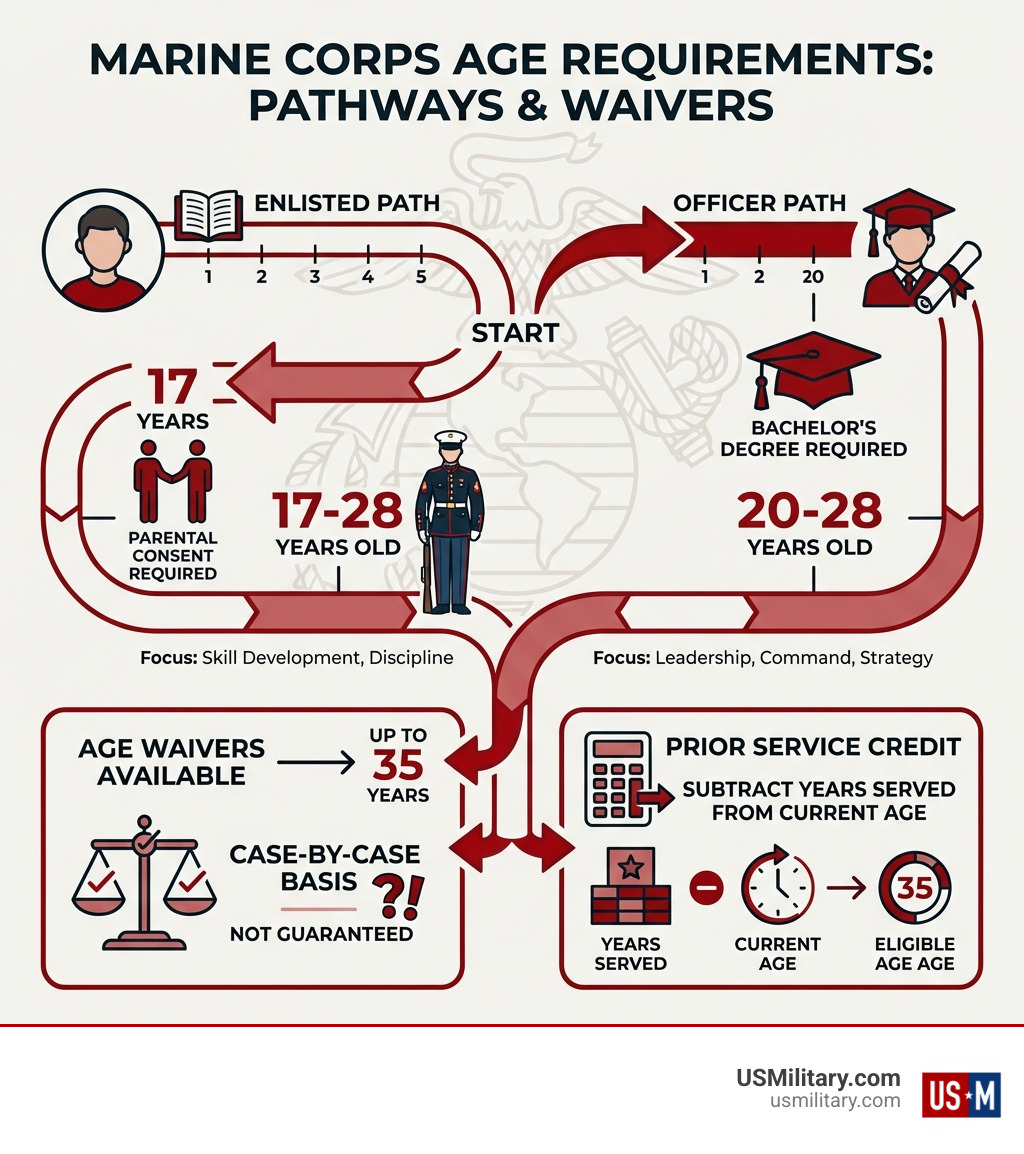
- Enlisted Marines: Ages 17-28 (17 requires parental consent)
- Marine Officers: Ages 20-28 (in most cases)
- Maximum Legal Age: 35 with a waiver (not guaranteed)
- Prior Service: Years served may be subtracted from your current age
We all face battles. In front of us. Inside of us. But for a unique breed, there is an unwavering willingness to fight and an undeniable determination to defeat each one of them. The Marine Corps looks for individuals who embody this spirit—but first, you must meet the tangible requirements.
Age is one of the most straightforward barriers to entry, yet it’s also one of the most misunderstood. Many people assume they’ve “aged out” of military service when they may still have options. Others don’t realize that the Marine Corps has the youngest age limit among major military branches, reflecting its unique mission as America’s rapid response force.
Whether you’re a recent high school graduate, a college student considering officer programs, or someone who regrets not pursuing this path earlier in life, understanding the age requirements is your first step. The rules are clear, but there are also exceptions, waivers, and paths for prior service members that can extend your eligibility.
Basic Age Requirements for Enlisted Marines

Joining the Marine Corps as an enlisted member means stepping onto a path of rigorous training, unwavering discipline, and unparalleled camaraderie. But before you can even begin this journey, you need to meet a set of fundamental requirements, with age being one of the most significant. The enlistment process is designed to ensure that every recruit is ready for the mental and physical demands of being a Marine.
What is the minimum and maximum age limit for Marines enlistment?
For those looking to serve our nation as an enlisted Marine, the age limit for marines enlistment for active duty is quite specific. You must be at least 17 years old to begin the enlistment process. If you’re 17, you’ll need a signed parental consent form to proceed. This ensures that young recruits have the full support of their families as they start on this life-changing commitment.
The maximum age to enlist in the Marine Corps as an active duty enlisted service member is 28 years old. This standard cutoff reflects the Marine Corps’ emphasis on youth and peak physical readiness, aligning with its role as an expeditionary and rapid-response force. While this might seem like a tight window compared to other branches, it’s designed to ensure that those joining are best prepared for the intense physical demands of Marine training and service.
What other initial requirements must be met?
Beyond age, there are several other crucial initial requirements that aspiring Marines must fulfill. These ensure that every individual joining the ranks possesses the necessary mental, physical, and moral aptitude for service:
- U.S. Citizen or Legal Resident: You must be a U.S. citizen or a foreign national legally residing in the United States with a Green Card. The Marine Corps cannot assist foreign nationals in obtaining U.S. citizenship, so this status must be established beforehand.
- Education: A high school diploma is generally required before beginning Marine recruit training. While you can talk to a recruiter or even sign an enlistment contract before graduating, the diploma must be in hand prior to starting boot camp. For those with a GED or non-traditional diploma, specific additional qualifications and a higher ASVAB score may be necessary.
- ASVAB Test: The Armed Services Vocational Aptitude Battery (ASVAB) is a mandatory test for all military enlistees. It measures your aptitudes across various subjects and helps determine your eligibility for different Military Occupational Specialties (MOS). For the Marine Corps, a minimum ASVAB score of 31 is required for high school diploma holders, and a minimum of 50 for those with a GED.
- Physical and Medical Exam: All recruits must pass a comprehensive medical examination at the Military Entrance Processing Station (MEPS). This ensures you meet the physical standards necessary for military service. Additionally, to even begin recruit training, aspiring Marines must pass the Initial Strength Test (IST), which assesses your physical readiness with events like pull-ups or push-ups, a 1.5-mile run, and a plank.
- Background Check: A thorough criminal background check is conducted, and applicants must not have any felony convictions. Moral and conduct standards are paramount in the Marine Corps.
Age Requirements for Marine Corps Officers

Becoming a Marine Officer means stepping into a role of profound leadership, responsibility, and strategic thinking. Unlike enlisted service, which focuses on direct combat and specialized skills, officers are trained to lead, manage, and make critical decisions. This path has its own distinct age requirements and pathways, reflecting the different nature of their responsibilities.
What is the age range to become a Marine Officer?
To commission as a Marine Corps officer, you must generally be at least 20 years old at the time of application. The maximum age for most officer candidates is 28. This age window allows for individuals to complete their higher education—a bachelor’s degree is a prerequisite for all Marine officers—and to develop the maturity, moral standards, and leadership potential required for such a demanding role.
The focus for officers is not just on physical prowess, but also on intellectual capability and the ability to command respect and lead effectively. While the age range is similar to enlisted Marines, the expectation is that officer candidates bring a level of academic achievement and life experience that prepares them for leadership.
Are there different paths to becoming an officer?
Absolutely! The Marine Corps offers several distinct paths to becoming a commissioned officer, catering to different educational backgrounds and career stages:
- Officer Candidate School (OCS): This is a primary route for college graduates or those nearing graduation. OCS is a demanding 10- or 12-week program at Quantico, Virginia, designed to evaluate and screen officer candidates for leadership potential.
- Platoon Leaders Class (PLC): For undergraduates, PLC allows you to complete officer training over two summers (two six-week courses) or one 10-week course, without interrupting your academic year. You commission after graduating college.
- Naval Reserve Officers Training Corps (NROTC): Offered at various colleges and universities, NROTC provides scholarships and training alongside your degree, leading to a commission upon graduation.
- Enlisted-to-Officer Opportunities: The Marine Corps values the experience of its enlisted members. Programs like the Enlisted Commissioning Program (ECP) and Enlisted Commissioning Education Program (ECEP) allow qualified enlisted Marines to earn a bachelor’s degree and commission as an officer. There’s also the Warrant Officer Program for highly experienced technical specialists.
For those interested in exploring these leadership development opportunities further, you can find more on becoming a Marine officer on the official Marine Corps website.
Understanding the Age Limit for Marines Enlistment: Waivers and Exceptions
The age limit for marines enlistment might seem rigid, but like many military regulations, it comes with potential flexibility. The Marine Corps understands that life paths aren’t always linear, and exceptional candidates may present themselves outside the typical age range. However, these exceptions are not guaranteed and are always handled on a case-by-case basis.
Can you get an age waiver if you are over 28?
Yes, age waivers are a possibility for both enlisted and officer applicants who exceed the standard age limits. While the maximum eligible enlisted age is 28, and the maximum for officers is also 28 (in most cases), waivers may be available on a case-by-case basis.
A waiver isn’t an automatic pass. It’s a formal request that allows an otherwise highly qualified individual to enlist or commission despite not meeting a specific eligibility criterion. These waivers are typically granted based on the “needs of the Corps” and the applicant’s exceptional qualifications, such as specialized skills, prior service, or a particularly strong academic and physical record.
By law, the absolute maximum age for enlistment in any U.S. military service is 35, and this is not waiverable. So, while you might be able to get a waiver if you’re 29 or 30, it’s generally not possible if you’re, say, 36. The best course of action if you’re over the standard age limit is to speak directly with a Marine Corps recruiter or an Officer Selection Officer (OSO). They can assess your individual situation and advise you on the likelihood and process of obtaining an age waiver.
How does prior service affect the age limit for Marines enlistment?
Prior military service can significantly impact your age eligibility for the Marine Corps, offering a valuable pathway for those who wish to return to service or transition from another branch. If you have prior service time, that time can often be subtracted from your current age to determine your adjusted age for enlistment purposes.
For example, if you are 37 years old but have 10 years of prior active duty service, your adjusted age for enlistment considerations would be 27. This brings you within the standard age limit for enlisted Marines. This rule recognizes the experience, training, and discipline that prior service members bring to the Corps, making them valuable assets.
This adjusted age calculation mainly applies to re-enlistment or cross-service transfers. If you’re a veteran considering returning to the Marine Corps, or if you served in another branch and now wish to become a Marine, this rule could be your ticket. However, specific policies and available slots can vary, so always consult with a recruiter about current Enlistment and Re-enlistment policies.
Are there different age limits for the Marine Corps Reserve?
Yes, the Marine Corps Reserve generally follows similar age guidelines to active duty, but with some specific considerations. For initial enlistment into the Marine Corps Reserve, the age limit is typically between 17 and 28 years old.
However, just like with active duty, prior service can offer exceptions. If you have previous military experience, your years of service may be subtracted from your current age to determine eligibility. This allows experienced individuals to continue serving our nation on a part-time basis. The Reserve component offers an opportunity to serve one weekend a month and two weeks a year, balancing civilian life with military commitment.
Do special roles like Marine Recon or Raiders have different age limits?
When it comes to highly specialized roles like Marine Reconnaissance or Marine Raider (MARSOC), the age limit for marines enlistment can become even more nuanced. While the general enlistment age limits still apply for entry into the Marine Corps, the selection processes for these elite units often focus less on chronological age and more on physical and mental performance, experience, and leadership potential.
- Marine Reconnaissance: Similar to Navy SEAL training, the age range for Marine Reconnaissance is typically aligned with the general enlisted age of 17 to 28. However, age waivers may be granted based on specific circumstances, especially for those with prior military experience who demonstrate exceptional physical and mental capabilities.
- Marine Raider (MARSOC): Interestingly, MARSOC (Marine Corps Forces Special Operations Command) does not have a specific age limit for Marines attending their Assessment and Selection (A&S) phase. This means that if you are already a Marine, regardless of your MOS, you could potentially apply for MARSOC even if you are older than the typical enlistment age. The average age of MARSOC attendees and graduates is often between 25-27, reflecting a blend of maturity and prime physical condition, but older, highly qualified Marines are certainly considered. The emphasis here is overwhelmingly on your ability to meet the rigorous physical, mental, and tactical demands of special operations, rather than a strict age cutoff.
How Marine Corps Age Limits Compare to Other Branches
The Marine Corps stands out among the U.S. military branches for having the youngest maximum age limit for general active duty enlistment. This difference is not arbitrary; it reflects the unique mission and operational philosophy of the Corps.
Here’s a comparison of the active duty age limits across the different branches:
| Branch | Minimum Age | Maximum Age |
|---|---|---|
| Army | 17 | 35 |
| Marine Corps | 17 | 28 |
| Navy | 17 | 41 |
| Air Force | 17 | 42 |
| Coast Guard | 17 | 41 |
| Space Force | 17 | 42 |
As you can see, the Marine Corps’ 28-year-old maximum for active duty enlisted personnel is notably lower than its sister services.
Why is the Marine Corps age limit lower than other branches?
The reasons behind the Marine Corps’ younger age limit are deeply rooted in its identity and operational role:
- Expeditionary Force and Rapid Response: The Marine Corps prides itself on being the nation’s “911 force” – a rapid-response, expeditionary force capable of deploying anywhere in the world at a moment’s notice. This mission demands a force that is exceptionally agile, physically robust, and capable of enduring the most extreme conditions.
- Physical Readiness: Marine training is notoriously rigorous, often considered the toughest basic training among all branches. The emphasis on sustained physical readiness throughout a Marine’s career is paramount. A younger force is generally better equipped to meet these intense physical demands, recover quickly, and maintain peak performance for extended periods.
- “First-to-Fight” Mission: Marines are often the first to respond in crises, requiring a high level of endurance and resilience. This “first-to-fight” ethos underpins the need for a physically capable and adaptable force.
- Youth and Resilience: While maturity and experience are valuable, the Marine Corps historically has prioritized the raw physical energy, adaptability, and resilience often associated with younger individuals. This is not to say older individuals aren’t resilient, but the Corps’ operational tempo places a premium on these attributes from day one.
- Historical Context: The Marine Corps has traditionally maintained a strong focus on recruiting younger individuals, a policy that has been reinforced over decades to support its unique mission set.
Frequently Asked Questions about Marine Corps Age Limits
Even with all the information, specific scenarios often lead to more questions. Here, we address some common concerns regarding the age limit for marines enlistment.
What happens if I turn 29 during the enlistment process?
This is a critical point for many aspiring Marines. The rule is that you must ship to boot camp before your 29th birthday. If you turn 29 while you are in the Delayed Entry Program (DEP) but haven’t yet left for boot camp, you will typically be disqualified unless you can secure a waiver. This means timing is crucial. Your recruiter will guide you through this, emphasizing the importance of processing your paperwork and securing a ship date well in advance of your 29th birthday. Delays can happen, so it’s best to start the process with plenty of time to spare.
Can I join the Marines with a GED?
Yes, it is possible to join the Marine Corps with a General Educational Development (GED) certificate, but it comes with additional requirements. While a high school diploma is always preferred, the Marine Corps does accept GED holders under certain conditions. The primary difference is that GED applicants typically need a significantly higher score on the ASVAB test. For those with a high school diploma, a minimum ASVAB score of 31 is required. However, for individuals with a GED, the minimum ASVAB score needed is 50. This higher score helps demonstrate academic aptitude in lieu of a traditional diploma.
Are the physical standards different for older recruits?
No, the physical standards for Marine Corps enlistment are not different for older recruits. Regardless of age (within the eligible range), every aspiring Marine must meet the same rigorous physical requirements. There are no age-based adjustments or relaxed standards for entry. This means that whether you’re 17 or 28, you’ll need to pass the same Initial Strength Test (IST) to begin recruit training, and later, the Physical Fitness Test (PFT) and Combat Fitness Test (CFT). The Marine Corps maintains a uniform standard to ensure that every Marine, regardless of when they joined, is capable of performing their duties in the most demanding environments.
Your Next Step to Becoming a Marine
Understanding the age limit for marines enlistment is just the first step on what could be an incredibly rewarding journey. We’ve seen that while the Marine Corps has the youngest maximum age for active duty enlisted personnel (28), there are pathways for officers, opportunities in the Reserve, and potential waivers for specific situations, especially for those with prior service. The absolute legal maximum age for any military enlistment is 35, though securing a waiver for the Marines beyond 28 is on a case-by-case basis.
Our goal at USMilitary.com is to provide you with comprehensive resources and guidance as you explore your military options. While this article provides a solid overview, the most accurate and personalized information will come from a Marine Corps recruiter. They are your best resource for understanding your unique qualifications, discussing potential waivers, and navigating the enlistment process.
Don’t let assumptions about age deter you from exploring a path that could define your future. The first step is always a conversation. Reach out, ask questions, and find if you have what it takes to earn the title of Marine.
Learn more about the age limit to join the military and connect with a recruiter today!
Free for Service Members & Veterans
Get the military benefits intel no one tells you about.
Weekly updates on VA benefits, pay changes, and money tips — free for service members and veterans.
No spam. Unsubscribe anytime. Your info is never shared.


More Than 90% Of Clients Have Increased Ratings! Why Settle For Less Than You Deserve? Expert Priority Help With Your VA Claim Today! Free Evaluation Call!
The mission of Veteran Services United is to support veterans in filing and winning disability claims by offering expert guidance, advocacy, and personalized assistance. Through dedicated service, Veteran Services United empowers veterans to secure the benefits they have earned, ensuring they receive the care and support they deserve.