Why the Marine Corps Wants 31,250 More Recruits in 2026

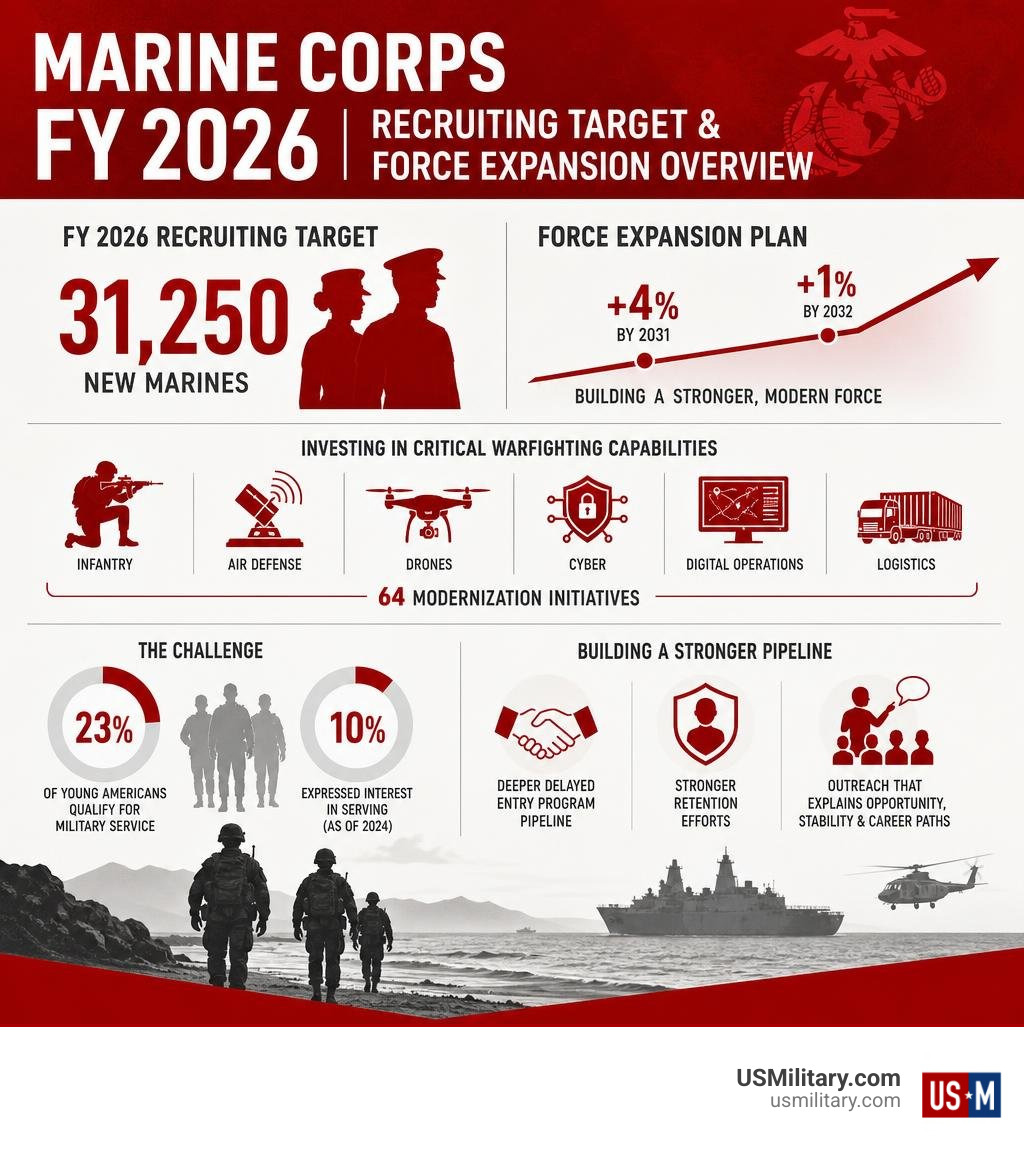
The Marine Corps wants more recruits to fill a planned expansion of more than 6,500 billets while keeping its entry standards intact. For fiscal year 2026, the Corps is seeking 31,250 new Marines and is building a larger pipeline for jobs in infantry, air defense, drones, cyber, digital operations, and logistics.
This is not simply a push for a larger force. The Marine Corps plans a 4% end-strength increase by 2031, followed by another 1% in 2032, across 64 modernization initiatives. The need is especially urgent for junior enlisted Marines who can operate, maintain, and support new technology at the unit level.
The challenge is clear: about 23% of young Americans qualify for military service, but only 10% expressed interest in serving as of 2024. The Corps is responding with a deeper Delayed Entry Program pipeline, stronger retention efforts, and outreach that explains the stability, training, and career paths military service can offer.
I am Larry Fowler, publisher of the USMilitary.com Network, which has helped connect military-minded Americans with reliable service and benefits information since 2007. Through our work supporting prospects across the armed forces, I have followed why the Marines Wants More Recruits and what prospective Marines should understand before talking with a recruiter.
Marines Wants More Recruits glossary:
Why the Marines Wants More Recruits to Expand Force Structure
The Marine Corps is currently executing one of the most deliberate structural expansions in its modern peacetime history. Rather than expanding indiscriminately, leadership has outlined a roadmap to add more than 6,500 billets distributed across 64 targeted initiatives. This measured growth aims for an overall 4% increase in active end-strength by 2031, with an additional 1% growth phase targeted for 2032.
These manpower adjustments directly support broader modernization roadmaps, including Force Design 2030 and Ground Combat Element 2040. Under guidance to project combat power effectively across contested littoral environments, the service must balance traditional expeditionary warfare capabilities with specialized technical proficiencies. Reports covering expanding Marine forces show how these structural updates alter the frontline composition of combat formations.
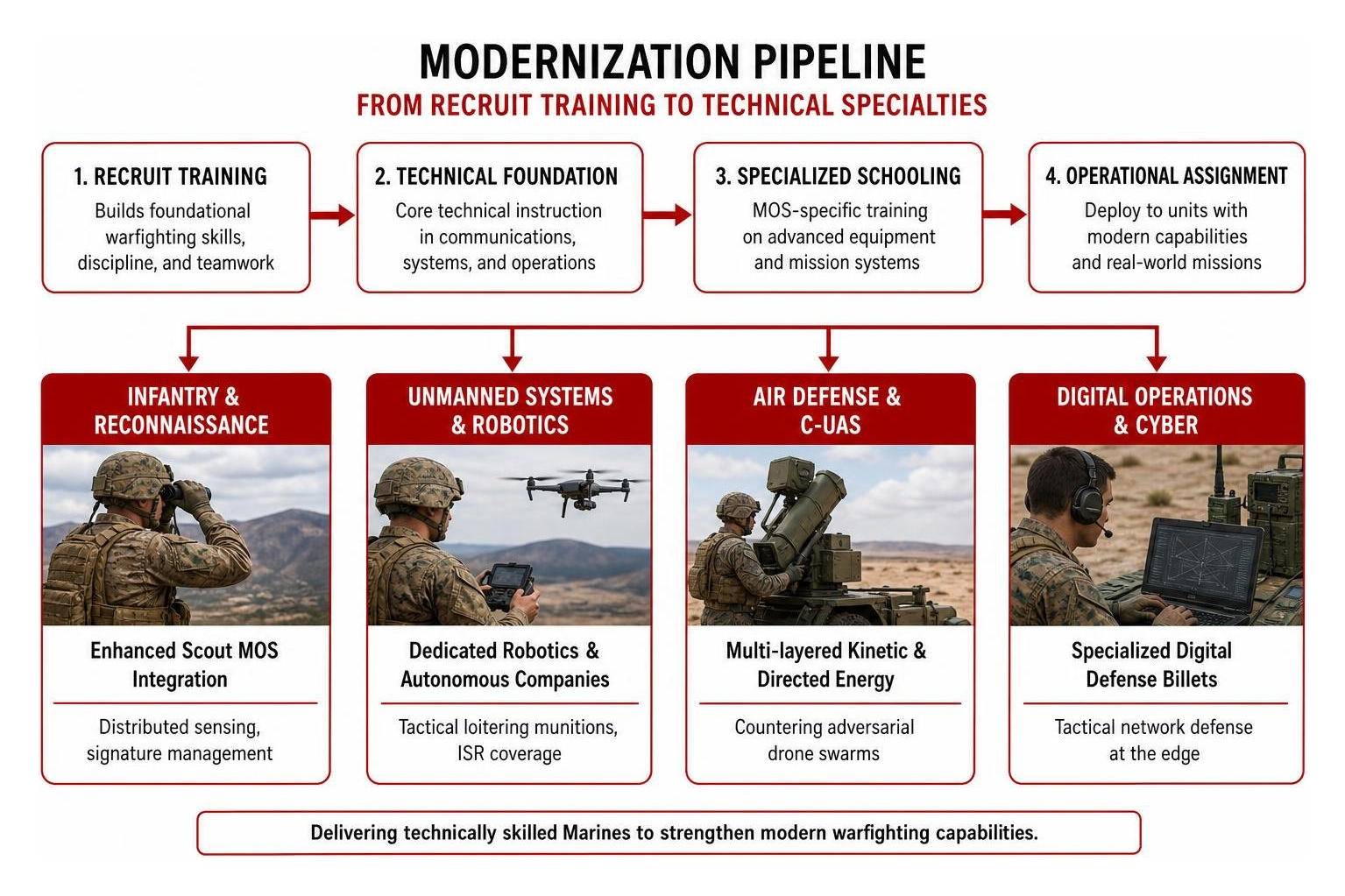
| Specialty / Focus Area | Legacy Force Posture | Modernized Target (2031–2032) | Primary Objective |
|---|---|---|---|
| Infantry & Reconnaissance | Standard rifle company structures | Enhanced Scout MOS integration | Distributed sensing, signature management |
| Unmanned Systems & Robotics | Ad-hoc drone operators at unit level | Dedicated Robotics & Autonomous Cos | Tactical loitering munitions, ISR coverage |
| Air Defense & C-UAS | Stinger missile batteries | Multi-layered kinetic & directed energy | Countering adversarial drone swarms |
| Digital Operations & Cyber | General communications battalions | Specialized digital defense billets | Tactical network defense at the edge |
This transformation requires hands-on operators. Marine leadership has humorously noted that the service does not simply need a room full of master sergeants developing policy; it needs lance corporals turning wrenches on flight lines, configuring network terminals, and operating loitering munitions in the field.
Strategic End-Strength Targets: Where the Marines Wants More Recruits Across Units
The Marine Corps remains the most compact branch within the Department of Defense, maintaining an active-duty roster of roughly 170,000 service members. By comparison, the Army maintains over 450,000 active soldiers, while the Navy operates with more than 440,000 active sailors. Because of its leaner footprint, even minor personnel adjustments significantly alter operational readiness.
Future billets are being allocated across three distinct operational hubs:
- Infantry Battalions: Ground units are receiving enhanced direct-fire weapons teams, expanded intelligence-gathering detachments, and specialized organic drone operators.
- Low-Altitude Air Defense (LAAD): Units are fielding new counter-unmanned aerial systems (C-UAS) to shield expeditionary advance bases from loitering aerial threats.
- Combat Logistics Elements: Expeditionary logistics units are expanding to sustain small, dispersed tactical units across long island chains without relying on vulnerable central supply hubs.
For prospects researching career options, evaluating the pathways for military enlistment in the US provides helpful context on how military occupational specialties (MOSs) align with broader strategic goals.
Modernization Imperatives: How the Marines Wants More Recruits for Tech-Driven MOSs
To meet peer-adversary capabilities in the Indo-Pacific and globally, the Marine Corps has introduced new occupational fields requiring elevated technical aptitude.
Among the most notable new MOS additions are:
- 0315 Scout: Designed to transform infantry reconnaissance by fusing traditional scout-sniper skills with advanced tactical sensor operations, digital communications, and distributed targeting.
- 0673 Digital Operations Specialist: Tasked with safeguarding tactical networks, preventing adversary electronic intrusions, and running edge-computing systems under austere field conditions.
To support these advanced roles, each Marine Expeditionary Force (MEF) is standing up a dedicated robotics and autonomous systems company. The service has also established a second Small Unmanned Aircraft System Schoolhouse at Camp Pendleton, California, complementing existing training facilities at Camp Lejeune, North Carolina. Recruits moving through these pipelines are trained on cutting-edge platforms like the Bolt-M autonomous air vehicle, ensuring units deploy with organic precision strike and reconnaissance capabilities. Those interested in pursuing these specialized tracks can review requirements via official recruitment programs.
Unapologetic Standards: How Marine Recruitment Differs from Other Branches
While several armed services have adapted their accessions strategies by introducing remedial academic programs or easing certain tattoo and physical testing thresholds, the Marine Corps has maintained strict, unchanged entry criteria. Marine leaders describe these policies as “unapologetic standards.”

The Corps’ recruiting philosophy relies on intrinsic motivation rather than large monetary enlistment bonuses. General Eric Smith, Commandant of the Marine Corps, has frequently reiterated that a recruit’s primary enlistment bonus is the privilege of earning the title of United States Marine. Despite operating with roughly 2.5% ($51 million) of the total $2 billion Department of Defense recruiting budget, the Marine Corps continues to hit its targets. For FY 2025, the service recruited 30,536 active and reserve enlisted Marines—beating its goal by exactly one person—while beating its officer accession goal by two.
Recent reporting on recruiting and retention success emphasizes that maintaining high entry barriers preserves the service’s prestige, helping attract recruits who specifically seek an intense challenge.
Delayed Entry Program and Prior Service Enlistment Surge
The Delayed Entry Program (DEP) serves as an essential operational buffer for the Marine Corps. Rather than shipping candidates immediately to boot camp, the DEP allows “poolees” to train under the mentorship of local recruiters, building physical fitness, mastering military customs, and preparing mentally for recruit training.
At the start of FY 2026, the Marine Corps built its DEP pool to 38% of its total recruitment objective, with projections targeting a 45% start pool for the following fiscal year. This marks a full recovery from pandemic-era disruptions, when delayed-entry pools across all branches fell to historic lows.
Complementing the DEP is a surge within the Prior Service Enlistment Program (PSEP). The Corps nearly tripled its prior-service enlistment numbers year-over-year, welcoming more than 200 former Marines back to active duty. This enables the service to fill critical technical billets with experienced noncommissioned officers without having to train new accessions from scratch. You can review our breakdown of the steps for joining the military to see how the DEP process works from initial contact to shipment day.
Retention Success: Shifting from Recruit and Replace to Invest and Retain
A cornerstone of the Corps’ force planning is Talent Management 2030, a strategic initiative shifting the personnel model from a high-turnover “recruit and replace” system to an “invest and retain” framework.
Key milestones achieved under this strategy include:
- Exceeding retention targets by securing over 14,000 reenlistment packages against a goal of 13,228 active-duty reenlistments (reaching 94% of the benchmark early in the fiscal cycle).
- Achieving 114% of the targeted first-term reenlistment mission, with over 5,700 subsequent-term Marines choosing to remain in uniform.
- Introducing multi-year retention cohorts, allowing Marines to negotiate reenlistment incentives and duty-station preferences well before their active contracts expire.
- Offering targeted selective retention bonuses and lateral move options for high-demand specialties such as cyber operations, aviation maintenance, and tactical communications.
By retaining experienced lance corporals, corporals, and sergeants, the Marine Corps reduces overall recruiting strain while maintaining experienced tactical leadership.
Navigating Demographic Headwinds and Influencer Support Challenges
Despite hitting accession targets, the Marine Corps faces persistent demographic and cultural headwinds. Department of Defense data indicates that approximately 23% of young Americans aged 17 to 24 meet the physical, academic, and moral qualifications for military enlistment without an administrative waiver. Furthermore, broader youth surveys show that only 10% of eligible young adults express interest in military service.

A notable challenge for the Marine Corps is influencer support. Defense department metrics reveal that only 44% of key adult influencers (parents, guardians, teachers, athletic coaches) would actively encourage a young person to join the Marine Corps—the lowest favorability rate among all military branches (compared to 54% for the Navy).
To counter these misperceptions, Marine recruiting commands are actively engaging local communities. Outreach efforts focus on highlighting the educational benefits, competitive pay scales, VA home loan access, and transferable technical skills gained during an enlistment. For families assessing qualifications, our guide on enlistment eligibility in 2026 details medical, moral, and academic baselines.
Economic Dynamics, Pay Increases, and Recruiter Transparency
Broader economic shifts continue to shape military accessions. While civilian unemployment metrics remain low, shifts in entry-level hiring have made military service an appealing choice for individuals seeking stable employment, comprehensive healthcare, and clear promotion timelines.
Recent congressional defense budgets have delivered strong compensation improvements, including a 4.5% baseline military pay raise paired with an additional targeted 10% pay bump for junior enlisted personnel. Combined with tax-free Basic Allowance for Housing (BAH) and Basic Allowance for Sustenance (BAS), first-term Marines often experience greater financial security than peers in entry-level civilian jobs.
When meeting with station personnel, prospective recruits should expect candid guidance regarding contract commitments, MOS availability, and training expectations. Reviewing our resource on navigating recruiter claims helps applicants ask informed questions and secure the contract terms that align with their career goals.
Frequently Asked Questions About Marine Corps Enlistment
What are the basic enlistment requirements to join the Marine Corps in 2026?
Applicants must be U.S. citizens or permanent legal residents between the ages of 17 and 28 (17-year-olds require parental consent). Candidates must hold a high school diploma (or a qualifying GED score with additional college credits), achieve a qualifying score on the Armed Services Vocational Aptitude Battery (ASVAB), and pass a comprehensive medical screening at a Military Entrance Processing Station (MEPS). To check specific age cutoffs and waiver policies across the services, consult our breakdown of military enlistment age limits.
How many recruits is the Marine Corps targeting for FY 2026?
For fiscal year 2026, the Marine Corps has established an accession target of 31,250 active-duty and reserve enlisted personnel. This target supports planned force expansion across new combat formations and technical fields while balancing normal annual attrition across the fleet.
What new military occupational specialties are opening for recruits?
The Marine Corps has established specialized occupational fields to meet the technological demands of modern warfare. Key additions include the 0315 Scout MOS within ground combat elements and the 0673 Digital Operations Specialist MOS within communications and cyber formations. The service is also expanding billets for small unmanned aerial systems operators, robotics maintenance technicians, and expeditionary air defense crew members.
Conclusion
The Marine Corps’ ongoing push to expand its ranks reflects a deliberate effort to modernize combat formations without lowering the performance standards that define the branch. By targeting 31,250 new recruits for FY 2026, integrating specialized technical MOSs, and expanding its delayed-entry pipelines, the Corps is building a force prepared for modern, multi-domain operations.
At USMilitary.com, we are committed to providing prospective service members, active-duty personnel, and military families with transparent, accurate information on enlistment pathways, compensation packages, and veteran benefits. If you are exploring your service options, take time to compare paths using our comprehensive guide to all branches of the military to determine which branch best fits your long-term personal and professional ambitions.
Free for Service Members & Veterans
Get the military benefits intel no one tells you about.
Weekly updates on VA benefits, pay changes, and money tips — free for service members and veterans.
No spam. Unsubscribe anytime. Your info is never shared.


