What You Need to Know About Military ADHD Policy

Military ADHD policy has changed significantly in recent years — and if you have an ADHD diagnosis, you have more options than you might think.
Here is a quick answer to what most people want to know:
| Question | Quick Answer |
|---|---|
| Does ADHD automatically disqualify you? | No. ADHD is not an automatic disqualifier. |
| Can you enlist without a waiver if you have ADHD? | Possibly yes, under the MARP program, if off treatment for 12+ months. |
| What still triggers extra review? | Recent stimulant medication, IEP after age 14, or documented functional impairment. |
| Do all branches treat ADHD the same? | No. Each branch has its own waiver process and approval standards. |
| Can active duty members keep serving with ADHD? | Yes, but stimulant medication use requires a retention waiver. |
Finding clear, accurate information on this topic is genuinely hard. Recruiters sometimes give conflicting advice. Policies have shifted. And the rules differ depending on which branch you are targeting.
What is clear is this: tens of thousands of service members are currently serving with ADHD. In 2018 alone, more than 41,000 active component service members carried an ADHD diagnosis. The military is not trying to keep everyone with ADHD out — it is trying to assess whether you, right now, can function effectively in a demanding, structured environment.
I’m Larry Fowler, publisher of USMilitary.com since 2007, and I’ve spent nearly two decades helping recruits and veterans navigate complex topics like military ADHD policy — from enlistment standards to VA benefits. In this guide, I’ll walk you through everything you need to know, branch by branch, step by step.
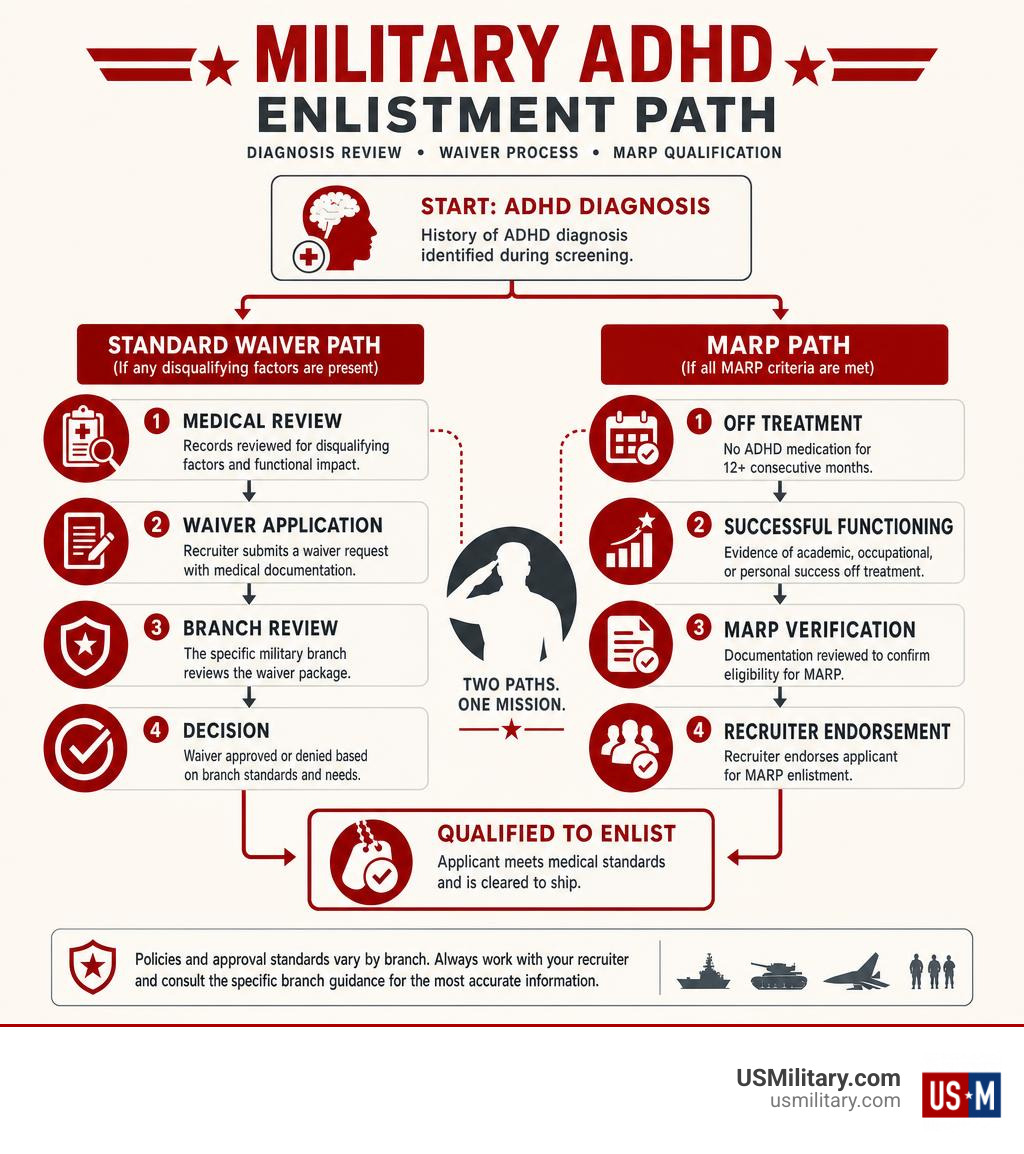
Understanding the DoD Military ADHD Policy for Enlistment
When we look at how the Department of Defense (DoD) regulates enlistment, all medical guidelines stem from a single, comprehensive document: Department of Defense Instruction (DoDI) 6130.03, Volume 1. This document outlines the physical and mental standards for entering military service.
Historically, any history of ADHD was met with immediate skepticism. However, we have observed a progressive shift in how the military handles neurodiversity. If you are researching older guidelines, such as the military adhd policy 2023, you will find that the rules have become far more realistic. The core question we address in our guide, Can I Join The Military If Suffer From Adhd, is no longer a flat “no,” but rather a “yes, if you meet specific stability criteria.”
Under the current DOD physical standards, ADHD is classified under the “Learning, Psychiatric, and Behavioral Disorders” section. The military’s primary goal is ensuring that recruits can handle the intense, unaccommodated environment of basic training and subsequent operational deployments. If your ADHD history does not limit your current functional capabilities, your chances of enlisting are higher than ever.
How the Military ADHD Policy Defines Disqualification
While the policy has eased, certain “red flags” still trigger an automatic medical disqualification at the Military Entrance Processing Station (MEPS). If disqualified, you must obtain a medical waiver to move forward.
According to the DoD medical standards, you will face disqualification if you meet any of the following conditions:
- Recent Medication Use: You have been prescribed or have taken ADHD medication (such as Adderall, Ritalin, or Vyvanse) within the previous 12 to 24 months.
- Academic or Work Accommodations: You required an Individualized Education Program (IEP), a 504 plan, or work-related accommodations after your 14th birthday.
- Comorbid Conditions: Your ADHD is accompanied by other documented mental health issues, such as depression, anxiety, bipolar disorder, or oppositional defiant disorder.
- Adverse Performance: There is documented history of adverse academic, behavioral, or occupational performance linked to your ADHD.
If none of these conditions apply to you—for example, if you were diagnosed as a child but have been off medication and performing excellently in school and work without accommodations for years—you may be medically qualified without needing a waiver.
Psychological Evaluation Requirements at MEPS
If your history of ADHD triggers a disqualification, the next step is often a psychological evaluation. MEPS medical officers will review your history, but they may also refer you to an independent psychologist for a consult.
This clinical assessment is not designed to re-diagnose you. Instead, it focuses on your current cognitive functioning, behavioral stability, and readiness for service. The evaluating psychologist will look closely at:
- Attention and Executive Functioning: Can you focus and complete tasks without chemical assistance?
- Impulse Control and Emotional Regulation: How do you respond to high-stress, high-pressure situations?
- Organizational Capabilities: Can you manage your time and responsibilities in a highly structured environment?
Additionally, all applicants must pass the Armed Services Vocational Aptitude Battery (ASVAB) without any testing accommodations. Demonstrating that you can score well on this mental aptitude test under standard conditions is a major step toward proving your functional stability.
The Medical Accession Records Pilot (MARP) and Waiver Process
The biggest game-changer in recent military recruiting history is the Medical Accession Records Pilot (MARP). Launched to address recruiting shortfalls and modernize outdated medical barriers, MARP has revolutionized how the military handles common conditions like ADHD.
Historically, applicants had to be completely off ADHD medication for at least three consecutive years before enlisting without a waiver. Under the MARP guidelines, the Pentagon lowered this treatment-free requirement to just 12 months.
The results of this pilot program speak for themselves. Between July 2022 and August 2024, the MARP program medically qualified more than 9,900 applicants who otherwise would have faced lengthy waiver processes. Of those qualified, 57% ultimately enlisted—and roughly 60% of those recruits had a history of ADHD. This means thousands of stable individuals with ADHD are entering the ranks faster than ever before.

Crucially, this pilot operates alongside MHS Genesis, the military’s centralized electronic health records system. When you go to MEPS, MHS Genesis pulls your real-time civilian medical and prescription histories. Lying about past ADHD diagnoses or prescriptions is no longer possible; the system will flag them instantly.
Because MHS Genesis makes medical history fully transparent, the Pentagon has used this data to initiate a broader Pentagon medical waiver review to determine whether certain conditions should remain automatic disqualifiers. For applicants, this means honest disclosure is your only path forward—and thanks to MARP, it is a highly viable path.
Branch-Specific Variations in the Military ADHD Policy
While the overarching medical standards are set by the DoD, each military branch has the authority to issue its own medical waivers. This leads to variations in waiver approval rates and processing times.
Nearly 77% of youth between the ages of 17 and 24 require some type of medical or behavioral waiver to qualify for military service today. In fiscal year 2024 alone, the services granted more than 52,400 medical waivers to prospective troops.
Here is how the branches compare regarding their ADHD waiver trends:
| Military Branch | ADHD Waiver Priority & Trends | Common Co-Waiver Conditions |
|---|---|---|
| U.S. Army | Highly receptive. In FY 2024, behavioral health (led by ADHD) was the #1 category for approved medical waivers. | Orthopedic issues, eye-related problems. |
| U.S. Navy | Receptive, but thorough. ADD/ADHD remains one of the top three approved health waivers. | Astigmatism, environmental allergies. |
| U.S. Air Force | Historically the strictest, but has significantly eased standards to meet recruiting goals, admitting thousands under updated waiver policies. | Astigmatism, mild asthma history. |
| U.S. Marine Corps | Strict, focusing heavily on physical and mental grit. ADHD remains a top waiver, but requires pristine documentation. | Astigmatism, post-13 asthma history. |
| U.S. Space Force | Highly selective, reviewing cognitive and technical performance. Follows Air Force medical waiver channels. | Visual issues, mild learning differences. |
Active Duty Retention and Coast Guard ALCOAST 061/26 Updates
What happens if you are already in the military and receive an ADHD diagnosis, or find that you need to resume medication to maintain your performance?
The standards for retention (staying in the military) are vastly different from accession (joining). The military has a vested interest in keeping trained, experienced personnel. In nondeployed U.S. Army personnel, for example, the estimated 30-day prevalence for ADHD is 7.0%—meaning thousands of active duty soldiers successfully manage the condition.
However, policies regarding stimulant medications are strictly regulated. A prime example of this is the Coast Guard’s landmark ALCOAST 061/26 policy update issued in February 2026.

The ALCOAST 061/26 policy update outlines the following strict protocols for Coast Guard members:
- Accession Restriction: Active use of DEA Class 2 stimulant medications (like Adderall or Ritalin) remains completely unacceptable for entering service.
- Retention Waivers: Active duty members diagnosed with ADHD who require stimulant medication must secure an official retention waiver.
- Waiver Requirements: To qualify for a retention waiver, the member must:
- Undergo formal neuropsychological testing to confirm the diagnosis.
- Document the failure of at least two separate non-stimulant medication trials.
- Secure a positive command endorsement addressing their professional performance and reliability.
- Establish an annual military medical provider follow-up plan.
- Provide a clear medication management plan for deployed or underway periods.
- Grace Period: Active duty members already prescribed DEA Class 2 stimulants were granted an 18-month window from the policy release date to meet these rigorous waiver requirements.
These retention policies align with broader DoD initiatives like DoDI 6490.13 neurocognitive assessments, which mandate computerized neurocognitive testing (such as the ANAM) across deployment cycles to monitor service members’ cognitive health and operational readiness.
International Comparisons: Allied Forces ADHD Policies
When we look outside the United States, our international allies handle ADHD in their ranks with varying degrees of flexibility.
United Kingdom Ministry of Defence (MoD)
The British Armed Forces manage ADHD on a case-by-case basis, though their branches operate under slightly different internal procedures:
- Royal Navy: Focuses heavily on operational safety. If an active duty sailor presents with ADHD symptoms, they undergo a formal medical assessment followed by a detailed occupational grading to determine where they can safely serve.
- Royal Air Force (RAF): Refers potential ADHD cases to the Department of Community Mental Health (DCMH). If there is no documented evidence of childhood ADHD, they may coordinate with NHS services for further evaluation.
- Specialist Support: To support serving members, the UK’s Defence Primary Healthcare officially endorsed a specialist ADHD clinical service to streamline diagnoses and management.
New Zealand Defence Force (NZDF)
The NZDF outlines its medical policies in its official clinical guides, specifically the NZDF clinical practice guidelines (DHR 31, Applied Clinical Practice).
- Regular Force Members: The NZDF distinguishes general neurodiversity from clinically diagnosable neurodevelopmental disorders like ADHD and Autism Spectrum Disorder (ASD). Regular Force members are managed under strict clinical guidelines to ensure operational readiness.
- Territorial Force: Members of the reserve components are evaluated on a case-by-case basis, focusing strictly on their specific occupational and operational requirements rather than applying a blanket disqualification.
Frequently Asked Questions About Military ADHD Rules
Can you join the military if you are currently taking ADHD medication?
Under standard DoD accession policy, you cannot enlist while actively taking prescription stimulant medications. To qualify for enlistment or a waiver, you must demonstrate that you can function successfully without medication.
Under the MARP program, you must be off all ADHD medication for a minimum of 12 consecutive months before enlisting. If you do not qualify under MARP, the standard policy typically requires a 24-month treatment-free period before a medical waiver can be considered. Additionally, your prescribing doctor must officially clear you as no longer requiring the medication.
How does MHS Genesis affect ADHD disclosure at MEPS?
MHS Genesis has completely changed the enlistment process. This advanced health information system links directly to commercial pharmacy networks and civilian electronic health records.
When you sign your medical release forms at MEPS, MHS Genesis will automatically compile your medical history, including:
- Every ADHD diagnosis you have ever received.
- Every prescription filled for ADHD stimulants or non-stimulants.
- Any visits to therapists, psychiatrists, or counselors.
Honesty is absolutely critical. Attempting to hide your ADHD history is a federal offense (fraudulent enlistment) and will be caught by MHS Genesis. The best approach is to disclose your history upfront and work with your recruiter to build a strong waiver package.
What documentation is required to secure an ADHD medical waiver?
To build a successful ADHD medical waiver package, you must provide clear, objective evidence that you can perform well without medication or accommodations. You should gather:
- High School and College Transcripts: To prove academic stability and strong grades.
- IEP/504 Plan Records: If you had these plans, obtain letters from your school stating when they were terminated (ideally prior to age 14).
- Detailed Pharmacy Logs: Certified records showing the exact date you last filled an ADHD prescription.
- Employer Evaluations: Letters from supervisors confirming that you are reliable, focused, and perform your job duties excellently without accommodations.
- Independent Neuropsychological Testing: A current evaluation from a licensed psychologist confirming that you do not currently exhibit disabling symptoms of ADHD.
Conclusion
Navigating the military ADHD policy can feel overwhelming, but the doors to military service are wider open today than they have been in decades. Thanks to programs like MARP and modernized branch waiver policies, a history of ADHD is no longer the career-ender it once was.
Success comes down to preparation, timing, and showing that you can thrive in structured environments without medication. If you are ready to take the next step, we encourage you to research your options thoroughly, prepare your medical documentation, and speak with an experienced recruiter.
For more resources on military career paths, VA benefits, and step-by-step enlistment guides, visit us at USMilitary.com and Explore US Military Recruiting Options today.
Free for Service Members & Veterans
Get the military benefits intel no one tells you about.
Weekly updates on VA benefits, pay changes, and money tips — free for service members and veterans.
No spam. Unsubscribe anytime. Your info is never shared.


