Understanding the Path to Becoming a Navy SEAL
Navy SEAL training is one of the most grueling and selective military training programs in the world. Only about 10% of candidates who begin the process will ultimately graduate and earn the coveted SEAL Trident. Here’s what you need to know:
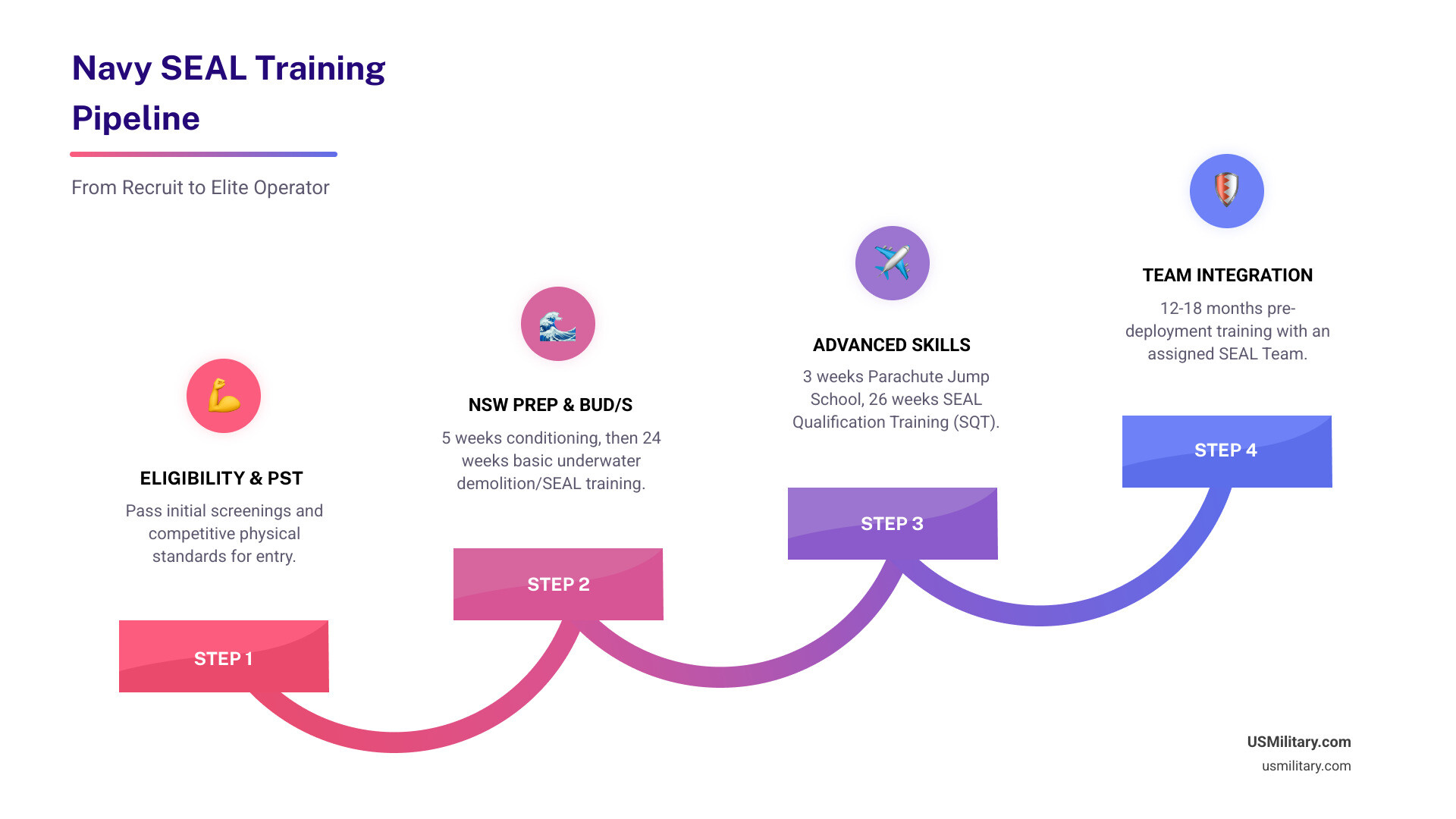
Navy SEAL Training Pipeline Overview:
- Physical Screening Test (PST) – Meet competitive scores (500-yard swim in 9:30, 75 push-ups, 75 sit-ups, 15 pull-ups, 1.5-mile run in 9:30)
- NSW Preparatory School – 5 weeks of physical conditioning
- Basic Underwater Demolition/SEAL (BUD/S) – 24 weeks including Hell Week
- Parachute Jump School – 3 weeks of static-line and free-fall training
- SEAL Qualification Training (SQT) – 26 weeks of advanced tactical skills
- Pre-Deployment Training – 12-18 months with your SEAL Team
Total Time: Over a year of formal training, plus 18 months of pre-deployment preparation
The journey begins with strict eligibility requirements: candidates must be U.S. citizens between 18 and 29 years old, possess at least a high school diploma, achieve a minimum ASVAB score of 220, and pass the demanding Physical Screening Test. The average member spends over a year in formal training environments before joining a SEAL Team, and the path is designed to test the absolute limits of human endurance and mental toughness.
BUD/S training consists of three brutal phases covering physical conditioning, combat diving, and land warfare. The infamous Hell Week occurs during the fourth week of training, where candidates endure five and a half days of continuous training with only four hours of total sleep, running more than 200 miles and performing physical training for over 20 hours per day. This crucible moment separates those with unbreakable commitment from those who aren’t ready.
I’m LARRY FOWLER, publisher of the USMilitary.com Network, and I’ve spent years helping prospective service members understand the demands and opportunities of elite military careers like Navy SEAL training. My work has connected thousands of qualified candidates with military recruiters, and I’ve seen what it takes to succeed in special operations.
Navy SEAL training helpful reading:
The Gauntlet Begins: Eligibility and Initial Screening
The journey to becoming a Navy SEAL is not for the faint of heart, and it begins long before candidates ever set foot in Coronado. The initial screening process is designed to weed out those who don’t meet the stringent physical, mental, and moral standards required for this elite force. We’re looking for individuals who not only meet the minimums but exceed them, demonstrating a commitment that sets them apart from the start.
First and foremost, candidates must be U.S. citizens. This is non-negotiable. Age-wise, aspiring SEALs typically need to be between 18 and 29 years old. However, we understand that life paths vary, so waivers can sometimes be granted for 17-year-olds with parental consent or for individuals up to 30 years old, provided they have exceptional qualifications. Education is also key; a high school diploma or its equivalent (GED) is a must. Academics play a role too, with a composite ASVAB (Armed Services Vocational Aptitude Battery) score of at least 220 being a general requirement.
Vision standards are critical for special operations. Candidates must have at least 20/70 vision, correctable to 20/25 in both eyes. Beyond the physical and academic, we also look into a candidate’s background. A clean record, meaning no recent history of drug abuse and a demonstration of good moral character, is absolutely essential. These aren’t just arbitrary rules; they’re foundational requirements for trust, reliability, and the intense pressures SEALs face.
Passing the Physical Screening Test (PST)
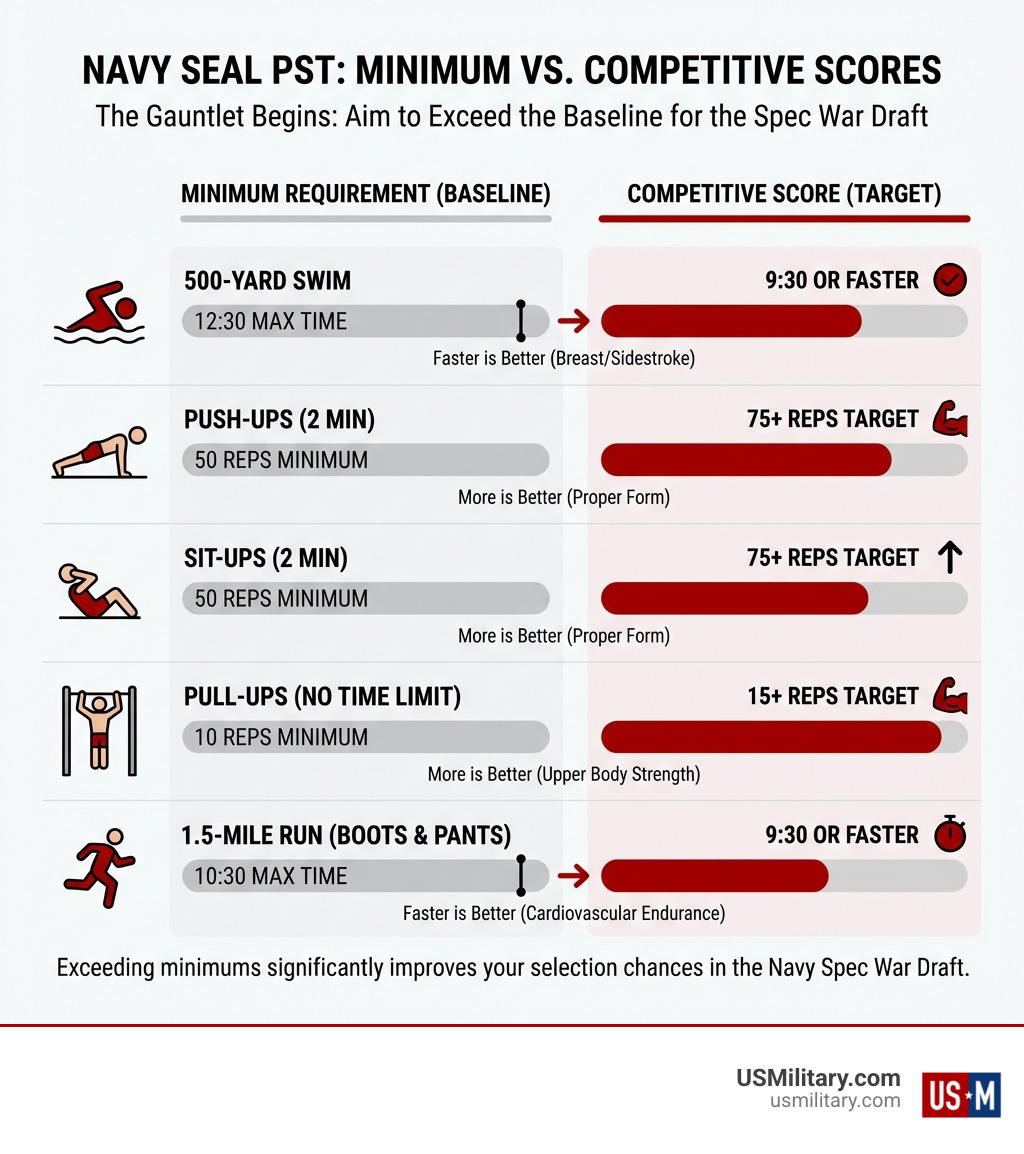
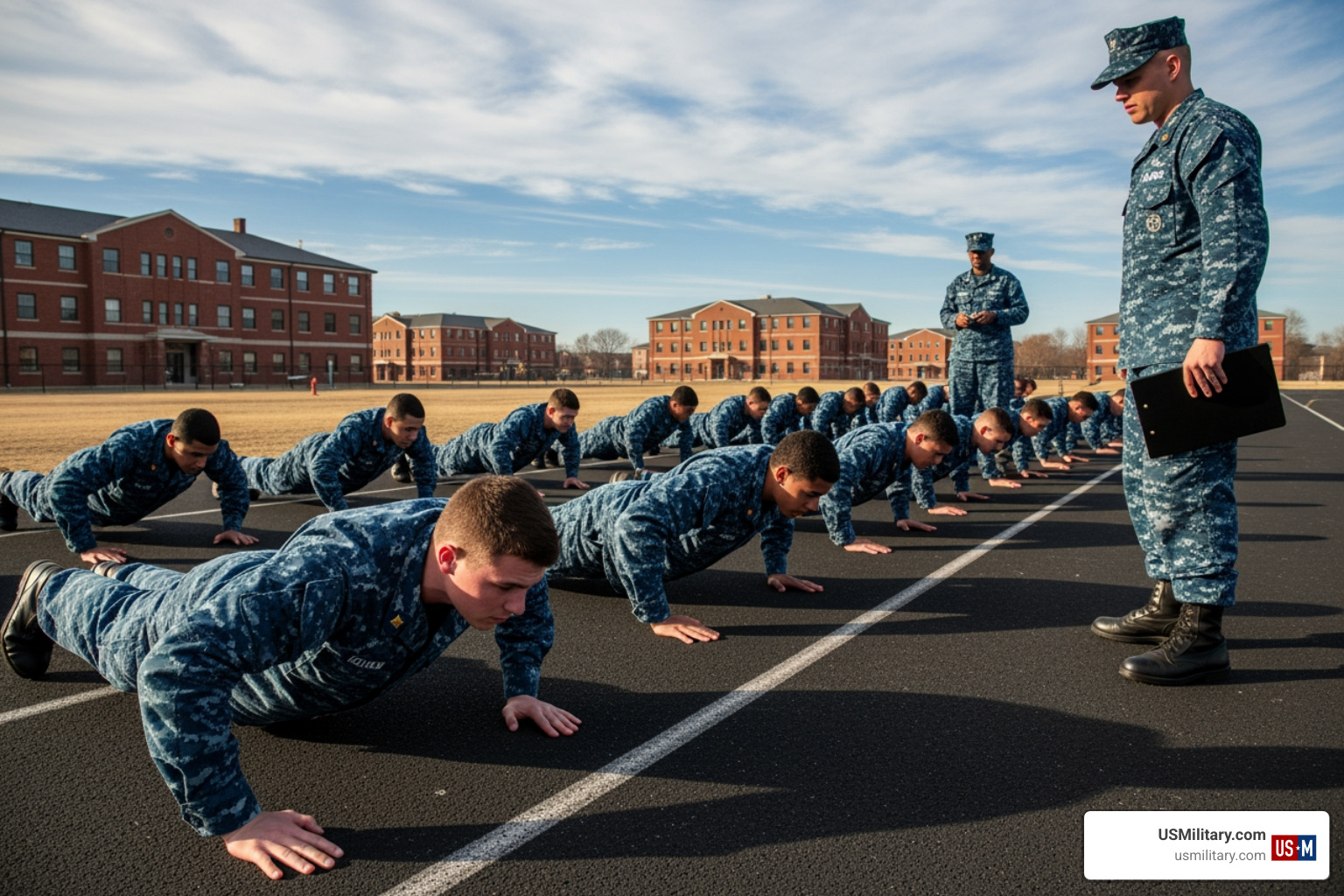
The Physical Screening Test (PST) is the first major hurdle for any aspiring SEAL. It’s not designed to “get you in shape”; rather, it’s a measure of your existing fitness baseline and a predictor of your potential to endure the rigors of Navy SEAL training. We emphasize that simply meeting the minimum standards is often not enough. To truly stand out and make recruiters take notice, you need to aim for competitive scores. The Navy Spec War Draft, which selects candidates for SEAL/SWCC contracts, ranks PST scores nationally, meaning only the best performers are selected for available spots.
Let’s break down the components of the PST:
- 500-yard Swim (Breaststroke or Sidestroke): This isn’t just about speed; it’s about water comfort and efficiency. While the minimum is 12:30, competitive candidates typically complete this in around 9:30.
- Push-ups (2 minutes): You need to perform as many push-ups as possible with proper form. The minimum is 50, but competitive scores are closer to 75.
- Sit-ups (2 minutes): Similar to push-ups, form is crucial here. Minimum is 50, with competitive scores around 75.
- Pull-ups (No time limit): This is a test of upper body strength and endurance. The minimum is 10, but aiming for 15 or more significantly improves your chances.
- 1.5-mile Run (in boots and pants): This tests cardiovascular endurance. The minimum time is 10:30, but competitive candidates often finish in 9:30 or less.
To give you a clearer picture, here’s a comparison of the minimum versus competitive PST scores:
| PST Event | Minimum Requirement | Average Contract Score |
|---|---|---|
| 500-yard Swim | 12:30 | 9:30 |
| Push-ups (2 min) | 50 | 75 |
| Sit-ups (2 min) | 50 | 75 |
| Pull-ups (no time) | 10 | 15 |
| 1.5-mile Run | 10:30 | 9:30 |
That these are just the initial gates. The Naval Special Warfare Physical Training Guide emphasizes a 26-week plan to build up to these levels, noting that preparing for this training can be equally strenuous. We recommend consulting a physician before starting any new exercise program and focusing on consistent, balanced training to improve your weakest areas.
The Complete Navy SEAL Training Pipeline
Once a candidate passes the PST and earns a Special Operator (SO) contract through the highly competitive Navy Spec War Draft, their journey through the official Navy SEAL training pipeline truly begins. This entire process, from initial enlistment to becoming a fully qualified SEAL, is a multi-stage gauntlet designed to progressively build skills and mental fortitude. It spans over a year of formal training environments, and the success rates reflect its immense difficulty: only about 10% of those who contact a recruiter eventually graduate Airborne School.
The training pipeline is structured with increasing levels of difficulty, pushing candidates to their physical and mental limits at each stage. This progressive approach allows instructors to identify those with the resilience, adaptability, and teamwork essential for special operations. We often see high attrition rates, especially in the early stages, as candidates either fail to meet standards or voluntarily withdraw, realizing the demands are too great.
Stage 1: Naval Special Warfare (NSW) Preparatory School
The first stop for a SEAL candidate after signing their contract is Navy Boot Camp in Great Lakes, Illinois. While essential for all sailors, candidates can become somewhat deconditioned during this 10-week period. That’s where the Naval Special Warfare Preparatory School (NSW Prep) comes in. This five-week program, followed by a two-week Naval Special Warfare orientation, is held in Coronado, California. Its primary goal is to recondition candidates, focusing on physical fitness and preparing them specifically for the rigors of BUD/S.
During NSW Prep, we help candidates refine their physical conditioning, improve their PST scores further, and develop crucial water competency. This phase also emphasizes injury prevention, which is paramount given the extreme physical demands ahead. Candidates who fail to meet the required physical standards by the end of NSW Prep may be reclassified into other Navy ratings.
Stage 2: Basic Underwater Demolition/SEAL (BUD/S)
Basic Underwater Demolition/SEAL (BUD/S) is the 24-week core of Navy SEAL training, held in Coronado, California. This is where the legend is forged, and it’s designed to push candidates beyond what they thought possible, physically and mentally. BUD/S is not just about physical prowess; it’s about forging mental stamina, developing leadership skills under extreme duress, and instilling an unbreakable sense of teamwork. The training aims to create individuals who can operate effectively in the most challenging environments, relying on their teammates and their own inner strength.
BUD/S is comprised of three distinct, seven-week phases—Physical Conditioning, Combat Diving, and Land Warfare—each building upon the last to develop a well-rounded special operator.
Stage 3: Parachute Jump School
Upon successful completion of BUD/S, the newly minted SEAL candidates proceed to Parachute Jump School. This is an accelerated three-week program, typically conducted at Tactical Air Operations in San Diego, California. Here, candidates learn the critical skills of airborne insertion.
The training covers both static-line parachuting, where the parachute is automatically deployed as the jumper exits the aircraft, and free-fall training, which includes both High Altitude-Low Opening (HALO) and High Altitude-High Opening (HAHO) techniques. We train them to execute complex jump progressions, culminating in night descents with full combat equipment. This stage is vital for developing the ability to infiltrate hostile territory from the air, often under the cover of darkness.
Stage 4: SEAL Qualification Training (SQT)
After the intensity of BUD/S and the specialized skills learned in Jump School, candidates move on to SEAL Qualification Training (SQT). This is a comprehensive 26-week course that digs deep into advanced tactical training. SQT is where candidates refine their skills and learn the specific tactics, techniques, and procedures that make a SEAL an effective special operator.
During SQT, we focus on a wide array of critical skills, including advanced weapons proficiency, demolitions, maritime operations, and small-unit tactics. Candidates also undergo cold weather training, preparing them for operations in diverse and extreme environments. A significant part of SQT is Survival, Evasion, Resistance, and Escape (SERE) school, which teaches them how to survive if captured and resist interrogation. Upon successful completion of SQT, candidates are officially awarded the coveted SEAL Trident, signifying their qualification as a U.S. Navy SEAL. This is also where they receive their Special Warfare Operator Naval Rating (NEC O26A) or Special Warfare Officer designation (113X).
Forging the Elite: A Deep Dive into BUD/S navy seal training
BUD/S, or Basic Underwater Demolition/SEAL, is truly the heart of the Navy SEAL training pipeline. This 24-week crucible is where individuals are transformed into elite special operators, learning to push past perceived limits and perform as part of an unbreakable team. We often say, “It pays to be a winner,” a mantra that encapsulates the relentless drive and competitive spirit demanded at every turn. Teamwork is paramount; candidates learn that individual strength means little without the collective power of their boat crew or swim pair.
The pressure is immense, and the option to quit is always present through the “Drop on Request” (DOR) tradition. A candidate can ring a brass ship’s bell three times, signifying their withdrawal from the program. This tradition highlights the voluntary nature of the training and the profound personal choice involved in continuing.
First Phase: Basic Conditioning
The First Phase of BUD/S is a grueling seven-week period focused on intense physical conditioning, water competency, and teamwork. It’s designed to break down individualistic tendencies and build cohesive small units. We push candidates through endless running, swimming, and calisthenics. Iconic exercises like “Log PT,” where boat crews carry heavy logs over their heads, foster teamwork and shared suffering, a tradition inherited from British Commando training during WWII.
Candidates also undergo extensive small boat seamanship training and learn how to conduct hydrographic surveys and charting, essential skills for maritime special operations. A critical and often feared test is the “drown-proofing” exercise, where candidates are tied hand and foot and must demonstrate comfort and survival skills in the water without using their limbs. This phase is about stripping away comfort and forcing reliance on grit and fellow trainees.
What is ‘Hell Week’ in navy seal training?
‘Hell Week’ is arguably the most infamous component of Navy SEAL training, occurring during the fourth week of First Phase. It’s a five-and-a-half-day period of continuous training designed to test a candidate’s physical endurance, mental toughness, and commitment to the team under extreme sleep deprivation. During this harrowing week, candidates sleep at most four hours the entire week, running more than 200 miles and performing physical training for over 20 hours per day.
We expose candidates to constant cold and wet conditions, pushing them to their absolute breaking point. It’s not about being the strongest or fastest; it’s about demonstrating an unwavering will to continue, to support your teammates, and to never quit, even when every fiber of your being screams otherwise. Hell Week is the ultimate test of will and commitment, and those who make it through emerge with an unparalleled understanding of their own resilience and the power of teamwork. It’s a defining moment, where many candidates decide to DOR, but for those who persist, it’s a profound step towards becoming a SEAL.
Second Phase: Combat Diving
Following the relentless challenges of First Phase, the Second Phase of BUD/S shifts focus to combat diving. This seven-week period is where candidates become proficient combat swimmers, a distinguishing skill for Navy SEALs among other special operations forces. We teach candidates to operate stealthily and effectively underwater, utilizing both open-circuit (SCUBA) and closed-circuit diving apparatus.
Training includes long-distance underwater dives, often in challenging conditions, pushing the limits of their physical and psychological endurance. Candidates gain a deep understanding of dive physics, the physiological effects of diving, and basic dive medicine. This phase is crucial for developing the ability to conduct clandestine operations, insertion, and reconnaissance from beneath the surface, preparing them for maritime missions around the globe.
Third Phase: Land Warfare
The final seven weeks of BUD/S comprise the Third Phase: Land Warfare. This phase takes place primarily on San Clemente Island, where candidates transition from the aquatic environment to mastering ground combat skills. We immerse them in a realistic combat environment, teaching them how to operate effectively on land.
Training here is extensive and includes advanced weapons proficiency, precise demolitions, and critical land navigation skills. Candidates hone their marksmanship, learn small-unit tactics, and practice patrolling and rappelling techniques. They also gain experience with live explosives and ammunition, ensuring they are proficient and safe in handling the tools of their trade. This phase culminates in a series of tactical exercises that integrate all the skills learned, preparing them for the complex land operations they will face as SEALs.
Beyond BUD/S: Advanced Training and a Career as a SEAL
Graduating from BUD/S and SQT is a monumental achievement, but it’s just the beginning of a SEAL’s career. Once awarded the Trident, new SEALs are assigned to a SEAL Team, marking the start of a continuous cycle of advanced training and deployments. The journey from initial qualification to becoming a fully experienced operator involves ongoing learning and development, typically spanning 12-24 months of pre-deployment workup cycles before they’re considered fully mission-ready for sustained operations.
Individual and Unit Level Training
Upon joining a SEAL Team, the training intensifies and becomes more specialized. This period is divided into several stages:
- Individual Specialty Training: This six-month phase allows SEALs to specialize in specific skill sets that are vital to their team’s capabilities. This can include attending:
- SEAL Sniper Course
- Advanced Close Quarter Combat/Breacher training
- Special Operations Combat Medic Course (a six-month program for the highly specialized 18D NEC)
- Language School, where they gain proficiency in critical foreign languages
- Advanced Air Operations, such as Jumpmaster or Parachute Rigger
- Technical Surveillance Operations
- Advanced Driving Skills and High Threat Protective Security (PSD)
- Advanced Demolition, and more.
- Unit Level Training (ULT): This six-month phase focuses on integrating individual skills into cohesive team operations. We practice core mission area skills like small unit tactics, land warfare, Close Quarter Combat (CQC), urban warfare, and hostile maritime interdiction (VBSS/GOPLATS).
- Task Group Level Training: The final six months of the workup cycle involve advanced training with various supporting attachments and enablers, such as Special Boat Teams (SWCC), intelligence teams, and medical teams. This phase culminates in a Certification Exercise (CERTEX), which validates the team’s readiness for deployment.
This continuous training ensures that SEALs remain at the peak of their operational readiness and are adaptable to any mission requirement.
Roles, Responsibilities, and Career Progression
Once fully qualified and integrated into a team, a Navy SEAL’s roles and responsibilities are incredibly diverse and critical to national security. They are primarily involved in:
- Direct Action (DA) Missions: Short-duration strikes and other small-scale offensive actions.
- Special Reconnaissance (SR): Collecting intelligence behind enemy lines.
- Counter-Terrorism (CT): Preventing, deterring, and responding to terrorist threats.
- Foreign Internal Defense (FID): Training and assisting foreign militaries in their own defense.
Career progression for SEALs can vary depending on whether they are officers or enlisted personnel. Enlisted SEALs typically advance through the ranks, gaining more experience and taking on greater leadership roles within their platoons and teams. They can become experts in specific fields, leading specialized detachments. Officers, on the other hand, focus more on command and strategic planning, leading platoons and eventually entire SEAL Teams. Both paths demand exceptional leadership, tactical proficiency, and unwavering dedication.
SEALs also receive various special pays beyond their base military salary, recognizing the hazardous and specialized nature of their work. This can include dive pay ($375/month), SDV (SEAL Delivery Vehicle) team pay ($300/month), HALO (High Altitude-Low Opening) jump pay ($225/month), and special duty assignment pay ($110/month), among others. These incentives acknowledge the unique demands and dangers inherent in their service.
Frequently Asked Questions about Navy SEAL Training
We understand that the path to becoming a Navy SEAL sparks many questions. Here, we address some of the most common inquiries we receive about this challenging journey.
How long does it take to become a Navy SEAL?
The initial formal Navy SEAL training pipeline, from the Naval Special Warfare Preparatory School through BUD/S, Jump School, and SQT, typically takes over a year. Specifically, it’s about 60 weeks of intensive instruction. However, this is just to earn the Trident. Once qualified, new SEALs are assigned to a SEAL Team and undergo an additional 12-18 months of rigorous pre-deployment training, known as the workup cycle. Only after completing this workup and potentially their first deployment are they considered fully operational and experienced SEALs. So, from the moment you contact a recruiter to being a seasoned operator, you’re looking at a multi-year commitment to training and readiness.
What are the biggest reasons people fail navy seal training?
While the physical demands are extreme, the biggest reasons people fail Navy SEAL training are often mental rather than physical. The training is designed to break candidates down psychologically, exposing their deepest fears and weaknesses. The constant stress, severe sleep deprivation (especially during Hell Week where candidates get only about four hours of sleep total for five and a half days), and unrelenting physical discomfort cause many to voluntarily withdraw (DOR).
Candidates might also fail by not meeting timed standards in swimming or running, or by making poor decisions under pressure. Injuries are another significant factor, as the intense physical regimen can lead to stress fractures, hypothermia, and other medical issues. Many training programs developed by former special operators focus on combining physical and mental toughness to help candidates survive phases like Hell Week, underscoring the importance of psychological resilience. It’s the lack of mental fortitude and an unbreakable will that often leads to failure, rather than a lack of physical strength.
Can women become Navy SEALs?
Yes, absolutely! As of December 2015, all military occupations, including Navy SEALs, were opened to women. This means that female candidates are eligible to volunteer for Navy SEAL training and must meet the exact same rigorous physical and mental standards as their male counterparts. There are no separate or lowered standards for women.
While the path has been challenging, we’ve seen progress. The first woman to enter the training pipeline did so in August 2017, and the first woman successfully completed the screening required to enter BUD/S in 2019. While no woman has yet completed the full SEAL training pipeline to earn the Trident, the opportunity is there for those who can meet the demanding requirements. We believe in providing equal opportunities for all qualified individuals to serve in any capacity they choose.
Conclusion
The path to becoming a Navy SEAL is one of the most demanding military training programs in the world, designed to find and forge an elite few. It requires unparalleled physical fitness, mental fortitude, and an unbreakable commitment to the team. From the initial Physical Screening Test to the brutal weeks of BUD/S, the specialized skills learned in Jump School, and the advanced tactics of SQT, every stage is a test of a candidate’s will and capability. The journey is long and arduous, with high attrition rates demonstrating its selectivity, but for those who endure, it leads to a career of profound purpose and extraordinary service to our nation.
For those who believe they have what it takes to join this elite force, USMilitary.com provides comprehensive resources to understand this challenging and honorable career path, connecting you with the information and support you need to explore your options.
Explore our complete guide to Navy SEALs
Free for Service Members & Veterans
Get the military benefits intel no one tells you about.
Weekly updates on VA benefits, pay changes, and money tips — free for service members and veterans.
No spam. Unsubscribe anytime. Your info is never shared.


