Why Understanding the Age Limits for Military Draft Matters
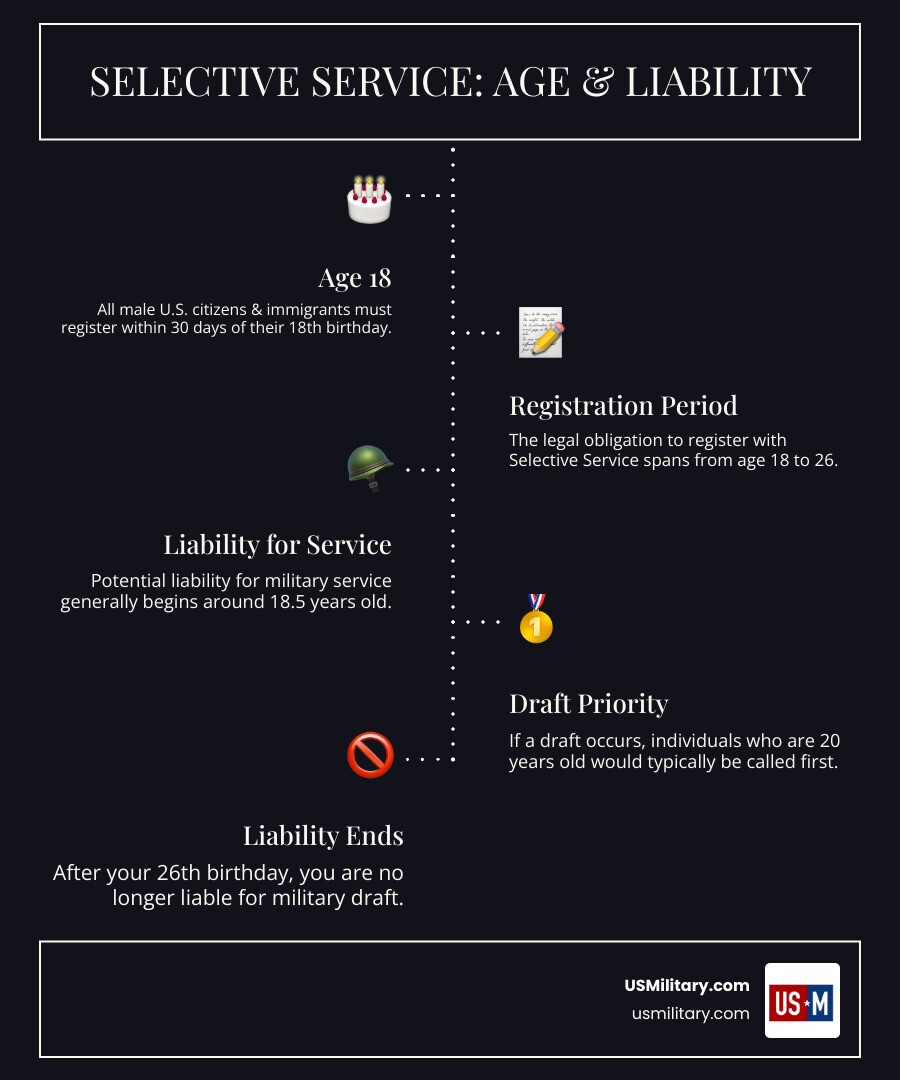
Age limits for military draft are a critical legal requirement that every young American man must understand. If you’re looking for a quick answer, here’s what you need to know:
Current Draft Age Requirements:
- Registration Required: All male U.S. citizens and male immigrants (ages 18-25)
- Registration Deadline: Within 30 days of turning 18
- Liability for Service: Generally from age 18.5 to 26
- Maximum Age: After your 26th birthday, you are no longer liable for the draft
- Priority for Induction: If a draft occurs, 20-year-olds would be called first
The Selective Service System is not the same as enlisting in the military. It’s a registration system that maintains a database of potential draftees in case Congress and the President authorize a military draft during a national emergency.
While the United States has operated as an all-volunteer military since 1973, the draft registration requirement remains law. More than 1 million men have been denied government benefits—including student loans, federal jobs, and job training programs—for failing to register. For immigrants seeking U.S. citizenship, registration is a legal requirement that can affect the naturalization process.
Understanding these age limits is not just about following the law. It’s about knowing your rights, your obligations, and what could happen if a national crisis requires the country to reinstate conscription. The rules have changed dramatically throughout American history—from ages 20-45 during the Civil War to 18-45 during World War II—showing that Congress has the power to modify these limits based on military needs.
Understanding the Current Age Limits for Military Draft
When we talk about age limits for military draft, it’s crucial to distinguish between registering for the draft and actually being conscripted. Currently, the United States relies on an all-volunteer military, meaning no one is actively being drafted. However, the Selective Service System remains in place as a contingency.
Under current U.S. law, the maximum age for draft registration and potential conscription is 25 years old. This means that men must register with the Selective Service System when they turn 18 and remain eligible for potential conscription until their 26th birthday. This requirement applies to a broad category of individuals, ensuring that if a draft were ever reinstated, the process would be fair and equitable.
Who Must Register with the Selective Service?
The Selective Service System clearly outlines who is required to register. It’s not just U.S. citizens, but a wide array of individuals residing in the country. This includes:
- Male U.S. citizens: Whether born in the U.S. or naturalized.
- Male immigrants: This covers legal permanent residents, asylum seekers, refugees, parolees, and even undocumented immigrants.
- Dual nationals: U.S. dual nationals are required to register, regardless of whether they live inside or outside the U.S.
The critical window for registration is within 30 days of turning 18. For immigrants, this means 30 days after their 18th birthday or 30 days after entry into the United States, if they are between the ages of 18 and 25. There are some exemptions, primarily for individuals on current non-immigrant visas, as long as they maintain a valid visa up until they turn 26.
It’s a legal obligation, and understanding these requirements is the first step in being prepared. For more detailed information on who needs to register, you can visit the official Selective Service System website: Who Needs to Register.
What Happens After You Register?
Once you’ve registered with the Selective Service, you are officially on the list of individuals potentially liable for military service should a national emergency necessitate a draft. While registration is mandatory, being drafted is a separate process that would only occur if authorized by Congress and the President.
If a draft were held today, the Selective Service System would likely use a lottery system based on birth dates, similar to the one used during the Vietnam War. This system is designed to be fair and impartial. Here’s how the liability for service generally works:
- Priority Groups by Age: The draft prioritizes younger individuals. According to the Selective Service, if a draft were held today, those who are 20 years old—or turning 20 during the year in which the numbers are drawn—would be the first to go.
- Sequential Priority: Beginning January 1 of the year an eligible male turns 21, he would drop into the second priority category. Each succeeding year, a draft-eligible man drops into the next lower priority group.
- Over the Age of Liability: Once you reach your 26th birthday, you are over the age of liability for the draft, meaning you can no longer be called up for military service through conscription.
The Selective Service System would draw numbers similar to a lottery, assigning a sequence number to each birth date. If your birthdate is the first one drawn, you would be among the first to be drafted, assuming you meet all other eligibility criteria and are not granted a deferment or exemption. This ensures that the process is random and minimizes perceived unfairness.
The Historical Evolution of U.S. Draft Ages
The concept of military conscription, or the draft, is not new to the United States. Throughout our nation’s history, the age limits for military draft have fluctuated significantly, often in response to the demands of war and national defense. These changes reflect evolving military needs, societal attitudes, and legislative actions.
Here’s a brief look at how draft age limits have changed over time:
| Conflict/Era | Age Range for Service | Notes |
|---|---|---|
| Early Militia (1792) | 18-45 | The Second Militia Act of 1792 defined the first group who could be called up as ‘each and every free able-bodied white male citizen of the respective states, resident therein, who is or shall be of the age of eighteen years, and under the age of forty-five years’. This was more of a local militia requirement than a national draft. |
| Civil War (1863) | 20-45 | The Enrollment Act of 1863, the first genuine national conscription law, required the enrollment of every male citizen and those immigrants who had filed for citizenship, between 20 and 45 years of age. |
| World War I (1917) | 21-31 (later 18-45) | The Selective Service Act of 1917 initially authorized a selective draft of all those between 21 and 31 years of age. By the end of the war, the age range was expanded to 18 to 45 years to meet growing personnel needs, and exemptions were reduced. |
| World War II (1940-1945) | 21-35 (later 18-45) | The Selective Training and Service Act of 1940 began the first peacetime draft, requiring registration for men aged 21 to 35. As the war escalated, the age range was expanded to 18 to 45. Some specialized roles even accepted older individuals with specific skills or expertise. |
| Vietnam War (1964-1973) | 18-25 | During this period, men between 18 and 25 were liable for the draft. The draft lottery system was implemented to determine the order of induction, with priority given to younger men. The last men conscripted were born in 1952 and earlier, with active conscription ending in January 1973. |
| Current Law (Post-1973) | 18-25 (registration) | While active conscription ended in 1973, the requirement for men aged 18-25 to register with the Selective Service System remains. Liability for service would generally be from 18.5 to 26 if a draft were reinstated, with 20-year-olds being the first priority. |
Early Conscription: From the Civil War to WWI
Our nation’s earliest forms of conscription were rooted in the militia system. The Second Militia Act of 1792 set the age range for service at 18 to 45 for “free able-bodied white male citizen[s].” This was a local, state-level obligation, not a federal draft as we know it today. For more on the history of state militias, you might find this interesting: The American Home Guard: The State Militia in the Twentieth Century.
The Civil War brought about the first genuine national conscription law with the Enrollment Act of 1863. This act required the enrollment of male citizens and immigrants who had filed for citizenship, between the ages of 20 and 45. It was a controversial measure, leading to significant unrest, but it marked a pivotal moment in federal authority over military service.
World War I saw the implementation of the Selective Service Act of 1917, which sought to create a more equitable system than its Civil War predecessor. Initially, it drafted men between 21 and 31. However, as the war intensified and the need for manpower grew, the age range was expanded to include men from 18 to 45. This period also saw efforts to allow exemptions for dependency, essential occupations, and religious beliefs, aiming to place each man in his “proper niche” in the national war effort. In 1917, 10 million men were registered, a number deemed inadequate, leading to the expansion of age ranges and reduction of exemptions, ultimately registering 24 million men by the end of 1918.
The World War II and Cold War Eras
The looming threat of World War II led to the United States’ first peacetime draft. The Selective Training and Service Act, passed on September 16, 1940, required the registration of all men between 21 and 35. This was a significant shift, preparing the nation for potential conflict even before its direct involvement. Once the U.S. entered World War II, the draft expanded dramatically, with men between 18 and 45 liable for military service. During WWII, a staggering 49 million men were registered, 36 million classified, and 10 million inducted into service.
Following WWII and into the Cold War, conscription continued, especially during the Korean War. The “Doctor Draft” was a notable aspect of this era, aimed at ensuring adequate medical personnel for the armed forces.
The Vietnam War era saw the draft become a highly contentious issue. The age limits for military draft during this period primarily targeted men between 18 and 25. The introduction of the draft lottery system in 1969, which randomly selected men based on their birth dates, was an attempt to make the process more fair and transparent. Between 1964 and 1973, over 9 million men and women served in the armed forces, with 1,766,910 men drafted. The last inductions occurred in December 1972, and active conscription officially ended in January 1973, ushering in the all-volunteer military era we have today.
How a Modern Draft Works: Process, Exemptions, and Penalties
Even though the U.S. military is all-volunteer, the Selective Service System remains active. This is our nation’s insurance policy, ensuring we can rapidly mobilize if a national crisis ever overwhelms our volunteer forces. If a draft were to be reinstated, it would follow a very specific process, designed to be as fair and impartial as possible.

The authority to reinstitute the draft rests solely with Congress and the President. In a declared national emergency, they would need to pass legislation to activate the Selective Service System for conscription.
The Draft Lottery and Order of Induction
The cornerstone of a modern draft would be the lottery system. This system, refined since its use during the Vietnam War, aims to eliminate arbitrariness and ensure that those called upon are selected randomly.
The process is quite fascinating, almost like a national game of chance, but with very serious implications:
- Two Machines, Two Draws: The lottery begins with two large air lottery drawing machines. One machine holds 365 (or 366 for a leap year) balls, each representing a day and month of the year. The second machine holds balls numbered 1 to 365 (or 366).
- Date and Number Pairing: Officials would draw a date from the first machine and a number from the second. For example, if August 4 is drawn from the date machine and 32 from the number machine, then all men whose birthday is August 4 would be assigned a draft priority number of 32. This process continues until all dates are paired with a sequence number.
- Priority Groups: If a draft were initiated, the Selective Service System would call men in order of their lottery numbers, starting with the lowest. As we mentioned, 20-year-olds would be the first priority group. As men age out of the 20-year-old category, they fall into subsequent priority groups until they reach their 26th birthday, at which point they are no longer liable for the draft.
This system is designed to provide a clear, random, and publicly verifiable method for determining the order of induction. You can learn more about the specifics of the lottery system on the Selective Service System’s website: Lottery : Selective Service System.
Exceptions and Conditions Affecting Age Limits for Military Draft
While the age limits for military draft define the broad pool of eligible men, various exceptions and conditions can affect an individual’s liability for service. These are generally categorized as deferments or exemptions.
- Deferments: These are temporary postponements of military service. Historically, common deferments included:
- Student Deferments: During conflicts like the Vietnam War, college students could often defer service. Today, such deferments are less likely to be automatic and would depend on specific legislative provisions.
- Hardship Deferments: Granted when a person’s induction would cause extreme hardship to dependents.
- Occupational Deferments: For individuals in critical occupations deemed essential to national health, safety, or interest.
- Exemptions: These are permanent exclusions from military service.
- Conscientious Objectors: Individuals who, by reason of religious training and belief, are conscientiously opposed to participation in war in any form. The Supreme Court has ruled that conscientious objection can stem from non-religious beliefs as well, but not simply opposition to a specific war. If granted this status, they may be required to perform alternative service.
- Medical and Psychological Standards: Individuals who do not meet the physical, mental, or moral standards set by the military would be disqualified.
- Ministerial Students and Ministers: Historically, those preparing for or serving in ministry have been exempt.
The specifics of deferments and exemptions can change with legislation. During times of national crisis, Congress has the power to modify these conditions to meet military needs, as seen in World War I when exemptions were reduced to increase manpower.
Legal Consequences of Failing to Register
Failing to register for the draft is a serious matter with significant legal and personal repercussions. It’s not a minor oversight; it’s a federal felony.
- Felony Offense: The law states that failing to register or to comply with a draft order is punishable by a fine of up to $250,000 or a prison term of up to five years, or both. While prosecutions for failing to register have been rare since 1986, the potential penalties are severe.
- Ineligibility for Federal Benefits: This is perhaps the most immediate and widespread consequence. Men who fail to register can be denied:
- Federal student aid (including Pell Grants, Federal Work-Study, and federal student loans).
- Federal job training.
- Employment with federal agencies.
- In many states, registration is also a requirement for state-based student aid and state government employment.
- Citizenship Process for Immigrants: For immigrant men, failure to register can jeopardize their path to U.S. citizenship. Registration is a mandatory step for immigrant men seeking naturalization.
The Selective Service System has actively provided names of non-registrants to federal agencies, leading to over 1 million men reportedly being denied government benefits. This highlights that even without active conscription, the registration requirement carries real-world consequences for individuals. So, while we might joke about “getting drafted,” the legal obligation to register is no laughing matter.
The Future of Military Conscription and Age Limits
The discussion around age limits for military draft is not static. As modern warfare evolves and geopolitical landscapes shift, so too do the conversations about how the U.S. might meet its military personnel needs in the future.
The all-volunteer force has served the nation well for decades, but recent reports and discussions suggest that some influential figures are considering alternatives. For example, The Washington Post reported in 2024 that “a cluster of influential former administration officials and GOP lawmakers… have mused aloud about a national service mandate and other measures to remedy what they see as a ‘crisis’ facing the all-volunteer military.” This indicates that while a draft is not imminent, the idea of national service, which could include some form of conscription, is not entirely off the table in policy discussions.
Modern warfare’s reliance on advanced technology, cyber capabilities, and specialized skills might influence future decisions about draft age limits. Instead of a broad call for general infantry, a future draft could potentially focus on:
- Special Skills Drafts: Targeting individuals with specific, high-demand skills, such as healthcare professionals (a “Doctor Draft” has historical precedent), cyber warfare specialists, or engineers. This could potentially involve older individuals who possess these critical skills, similar to how specialized roles in WWII accepted older experts.
- Evolving Military Needs: The nature of conflict could necessitate different age profiles. For instance, highly technical roles might benefit from individuals with more education and experience, potentially pushing the effective draft age higher for those specific skill sets.
Another significant ongoing debate centers on the inclusion of women in draft registration. Currently, only men are required to register. However, with women serving in all combat roles and the military emphasizing gender equality, there’s increasing pressure to extend draft registration to women. Legal challenges have been brought forward, and while the Supreme Court upheld the male-only registration in 1981’s Rostker v. Goldberg, subsequent changes in military policy regarding women in combat have reignited this discussion in Congress and the courts. Any change would require an act of Congress to amend the Military Selective Service Act to include “female persons.”
These discussions underscore that while the current age limits for military draft are clearly defined, they are ultimately subject to the legislative power of Congress and the evolving needs of national defense.
Frequently Asked Questions about Draft Age Limits
We understand that the topic of military conscription can raise many questions, especially regarding age limits. Here are some of the most common inquiries we receive:
What is the absolute maximum age someone could be drafted?
Under current U.S. law, the liability for military conscription generally ends on a man’s 26th birthday. This means that if a draft were to be reinstated today, individuals would typically not be called after they turn 26.
However, it’s crucial to remember that Congress has the power to modify these age limits. History provides a clear precedent: during World War II, the draft age was expanded to include men up to 45 years old. In extreme national emergencies, Congress could theoretically adjust the maximum draft age upward again. Furthermore, in the event of a special skills draft (e.g., for doctors or cyber experts), older individuals with critical expertise might be targeted, irrespective of a general age limit. So, while 26 is the current cutoff, it’s not an immutable maximum if the nation’s needs drastically change.
Are there any exceptions for only sons, students, or married men?
Historically, yes, there have been various deferments and exemptions for specific groups, including only sons, students, and married men. During the Vietnam War, for instance, student deferments were quite common, and some men even rushed to marry to avoid the draft.
However, current regulations are much tighter, and automatic deferments are far less likely to be granted. If a draft were to be reinstated today:
- Students: While there might be provisions for temporary student deferments, they are unlikely to be automatic or last for the entire duration of a degree program. The focus would be on meeting military needs.
- Married Men and Fathers: These categories historically received deferments, but in a modern draft, such deferments would likely be limited and contingent on specific circumstances, such as extreme hardship to dependents, rather than being automatic.
- Only Sons: The concept of an “only son” deferment has existed, often tied to preventing the last surviving son in a family from serving if other siblings died in military service. The specifics of such a deferment would depend on the legislation passed to reinstate a draft.
- Conscientious Objectors: This remains a valid exemption, provided an individual can demonstrate a sincere and deeply held moral or religious opposition to participation in war in any form. This status is typically determined after an individual has been drafted.
The key takeaway is that while some historical exceptions existed, a modern draft would likely have very few automatic deferments, and any exceptions would be narrowly defined and subject to strict criteria.
Why do men have to register but women do not?
This is a frequently asked question and a topic of ongoing debate. Currently, the Military Selective Service Act, as written, specifies that “male persons” are required to register. This legal distinction dates back to historical military policies that largely excluded women from combat roles.
In 1981, the Supreme Court, in the case of Rostker v. Goldberg, upheld the male-only registration requirement. The Court reasoned that since women were excluded from combat service by statute or military policy, men and women were not “similarly situated” for the purposes of a draft or registration. Therefore, Congress’s decision to authorize the registration of only men did not violate the Due Process Clause.
However, military policy has evolved significantly since 1981. Women are now eligible to serve in all combat roles, including infantry, armor, and special operations. This change has fueled renewed calls from both legal scholars and some members of Congress to require women to register for the draft. There is an ongoing legal and congressional debate about whether to extend draft registration to women or to abolish the Selective Service System entirely. Until Congress acts to change the law, the requirement remains male-only.
Conclusion
Understanding the age limits for military draft is a crucial civic responsibility for every young man in the United States. While our nation proudly operates with an all-volunteer military, the Selective Service System remains a vital contingency plan, ready to provide personnel in the event of a national emergency.
We’ve explored how the current law requires men aged 18 to 25 to register, with liability for conscription typically ending at 26. We’ve also seen that these age limits are not set in stone, having been historically flexible to meet the demands of conflicts like the Civil War, World War I, and World War II, where ages soared to 45. The mechanics of a modern draft, relying on a fair lottery system, aim to ensure equity should conscription ever be reinstated.
The consequences of failing to register are serious, ranging from denial of federal benefits to potential felony charges, underscoring the importance of compliance. As warfare continues to evolve, discussions about the future of conscription, including the potential for specialized skill drafts and the inclusion of women, will undoubtedly continue.
The Selective Service System is a testament to our nation’s commitment to defense and the shared responsibility of its citizens. Knowing your obligations and the historical context behind them empowers you to be an informed and prepared member of society.
For those interested in serving our country voluntarily, we encourage you to explore the many rewarding career paths available. You can Learn more about the age limits to join the military voluntarily and connect with recruiters to find how you can contribute to our nation’s strength.
Free for Service Members & Veterans
Get the military benefits intel no one tells you about.
Weekly updates on VA benefits, pay changes, and money tips — free for service members and veterans.
No spam. Unsubscribe anytime. Your info is never shared.



More Than 90% Of Clients Have Increased Ratings! Why Settle For Less Than You Deserve? Expert Priority Help With Your VA Claim Today! Free Evaluation Call!
The mission of Veteran Services United is to support veterans in filing and winning disability claims by offering expert guidance, advocacy, and personalized assistance. Through dedicated service, Veteran Services United empowers veterans to secure the benefits they have earned, ensuring they receive the care and support they deserve.