The Safest Jobs in the Air Force Today: A Quick-Start Guide

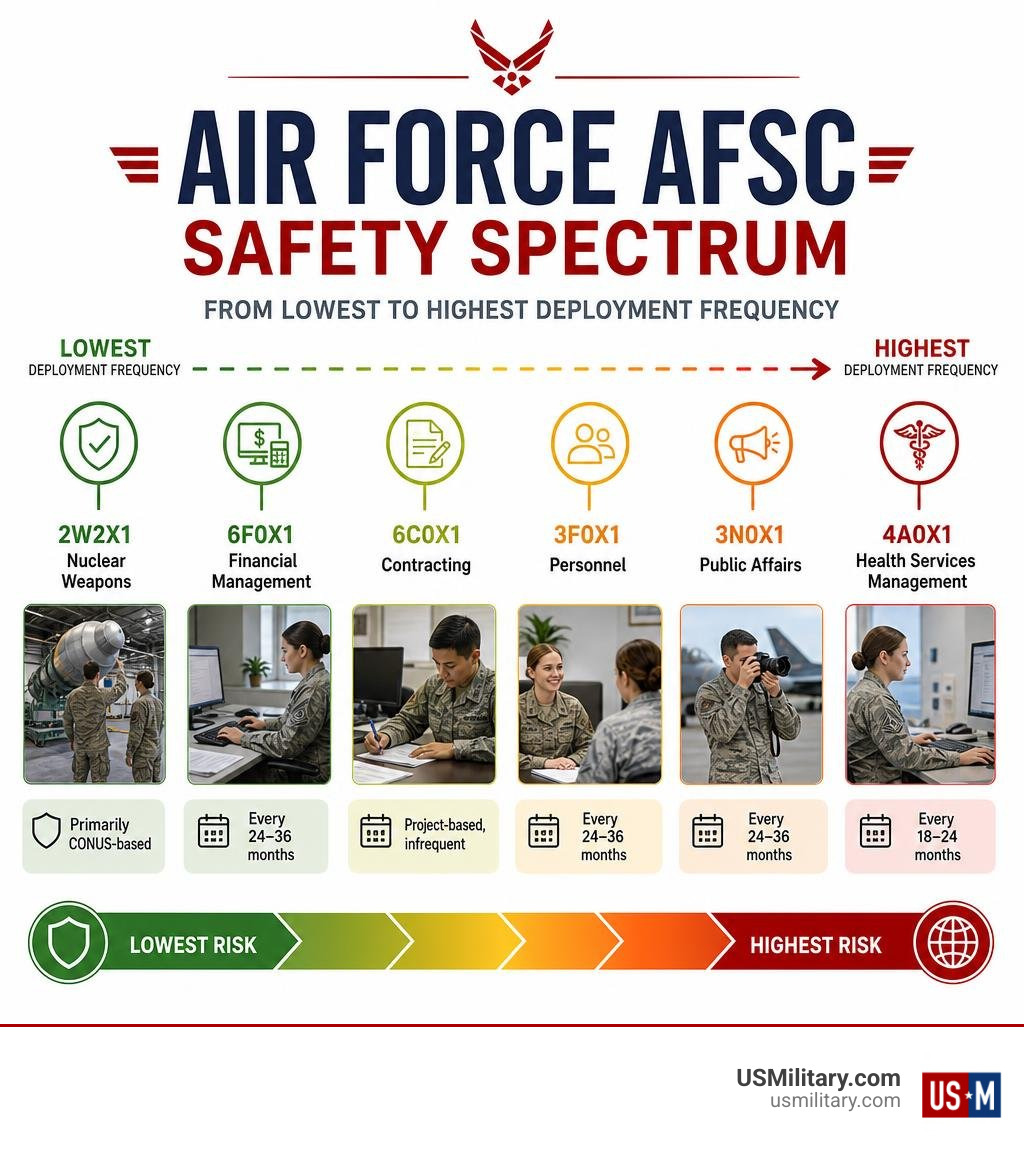
If you’re weighing enlistment options, knowing the safest jobs in the Air Force today can make a huge difference in your decision. Here’s a fast overview of the roles with the lowest deployment rates and least combat exposure:
| AFSC | Job Title | Deployment Frequency | Min. ASVAB Score |
|---|---|---|---|
| 6F0X1 | Financial Management | Every 24-36 months | ADMI 57 |
| 6C0X1 | Contracting | Project-based, infrequent | ADMI 65 |
| 3F0X1 | Personnel | Every 24-36 months | ADMI 41 |
| 3N0X1 | Public Affairs | Every 24-36 months | GEND 62 |
| 4A0X1 | Health Services Management | Every 18-24 months | ADMI 44 |
| 2W2X1 | Nuclear Weapons | Primarily CONUS-based | Varies |
The Air Force offers more than 200 jobs — called Air Force Specialty Codes (AFSCs) — and not all of them carry the same risk. Some roles keep you stateside for years at a time. Others can send you downrange far more often than you’d expect.
The key point most recruiters won’t lead with: every Airman is technically deployable. But “deployable” doesn’t mean every job deploys at the same rate or into the same environments.
I’m Larry Fowler, publisher of USMilitary.com since 2007, and I’ve spent nearly two decades helping servicemembers and recruits navigate decisions exactly like this one — including identifying the safest jobs in the Air Force today that align with both lifestyle goals and long-term career growth. Below, I’ll walk you through everything you need to know to make a smart, informed choice.
Learn more about Safest Jobs In The Air Force Today:
- Airman First Class
- Captain US Air Force
- Air Force Lieutenant Colonel
Understanding What Makes a Safest Jobs In The Air Force Today List
When we talk about the safest jobs in the military, it helps to understand how risk is calculated across the service branches. While branches like the Army or Marine Corps maintain primary infantry units on the ground, the Air Force operates differently. Most Air Force career fields operate well behind the front lines, providing critical support, technology, logistics, and air support. If you are comparing branches, you can read our breakdown on Which Army Jobs Are Least Likely To See Combat to see how the services differ.
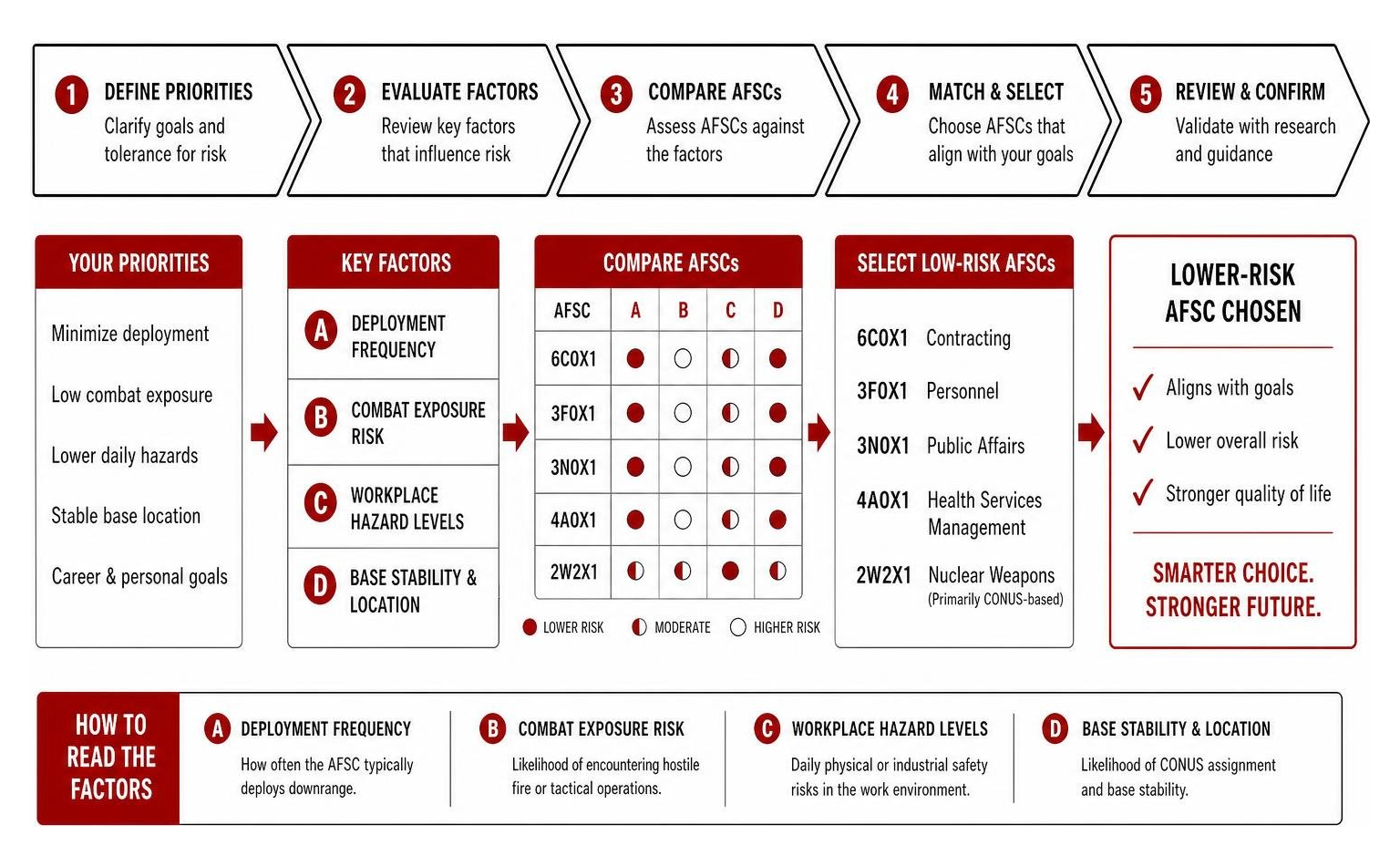
To compile a true safest jobs in the Air Force today list, we evaluate four main factors:
- Deployment Frequency: How often an Air Force Specialty Code (AFSC) deploys downrange compared to home-station duty.
- Combat Exposure Risk: The statistical likelihood of encountering hostile fire, indirect attacks, or tactical field operations.
- Workplace Hazard Levels: Daily industrial or operational physical safety risks, such as flight line operations, high-voltage machinery, or hazardous munitions handling.
- Base Stability & Location: Whether an AFSC is restricted to permanent Continental United States (CONUS) military bases versus forward-operating locations.
While no military career offers absolute immunity from operational requirements, selecting an administrative, intelligence, or fixed-base specialty significantly minimizes occupational danger.
Top Low-Deployment Support and Administrative AFSCs
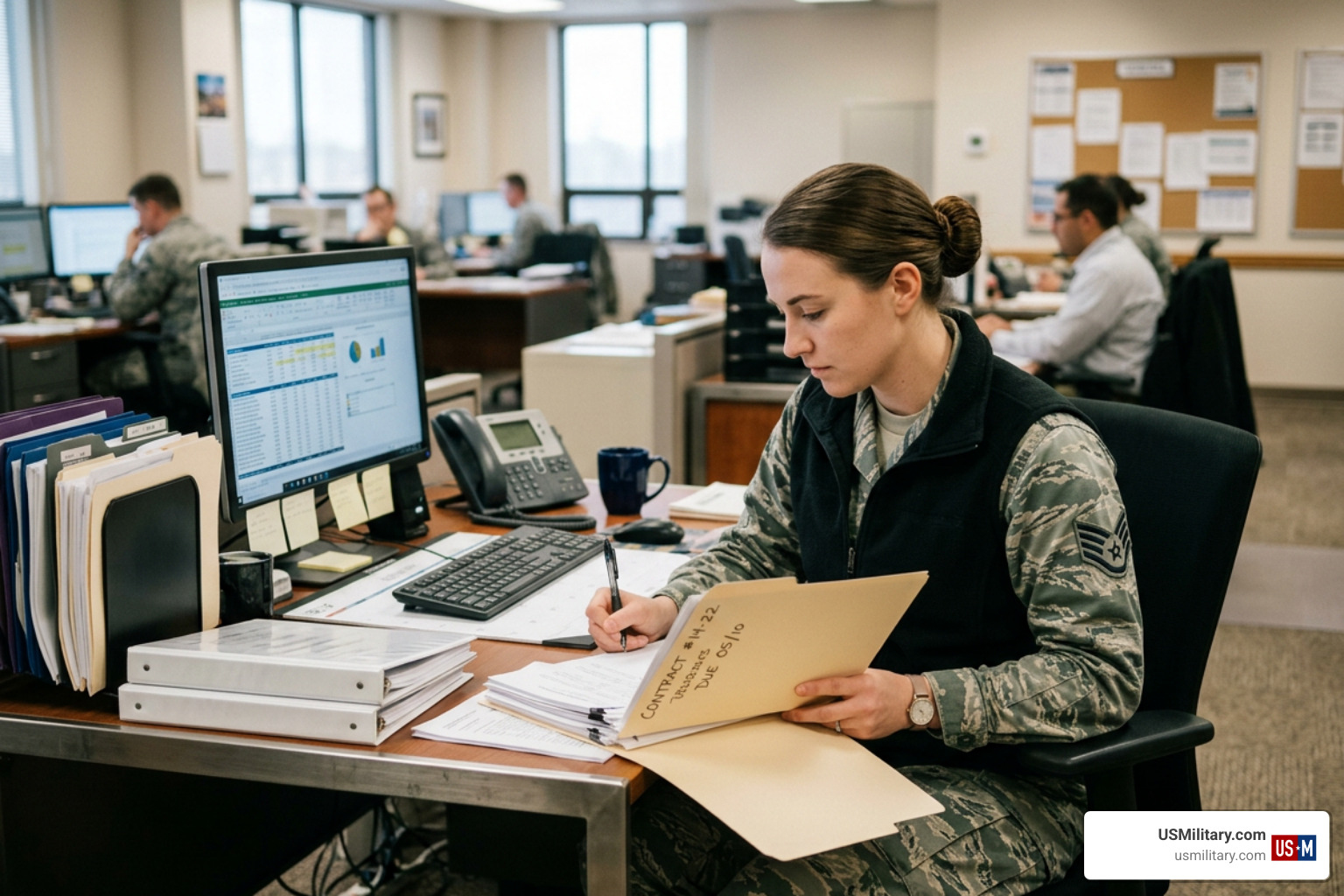
If your goal is daily stability, predictable work schedules, and minimal travel downrange, administrative support career fields represent some of the safest jobs in the Air Force today. These office-based career fields keep base infrastructure running smoothly while offering steady 9-to-5 schedules.
6F0X1 Financial Management and 6C0X1 Contracting: Safest Jobs In The Air Force Today
Financial Management (6F0X1) and Contracting (6C0X1) are widely recognized as two of the most stable and low-risk career paths in the Air Force.
- Financial Management (6F0X1): Financial specialists handle accounting, military pay, travel vouchers, and budget execution across every base. With a low deployment cycle of roughly once every 24 to 36 months, specialists in this field work almost exclusively in climate-controlled office spaces. To qualify, applicants need an Armed Services Vocational Aptitude Battery (ASVAB) Administrative (ADMI) score of 57.
- Contracting (6C0X1): Contracting specialists negotiate, award, and oversee multi-million dollar military contracts for base supplies, services, and construction projects. Because their work revolves around procurement law and civilian vendor oversight, deployments are project-based and extremely infrequent. Contracting requires an ADMI score of 65 due to the complex legal and analytical work involved.
Both fields build high-level business acumen that transitions effortlessly into six-figure corporate careers. Explore our guide on 15 Best Air Force Jobs For Long-Term Financial Success for more on lucrative Air Force specialties.
3F0X1 Personnel and 3N0X1 Public Affairs: Safest Jobs In The Air Force Today
For candidates seeking accessible entry qualifications along with safe working conditions, Personnel and Public Affairs stand out:
- Personnel (3F0X1): Personnel specialists manage Airman career records, assignments, promotions, and re-enlistments. Sits near the bottom of the Air Force deployment rotation list, with rotations typically occurring every 24 to 36 months. Tech school lasts just four weeks at Keesler Air Force Base in Mississippi, and it features one of the most accessible ASVAB entry standards at ADMI 41.
- Public Affairs (3N0X1): Public Affairs specialists handle media relations, photojournalism, graphic design, and internal base communications. Requiring a General (GEND) ASVAB score of 62, Public Affairs Airmen enjoy low operational rotation rates while getting a front-row seat to document military operations without engaging in direct combat roles.
To explore additional top-rated specialties, check out our master overview on Best Air Force Jobs.
4A0X1 Health Services Management and Medical Support
While field medics and aerospace medical apprentices can deploy into tactical environments, Health Services Management (4A0X1) focuses entirely on hospital administration and clinic logistics.
- Daily Duties: Managing patient records, medical supply chains, tricare processing, and facility scheduling.
- ASVAB Requirement: ADMI score of 44.
- Deployment Profile: Standard rotation frequency of 18 to 24 months, with deployments taking place inside established military hospitals or regional clinic centers overseas.
Health Services Management offers a clean, professional healthcare environment with minimal physical stress and zero tactical exposure.
Stationary CONUS and Technical Careers with Minimal Combat Risk
Beyond administrative desks, several specialized technical career fields maintain extraordinarily low combat risk due to the stationary nature of their missions.
2W2X1 Nuclear Weapons Specialists and Missile Operations
While working with nuclear munitions sounds intense, the 2W2X1 Nuclear Weapons field is statistically one of the safest from a combat standpoint.
Nuclear weapons technicians maintain and inspect strategic assets like the Minuteman III intercontinental ballistic missile system and air-launched nuclear munitions under the strict Air Force Nuclear Weapons Surety Program.
- Base Locations: These strategic weapons are anchored at stationary domestic bases, primarily Minot AFB (North Dakota), F.E. Warren AFB (Wyoming), and Malmstrom AFB (Montana).
- Deployment Rates: Extremely low overseas deployment frequency because the core mission is centered inside fixed, heavy-security stateside facilities.
- Standards: Personnel must maintain rigorous adherence to the Personnel Reliability Program (PRP) and the non-negotiable two-person safety rule.
- Civilian Transition: Directly prepares members for civilian roles as nuclear technicians, earning median salaries around $84,190 per year according to industry reports.
Cyber Systems Operations and Intelligence Support
In modern defense, the digital battleground is operated thousands of miles away from traditional battle zones.
- Cyber Systems Operations (3D0X2 / 1D7X1): Cyber defenders secure Air Force networks, install firewalls, and manage enterprise server infrastructure. The vast majority of cyber airmen work inside secure, climate-controlled operations centers located within major stateside installations.
- Operations Intelligence (1X0X1): Intelligence analysts collect and interpret satellite images, signal data, and field intelligence reports. Because their equipment relies on stationary satellite feeds and supercomputers, intel specialists perform critical combat support without setting foot on a physical battlefield.
Both cyber and intelligence career fields offer top-tier civilian transition value to defense contractors and federal intelligence agencies. Candidates curious about official career paths can explore the official Air Force Careers hub or read 10 of the Best Jobs in the US Air Force.
ASVAB Requirements, Bonuses, and Trade-Offs of Low-Risk AFSCs

Securing one of the safest jobs in the Air Force today requires understanding the entry testing requirements and career trade-offs involved.
Qualifying via ASVAB Scores and Qualification Standards
To land an administrative or technical role, your ASVAB scores matter significantly. The Air Force divides ASVAB results into four composite areas: General (GEND), Administrative (ADMI), Mechanical (MECH), and Electrical (ELEC).
Administrative and low-deployment career fields rely heavily on the ADMI and GEND composites, which measure verbal comprehension, word knowledge, math knowledge, and arithmetic reasoning.
- Minimum active duty AFQT score to enlist: 36
- Personnel (3F0X1): ADMI 41
- Health Services Management (4A0X1): ADMI 44
- Financial Management (6F0X1): ADMI 57
- Public Affairs (3N0X1): GEND 62
- Contracting (6C0X1): ADMI 65
Preparing for these academic sections before heading to the Military Entrance Processing Station (MEPS) is crucial. Before you step into the testing room, review our guides on What To Expect Air Force Basic Training and How Long Is Air Force Basic Training.
Selective Retention Bonuses and Promotion Trade-Offs
While safe desk jobs offer comfort and predictability, applicants should weigh several practical trade-offs:
- Enlistment & Retention Bonuses: High-demand operational fields like bomb disposal or special warfare command multi-thousand-dollar initial enlistment incentives. While the Air Force allocated $1.1 billion toward retention and expanded its Selective Retention Bonus (SRB) list to 89 fields in fiscal 2025, administrative roles rarely receive top-tier initial enlistment bonuses. For a comparison of high-payout fields, read about 15 High-Demand Military Jobs With Great Enlistment Bonuses.
- Promotion Speed: Administrative fields often face stiffer promotion competition and slower rank advancement compared to heavily manned operational fields.
- Daily Routine: Desk jobs lack the high-octane operational variety and travel opportunities associated with aircrew or combat support roles.
If maximum home stability is your primary objective, you can also look into the Air Force Reserve or Air National Guard Jobs, which allow you to serve locally while maintaining a full-time civilian job.
Common Misconceptions and Hidden Realities of “Safe” Air Force Roles
A common mistake new recruits make is assuming that a “safe” AFSC means zero military obligations or stress. Let’s clear up a few realities:
- Universal Deployability: Every Airman, regardless of specialty, is basic-combat-trained and worldwide deployable. If a major conflict arises, support personnel deploy to backfill forward locations.
- Casualty Augmentation & Mortuary Duty: During unexpected mass-casualty events or humanitarian disasters, administrative, services, and medical support personnel can be assigned to casualty processing or mortuary affairs support teams.
- Base Defense & Perimeter Guard: Personnel in low-risk office jobs can still be tasked with base defense augmentee duties, working flight line gates or base perimeter security shifts during heightened threat levels.
- Mental Stress: While physical combat danger is low, fields like Contracting, Finance, and Cyber deal with intense workload pressures, strict legal accountability, and tight operational deadlines.
Understanding these military realities ensures you enter the service with eyes wide open. If you’re deciding between service branches, review Should You Join The Army Or The Air Force to compare branch cultures.
Frequently Asked Questions About Safe Air Force Careers
Which Air Force job has the absolute lowest deployment rate?
Stationary domestic technical roles (such as 2W2X1 Nuclear Weapons maintenance assigned to CONUS ICBM missile bases) and office support specialties like 6C0X1 Contracting and 6F0X1 Financial Management feature some of the lowest deployment frequencies in the service, often going 24 to 36 months or longer between rotation cycles.
Are administrative jobs in the Air Force completely risk-free?
No military job is 100% risk-free. All Airmen are worldwide deployable support personnel who can be tasked with base defense duties, local emergency response, or deployed support assignments depending on military operational necessity.
How do safe Air Force jobs transition to civilian careers?
Administrative, financial, cyber, and medical support AFSCs offer seamless transitions into the civilian workforce. Contracting specialists transition into corporate procurement officers, cyber defenders move into private cybersecurity engineering, and financial management specialists enter federal budget analysis or corporate finance roles.
Conclusion
Choosing among the safest jobs in the Air Force today comes down to balancing your personal risk tolerance, academic strengths on the ASVAB, and long-term civilian career ambitions. Whether you align with the corporate focus of Contracting and Finance, the technical routine of Cyber Defense, or the static security of Nuclear Weapons operations, the Air Force provides incredible avenues to serve your country safely while building professional experience.
At USMilitary.com, we are dedicated to supporting your military journey every step of the way — from initial enlistment testing to understanding your benefits, pay scales, and rank progression. Explore our comprehensive guide to Air Force Enlisted Ranks or review the master Military Ranks Guide to prepare for a successful career in uniform.
Free for Service Members & Veterans
Get the military benefits intel no one tells you about.
Weekly updates on VA benefits, pay changes, and money tips — free for service members and veterans.
No spam. Unsubscribe anytime. Your info is never shared.


