Understanding Air Force Special Warfare: The Ground Force in the Sky
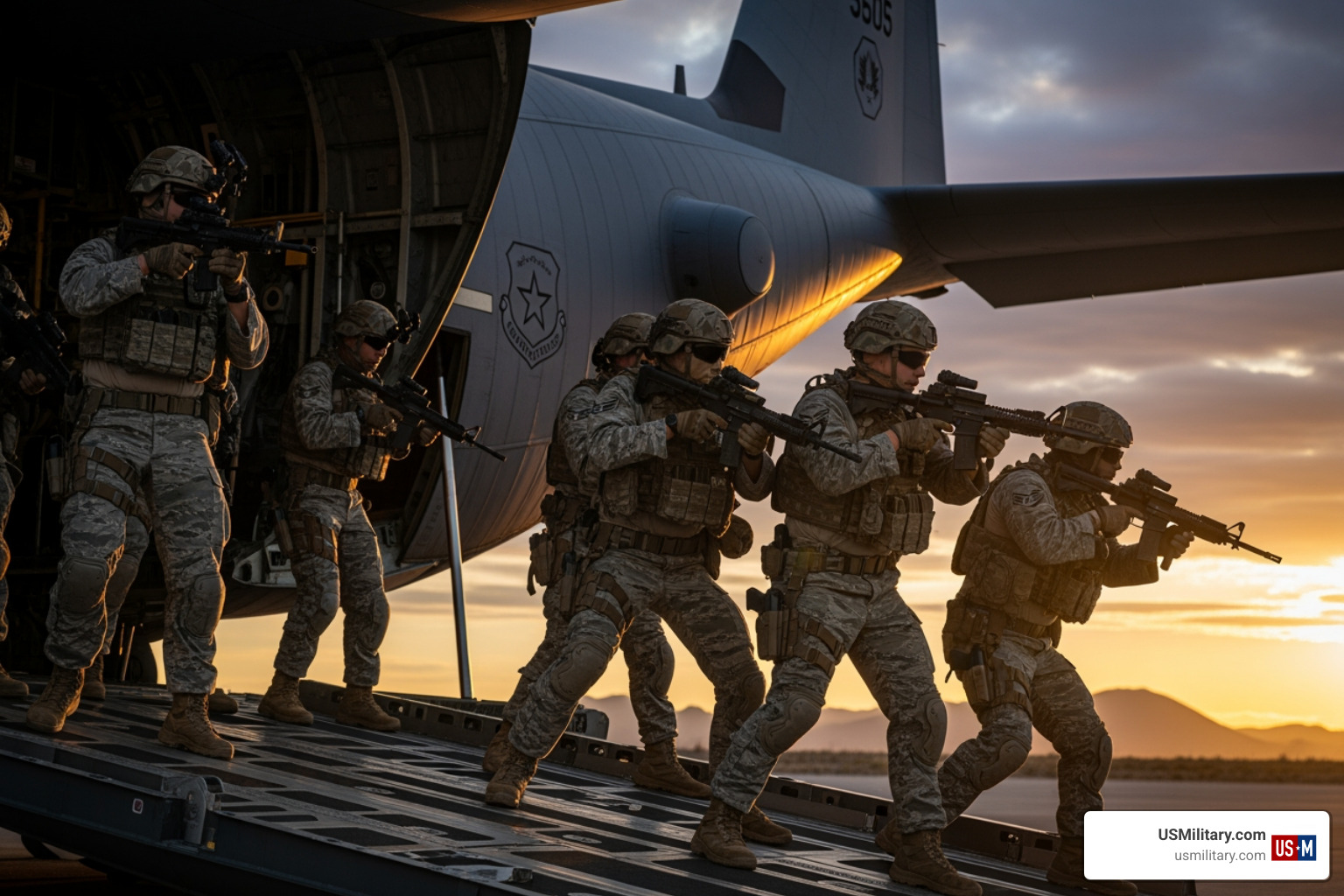
Air Force special forces, officially known as Air Force Special Warfare (AFSW), are the ground combat forces of the U.S. Air Force specializing in airpower application in hostile, denied, and politically sensitive environments. These elite operators serve as the “tip of the spear” for the Air Force, conducting tactical, sensitive, and special operations across air, land, maritime, space, and cyber domains.
Quick Overview: What You Need to Know
- Primary Organization: Air Force Special Operations Command (AFSOC), established May 22, 1990
- Total Personnel: Approximately 20,800 active-duty, reserve, and civilian personnel
- Core Mission Areas: Global Access, Precision Strike, Personnel Recovery
- Main Specialties: Combat Control (CCT), Pararescue (PJ), Special Reconnaissance (SR), Tactical Air Control Party (TACP)
- Training Difficulty: 80-90% attrition rate during pipeline training
- Enlistment Bonuses: Up to $50,000 for qualified candidates
When most people think about Air Force careers, they picture pilots flying jets or mechanics working on aircraft. But Air Force Special Warfare operators are something entirely different. They’re the Air Force’s only special operations ground force, and they often work on the ground alongside Navy SEALs, Army Rangers, and Marine Raiders.
The select individuals who make up Air Force Special Warfare are among the toughest, most highly trained warriors on the planet. They embed with joint special operations forces to provide unique capabilities that only the Air Force can deliver—from establishing airfields in hostile territory to coordinating precision air strikes, rescuing isolated personnel, and gathering critical intelligence.
A vast majority of Americans—82% according to a Rand Corporation study—have limited to no familiarity with Air Force Special Warfare. This is by design. These are the “quiet professionals” who prefer to let their actions speak louder than their reputation. While Navy SEALs and Army Green Berets dominate headlines, Air Force special operators quietly conduct some of the most dangerous and technically demanding missions in the U.S. military.

The Operators: Air Force Special Warfare Specialties
Within the field of Air Force special forces, operators are organized into distinct “Weapon Systems” that define their primary mission focus and capabilities. These systems are: Guardian Angel (GA), Special Tactics (ST), and Tactical Air Control Party (TACP). Each system encompasses specialized enlisted and officer roles, all working in concert to achieve complex objectives in challenging environments.
Let’s explore the core enlisted specialties that form the backbone of Air Force Special Warfare:
| Specialty | Primary Mission | Key Skills | Typical Operational Environment |
|---|---|---|---|
| Combat Control (CCT) | Rapidly deploy and establish assault zones or airfields in austere or hostile territory, providing air traffic control and fire support. | Air traffic control (FAA certified), combat search and rescue, special reconnaissance, direct action, counter-terrorism, foreign internal defense, humanitarian assistance, fire support, command and control. | Front lines, behind enemy lines, remote locations, disaster areas, often embedded with other SOF. |
| Pararescue (PJ) | Conduct conventional and unconventional personnel recovery operations, including combat search and rescue (CSAR), medical treatment, and evacuation of isolated personnel. | Advanced combat medicine, parachuting (freefall and static-line), diving, mountaineering, small unit tactics, survival, evasion, resistance, and escape (SERE), casualty extraction. | Any environment where personnel need to be rescued or receive immediate medical care, including combat zones and disaster areas. |
| Special Reconnaissance (SR) | Collect and report on critical intelligence, conduct environmental assessments, and provide advanced information, surveillance, and reconnaissance (ISR) in denied or hostile areas. | Advanced reconnaissance techniques, environmental data collection and analysis, target interdiction, small unit tactics, survival, evasion, resistance, and escape (SERE), specialized insertion/extraction methods. | Deep behind enemy lines, denied areas, politically sensitive regions, focusing on intelligence gathering. |
| Tactical Air Control Party (TACP) | Integrate airpower into ground operations, serving as precision strike experts and Joint Terminal Attack Controllers (JTACs) to direct close air support and coordinate air assets. | Joint terminal attack control (JTAC), close air support (CAS), fire support coordination, multi-domain command and control, communication with ground forces and aircrews, advising ground commanders on airpower capabilities. | Embedded with Army or Marine ground units, directing air strikes and managing airspace in close proximity to combat. |
The Core Roles of Special Forces Air Force Operators
Let’s dig deeper into what makes each of these special forces Air Force roles so vital.
Combat Control (CCT)
If you’ve ever wondered who lands planes in a war zone when there’s no airfield, you’re thinking of a Combat Controller. These highly specialized operators are FAA certified Air Traffic Controllers who can establish, operate, and maintain airfields and assault zones in the most austere and hostile environments. Their mission, often falling under the “Global Access” capability, is to create pathways for airpower where none exist, making them indispensable for any large-scale operation. They not only control air traffic but also integrate fire support and provide critical command and control. They are truly the “eyes and ears” of the Air Force on the ground, enabling our forces to project power anywhere in the world. To learn more about ground-based special operations, you might be interested in exploring More info about Special Forces Army Operations Careers.
Pararescue (PJ)
Often called the “Guardians of the Galaxy” (though they’d probably prefer “Guardians of the Injured”), Pararescuemen are the Department of Defense’s premier personnel recovery specialists. Their motto, “That Others May Live,” perfectly encapsulates their mission: to rescue, recover, and provide advanced combat medical care to isolated personnel in any environment. This includes downed pilots, special operations forces in distress, or civilians in natural disaster zones. Their training is incredibly diverse, encompassing everything from advanced combat medicine to parachuting, diving, and mountaineering, making them truly versatile rescuers. For a broader look at elite operators, you can check out The Most Feared Special Forces Operators in the US Military.
Special Reconnaissance (SR)
Special Reconnaissance operators are the Air Force’s quiet intelligence gatherers. Formerly known as Special Operations Weather Team members, their role has evolved to encompass far more than just weather forecasting. SR operators deploy into denied or hostile territory to collect and report critical intelligence, conduct environmental reconnaissance, and provide advanced Information, Surveillance, and Reconnaissance (ISR) from the ground. They are masters of stealth and observation, providing commanders with crucial insights that shape operational decisions. Their work is vital for understanding the battlespace and ensuring the success of other special operations units. If you’re curious about their predecessors, read about the USAF Special Operations Weather Apprentice.
Tactical Air Control Party (TACP)
TACPs are the vital link between ground combat forces and airpower. Embedded with Army or Marine units, these Joint Terminal Attack Controllers (JTACs) are experts in directing close air support (CAS) and coordinating precision strikes on high-value targets. They advise ground commanders on the capabilities of air assets and ensure that bombs and bullets from the sky hit their intended targets, protecting friendly forces and maximizing combat effectiveness. Their role is central to the “Precision Strike” capability of the Air Force.

Officer and Support Roles
It’s not just enlisted operators who make up special forces Air Force. Officers play crucial leadership and command roles, and a dedicated support structure ensures these elite teams can operate effectively.
- Combat Rescue Officer (CRO): These officers lead Pararescue teams, providing command and control for personnel recovery missions. They are experts in rescue operations, able to plan and execute complex scenarios to bring isolated personnel home.
- Special Tactics Officer (STO): STOs are the mission commanders for Special Tactics teams. They lead multi-functional teams of CCT, PJ, SR, and TACP operators, orchestrating global access missions and contingency planning. The selection process for STOs is highly competitive, reflecting the immense responsibility they carry.
- TACP Officer (TACPO): TACPOs serve as the Air Force’s advisors to the Army, specializing in integrating ground and air power. They ensure seamless coordination of air assets to support ground maneuver units, providing critical expertise in precision strike and joint fires integration.
- Human Performance Optimization (HPO): This specialized field focuses on enhancing the physical and mental capabilities of Air Force special forces personnel. HPO specialists work to optimize training, nutrition, and recovery to ensure operators are always at their peak performance.
- Special Warfare Mission Support (SWMS): This encompasses a variety of support roles that are critical to the success of AFSW operations. These professionals ensure that operators have the logistics, intelligence, and administrative support they need to focus on their mission. Additionally, elite members from other Air Force fields like Explosive Ordnance Disposal (EOD), Survival, Evasion, Resistance, Escape (SERE), and Security Forces can also assess, train, and deploy as part of the broader AFSPECWAR mission set, providing vital enabling capabilities.
The Mission: Core Capabilities and Joint Operations
The Air Force special forces are defined by three core capabilities: Global Access, Precision Strike, and Personnel Recovery. These aren’t just buzzwords; they represent the fundamental contributions AFSW makes to national defense.
- Global Access: This involves the ability to project power and personnel into any environment, regardless of how remote or hostile. CCTs establishing airfields, SR operators conducting reconnaissance, and specialized aircraft like the MC-130J Commando II all contribute to ensuring U.S. forces can go “any place, any time, anywhere.”
- Precision Strike: This capability ensures that airpower can be applied with pinpoint accuracy to neutralize threats and support ground forces. TACPs are the masters of precision strike, coordinating close air support and directing air assets to deliver devastatingly accurate firepower.
- Personnel Recovery: “That Others May Live” is the heart of this mission. PJs and CROs are dedicated to recovering isolated personnel, whether from a combat zone or a natural disaster. This includes combat search and rescue (CSAR) and recovery of sensitive equipment, often under extreme pressure.
Beyond these core capabilities, AFSW also includes specialized units like the Special Operations Surgical Team (SOST). These teams are lightweight, mobile, and rapidly deployable, providing highly advanced trauma life support and life-saving damage-control surgery directly on the battlefield. They bring critical medical care to the point of injury, significantly increasing the survival rates of severely wounded personnel.
A key aspect of Air Force special forces operations is their deep integration with other branches of the U.S. military. AFSW operators regularly embed with joint special operations partners, including Navy SEALs, Army Rangers, and Marine Raiders. This seamless integration allows for the effective use of airpower to solve complex ground problems. For an interesting comparison of these elite units, read about Navy Seals Marine Raiders.
Their expertise isn’t limited to combat. AFSW units are also crucial in humanitarian aid missions. A prime example is the 2018 Thai Cave Rescue, where Air Force special forces played a critical role, demonstrating their versatility and commitment to saving lives, even outside of traditional warfare scenarios.
The Pipeline: Forging the Toughest Warriors
Becoming a member of the Air Force special forces is not for the faint of heart. It requires an extraordinary level of mental fortitude and physical toughness, far beyond what most people can imagine. The training pipeline is notoriously difficult, designed to push candidates to their absolute limits and ensure only the most resilient and capable individuals earn the coveted beret.
✉ Get updates like this in your inbox
Weekly VA benefit changes, pay updates, and money tips for service members, veterans, and military families. Free, no spam.
The attrition rates during the AFSW pipeline are staggering, often ranging between 80% and 90%. This means that for every ten candidates who start, only one or two will successfully complete the entire training regimen. This high attrition is a testament to the rigorous standards and the demanding nature of the roles.
The journey begins with an initial Assessment and Selection (A&S) phase, designed to identify candidates with the right physical, mental, and psychological attributes. This is followed by a series of specialized courses and technical training that can last for months, or even years, depending on the chosen specialty. For example, Pararescue training includes an intense 10-week indoctrination course, followed by a 24-week paramedic course and a 20-week recovery specialist course, among others. Combat Control training involves a 35-week pipeline that includes FAA air traffic control qualifications, while Special Reconnaissance operators undergo extensive training in advanced reconnaissance, diving, and freefall parachuting. These pipelines often include cross-service training at Army Airborne School, Army Special Forces Combat Divers School, and Navy Underwater Egress Training.
The Air Force recognizes the immense commitment and sacrifice required for these roles. To attract top talent, they offer significant incentives. Qualified Air Force special forces enlistees can receive up to $50,000 in enlistment bonuses for a 6-year contract, depending on the specific specialty. These bonuses are typically paid out after completing technical training and earning a 3-skill level in their AFSC. Furthermore, operators can expect special monthly pays, such as Battlefield Airman Incentive Pay (BASIP) and Special Duty Assignment Pay (SDAP), which can significantly boost their monthly earnings. There are also re-enlistment and retention bonuses for both enlisted and officer operators, with enlisted members potentially receiving up to $90,000 during their re-enlistment window and officers earning $15,000-$25,000 annually through retention bonuses.
If you’re considering a career in this elite field, the first step is to see if your skills and interests align. You can take a career assessment to explore potential paths: Find a career that fits Take our career assessment.
The Command: Structure and History of the Special Forces Air Force
The umbrella organization for Air Force special forces is the Air Force Special Operations Command (AFSOC). As the Air Force component of the U.S. Special Operations Command (USSOCOM), AFSOC is responsible for providing specialized airpower capabilities across the entire spectrum of conflict. Headquartered at Hurlburt Field, Florida, AFSOC boasts approximately 20,800 active-duty, Air Force Reserve, Air National Guard, and civilian personnel.
AFSOC’s organizational structure is designed for agility and global reach. It includes two active-duty wings (the 1st Special Operations Wing and the 27th Special Operations Wing), one reserve wing, one National Guard wing, two overseas groups, and several direct reporting units. These units are equipped with a diverse fleet of specialized aircraft to conduct their unique missions.
Some of the key aircraft and equipment used by AFSOC include:
- AC-130J Ghostrider: AFSOC’s primary gunship, providing precision strike and close air support with a formidable array of armaments.
- CV-22B Osprey: A tiltrotor aircraft that combines the speed and range of a turboprop with the vertical takeoff and landing capabilities of a helicopter, used for long-range infiltration, exfiltration, and resupply of special operations forces.
- MC-130J Commando II: A multi-mission combat transport and special operations tanker, capable of refueling SOF helicopters and tiltrotor aircraft, as well as infiltration, exfiltration, and resupply of special operations forces.
- MQ-9 Reaper: An unmanned aerial vehicle (UAV) primarily used for intelligence, surveillance, and reconnaissance (ISR) and precision strike missions, providing persistent oversight and critical data. To learn more about operating these assets, explore the USAF Airborne ISR Operator role.
These aircraft, along with others like the U-28A Draco and C-146A Wolfhound, allow AFSOC to execute a wide range of global special operations missions, from precision application of firepower to infiltration, exfiltration, resupply, and aerial refueling of SOF operational elements.
Historical Roots of the Special Forces Air Force
The concept of Air Force special forces has a rich and storied history, evolving from the need for specialized air support and ground capabilities during wartime.
The lineage of what would become AFSOC can be traced back to World War II, with units like the “Air Commandos” who supported Allied forces behind enemy lines, notably in the China-Burma-India theater. Operations like “Carpetbagger” involved clandestine air drops of agents and supplies into occupied Europe, showcasing early forms of special air operations.
During the Vietnam War, the Air Force’s need for ground defense became acutely clear. While the Air Force was focused on air superiority, its bases and assets were vulnerable to ground attacks. This led to the development of robust Air Base Ground Defense doctrines and the expansion of Security Police (now Security Forces) roles, with some units performing infantry-like duties to protect airfields.
In the post-Vietnam era, the need for a dedicated special operations air component became undeniable. AFSOC was officially established on May 22, 1990, evolving from earlier special operations units. Early operations, such as Operation Urgent Fury in Grenada, highlighted the critical role of specialized air support in joint special operations. The command has since been at the forefront of nearly every major conflict and contingency, including Operations Desert Storm, Enduring Freedom, and Iraqi Freedom. This continuous involvement has solidified the Air Force special forces as an indispensable part of the U.S. military’s special operations capabilities. To understand some of the broader history of special operations development, consider reading about The Birth of the Navy Seals.
Frequently Asked Questions about Air Force Special Forces
We often get questions about the unique nature of Air Force special forces. Here are some common inquiries:
What is the difference between Air Force Special Warfare and Security Forces?
While both involve ground operations, their primary missions are distinct. Air Force Special Warfare (AFSW) operators are offensive-minded, conducting specialized airpower application, global access, precision strike, and personnel recovery missions, often deep within enemy territory or in austere environments. They are trained for ground combat and special operations.
Air Force Security Forces, on the other hand, are primarily defensive. Their mission focuses on force protection, base defense, law enforcement, and security for Air Force installations and assets. They ensure the safety and security of personnel and property, often within the confines of a military base or designated security zone. While Security Forces may engage in ground combat to defend a base, their role is fundamentally different from the offensive, specialized missions of AFSW.
Are Air Force Special Forces the same as Green Berets or Navy SEALs?
No, they are not the same, but they are equally elite and often work together. Green Berets (Army Special Forces) focus on unconventional warfare, foreign internal defense, and special reconnaissance. Navy SEALs specialize in direct action, special reconnaissance, counter-terrorism, and maritime special operations.
Air Force special forces bring a unique set of skills centered around integrating airpower into ground operations, establishing airfields, directing precision strikes, and conducting personnel recovery. While each branch’s special operations forces have their distinct expertise, they frequently embed and operate as joint teams, leveraging each other’s strengths to achieve mission success. AFSW operators are often the ones other special forces look to when the mission requires their unique air-ground integration skills.
Can you join Air Force Special Warfare as an officer?
Yes, absolutely! While many of the direct operator roles are enlisted, officers play critical leadership and command roles within Air Force special forces. These include:
- Combat Rescue Officer (CRO): Leads Pararescue teams and personnel recovery missions.
- Special Tactics Officer (STO): Commands Special Tactics teams, orchestrating complex special warfare operations.
- TACP Officer (TACPO): Advises ground commanders on airpower integration and coordinates precision strike missions.
These officer roles require exceptional leadership qualities, strategic thinking, and the ability to lead highly skilled teams in high-stakes environments. The selection and training for these officer positions are just as rigorous, if not more so, than their enlisted counterparts.
Conclusion: Do You Have What It Takes?
The Air Force special forces represent the pinnacle of specialized airpower and ground combat capabilities within the U.S. military. From the quick-thinking Combat Controllers establishing airfields in hostile territory to the life-saving Pararescuemen, the intelligence-gathering Special Reconnaissance operators, and the precision-focused Tactical Air Control Party specialists, these are the quiet professionals who are always ready to answer our nation’s call—any place, any time, anywhere.
Their unwavering commitment, unparalleled training, and relentless pursuit of excellence make them an unrelenting force, equipped with many best skills. They are not just warriors; they are problem-solvers, innovators, and heroes who consistently push the boundaries of what’s possible.
If reading about these elite operators has ignited a spark within you, and you believe you possess the mental fortitude, physical toughness, and unwavering dedication required, then the path to joining the Air Force special forces might be for you. The journey is arduous, with high attrition rates, but the rewards—the camaraderie, the purpose, and the privilege of serving alongside the best—are immeasurable.
We encourage you to learn more, prepare yourself physically and mentally, and consider taking the first step. You can find more resources and connect with recruiters through platforms like USMilitary.com, where we provide comprehensive information to guide you on your military career path. For a deeper dive into other elite units and to compare their unique capabilities, explore articles like Compare elite units like Delta Force vs Navy SEALs. The nation needs its toughest warriors, and the Air Force is always looking for the next generation of special forces Air Force operators.
Free for Service Members & Veterans
Get the military benefits intel no one tells you about.
Weekly updates on VA benefits, pay changes, and money tips — free for service members and veterans.
No spam. Unsubscribe anytime. Your info is never shared.


