
To make informed career decisions, let’s examine how key Air Force Specialty Codes (AFSCs) translate to private and public sector earnings. The table below outlines the core requirements, certifications, and median salaries across these top fields:
| AFSC & Title | Primary ASVAB Area | Key Civilian Certifications / Qualifications | Median Civilian Career | Median Civilian Salary |
|---|---|---|---|---|
| 11MX (Mobility Pilot / Combat Pilot) | Officer (AFOQT) | FAA ATP, Type Ratings, Commercial Pilot | Commercial Airline Captain / First Officer | $203,010 |
| 1C1X1 (Air Traffic Operations) | General: 55 | FAA Control Tower Operator (CTO), Credentialing | FAA Air Traffic Controller | $138,556 |
| 1D7X1 (Cyber Defense Operations) | Electronics: 70 | CompTIA Security+, CySA+, CISSP, CCNA | Information Security Analyst / Engineer | $102,600 – $165,000 |
| 1N4X1A (Cyber Intelligence Analyst) | General: 62 | DoD 8570 IAT II, CEH, TS/SCI Clearance | Cyber Threat Intelligence Specialist | $110,000 – $155,000 |
| 1C6X1 (Space Systems Operations) | Electronics: 60 | TS/SCI, Space Operations Fundamentals | Space Systems Operations Engineer | $102,223 |
| 2A6X6 (Aircraft Electrical & Env Systems) | Electronics: 70 | NCATT AET, FAA Airframe / Powerplant (A&P) | Avionics / Electrical Systems Engineer | $116,500 |
| 1N0X1 (All-Source Intelligence) | General: 64 | TS/SCI Clearance, Defense Intelligence Certs | Defense Contractor Intelligence Analyst | $100,000 – $140,000 |
| 4R0X1 (Diagnostic Imaging) | General: 44 | ARRT (Radiography / MRI / CT Certifications) | Radiologic / MRI Technologist | $78,000 – $110,000 |
| 2A2X1 (Special Warfare Avionics) | Electronics: 70 | NCATT AET, FCC GROL, TS/SCI Clearance | Senior Avionics Technician / Field Engineer | $81,390 – $105,000 |
| 2A6X1 (Aerospace Propulsion) | Mechanical: 56 | FAA Powerplant (P) License | Turbine Engine Overhaul Specialist | $78,680 – $98,000 |
| 2A5X1 (Airlift / Tanker Maintenance) | Mechanical: 47 | FAA Airframe and Powerplant (A&P) | Commercial Heavy Aircraft A&P Mechanic | $78,680 – $120,000 |
| 2A3X3 (Tactical Aircraft Maintenance) | Mechanical: 47 | FAA Airframe and Powerplant (A&P) | Defense Aerospace Maintenance Technician | $78,680 – $95,000 |
| 1A8X1 (Airborne Cryptologic Analyst) | General: 72 | TS/SCI Clearance, DLPT Language Certs | Cryptologic Language Analyst | $95,000 – $135,000 |
| 1A2X1 (Aircraft Loadmaster) | General: 57 | FAA Flight Dispatcher, Hazmat Endorsement | Air Cargo Operations Director / Logistics Manager | $85,000 – $125,000 |
| 4N0X1 (Aerospace Medical Service) | General: 50 | NREMT, Military-to-RN Prerequisites | Registered Nurse / Emergency Services Lead | $86,000 – $105,000 |
| 5J0X1 (Paralegal) | General: 51 | Certified Legal Assistant (CLA), Paralegal Cert | Corporate Legal Specialist / Law Firm Paralegal | $60,000 – $92,000 |
| 6F0X1 (Financial Management) | General: 57 | Certified Defense Financial Manager (CDFM) | Government Financial Auditor / Corporate Analyst | $82,000 – $115,000 |
| 3E0X1 (Electrical Systems) | Mechanical: 44 | State Journeyman / Master Electrician License | Industrial Electrician / Power Grid Technician | $67,000 – $102,000 |
| 2W0X1 (Munitions Systems) | Mechanical: 60 | Quality Assurance, Explosives Safety Certs | Hazardous Materials / Defense Logistics Manager | $75,000 – $108,000 |
| 3N0X6 (Public Affairs) | General: 72 | DINFOS Public Affairs Qualification, APR | Public Relations Director / Corporate Comms | $78,000 – $118,000 |
Flight, Aviation, and Maintenance Specialties in the Top 20 Jobs In The Air Force That Lead To High Paying Civilian Careers
Aviation operations and maintenance form the historical backbone of the Air Force’s post-service earning pipeline. Enlisted airmen and commissioned officers in these roles handle cutting-edge aerospace hardware, establishing immediate authority in the commercial market.
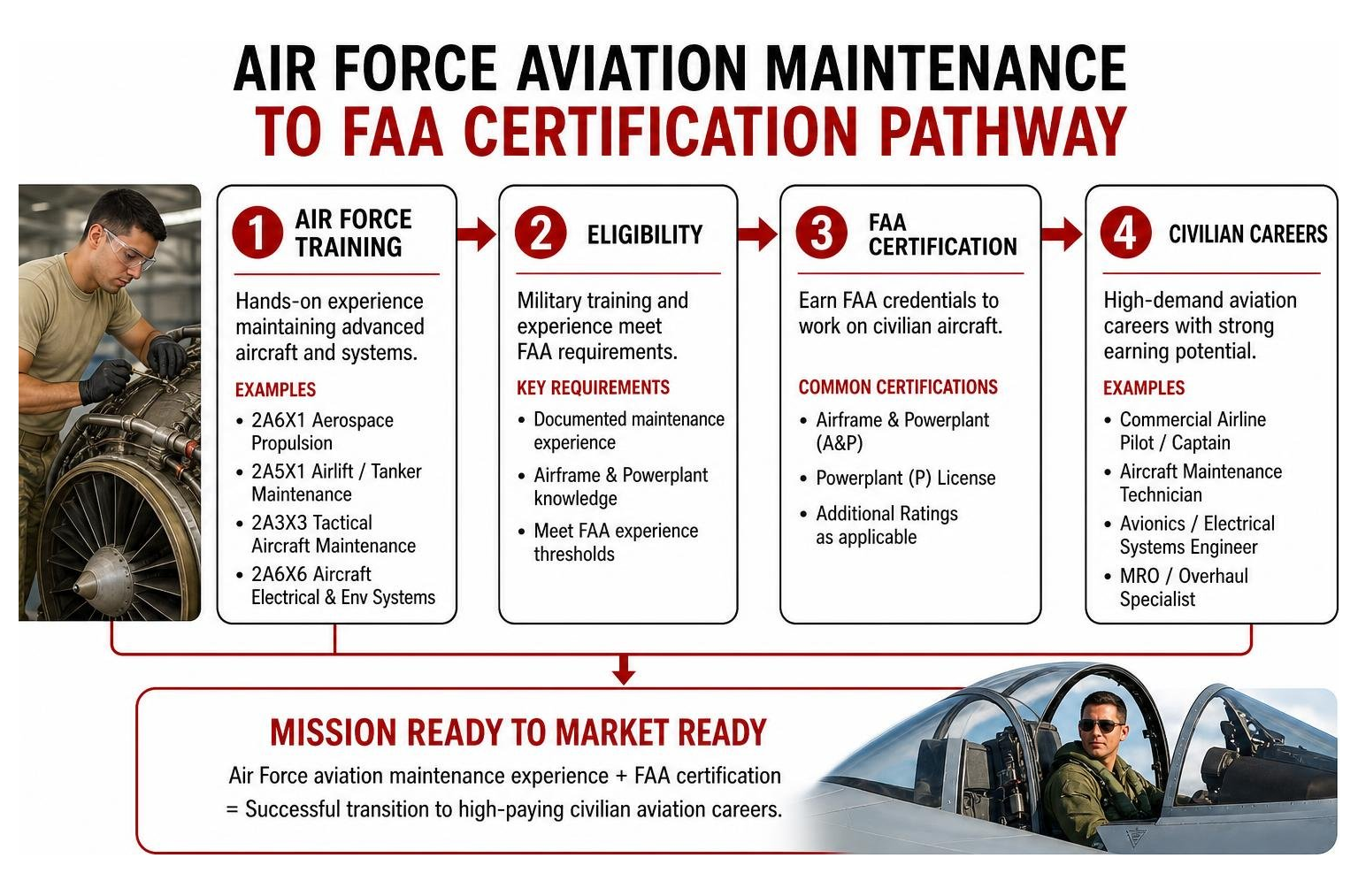
- Mobility & Combat Pilots (11MX): Air Force pilots complete some of the most rigorous flight programs in the world. With North American commercial carriers projecting a severe shortage of nearly 30,000 pilots over the coming decade, military flight hours fulfill FAA Airline Transport Pilot (ATP) requirements swiftly. The median salary for airline captains and flight crews stands at $203,010.
- Air Traffic Control (1C1X1): Air Force controllers coordinate crowded airspaces, precision radar approaches, and airfield operations under austere conditions. The Federal Aviation Administration (FAA) actively seeks military controllers, offering a direct transition into a career where median salaries reach $138,556 annually.
- Aerospace Propulsion (2A6X1): Specializing in turboprop and jet engines, these technicians develop extensive diagnostic and rebuild expertise. When paired with an FAA Powerplant rating, civilian maintenance repair and overhaul (MRO) facilities offer wages between $78,680 and $98,000.
- Airlift/Special Mission Aircraft Maintenance (2A5X1): Maintaining large transport airframes (such as the C-17, C-5, and C-130) provides direct parallel experience to Boeing and Airbus commercial airliners. Mechanics earning an A&P license easily bridge into commercial fleets with earnings up to $120,000 for experienced technicians.
- Tactical Aircraft Maintenance (2A3X3): Crew chiefs on airframes like the F-16, F-22, and F-35 build specialized knowledge in advanced composite materials, hydraulics, and integrated flight controls. Major defense contractors frequently hire 2A3X3 veterans into depot-level support roles.
- Aircraft Electrical and Environmental Systems (2A6X6): Managing onboard power generation, environmental controls, and wiring networks, these technicians transition smoothly into avionics engineering and systems engineering roles, which pay a median salary of $116,500.
- Special Operations Avionics (2A2X1): These specialists handle specialized communication, radar, and navigation packages. Their deep diagnostic skillset leads directly to avionics technician roles, with a median civilian wage of $81,390 and specialized contractor roles topping $105,000.
- Airborne Cryptologic Language Analyst (1A8X1): Operating aboard surveillance platforms, these specialists process intercepted foreign communications in real time. Backed by high-level clearances and language proficiencies, post-service positions at intelligence agencies and defense firms routinely yield six-figure compensations.
- Aircraft Loadmaster (1A2X1): Loadmasters calculate aircraft weight and balance, plan hazardous material placement, and supervise cargo loading operations. Global logistics and cargo airlines value this practical experience, placing former loadmasters into logistics and flight dispatch leadership roles.
For those interested in exploring non-combat flight-adjacent roles, reviewing Non-Combat Air Force Jobs 2026: Best AFSCs & Careers provides valuable clarity on operational life.
Cyber, Intelligence, and Support Specialties in the Top 20 Jobs In The Air Force That Lead To High Paying Civilian Careers
As warfare and national defense expand across digital networks and orbital platforms, technical support AFSCs have developed some of the highest earning trajectories in modern industry.
- Cyber Defense Operations (1D7X1): Air Force cyber operators defend critical networks against sophisticated state-sponsored attacks. With industry projections highlighting 3.5 million unfilled cybersecurity openings worldwide and a 33% growth rate for security analysts, 1D7X1 veterans earning DoD 8570 credentials enter private tech firms and government roles paying $120,000 to $200,000.
- Cyber Intelligence Analyst (1N4X1A): Blending advanced network analytics with geopolitical intelligence, these specialists uncover hidden digital threats. Backed by active TS/SCI clearances, they command high-paying roles as incident responders and threat hunters.
- Space Systems Operations (1C6X1): Monitoring satellite telemetry, tracking space debris, and managing space domain awareness create immediate opportunities within aerospace defense and the growing commercial space sector, where professionals earn an average of $102,223.
- All-Source Intelligence (1N0X1): Integrating imagery, signals, and human intelligence, 1N0X1 analysts present operational briefings to executive leadership. Defense contractors hire cleared analysts into positions offering $100,000 to $180,000.
- Diagnostic Imaging (4R0X1): Enlisted airmen operating advanced X-ray, CT, and MRI systems graduate with clinical experience that translates straight to civilian licensing through the American Registry of Radiologic Technologists (ARRT). Radiologic technologists operate in a healthcare field expanding by 13% over the decade.
- Aerospace Medical Service (4N0X1): Working as military medical technicians, 4N0s gain emergency trauma, clinical, and medication administration experience. This foundation drastically shortens the pathway toward becoming a civilian Registered Nurse (RN) or physician assistant.
- Paralegal (5J0X1): Air Force paralegals work on military justice proceedings, contract reviews, and operational law. This exposure develops high-level legal research skills, providing direct entry into corporate compliance and commercial litigation teams.
- Financial Management and Comptroller (6F0X1): Tracking military appropriations, budgets, and auditing practices prepares airmen to manage large corporate budgets or lead defense financial management contracts.
- Electrical Systems (3E0X1): Civil engineering airmen design, install, and maintain airfield lighting, primary power distribution grids, and backup generator systems, laying the foundation for lucrative civilian journeyman and master electrician careers.
- Munitions Systems (2W0X1): “Ammo” technicians handle the storage, inspection, assembly, and transport of advanced munitions. Private aerospace companies and defense logistics providers actively recruit these specialists for weapons systems management and hazardous handling compliance.
- Public Affairs (3N0X6): Managing crisis communications, digital media, press relations, and executive messaging gives public affairs specialists a competitive edge for corporate relations, brand management, and media leadership roles.
Connecting with veteran networks, such as communities discussing which air force careers translate best to civilian careers on Facebook, gives service members helpful peer insights into which specific companies are recruiting out of these AFSCs.
How ASVAB Scores and Air Force Credentials Fast-Track Civilian Earning Potential
Securing an optimal military specialty begins with the Armed Services Vocational Aptitude Battery (ASVAB). While branches like the Army rely on ten composite line scores, the Air Force categorizes an applicant’s potential using four distinct composite areas (MAGE):
- Mechanical (M): Assesses mechanical comprehension, general science, and automotive/shop information. Essential for propulsion and airframe repair specialties.
- Administrative (A): Focuses on word knowledge, paragraph comprehension, and mathematical reasoning. Core for finance, medical administration, and legal specialties.
- General (G): Evaluates verbal expression and arithmetic reasoning. Critical for air traffic controllers, intelligence analysts, and medical services.
- Electronics (E): Tests electrical information, general science, and math. Required for cyber defense operations, avionics, and space systems.
Aviation Maintenance and Technical Credentialing Pathways
One of the greatest benefits of Air Force technical training is the academic bridge provided by the Community College of the Air Force (CCAF). Technical school coursework translates directly into college credits toward an Associate of Applied Science (AAS) degree.
Furthermore, airmen in aviation maintenance specialties can utilize the Joint Service Aviation Maintenance Technician Certification Council (JSAMTCC) program. This joint military-FAA initiative evaluates military training and on-the-job task records, allowing airmen to take their FAA Airframe and Powerplant (A&P) written, oral, and practical exams on base.
To offset expenses, service members can use GI Bill education benefits to cover testing fees, which reimburse up to $2,000 per certification examination.
Cyber, Intelligence, and Healthcare Accreditation Transfer
The Air Force ensures that its technical workforce complies with strict commercial benchmarks. For cyber defense specialists (1D7X1), the military funds high-demand credentials to fulfill DoD 8570 / 8140 requirements:
- CompTIA Security+: Standard baseline qualification for cleared IT positions.
- Certified Information Systems Security Professional (CISSP): Advanced cybersecurity management certification commanding six-figure compensation.
- Cisco Certified Network Associate (CCNA): Core networking credential valued across enterprise environments.
Medical airmen gain practical hours directly applicable to testing through the National Registry of Emergency Medical Technicians (NREMT) and the ARRT, bypassing thousands of dollars in civilian educational expenses.
Navigating Federal Direct Hiring and Contractor Pipelines for Veterans
Leaving the military does not mean leaving public service behind. Many separating Airmen leverage their skills to secure federal positions through streamlined hiring authorities.

Federal agencies and military commands utilize Direct Hire Authority (DHA) to hire qualified candidates without navigating conventional civil service hiring delays. Veterans can search mission-critical positions on the AFCS Air Force Civilian Service job portal or USAJobs. DHA enables hiring managers to review resumes and extend on-the-spot job offers to candidates with proven technical backgrounds in STEM, cyber, maintenance, and intelligence.
Moreover, holding an active Top Secret / Sensitive Compartmented Information (TS/SCI) security clearance provides an enormous financial edge. Re-investigating a civilian candidate for a TS/SCI clearance can cost companies substantial capital and take over a year to complete. Consequently, defense contractors and aerospace firms regularly offer clearance holders a $15,000 to $30,000 annual salary premium.
Understanding how your military rank impacts your starting step on the federal General Schedule (GS) scale is essential. For more details on leadership tiers, review our comprehensive breakdown of Air Force enlisted rank progression to gauge your equivalent civilian grade. You can also review insights from corporate recruiters like Orion Talent’s guide on careers after the Air Force to evaluate corporate placement options.
Frequently Asked Questions About Air Force Transition Pathways
What is the highest paying civilian job coming out of the Air Force?
The highest-earning civilian transitions typically go to military pilots (11MX) moving to commercial passenger or cargo airlines, where senior captains regularly make over $200,000 per year. For enlisted personnel, Air Traffic Controllers (1C1X1) and Cyber Defense Operators (1D7X1) with advanced certifications and security clearances achieve immediate six-figure salaries, ranging from $120,000 to $180,000 in the civilian sector.
Which Air Force jobs provide the quickest path to civilian certification?
Air Traffic Control (1C1X1) and Cyber Defense Operations (1D7X1) offer the quickest routes. Air traffic control airmen earn FAA-recognized control tower ratings during their initial training and field assignments. Cyber specialists have their CompTIA Security+ and related IT certifications fully funded and embedded within their military training curriculum, ensuring immediate commercial viability.
Do I need a security clearance to land a six-figure civilian career?
No. While a TS/SCI clearance significantly accelerates six-figure placement among defense contractors, civilian aviation mechanics (A&P), commercial airline pilots, healthcare professionals, and commercial air traffic controllers command substantial six-figure compensation without needing an active defense security clearance.
Conclusion
Choosing an Air Force specialty code is one of the most consequential career choices you will ever make. By selecting an AFSC that aligns with long-term industrial demand, earning recognized civilian certifications during your enlistment, and maintaining technical proficiencies, you set yourself up for lasting professional and financial success.
For further advice on benefits, military branch comparisons, and transition assistance, explore USMilitary.com military transition guidance to build your career roadmaps with confidence. For those seeking personal encouragement and spiritual strength throughout their military and civilian journey, consider reading Dare to Live Greatly as you step into the next chapter of your career.
Free for Service Members & Veterans
Get the military benefits intel no one tells you about.
Weekly updates on VA benefits, pay changes, and money tips — free for service members and veterans.
No spam. Unsubscribe anytime. Your info is never shared.



More Than 90% Of Clients Have Increased Ratings! Why Settle For Less Than You Deserve? Expert Priority Help With Your VA Claim Today! Free Evaluation Call!
The mission of Veteran Services United is to support veterans in filing and winning disability claims by offering expert guidance, advocacy, and personalized assistance. Through dedicated service, Veteran Services United empowers veterans to secure the benefits they have earned, ensuring they receive the care and support they deserve.