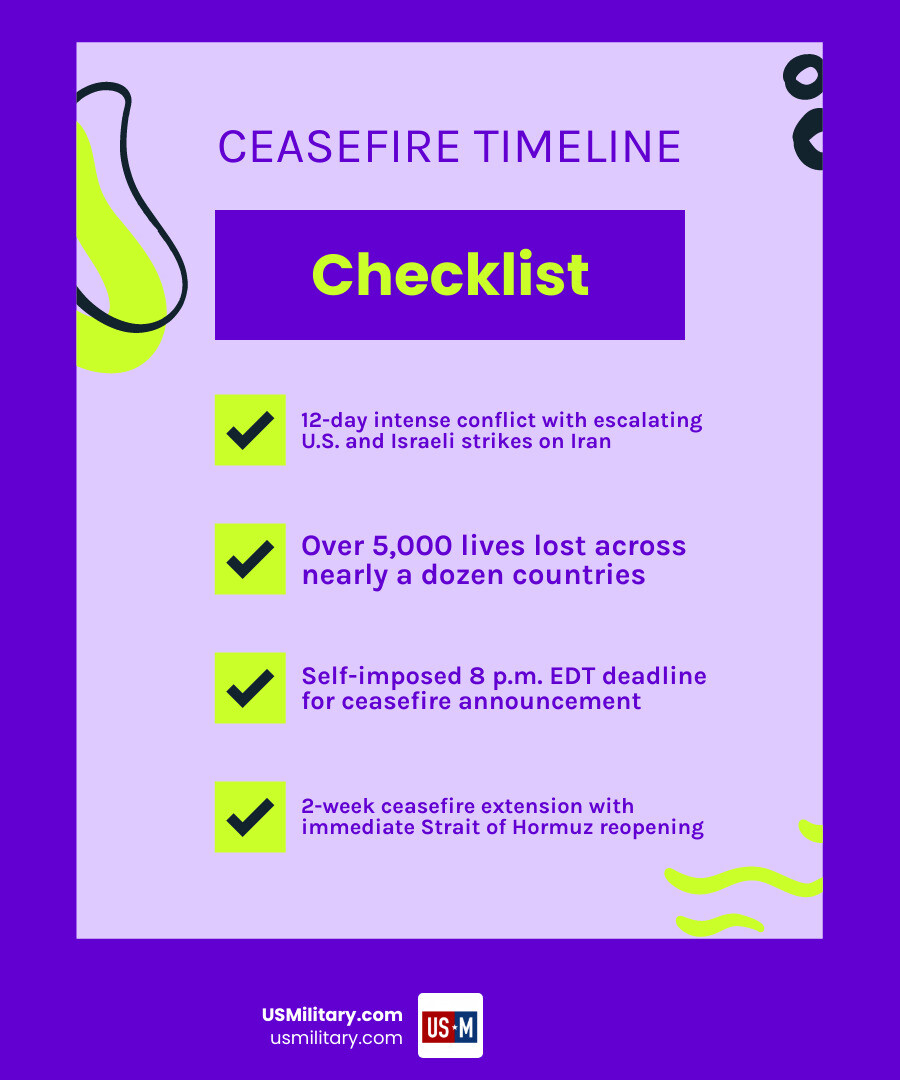
Trump signed a 2 week cease fire with Iran less than two hours before his self-imposed 8 p.m. EDT deadline — here’s a quick summary:
- What happened: President Trump announced a two-week ceasefire with Iran on Tuesday
- Key condition: Iran must fully, immediately, and safely reopen the Strait of Hormuz
- Who mediated: Pakistan’s Prime Minister Shehbaz Sharif and Field Marshal Asim Munir
- How it was announced: Via a Truth Social post, suspending all U.S. bombing operations
- What’s next: Negotiations based on Iran’s 10-point peace proposal, with talks planned in Islamabad
The announcement came after weeks of escalating strikes, threats of “civilization-ending” attacks, and a war that has already claimed more than 5,000 lives across nearly a dozen countries. Oil prices dropped over 9% within 30 minutes of the news breaking.
Trump described the back-and-forth diplomacy as communicating “like 2,000 years ago, with children bringing a note back and forth” — giving a rare glimpse into just how fragile and indirect these high-stakes negotiations have been.
I’m Larry Fowler, publisher of USMilitary.com and a longtime advocate for active-duty service members and veterans directly affects those currently deployed and families watching from home. Read on for a full breakdown of what this means for U.S. forces, global markets, and the road ahead.
Trump Signs a 2 Week Cease Fire With Iran terms to learn:
- Trump orders pause for attacks on Iranian power infrastructure after ‘very good’ talks
- US moves airborne troops, Marines as Iran rejects ceasefire, raising ground war potential
- Latest Update Operation Epic Fury Including Three American Deaths
Details of the Trump Signed 2 Week Cease Fire With Iran Announcement
The world held its breath as the clock ticked toward 8 p.m. ET on Tuesday. President Trump had previously issued a chilling ultimatum: reopen the Strait of Hormuz or face a bombardment so severe that a “whole civilization” could be at risk. However, in a dramatic turn of events, the President took to Truth Social to announce that he had agreed to a two-week suspension of hostilities.
This Trump signe 2 week cease fire with Iran was not a total surrender of military objectives, but rather a tactical pause. Trump clarified that the suspension of bombing is strictly contingent on Iran’s “COMPLETE, IMMEDIATE, and SAFE OPENING” of the Strait of Hormuz. Before this breakthrough, the administration had been weighing a 45-day ceasefire idea, but Trump ultimately opted for a shorter, more controlled two-week window to test Tehran’s sincerity.
The President’s rhetoric leading up to the deadline had been nothing short of intense. He had threatened to target Iranian bridges, railways, and power plants—essentially promising to “bomb them back to the Stone Age” if the maritime blockade wasn’t lifted. While some critics viewed these as empty threats, the recent U.S. strikes on Kharg Island proved that the administration was willing to hit Iran where it hurts most: its economic lifeline.
The Critical Role of the Strait of Hormuz and Global Oil Markets
To understand why this ceasefire is such a big deal, we have to look at the geography. The Strait of Hormuz is the world’s most important energy chokepoint. During peacetime, it handles about one-fifth (20%) of global oil shipments. When Iran effectively closed the strait, the shockwaves were felt at every gas station in America.
Before the war, U.S. gasoline prices averaged around $2.98 per gallon. During the height of the blockade, those prices spiked to a national average of $4.14. The Trump signe 2 week cease fire with Iran provided almost instant relief to the markets. Within just thirty minutes of the announcement, West Texas Intermediate (WTI) crude fell more than 9%, landing at approximately $96 a barrel.
| Metric | Pre-War | Mid-Conflict Peak | Post-Ceasefire Announcement |
|---|---|---|---|
| U.S. Gas Price (Avg) | $2.98 | $4.14 | Trending Down |
| WTI Crude Oil | ~$75 | $110+ | $96.00 |
| Hormuz Oil Traffic | 100% | Blockaded/Limited | Reopening Phase |
Iran’s leverage in this conflict largely comes from its control over this waterway and Kharg Island, which handles 80-95% of the country’s crude exports. By striking Kharg Island and threatening further infrastructure damage, the U.S. and its allies demonstrated that the cost of keeping the strait closed would be the total collapse of the Iranian economy. According to TIME, this pressure was a primary driver in bringing both sides to the table, even if the agreement remains fragile.
Pakistan’s Mediation and the Path to De-escalation
We cannot overlook the diplomatic heavy lifting done by regional players. While the U.S. and Iran have struggled to communicate directly—often relying on what Trump called “note-passing” through third parties—Pakistan stepped up as a vital intermediary.
Prime Minister Shehbaz Sharif and Field Marshal Asim Munir were instrumental in pitching the extension. It was through their efforts that a 10-point Iranian proposal reached the White House. Trump initially called this proposal a “very significant step,” though he cautioned that it wasn’t yet “good enough” for a permanent peace.
The “Islamabad Accord,” as some are calling the framework, suggests a 45-day window for deeper talks, though Trump has currently only signed off on the first two weeks. This “note-passing diplomacy” might seem primitive, but in a high-stakes war where direct lines are cut, these intermediaries are the only thing preventing a full-scale regional conflagration.
Military Implications of the Trump Signed 2 Week Cease Fire With Iran
For our community at USMilitary.com, the military cost of this conflict is the most sobering statistic. The war has claimed more than 5,000 lives across nearly a dozen countries. This includes 13 U.S. service members and over 1,600 Iranian civilians.
Operation Epic Fury has seen the U.S. achieve significant air superiority, but it has not been without risk. We’ve seen an intense search for a missing F-15 pilot in Iran and reports regarding the secret activation of SEALs and Delta Force for high-stakes extraction missions.
Israel has also played a massive role, using precision munitions to strike eight Iranian bridges used for transporting military equipment. While the ceasefire pauses these strikes, the military remains on high alert. The “quiet for quiet” agreement means that if Iran or its proxies fire a single missile, the bombardment of infrastructure could resume instantly.
Political and International Reactions to the Ceasefire
The reaction to Trump’s signing of a 2 week cease fire with Iran has been polarized, to say the least. Within the U.S., some Democrats have labeled the President’s “Stone Age” threats as “unhinged” and even suggested the 25th Amendment should be invoked. Critics like Rep. Jason Crow have argued that targeting civilian infrastructure constitutes a war crime under international law.
On the Republican side, there is a mix of relief and unease. While many support the “maximum pressure” campaign, some GOP lawmakers have expressed concern over the “unprecedented saber-rattling.” Meanwhile, the international community has been vocal. Pope Leo XIV called the threats against civilian life “truly unacceptable,” and the UN has urged both nations to move toward a permanent solution rather than a temporary pause.
One of the biggest questions on the minds of military families is the draft. We have analyzed whether Trump can bring back the military draft during this conflict, and while the ceasefire reduces that immediate pressure, the long-term status of U.S. troop levels in the Middle East remains a hot-button political issue.
Next Steps Following the Trump Signe 2 Week Cease Fire With Iran
The next 14 days will be a whirlwind of activity in Islamabad. The planned talks will focus on a 15-point plan that goes beyond just the Strait of Hormuz. Key hurdles include:
- Nuclear Rollback: The U.S. is demanding a significant reduction in Iran’s uranium stockpiles.
- Permanent Access: Ensuring the Strait of Hormuz remains open without the threat of future blockades.
- Humanitarian Aid: Addressing the displacement of over a million people in Lebanon and the rising death toll in Iran.
If the ceasefire holds, it could pave the way for a more permanent “Islamabad Accord.” If it fails, the U.S. has already positioned a third aircraft carrier strike group in the region, signaling that “Operation Epic Fury” is ready to resume at a moment’s notice.
Frequently Asked Questions about the Iran Ceasefire
What are the specific conditions Iran must meet for the ceasefire to hold?
The primary condition is the “complete, immediate, and safe opening” of the Strait of Hormuz. Iran must also stop all proxy attacks on global shipping and engage in good-faith negotiations in Islamabad based on the 10-point framework mediated by Pakistan.
How did global oil markets react to the announcement?
The reaction was immediate and dramatic. U.S. crude oil benchmark (West Texas Intermediate) fell more than 9% to around $96 a barrel within just 30 minutes of the Truth Social announcement. This drop reflects the market’s hope that the energy chokepoint at Hormuz will soon be functional again.
What role did Israel play in this agreement?
Israel, under pressure from the Trump administration, agreed to a “quiet for quiet” policy. This means they have suspended their bombing campaign against Iranian infrastructure, including bridges and detection sites, as long as Iran and its proxies (like Hezbollah) refrain from launching further attacks.
Conclusion
At USMilitary.com, we know that news of a ceasefire brings a mix of hope and skepticism to the military community. Whether you are a veteran following the geopolitical shifts or an active-duty member stationed in the Middle East, the Trump signed 2 week cease fire with Iran is the most significant development in this conflict to date.
We are committed to providing you with the most up-to-date, unbiased information on military news, VA disability benefits, and career guidance. As this situation evolves, we will be here to break down what it means for your service and your family. For those looking to serve or transition, you can find more info about Navy jobs and other branch opportunities on our platform.
Stay safe, stay informed, and thank you for your service.
Free for Service Members & Veterans
Get the military benefits intel no one tells you about.
Weekly updates on VA benefits, pay changes, and money tips — free for service members and veterans.
No spam. Unsubscribe anytime. Your info is never shared.


