Your VA Disability Benefits Are Not Guaranteed — Here’s What Can End Them

Here are the 7 sure-fire ways veterans can lose their VA disability benefits:
- Fraud or misrepresentation on a VA claim
- Missing a Compensation & Pension (C&P) exam without good cause
- Sustained medical improvement verified by VA re-examination
- Felony conviction and incarceration lasting more than 60 days
- Filing a new claim that triggers a full file re-evaluation
- Failing to report changes in income or dependency status
- Fugitive felon status or administrative non-compliance
Many veterans assume their monthly VA disability payments are permanent. They are not.
Under federal law, every VA disability benefit comes with ongoing eligibility requirements. The VA has the legal authority to reduce, suspend, or terminate payments under specific circumstances — and in some cases, it can happen faster than you expect.
The good news? Federal law also builds real protections into the process. Knowing what triggers a reduction is the first step to making sure it never happens to you.
I’m Larry Fowler, publisher of USMilitary.com and a longtime advocate for veterans navigating VA benefits — including understanding the 7 sure-fire ways veterans can lose their VA disability benefits that catch too many off guard. In the breakdown below, I’ll walk you through each risk clearly so you can protect what you’ve earned.
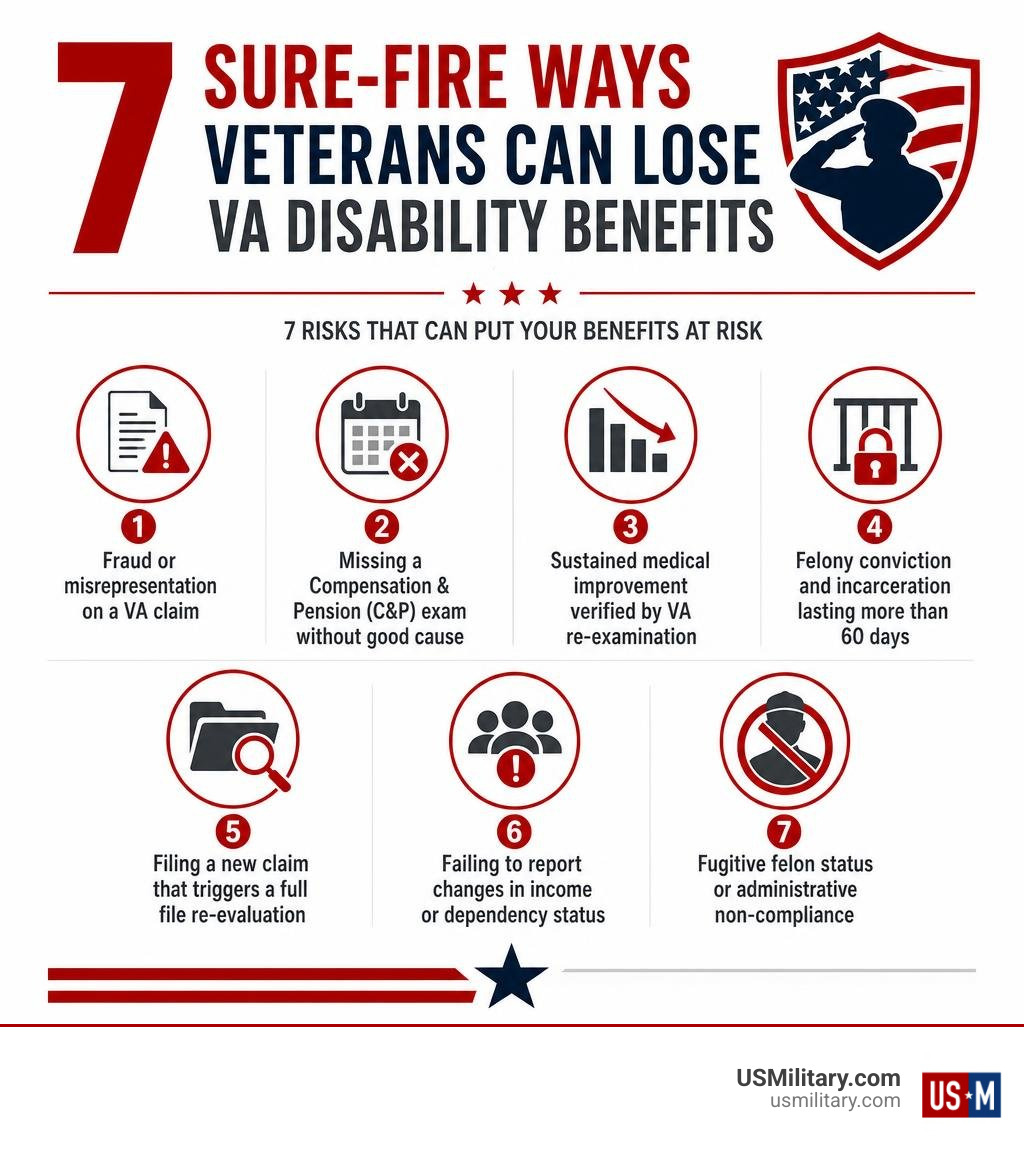
7 Sure-Fire Ways Veterans Can Lose Their VA Disability Benefits
When we receive our VA disability rating, we often feel a sense of relief. We believe the battle is finally won and our monthly compensation is locked in for life. However, we must remain vigilant. The Department of Veterans Affairs (VA) operates under strict federal guidelines that allow them to re-evaluate, reduce, or completely sever compensation under specific circumstances.
Understanding how these triggers work is the best way to safeguard our hard-earned ratings. While there are many administrative pathways the VA can take to alter our files, we have compiled the most critical pitfalls. For a broader look at how ratings can fluctuate, you can read about the 15 Ways to Have VA Benefits Reduced | Davidson Law Offices .
Below, we dive into the specific legal and administrative actions that can lead to a partial reduction or a total loss of your monthly compensation.

How Fraud and Misrepresentation Act as 7 Sure-Fire Ways Veterans Can Lose Their VA Disability Benefits
There is no faster or more permanent way to lose your benefits than committing fraud. Under federal law, specifically 38 U.S.C. § 6103, if the VA determines that a veteran knowingly submitted false statements, fabricated medical evidence, or misrepresented their military service to secure benefits, the consequence is immediate and absolute forfeiture.
Unlike standard rating reductions, which require the VA to show that a medical condition has improved over time, fraud overrides almost all rating protections. This means even if you have held your rating for 10 or 20 years, a finding of fraud will completely strip away your service connection and your monthly payments.
In addition to losing all current and future VA benefits, committing fraud is a federal crime. The government can pursue criminal prosecution, resulting in hefty court fines, mandatory restitution to repay every dollar of disability compensation received fraudulently, and even federal prison time. For a deeper look at how the government enforces these rules, you can review the guide on What Are the Grounds for VA Benefit Termination? – LegalClarity .
Why Missing a C&P Exam is One of the 7 Sure-Fire Ways Veterans Can Lose Their VA Disability Benefits
When the VA schedules you for a Compensation & Pension (C&P) re-examination, attendance is not optional. Under 38 C.F.R. § 3.655, if a veteran fails to report for a scheduled medical exam without showing “good cause,” the VA has the immediate legal authority to reduce or completely stop their disability payments.
Why does the VA do this? They view your failure to attend as a lack of cooperation or, worse, an implicit admission that your condition has improved and no longer requires the current level of compensation. The VA will issue a pretermination notice giving you a short window to respond, but if you ignore this administrative request, your rating will be slashed.
To avoid this, we must ensure the VA always has our current primary and temporary mailing addresses on file. If an emergency arises and you must miss an exam, you must contact the VA immediately to reschedule and submit a written statement showing good cause—such as a personal hospitalization or a severe family medical emergency. To understand how C&P exams fit into the broader claims ecosystem, read our guide on VA Disability Claims.
3. Experiencing Sustained Medical Improvement
Outside of administrative errors or fraud, the most common reason the VA reduces a rating is “sustained medical improvement.” If your service-connected disability gets better over time, the VA is legally required to adjust your rating to reflect your current level of impairment.
However, the VA cannot simply reduce your benefits because of a single good day or a one-off medical report. To legally lower your rating, the VA must prove through comprehensive medical evidence—usually gathered during a scheduled re-examination—that your condition has shown sustained, systematic improvement during your ordinary daily life and work activities.
This rule is particularly relevant for mental health conditions and chronic respiratory issues. For instance, veterans with a VA Disability Rating for PTSD are frequently subject to routine future examinations because mental health symptoms can fluctuate or improve with treatment. Similarly, those receiving VA Disability for Sleep Apnea may face re-evaluation if new treatments, surgeries, or weight loss significantly reduce their airway obstruction. If your medical records consistently show that your symptoms have minimized and your social or industrial adaptability has increased, the VA will initiate a rating reduction.
4. Felony Conviction and Incarceration
A common misconception is that veterans retain their full disability compensation regardless of their legal status. In reality, if you are convicted of a felony and incarcerated in a federal, state, or local jail for more than 60 days, your monthly payments will be severely restricted.
Under federal regulations, the VA is required to reduce monthly compensation payments starting on the 61st day of imprisonment:
- If your disability rating is 20% or higher, your monthly payment is capped at the 10% rate.
- If your rating is 10%, your monthly payment is cut in half to a 5% rate.
The logic behind this law is that the government is already providing your food, housing, and medical care while you are incarcerated. However, this reduction can place a massive financial burden on your family. Fortunately, we can apply for an “apportionment,” which allows the VA to redirect the withheld portion of your disability payments directly to your spouse, children, or dependent parents to prevent financial hardship. Once you are released from prison—including transition to a halfway house or a work-release program—your full benefits can be restored, but you must notify the VA immediately. For more details on current payment rates and how incarceration impacts your monthly check, refer to our VA Disability Pay 2026 Guide.
5. Filing a New Claim (The Re-Evaluation Trigger)
Perhaps the most surprising way to lose your benefits is by trying to get more of them. Filing a new claim for an increased rating or a secondary condition is a major trigger that prompts the VA to pull your entire claims folder for a comprehensive review.
When you ask the VA to re-evaluate a condition or add a new one, a claims rater will look at your existing service-connected disabilities. If they notice that you haven’t received medical treatment for an existing condition, or if older medical files suggest that a previously rated disability has improved, they can order a new C&P exam for your current ratings.
This is where “VA Math” and the “Whole Man Theory” come into play. The VA calculates combined ratings using a descending scale of efficiency rather than simple addition. If the VA decides to reduce one of your major ratings while evaluating your new claim, your overall combined rating could actually drop—leaving you with less monthly compensation than you had before you filed. Before submitting a new application, we highly recommend reading our guide on How to Increase VA Disability Rating to weigh the potential risks and rewards.
6. Failing to Report Changes in Dependency or Income
Many veterans receive extra monthly compensation because they have eligible dependents, such as a spouse, children under 18 (or up to 23 if enrolled in school), or dependent parents. However, these dependency benefits are not static.
If your dependency status changes, you are legally obligated to notify the VA immediately. Common status changes include:
- Divorcing your spouse
- The death of a dependent
- A child turning 18 and choosing not to attend college
If you fail to report these changes and continue to receive the higher monthly payment, the VA will eventually discover the discrepancy. When they do, they will retroactively reduce your benefits to the date the change occurred, creating an overpayment debt. The VA Debt Management Center will then withhold portions of your future monthly checks until the entire debt is repaid.
This issue is even more critical for veterans receiving VA Pension benefits, which are strictly income-based. Failing to report an inheritance, a spouse’s new salary, or other sources of countable income can cause your pension to be completely terminated. For older veterans, keeping these records straight is vital; you can find more information in our resource on VA Disability Claims for Vietnam Veterans.
7. Fugitive Felon Status or Administrative Non-Compliance
If you have an active warrant out for your arrest, your VA benefits are in immediate jeopardy. Under federal law, the VA is prohibited from paying disability compensation or pension benefits to any individual who is classified as a “fugitive felon.”
A veteran falls into this category if they are fleeing to avoid prosecution, custody, or confinement after a felony conviction, or if they are violating a condition of probation or parole. The moment law enforcement flags a veteran as a fugitive, the VA will suspend all monthly payments. These benefits will remain suspended until the veteran resolves the warrant and clears their legal status with the courts.
Furthermore, general administrative non-compliance can lead to a rapid suspension of benefits. This includes failing to return mandatory eligibility questionnaires, refusing to cooperate with VA audits, or failing to verify your income if you receive an income-dependent benefit. To learn more about your rights and how to navigate administrative hurdles, check out the comprehensive guide on Can You Lose VA Disability Benefits? Rules and Protections – LegalClarity .
Understanding the Difference Between Rating Reduction and Severance
It is crucial to understand that there is a massive legal difference between the VA reducing your disability rating and severing your service connection entirely. The administrative hurdles, legal standards, and burdens of proof required for each action are completely different.
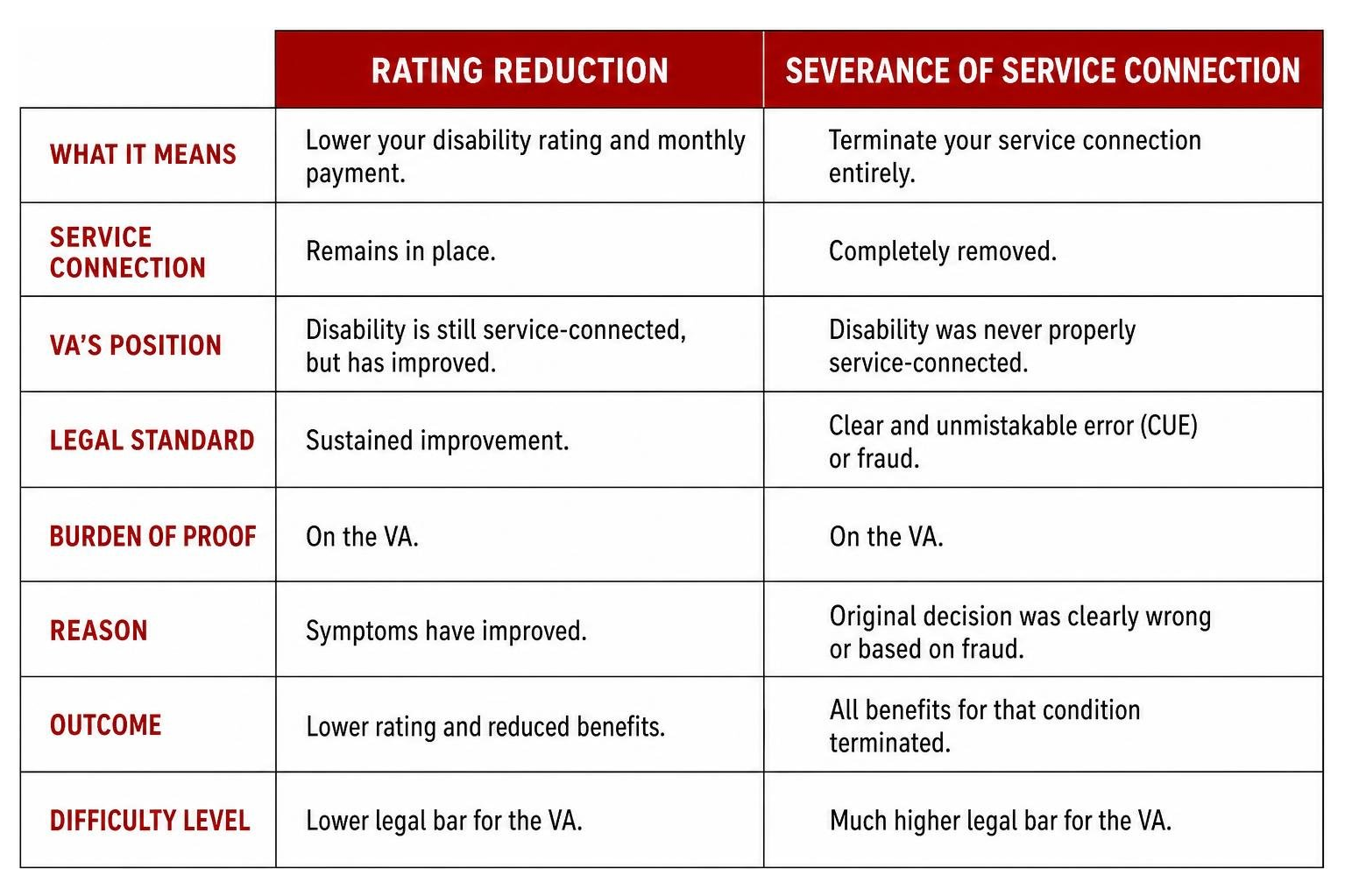
When the VA proposes a rating reduction, they are admitting that your illness or injury is still related to your military service, but they argue that your symptoms have improved enough to warrant a lower monthly payment. The burden of proof is on the VA to show “sustained improvement” through fresh medical evidence.
In contrast, severance of service connection is far more severe. Severance means the VA is completely terminating your service connection, declaring that your disability should never have been approved in the first place. The VA faces a much higher legal bar to sever a connection than to reduce a rating. They must prove that there was a “clear and unmistakable error” (CUE) in the original decision, or that the claim was built on fraud.
| Feature | Rating Reduction | Severance of Service Connection |
|---|---|---|
| What It Means | Your disability rating percentage is lowered. | Your service-connected status is completely revoked. |
| VA’s Burden of Proof | Must show sustained medical improvement over time. | Must prove a Clear and Unmistakable Error (CUE) or fraud. |
| Impact on Benefits | Your monthly check is reduced but payments continue. | Your monthly payments for that condition stop entirely. |
| Applicable Protections | Protected by the 5-year and 20-year rules. | Protected by the 10-year rule (except in cases of fraud). |
How Protected Rating Rules Safeguard Your Benefits
While the VA has many tools to reduce ratings, Congress has established powerful legal safeguards to protect veterans. These are known as the 5-year, 10-year, and 20-year protected rating rules. The longer you hold your rating, the more secure it becomes.
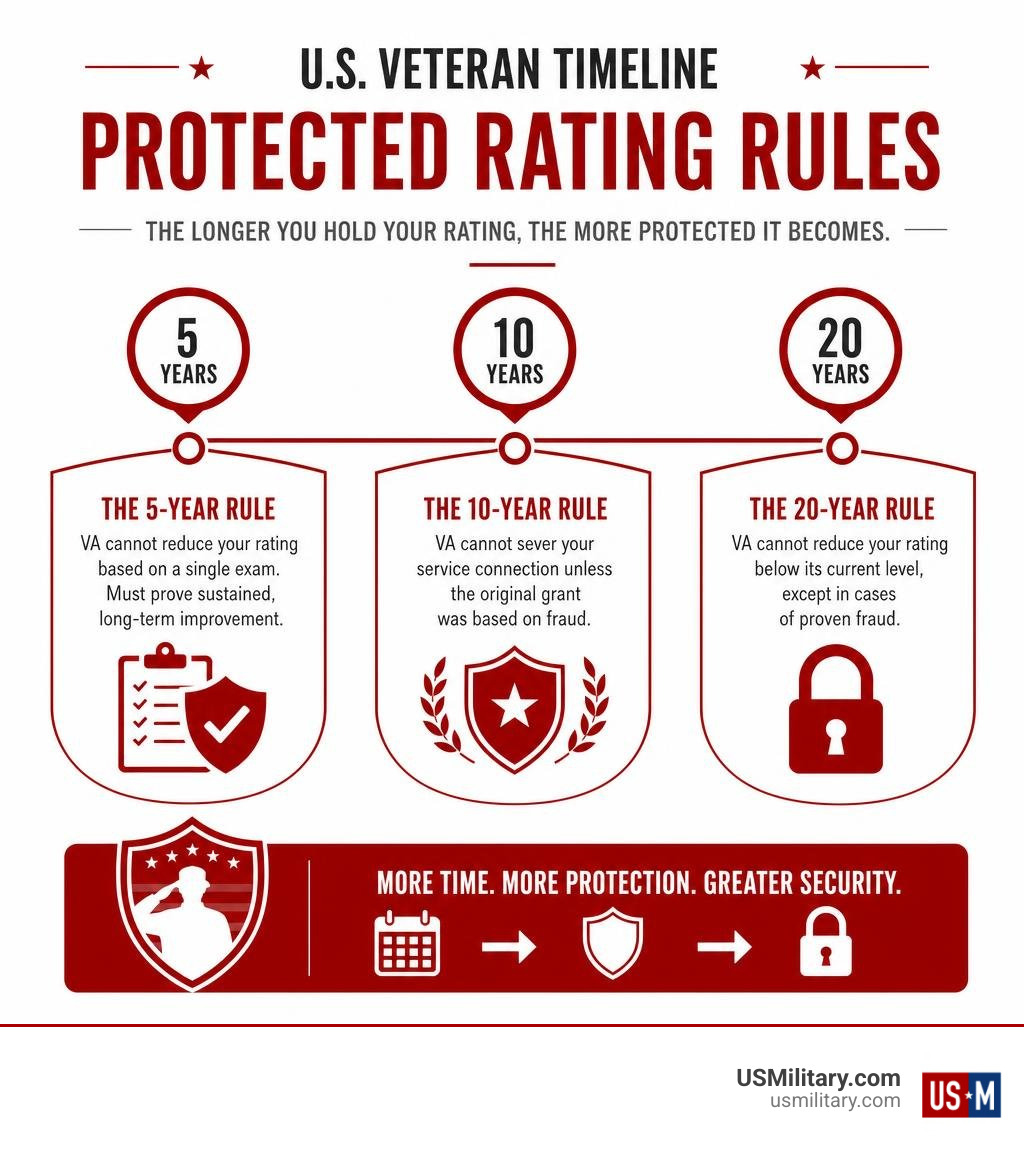
- The 5-Year Rule: If you have held a stable disability rating for five years or more, the VA cannot reduce it based on a single medical exam. To lower your rating, they must prove that your condition has shown sustained, long-term improvement across multiple medical evaluations and treatment records. You can learn more about how this rule works by reading our detailed breakdown of the VA Disability 5 Year Rule.
- The 10-Year Rule: Once your service connection has been in place for 10 continuous years, the VA cannot sever it unless the original grant was based on fraud. Even if the VA determines that your physical condition has improved to 0%, they must keep the service-connected status on your record.
- The 20-Year Rule: This is the gold standard of protection. If a disability rating has been continuous for 20 years or more, the VA is legally barred from reducing it below that original level, except in cases of proven fraud. Even if your medical records show complete recovery, your monthly compensation is locked in for life.
Frequently Asked Questions About VA Benefit Reductions
Can the VA automatically reduce or terminate my disability benefits without notice?
No. Under federal due process laws, the VA is legally barred from reducing or terminating your benefits without warning. If the VA intends to lower your rating, they must first send you a “Notice of Proposed Reduction.”
Once you receive this letter, you have a strict 60-day window to submit new medical evidence proving your condition has not improved. Additionally, you have 30 days from the date of the letter to request a formal hearing. If you request a hearing within those 30 days, the VA cannot reduce your payments until the hearing takes place and a final decision is made.
What happens to my VA disability benefits if I am incarcerated?
If you are incarcerated for a felony for more than 60 days, your monthly disability payments will be reduced. For veterans rated 20% or higher, your compensation is capped at the 10% rate. For those rated at 10%, your payments are cut in half.
However, your family does not have to suffer. You can submit an administrative request to the VA to have the withheld portion of your benefits “apportioned” (redirected) to your dependent spouse, children, or parents. Once you are released from custody, you must notify the VA immediately with release documentation to restore your full monthly compensation.
What should I do if I miss a scheduled C&P exam?
If you miss a scheduled C&P exam, you must act quickly to prevent a benefit reduction. Contact the VA immediately to explain your absence and request a rescheduled date.
If you can show “good cause”—such as a sudden illness, hospitalization, or a family emergency—the VA must reschedule your appointment. If the VA reduced your rating because you missed an exam, but they failed to send the scheduling or pretermination notices to your correct address, the reduction is legally considered void ab initio (void from the beginning). In these cases, the VA is legally required to fully restore your original rating and issue back pay.
Conclusion
Our VA disability benefits are a lifeline that we earned through sacrifice and service. While the system can feel overwhelming, we do not have to navigate it in fear. By staying informed, keeping our addresses updated, attending all scheduled medical appointments, and reporting life changes promptly, we can easily avoid the pitfalls that lead to benefit reductions.
Protecting your rating requires proactive management. If you are preparing to submit a new claim, or if you want to ensure your current benefits are fully secure, we encourage you to take advantage of our step-by-step guides. Head over to our main platform to learn more about Applying for VA Disability Benefits or explore our homepage at USMilitary.com for up-to-date resources. For further inspiration on overcoming life’s battles with strength and faith, you can also check out the powerful book Dare to Live Greatly. Keep your records organized, stay proactive, and continue to stand up for the benefits you deserve!
Free for Service Members & Veterans
Get the military benefits intel no one tells you about.
Weekly updates on VA benefits, pay changes, and money tips — free for service members and veterans.
No spam. Unsubscribe anytime. Your info is never shared.


