Which Military Bases Could Face Cuts?

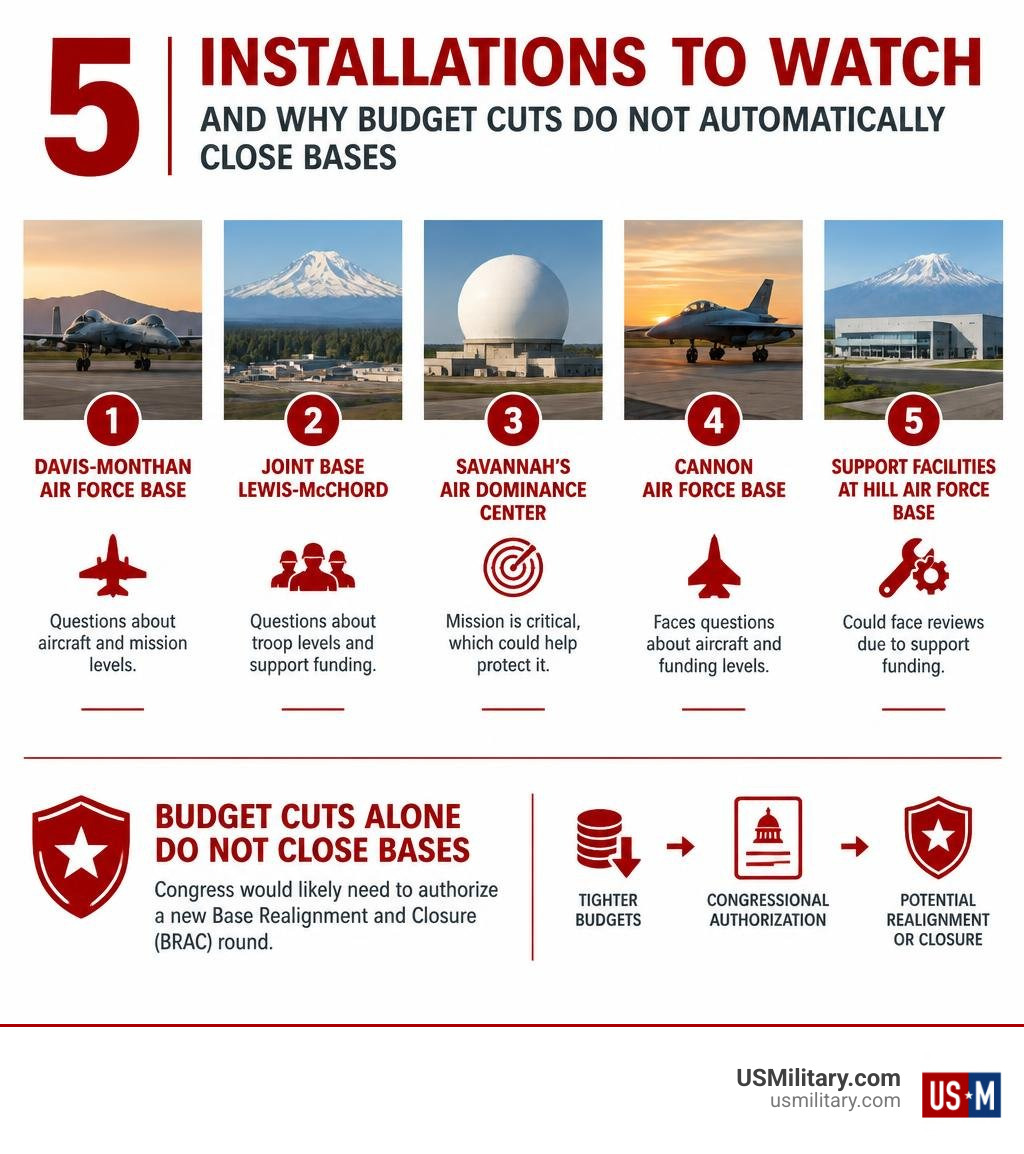
If a Democratic Congress makes deep military cuts, five places to watch for closure or realignment reviews are Davis-Monthan Air Force Base, Joint Base Lewis-McChord, Savannah’s Air Dominance Center, Cannon Air Force Base, and support facilities at Hill Air Force Base. None is on an official 2026 closure list. Some face questions about aircraft, troop levels, or support funding, while others have missions that could protect them. A budget cut alone would not close a major domestic base; Congress would likely need to authorize a new Base Realignment and Closure (BRAC) round.
I’m Larry Fowler, a Navy veteran, BUD/S Class 89 graduate, and publisher of USMilitary.com. My military background helps me examine What Military Bases Could Be Closed With Democrat Congress Making Deep Military Cuts while separating possible cuts from confirmed closure plans.
What Military Bases Could Be Closed With Democrat Congress Making Deep Military Cuts
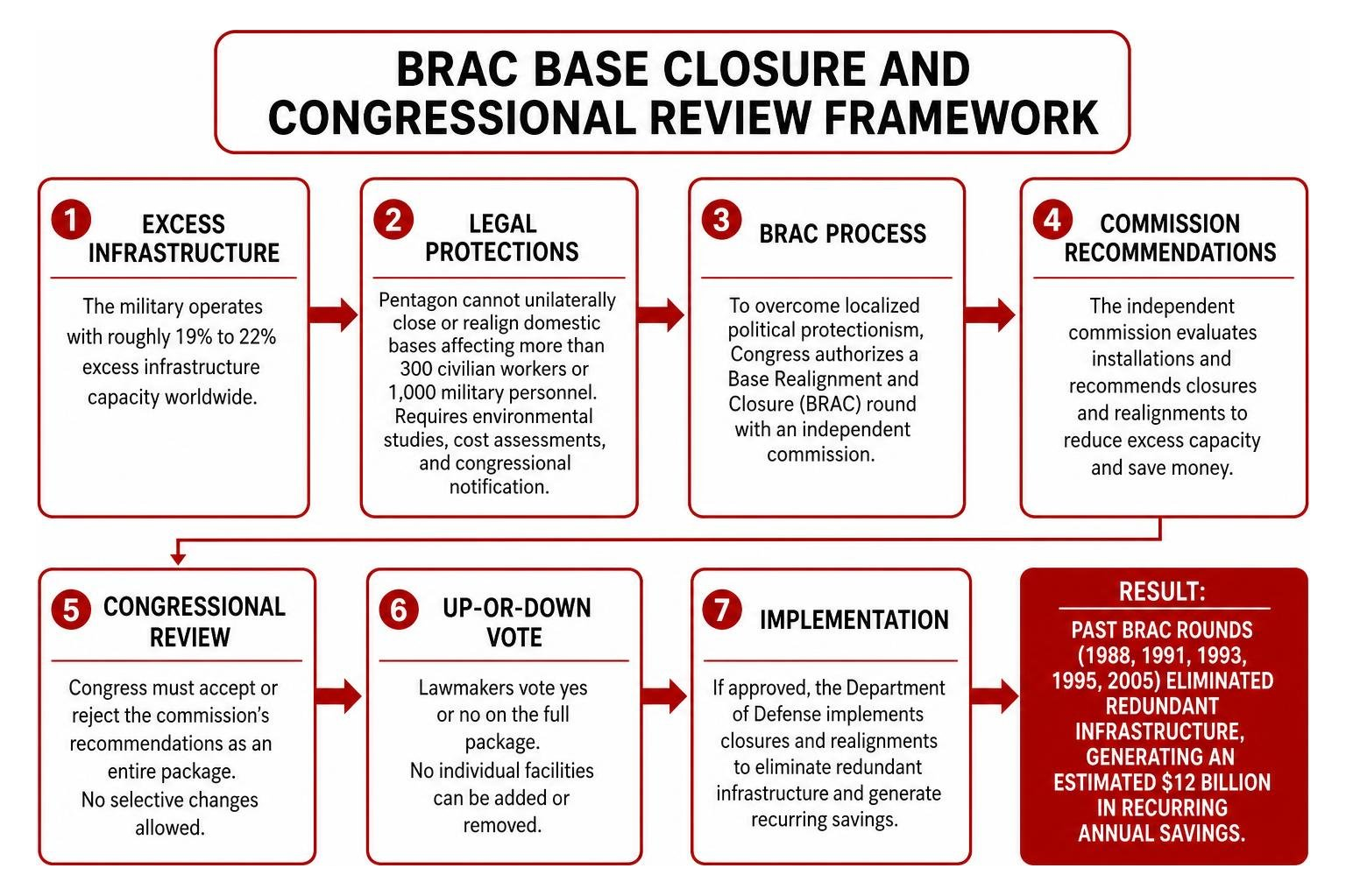
Whenever defense budgets tighten on Capitol Hill, military leadership and lawmakers face an unavoidable reality: maintaining excess real estate diverts precious funding away from troop readiness and modernization. Department of Defense studies consistently indicate that the military operates with roughly 19% to 22% excess infrastructure capacity worldwide. Both the Army and the Air Force have previously estimated holding around 20% surplus capacity across domestic installations.
Addressing this surplus is not as simple as cutting an appropriation line item. According to an in-depth analysis of excess military infrastructure and the base realignment and closure process, strict statutory firewalls protect domestic installations. Under Title 10 U.S.C. Section 2687 and Section 993, the Pentagon is prohibited from unilaterally closing or executing large-scale realignments affecting more than 300 civilian workers or 1,000 military personnel without extensive environmental studies, cost assessments, and formal congressional notification.
To overcome localized political protectionism, past administrations turned to the independent Base Realignment and Closure (BRAC) process. Historical rounds in 1988, 1991, 1993, 1995, and 2005 eliminated redundant infrastructure, generating an estimated $12 billion in recurring annual savings. An analysis from the Atlantic Council on military base locations and congressional deadlock highlights how BRAC relies on an up-or-down fast-track vote. Congress must accept or reject the independent commission’s recommendations as an entire package, preventing lawmakers from selectively shielding installations in their home districts.
Determining What Military Bases Could Be Closed With Democrat Congress Making Deep Military Cuts
When evaluating which facilities might be vulnerable to consolidation, defense planners prioritize objective military value criteria. These include:
- Operational readiness and mission capabilities
- Availability of joint airspace and training ranges
- Facility condition, age, and maintenance backlog
- The multi-year force structure baseline
As defense planners evaluate how massive the US military size is revealed, installations tied to retiring weapon systems, single-service footprints, or isolated rural locations face increased scrutiny. Planners also weigh return-on-investment timelines, community economic reliance, and statutory mandates such as the Title 10 50/50 rule, which requires at least half of depot-level maintenance funding to remain within organic, government-owned industrial facilities.
Analyzing What Military Bases Could Be Closed If a Democratic Congress Makes Deep Military Cuts
With incoming congressional majorities aiming to cap defense spending near a $1.0 trillion ceiling and scrutinize major procurement initiatives, the pressure on installation overhead intensifies. Defense analysts are already asking what military bases could be closed if a Democratic Congress makes deep military cuts, and the answer depends on force structure decisions rather than a single budget line. While established installations highlighted among the top 10 military bases in the United States feature diverse joint-service missions that provide strong defense against closure, smaller or single-mission facilities face higher risk.
| Installation | Service Branch | Primary Role / Mission | Primary Risk Factor | Local Economic Reliance |
|---|---|---|---|---|
| Davis-Monthan AFB | Air Force | Close air support / Aircraft storage | A-10 fleet divestment | Moderate (Tucson metro) |
| Joint Base Lewis-McChord | Army / Air Force | Power projection / Stryker brigades | Large-scale force drawdowns | High (South Puget Sound) |
| Savannah CRTC | Air National Guard | Advanced combat training | Direct branch budget defunding | Low-Moderate (Savannah area) |
| Cannon AFB | Air Force | Special operations aviation | Rural isolation / High overhead | Very High (Clovis / Curry County) |
| Hill AFB Support Centers | Air Force | Depot maintenance / Family support | Support service downsizing | Moderate (Salt Lake metro) |
5 Domestic Bases Most Vulnerable to Closures and Realignments
Under prospective defense spending reductions, major realignments, troop drawdowns, and targeted facility closures often precede full base shutdowns. Here is a closer look at five domestic installations currently facing structural or operational questions.
1. Davis-Monthan Air Force Base (Arizona)
Located in Tucson, Davis-Monthan Air Force Base has long been centered around the A-10 Thunderbolt II ground-attack aircraft and the 309th Aerospace Maintenance and Regeneration Group (AMARG). As the Air Force steadily divests from the aging A-10 fleet to fund modern F-35 and drone platforms, the long-term flying mission of the base evolves.
A review of historical reporting on BRAC infrastructure reshaping shows that bases losing primary flying airframes without immediate modern replacement wings become prime candidates for consolidation. While Davis-Monthan benefits from premier Southwest training ranges and sunny, dry weather ideal for aircraft preservation at the boneyard, changes to its primary combat air wing keep it in national force-structure discussions.
2. Joint Base Lewis-McChord (Washington)
Joint Base Lewis-McChord (JBLM) is a major joint power-projection installation in the Pacific Northwest. However, history demonstrates that large Army installations are vulnerable to macro-level budget caps. Past spending drawdowns led the Army to downsize active-duty end strength, inactivating Stryker, artillery, and aviation units.
During previous fiscal contractions, JBLM faced potential force reductions of up to 11,000 military and civilian personnel. When congressional budget caps restrict operations and maintenance accounts, spreading personnel drawdowns across major power-projection hubs like JBLM often becomes a primary method to capture rapid budget savings without shutting down entire installations.
✉ Get updates like this in your inbox
Weekly VA benefit changes, pay updates, and money tips for service members, veterans, and military families. Free, no spam.
3. Savannah Combat Readiness Training Center / Air Dominance Center (Georgia)
The Air Dominance Center at Savannah Air National Guard Base provides high-level air-to-air combat training, including the large-scale “Sentry Savannah” exercise. However, training centers operated by the reserve component often face targeted budget cuts.
Service branch leaders previously proposed defunding the Savannah center to achieve immediate operational savings, sparking legislative debates over proposals to shutter air training centers that recently received major military construction funds, like Savannah’s $25 million fighter hangar. Despite its modern infrastructure, specialized training centers remain susceptible to line-item appropriations cuts during broad budget contractions.
4. Cannon Air Force Base (New Mexico)
Situated in eastern New Mexico, Cannon Air Force Base hosts the 27th Special Operations Wing under Air Force Special Operations Command (AFSOC). While its remote location provides open airspace for complex special operations training, rural bases present distinct structural challenges during budget debates.
Cannon has historically appeared on realignment review lists due to the high logistical cost of supporting an isolated installation and its limited commercial reuse potential. If Congress prioritizes joint-basing efficiency, specialized rural installations with single-mission profiles face rigorous return-on-investment evaluations.
5. Hill Air Force Base Support Infrastructure (Utah)
Hill Air Force Base is an advanced logistics, maintenance, and operational powerhouse that supports fifth-generation fighters and intercontinental ballistic missile systems. However, federal hiring limitations and spending reductions frequently impact support infrastructure.
Recent workforce constraints have placed pressure on base child development centers, civilian contractor support teams, and facility maintenance accounts. When tracking current military deployments and equipment, defense planners must balance depot workloads between organic military facilities and commercial contractors, making non-core support activities at large depots vulnerable to streamlining.
Realigning Overseas Bases Under Democratic Defense Strategy
Outside domestic borders, the United States maintains more than 750 military sites across roughly 80 foreign countries and territories, costing approximately $66 billion annually. Congressional fiscal planners increasingly examine whether keeping vast overseas footprints remains cost-effective compared to stationing personnel domestically.
A CRS analysis on military base closures from 1988 to 1995 points out that overseas base realignments do not require domestic BRAC commission legislation; they are managed through executive authority and bilateral agreements. With advancements in rapid air and sealift capabilities, defense strategists argue that rotating troops from stateside bases reduces fixed foreign overhead while avoiding static targets vulnerable to modern long-range precision missiles. Our ultimate guide to the 25 largest US military bases worldwide illustrates how shifting forces back stateside also fills surplus capacity across domestic installations.
Economic and Industrial Base Impacts of Modern Base Closures
When Congress avoids authorizing a formal base closure round during spending drawdowns, the defense sector experiences an unintended “private-sector BRAC.” Private defense contractors downsize engineering, manufacturing, and maintenance personnel to absorb budget reductions, while the government continues funding underutilized public infrastructure.
Furthermore, economic outcomes vary widely based on location:
- Urban and suburban installations: Facilities located near vibrant metropolitan areas generally transition successfully into municipal airports, research hubs, and business parks (such as the redevelopment of Austin’s Bergstrom Air Force Base).
- Isolated rural installations: Rural communities face steeper hurdles attracting replacement industries, intensifying local economic reliance on defense payrolls.
Regardless of where budget adjustments occur, protecting troop quality of life remains vital. Service members and their families can turn to the ultimate guide to military benefits to understand compensation protections, healthcare allowances, and housing support during periods of force restructuring.
Frequently Asked Questions About Military Base Closures
Can Congress or the President close a military base without a BRAC commission?
No. Federal statutes under Title 10 U.S.C. Section 2687 and Section 993 prevent unilateral closures or major force reductions exceeding 300 civilian employees or 1,000 service members without extensive environmental reporting, cost validations, and explicit congressional approval.
How much money does closing excess military bases actually save?
Past BRAC rounds generate roughly $12 billion in recurring annual savings across the Department of Defense. However, realignments require upfront capital for military construction, troop relocations, and environmental cleanup, meaning net financial savings typically emerge several years after implementation.
What happens to local communities when a military base closes?
Communities receive technical and financial support through the Department of Defense Office of Local Defense Community Cooperation (OLDCC). Federal properties are frequently transferred to local redevelopment authorities at discounted rates to create civilian business parks, municipal airports, and public recreation areas.
Conclusion
As defense spending debates evolve on Capitol Hill, balancing fiscal discipline with military readiness remains a top national priority. While talks of budget ceilings, weapon cancellations, and force structure changes continue, statutory firewalls ensure that no domestic military base is closed overnight without exhaustive review and independent analysis.
At USMilitary.com, we are committed to keeping active-duty personnel, veterans, and military families informed on national defense policy, career options, and earned benefits. To learn more about installations across the country and the missions they support, explore U.S. military bases and resources to stay prepared for the future.
Free for Service Members & Veterans
Get the military benefits intel no one tells you about.
Weekly updates on VA benefits, pay changes, and money tips — free for service members and veterans.
No spam. Unsubscribe anytime. Your info is never shared.



Leave a Reply