Understanding Your VA 100% Disability Compensation
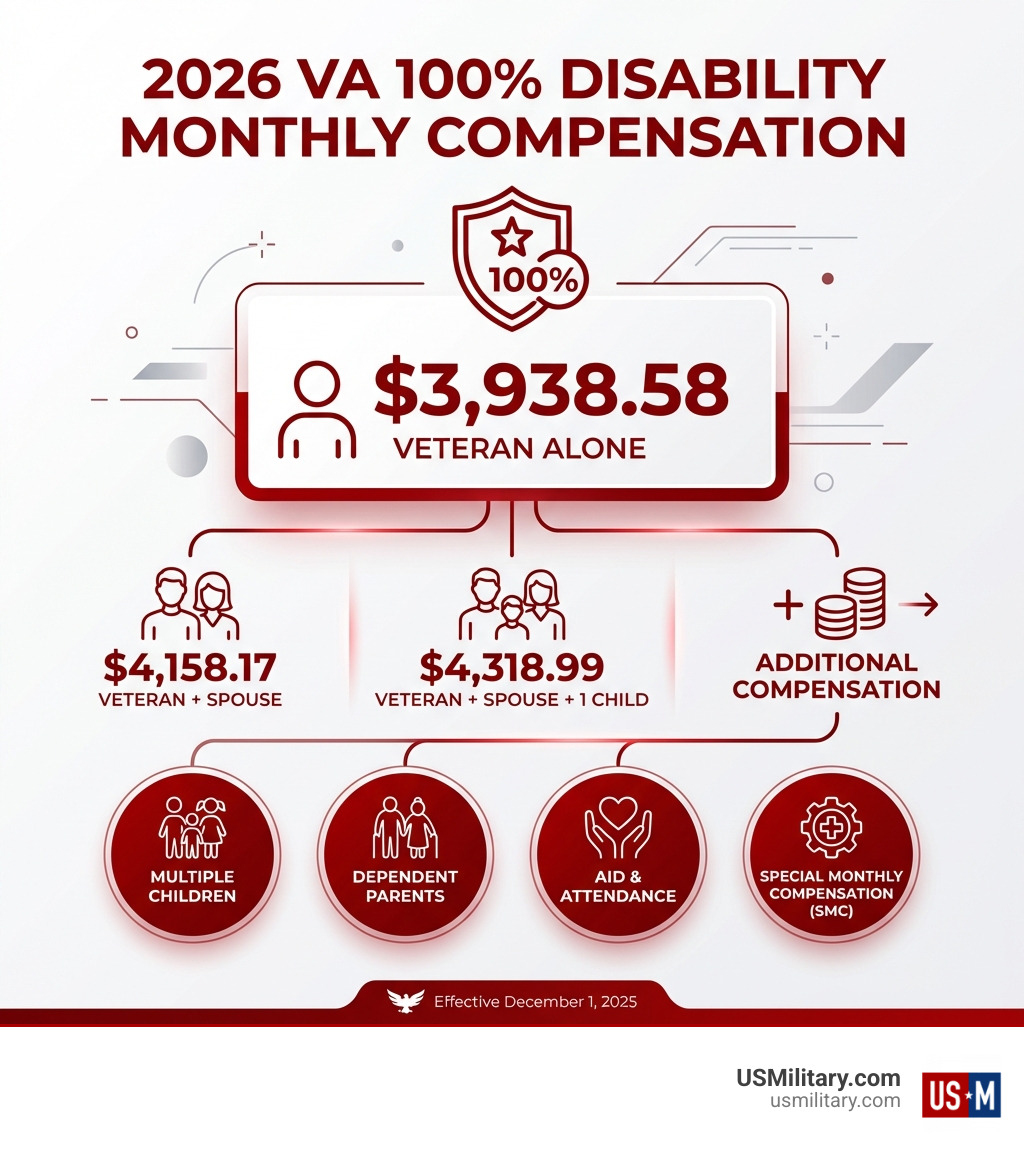
How much is VA 100% disability compensation in 2025 and 2026? Veterans with a 100% disability rating receive $3,831.30 per month (2025 rate) or $3,938.58 per month (2026 rate, effective December 1, 2025) without dependents. These amounts increase significantly with dependents:
| Dependent Status | 2025 Monthly Rate | 2026 Monthly Rate |
|---|---|---|
| Veteran Alone | $3,831.30 | $3,938.58 |
| Veteran + Spouse | $4,031.30 | $4,158.17 |
| Veteran + Spouse + 1 Child | $4,191.30 | $4,318.99 |
A 100% VA disability rating represents the highest level of service-connected disability compensation available to veterans. The VA awards this rating when your service-connected conditions completely prevent you from working and performing daily activities, or when multiple conditions combine to equal 100% using the VA’s rating system.
Unlike many government benefits, VA disability compensation is entirely tax-free. The rates increase annually based on Cost-of-Living Adjustments (COLA) that match Social Security benefits, ensuring your purchasing power keeps pace with inflation.
Increase Your VA Disability Rating! Free Consultation Call!
Veterans can achieve a 100% rating in three ways: through a single severe condition rated at 100%, through multiple conditions that combine to 100% using VA Math, or through Total Disability Individual Unemployability (TDIU) when service-connected disabilities prevent substantially gainful employment.
As Larry Fowler, publisher of the USMilitary.com Network since 2007, I’ve helped millions of veterans and active service members steer VA benefits, including how much is VA 100% disability compensation and the application process. This guide breaks down the exact monthly amounts, additional benefits, and strategies to secure your maximum entitled compensation.
Find more about How much is VA 100% disability:
Understanding the 100% VA Disability Rating (Schedular vs. TDIU)
A 100% VA disability rating is the highest recognition the Department of Veterans Affairs can give for service-connected conditions. It signifies that your disabilities are so severe they significantly impact your daily life and ability to work. But how exactly is this rating determined? There are primarily two paths to achieving a 100% rating: a schedular rating or Total Disability based on Individual Unemployability (TDIU).

Schedular 100% Disability Rating
This is perhaps the most straightforward way to reach the maximum rating. A schedular 100% rating means that, according to the VA’s Schedule for Rating Disabilities (VASRD), your service-connected conditions, either individually or combined, meet the criteria for a 100% disability.
Get The VA Disability Rating You Deserve! Free Consultation Call!
- Single Severe Condition: Some conditions are so debilitating that they alone warrant a 100% rating. Examples might include the loss of two or more limbs, total blindness, or severe, active diseases like certain cancers or advanced stages of conditions like PTSD.
- Combined Ratings (VA Math): Most veterans achieve a 100% rating through a combination of multiple service-connected disabilities. The VA doesn’t simply add up your individual ratings (e.g., a 60% rating and a 40% rating don’t automatically make 100%). Instead, they use a specific “VA Math” formula. The VA starts with the highest disability, then calculates the impact of the next highest disability on the remaining “abled” percentage. This process continues until all service-connected conditions are factored in, and the final combined percentage is rounded to the nearest 10%. For example, a 60% disability combined with a 30% disability results in a combined value of 72%, which is rounded to 70%. A 40% disability and a 20% disability combine to a 52% combined value, rounded to 50%. This combined rating must reach 100% to qualify for the full schedular benefit.
Total Disability based on Individual Unemployability (TDIU)
Even if your combined schedular rating is less than 100%, you might still qualify for compensation at the 100% rate through TDIU. This benefit is designed for veterans whose service-connected conditions, regardless of their combined percentage, prevent them from maintaining “substantially gainful employment.”
- Eligibility Requirements for TDIU: To be eligible for TDIU, you generally need:
- One service-connected disability rated at 60% or more, OR
- Two or more service-connected disabilities with a combined rating of 70% or more, where at least one condition is rated at 40% or more.
- Crucially, you must demonstrate that your service-connected conditions make it impossible for you to secure or keep a job that provides substantially gainful employment. “Substantially gainful employment” typically means earning above the federal poverty level for a single person (which was $15,060 annually in 2025, or about $1,255/month).
- Marginal Employment: If you’re working, but your earnings are below the federal poverty line, or you’re working in a protected environment (like a family business where accommodations are made for your disabilities), this is often considered “marginal employment” and generally won’t disqualify you from TDIU.
- Permanent and Total (P&T) Status: A 100% rating can also be designated as “Permanent and Total” (P&T). This means the VA has determined that your service-connected conditions are not expected to improve over time. A P&T designation carries additional benefits and typically exempts you from routine re-evaluations.
Understanding these different pathways is crucial for veterans seeking their rightful compensation. Whether through a schedular rating or TDIU, a 100% disability rating acknowledges the profound impact of service-connected health issues.
How Much is VA 100% Disability Pay in 2025 and 2026?
The question of how much is VA 100% disability pay is central for many veterans and their families. We’re pleased to share the latest figures for 2025 and the estimated rates for 2026, which reflect the annual Cost-of-Living Adjustment (COLA).
VA disability payments are adjusted annually to ensure their purchasing power keeps up with inflation. By law, the VA’s COLA matches the percentage of adjustments made to Social Security benefits. For 2026, the VA disability pay rates increased by 2.8%, taking effect on December 1, 2025. This means you’ll see the new rates reflected in your payment starting that month.
Here’s a breakdown of the monthly compensation for a 100% VA disability rating:
| Dependent Status | 2025 Monthly Rate | 2026 Monthly Rate |
|---|---|---|
| Veteran Alone | $3,831.30 | $3,938.58 |
| Veteran with Spouse | $4,031.30 | $4,158.17 |
| Veteran with Spouse and 1 Child | $4,191.30 | $4,318.99 |
| Veteran with 1 Child (no Spouse) | N/A | $4,085.43 |
| Veteran with 1 Parent (no Spouse/Child) | N/A | $4,114.82 |
| Veteran with 2 Parents (no Spouse/Child) | N/A | $4,291.06 |
| Veteran with Spouse, 1 Parent, and 1 Child | N/A | $4,495.23 |
| Veteran with Spouse, 2 Parents, and 1 Child | N/A | $4,671.47 |
Note: The “N/A” for 2025 indicates that specific rate breakdowns for all dependent combinations were not readily available in the provided 2025 data, but the base rates are consistent with the general increase.
These payments are entirely tax-free, providing significant financial relief to veterans and their families. These are base rates. The actual amount you receive can increase further depending on the number and type of your dependents, as well as any entitlement to Special Monthly Compensation (SMC). You can find the latest COLA information on the Social Security Administration’s (SSA) website.
Calculating How Much is VA 100% Disability with Dependents
One of the most impactful factors on how much is VA 100% disability compensation you receive is the presence of dependents. If you have a disability rating of 30% or higher, you are entitled to additional compensation for eligible dependents. For a 100% disability rating, these added amounts can significantly increase your monthly payment.
Who Qualifies as a Dependent?
The VA recognizes several categories of dependents:
- Spouse: Your legally married spouse.
- Children:
- Children under 18 years old.
- Children between 18 and 23 years old who are attending school full-time.
- Children of any age who are permanently incapacitated due to a disability that occurred before age 18.
- Dependent Parents: Parents who are financially dependent on the veteran for more than half of their support.
Additional Compensation for Dependents (2026 Rates for 100% Disability):
- Each additional child under 18: $109.11 per month.
- Each additional schoolchild over 18: $352.45 per month.
- Spouse receiving Aid and Attendance (A/A): An additional $201.41 per month (this is for the spouse’s own need for aid and attendance, not the veteran’s).
Let’s look at some examples of how these additions impact your 2026 monthly payment for a 100% disability rating:
- Veteran Alone: $3,938.58
- Veteran with Spouse: $4,158.17
- Veteran with Spouse and 1 Child: $4,318.99
- Veteran with Spouse and 2 Children: $4,318.99 (base for spouse + 1 child) + $109.11 (for 2nd child) = $4,428.10
- Veteran with Spouse, 1 Child, and 1 Dependent Parent: $4,495.23
- Veteran with Spouse, 2 Children, and 1 Dependent Parent: $4,495.23 (base for spouse + 1 child + 1 parent) + $109.11 (for 2nd child) = $4,604.34
It’s clear that declaring your dependents can make a substantial difference in your monthly compensation. We encourage all eligible veterans to ensure their dependent information is up-to-date with the VA. You can update your information online through the VA’s portal or by mail using VA Form 21-526EZ.
How Much is VA 100% Disability for Temporary Conditions and Cancer?
Not all 100% VA disability ratings are permanent. The VA also provides temporary 100% ratings under specific circumstances, particularly for severe, acute conditions like active cancer or periods of significant recovery. This ensures veterans receive maximum support during their most challenging times.
Active Cancer Diagnosis:
Veterans diagnosed with active cancer that is service-connected are typically granted a 100% disability rating as long as the cancer remains active and requires treatment. This acknowledges the debilitating nature of cancer and its treatments (like chemotherapy, radiation, or extensive surgery).
- Post-Treatment Recovery: Once active cancer treatment is complete, the VA generally continues the 100% rating for an additional six months. This crucial recovery period allows your body to heal from the intensive treatments.
- Reevaluation Based on Residuals: After this six-month recovery period, the VA will reevaluate your condition. The rating will then be based on any “residuals” – the lasting effects, side effects, or long-term physical limitations caused by the cancer and its treatment. For example, if cancer treatment left you with significant organ damage or chronic pain, your rating would reflect those ongoing issues.
Hospitalization and Convalescence:
Temporary 100% ratings can also be awarded for other severe, temporary situations:
- Hospitalization: If you are hospitalized for 21 days or more for a service-connected disability, you may be eligible for a temporary 100% rating during your hospital stay and for a period afterward.
- Convalescent Period: Following surgery for a service-connected condition, especially if it requires an extended recovery period, you might receive a temporary 100% rating. This “convalescent” rating supports you during your healing process.
These temporary 100% ratings are vital safety nets, ensuring veterans receive the highest level of financial and medical support when their health challenges are most acute. Establishing care at a VA health facility can help ensure your medical records support these claims.
Additional Compensation: Special Monthly Compensation (SMC)
Beyond the standard monthly disability pay, some veterans with a 100% rating may be eligible for Special Monthly Compensation (SMC). SMC is an additional tax-free benefit paid to veterans who have specific, very severe service-connected disabilities or combinations of disabilities. It’s designed to provide extra financial assistance for conditions that are exceptionally debilitating, such as the loss of a limb, blindness, or the need for daily aid and attendance.
SMC is divided into different “levels” (e.g., SMC-K, SMC-L, SMC-M, SMC-N), each with its own criteria and corresponding payment rate. The exact amount of SMC you receive depends on the specific nature and combination of your severe disabilities.
Examples of Conditions That May Qualify for SMC:
- Anatomical Loss or Loss of Use: This includes the loss or loss of use of a hand, foot, arm, leg, or an eye.
- Blindness: Specific levels of blindness in one or both eyes.
- Deafness: Total or severe deafness.
- Loss of Creative Organs: Such as loss of a penis or both testicles.
- Immobility: Being permanently bedridden or requiring regular aid and attendance for daily activities.
- Housebound Status: Being substantially confined to your home due to a service-connected disability.
- Combinations of Severe Disabilities: Certain combinations of these severe conditions can lead to even higher SMC rates.
For instance, SMC-K is a common additional payment for specific disabilities like the loss of a hand or foot, or certain levels of blindness, even if you don’t have a 100% schedular rating. For a 100% disabled veteran, SMC can significantly increase the total monthly compensation, recognizing the profound impact of these severe conditions on their quality of life.
The 2025 SMC-K rate, for example, is $142.35 per month, which is added on top of your regular monthly compensation. Higher levels of SMC (L, M, N) provide even greater additional compensation, reflecting the increased severity and functional limitations. If you believe your conditions might qualify for SMC, we highly recommend exploring this benefit further, as it can substantially impact how much is VA 100% disability for you.
Beyond Monthly Pay: Healthcare, Education, and Housing Benefits
A 100% VA disability rating open ups a comprehensive suite of benefits that extend far beyond just monthly compensation. These additional benefits are designed to support your overall well-being, education, and housing needs, as well as those of your eligible family members.
Healthcare Benefits:
Veterans with a 100% service-connected disability rating receive top-tier healthcare benefits through the VA.
- Priority Group 1 Enrollment: You are automatically placed in VA’s highest priority group for healthcare enrollment, ensuring you get timely access to medical services. This includes full medical care for all your service-connected and non-service-connected conditions.
- No Copayments: Generally, you won’t pay any copayments for VA healthcare services or prescription medications.
- Dental Care: Unlike lower disability ratings, a 100% service-connected disability rating typically grants access to comprehensive VA dental care.
- Travel Benefits: You may be eligible for reimbursement for travel costs to and from VA appointments.
- CHAMPVA: Your eligible dependents (spouse, children) may qualify for healthcare coverage through the Civilian Health and Medical Program of the Department of Veterans Affairs (CHAMPVA).
To apply for VA health care, you’ll need to fill out VA Form 10-10EZ. The Veterans Health Administration is the largest integrated healthcare system in the United States, offering a broad range of services.
Education Benefits:
A 100% disability rating opens doors to significant educational opportunities for both you and your family.
- Survivors’ and Dependents’ Educational Assistance (DEA – Chapter 35): Your spouse and children may be eligible for up to 45 months of education benefits, helping them pursue college degrees, vocational training, or other educational programs.
- Fry Scholarship: This scholarship provides Post-9/11 GI Bill benefits to children and spouses of service members who died in the line of duty after September 10, 2001, or were missing in action or captured.
- Veteran Readiness and Employment (VR&E – Chapter 31): This program provides services to help veterans with service-connected disabilities prepare for, obtain, and maintain suitable employment. It can include career counseling, job training, and even educational assistance. You could receive up to 48 months of benefits across various programs.
Housing Benefits:
Securing and adapting a home is also made easier with a 100% disability rating.
- Property Tax Exemptions: Many states offer full or partial property tax exemptions for 100% disabled veterans. This can result in substantial annual savings on your home. (Note: eligibility and amounts vary by state, so check with your local tax authority).
- VA Home Loan Benefits: While available to all eligible veterans, a 100% service-connected disability rating means you are exempt from paying the VA home loan funding fee, saving you thousands of dollars.
- Specially Adapted Housing (SAH) Grant: This grant helps severely disabled veterans build, buy, or modify a home to accommodate their disabilities.
- Special Housing Adaptation (SHA) Grant: This grant helps veterans adapt or purchase a home with accessibility modifications.
These additional benefits underscore the VA’s commitment to supporting veterans with the highest disability ratings, providing a foundation for a stable and fulfilling life.
How to Secure and Maintain a 100% Rating
Securing a 100% VA disability rating, whether initially or through an appeal, requires a thorough understanding of the VA’s claims process and meticulous preparation. Maintaining that rating also involves specific considerations.
The Foundation: Evidence and Nexus
The VA’s decision-making process hinges on evidence. You need to provide clear documentation that:
- Proves a current diagnosis of a disability.
- Shows an in-service event, injury, or illness that occurred during your military service.
- Establishes a “nexus” – a direct link or connection between the current disability and the in-service event.
- The Nexus Letter: This is often the most critical piece of evidence. A nexus letter is a medical opinion from a doctor or medical professional that explicitly states your current condition is “at least as likely as not” due to your military service. It’s an expert opinion that ties everything together.
- Medical Records: Gather all relevant medical records, both military (Service Treatment Records) and private. The more comprehensive your medical history, the stronger your claim.
- Lay Statements: Personal statements from you, your family, friends, or fellow service members can provide crucial context on how your condition developed and how it impacts your daily life.
The C&P Exam and VASRD
Once you file a claim, the VA will often schedule a Compensation and Pension (C&P) exam. This exam is conducted by a VA-approved medical professional who evaluates your current condition’s severity and functional impact. They review your medical records, perform assessments, and document how your disability affects your ability to work and perform daily activities.
The VA then uses the Schedule for Rating Disabilities (VASRD) to assign a diagnostic code and a percentage rating to your condition. The VASRD provides specific criteria for thousands of medical conditions. If a condition isn’t explicitly listed, the VA rates it “by analogy” to a similar condition.
Understanding VA Math for Combined Ratings
If you have multiple service-connected conditions, the VA uses a specific method to combine them, which we affectionately call “VA Math.” It’s not simple addition. The VA calculates the combined percentage by starting with your highest disability rating and then applying subsequent ratings to the remaining healthy percentage. The final combined percentage is then rounded to the nearest 10%.
- Example: If you have a 50% disability and a 30% disability:
- You are 50% disabled, meaning you are 50% “abled.”
- The 30% disability is applied to the remaining 50% abled (30% of 50% = 15%).
- Your total disability is 50% + 15% = 65%.
- This 65% is rounded up to a 70% combined rating.
The Claim Process and Speeding It Up
You can apply for VA disability benefits online through the VA’s portal, by mail with VA Form 21-526EZ, in person at a regional office, or with the help of a Veteran Service Officer (VSO).
To potentially speed up the process:
- Fully Developed Disability Claims (FDDC): If you submit all required forms and supporting evidence (medical records, nexus letter, lay statements) with your initial application, your claim might be processed faster, sometimes within 30 days.
- Benefits Delivery at Discharge (BDD) Program: If you are within 90 to 180 days of separating from service, you can file a pre-discharge claim through the Benefits Delivery at Discharge (BDD) program.
- Decision Ready Claims (DRC): Working with an accredited VSO can enable you to submit a DRC, which aims for processing in 30 days or less.
- Priority Processing: In specific situations (e.g., terminal illness, extreme financial hardship, or being age 85 or older), you can apply for faster review by submitting VA Form 20-10207.
Appealing a Decision
If your claim is denied or you receive a lower rating than expected, you have the right to appeal. The appeals process can be complex, but it’s essential if you believe the VA made an error. You can seek assistance from a VSO or a VA-accredited attorney to help steer this process and gather additional evidence to support your appeal.
Maintaining Your 100% Rating
For non-permanent 100% ratings, the VA may require periodic re-examinations, typically every two to five years, to assess if your condition has improved or worsened. If your condition is designated as Permanent and Total (P&T), you are generally exempt from these routine re-evaluations. However, even with a P&T rating, the VA can still review your case if there’s evidence of significant improvement or if fraud is suspected.
It’s always wise to continue seeking medical treatment for your service-connected conditions and to keep accurate records. If your condition worsens, you can initiate a review yourself to ensure your rating accurately reflects your current health status.
Frequently Asked Questions about 100% Disability
We understand that navigating VA disability benefits can bring up many questions. Here, we address some of the most common inquiries about a 100% VA disability rating.
Can I work with a 100% VA disability rating?
This is a critical question, and the answer depends on how you received your 100% rating:
- If your 100% rating is Schedular (based on the severity of your conditions or combined ratings): Yes, you can generally work without any income limitations or impact on your VA disability compensation. Your 100% schedular rating is based on the severity of your medical conditions, not your ability to work. However, earning a high income might affect eligibility for other VA benefits that have income thresholds.
- If your 100% rating is due to Total Disability based on Individual Unemployability (TDIU): In this case, there are strict limitations on working. TDIU is granted because your service-connected disabilities prevent you from maintaining “substantially gainful employment.” This generally means you cannot earn more than the federal poverty level for a single person annually (approximately $15,060 in 2025). If you engage in “marginal employment” (earning below this threshold or working in a protected environment), it typically won’t impact your TDIU benefits. However, if you start earning above this limit, your TDIU status and 100% pay rate may be reviewed and potentially reduced.
It’s vital to understand this distinction to avoid any issues with your benefits.
What is the difference between a temporary and permanent 100% rating?
The difference lies in the expectation of improvement and the frequency of re-evaluation:
- Temporary 100% Rating: These ratings are awarded for conditions that are severely debilitating but are expected to improve over time. Examples include:
- Active Cancer: A 100% rating is given during active treatment and for six months post-treatment, then re-evaluated based on residuals.
- Hospitalization: For extended hospital stays (21+ days) due to a service-connected condition.
- Convalescence: During a recovery period following surgery for a service-connected condition.
These ratings ensure maximum support during acute phases of illness or recovery.
- Permanent 100% Rating (P&T): This designation means the VA has determined that your service-connected conditions are stable and are not expected to improve significantly over your lifetime. Veterans with a P&T rating are typically exempt from routine re-evaluations, providing greater stability and peace of mind. P&T also open ups additional benefits, such as those for dependents.
How often does the VA review 100% disability ratings?
The frequency of review depends on whether your 100% rating is temporary or permanent:
- Non-Permanent 100% Ratings: If your 100% rating is temporary or not designated as Permanent and Total (P&T), the VA will generally schedule periodic re-examinations. These usually occur every two to five years. The purpose is to determine if your condition has improved or worsened, which could lead to an adjustment in your rating.
- Permanent and Total (P&T) Ratings: If your 100% rating is designated as P&T, the VA typically does not schedule routine re-examinations. This is because your conditions are deemed stable and unlikely to improve. However, even P&T ratings can be reviewed under specific, rare circumstances, such as clear evidence of fraud or if the veteran initiates a claim for a new condition that significantly impacts their existing ratings.
It’s always a good practice to keep detailed medical records of your conditions, regardless of your rating status. If your condition worsens, you can always request a re-evaluation to ensure your rating accurately reflects your current health.
Conclusion
Understanding how much is VA 100% disability compensation, along with the extensive array of additional benefits, is a critical step for every veteran. Whether you’ve achieved this rating through a single severe condition, a combination of disabilities, or Total Disability based on Individual Unemployability (TDIU), this highest level of compensation is designed to provide substantial support for your service-connected sacrifices.
At USMilitary.com, we are dedicated to providing comprehensive resources and nonbiased information to help you steer the complexities of VA benefits. From understanding the nuances of schedular versus TDIU ratings to deciphering the impact of dependents and Special Monthly Compensation, our goal is to empower you with the knowledge to secure every benefit you’ve earned.
We believe that every veteran deserves to receive the maximum compensation and support for their service-connected disabilities. Don’t hesitate to leverage the resources available to you, whether through the VA directly, Veteran Service Organizations, or platforms like ours. We are here to help you understand your entitlements and guide you through the process, ensuring your financial stability and well-being.
For more detailed information and assistance with your benefits, explore our comprehensive resources:
More info about disabled veteran benefits
Free for Service Members & Veterans
Get the military benefits intel no one tells you about.
Weekly updates on VA benefits, pay changes, and money tips — free for service members and veterans.
No spam. Unsubscribe anytime. Your info is never shared.


