Understanding the Army Max Enlistment Age: Your First Step to Service
Army max enlistment age is a critical factor for anyone considering military service. If you’re wondering whether you’re too old to join, here’s what you need to know right away:
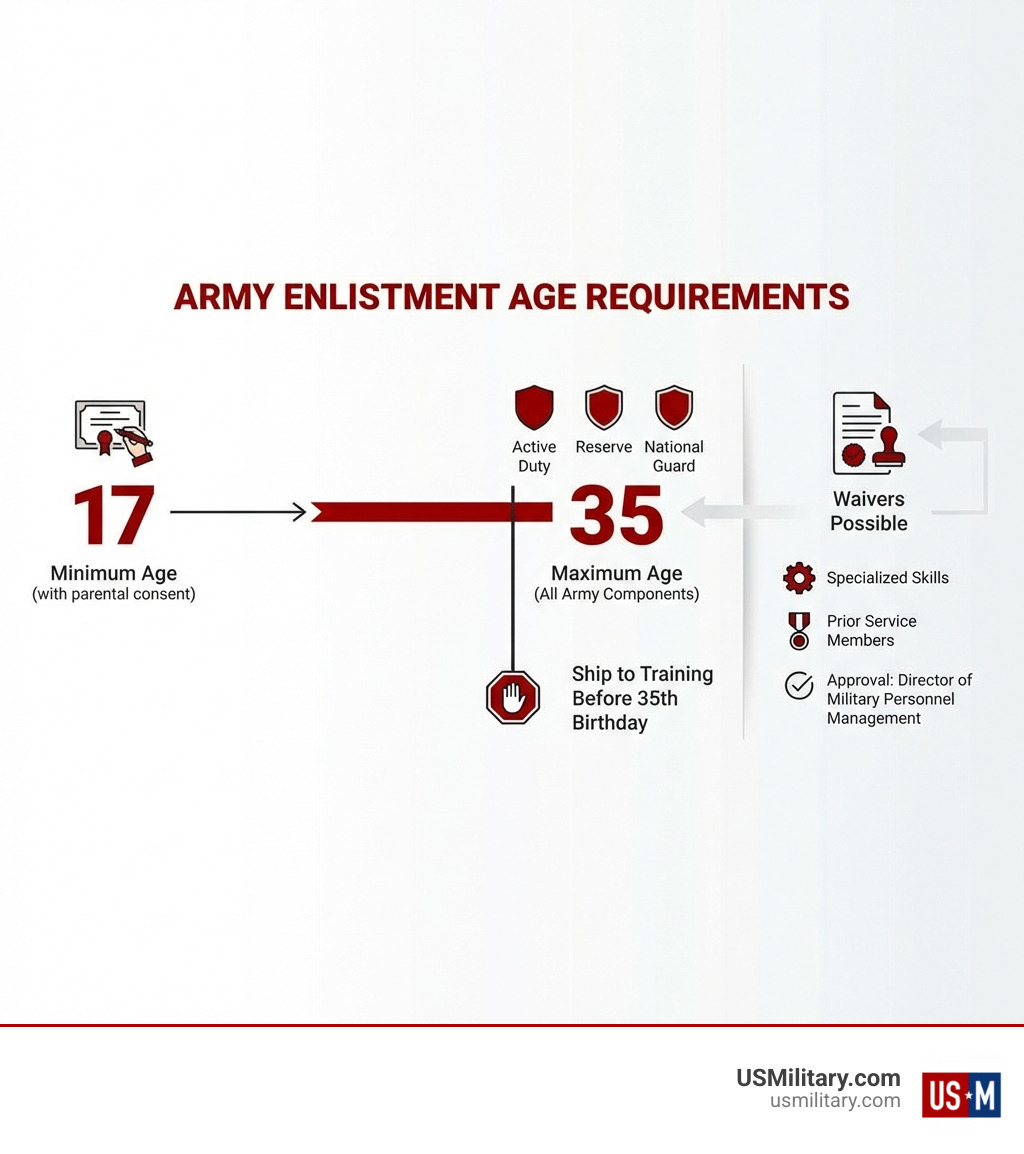
Quick Answer: The maximum age to enlist in the U.S. Army is 35 years old for all three components (Active Duty, Army Reserve, and Army National Guard). You must ship to training or be accessed into your component before your 35th birthday.
| Age Requirement | Details |
|---|---|
| Minimum Age | 17 years old (with parental consent) |
| Maximum Age | 35 years old (for all Army components) |
| Parental Consent | Required for applicants who are 17 years old |
| Waivers | May be available in certain cases through the Director of Military Personnel Management |
Age is just one piece of the enlistment puzzle, but it’s often the first question potential recruits ask. Whether you’re fresh out of high school or considering a mid-career change, understanding these age limits helps you plan your path to service.
The 35-year-old cutoff isn’t arbitrary. It reflects the physical demands of military training and service, as well as career progression timelines. But age limits aren’t the same across all military branches—the Army actually has a lower maximum age than the Air Force or Navy.
Prior military service can also affect your eligibility. Former service members may have different age calculations that add their previous years of service to the base age limit. And in rare cases, specialized skills or critical needs may open doors to age waivers.
What Are the Basic Age Requirements for Army Enlistment?
When we talk about joining the Army, age is one of the foundational eligibility criteria. It’s not just a number; it reflects the physical and mental readiness expected for the demanding life of a soldier. The Army has established clear minimum and army max enlistment age guidelines to ensure recruits are prepared for basic training and beyond.
Minimum Age to Enlist and Requirements for Minors
Let’s start with the younger end of the spectrum. To enlist in the U.S. Army, you must be at least 17 years old. This minimum age applies across all Army components: Active Duty, Army Reserve, and Army National Guard.
However, if you’re 17, there’s a crucial additional requirement: parental or legal guardian consent. We understand that deciding to join the military is a significant life step, and for minors, it’s a family decision. Your parents or legal guardians will need to sign specific consent forms, typically DD Form 1966, allowing you to enlist. This consent cannot be obtained more than 30 days prior to your 17th birthday, ensuring that the decision is recent and well-considered.
Most 17-year-old recruits are still in high school, and while they can begin the enlistment process, they generally join through a program like the Delayed Entry Program (DEP) or Future Soldier Program. This allows them to complete their high school diploma before shipping off to Basic Combat Training (BCT). While some exceptions might exist, a high school diploma or GED is a fundamental requirement for enlistment.
Understanding the Army Max Enlistment Age
Now, for the big question: what is the army max enlistment age? For anyone looking to join the U.S. Army, whether for Active Duty, the Army Reserve, or the Army National Guard, the maximum age for initial enlistment is 35 years old. This means you must ship to Basic Combat Training or be officially accessed into your respective Army component no later than your 35th birthday.
This age limit is outlined in official regulations, such as Army Regulation 601–210: Personnel Procurement Regular Army and Reserve Components Enlistment Program. The Army sets this limit primarily due to the intense physical demands of military training and service. Basic Combat Training is designed to push individuals to their physical and mental limits, and while age doesn’t define capability, statistical data suggests that younger recruits generally adapt more easily to these rigors.
This 35-year-old cutoff is quite firm. If you’re 35 and considering joining, we recommend contacting a recruiter immediately to ensure you can complete the entire enlistment process, including medical examinations, aptitude testing (ASVAB), and administrative paperwork, before you turn 36. Missing the age cutoff by even a day can significantly complicate your path to service, requiring a waiver process that is not guaranteed.

How Do Army Components and Prior Service Affect Age Limits?
You might be thinking, “Does it matter if I want to go Active Duty or join the Reserve?” That’s an excellent question! While the core army max enlistment age is 35 across the board, there are some nuances, especially when we consider prior military service.
Active Duty vs. Army Reserve and National Guard Age Limits
Here’s a straightforward answer: the maximum enlistment age of 35 years old applies uniformly to all three Army components. Whether you aspire to serve full-time in the Regular Army (Active Duty), or part-time in the U.S. Army Reserve or the Army National Guard, the 35-year-old threshold remains consistent for initial enlistment.
This consistency simplifies things, as you don’t need to steer different age charts for different components. However, it’s worth noting that while the age limit is the same, the nature of service differs. Active Duty is full-time military life, while the Army Reserve and National Guard offer part-time service, typically one weekend a month and two weeks a year, allowing individuals to balance military commitments with civilian careers or education.
The Army National Guard, while part of the U.S. Army, also has a unique dual federal and state mission. While the overarching Army policy sets the initial enlistment age at 35, legal statutes like 32 U.S. Code § 313: Appointments and enlistments: age limitations, specifically for the National Guard, mention that a person must be at least 17 years of age and under 45 for original enlistment, or under 64 if they are a former member of the Regular Army, Navy, Air Force, or Marine Corps. For reenlistment, a person must be under 64 years of age. While this federal code provides a broader legal framework, for practical recruiting purposes for initial enlistment, the Army’s operational policy for new recruits across all components, including the National Guard, generally adheres to the 35-year maximum. It’s always best to confirm with a recruiter about any specific programs or state-level Guard policies that might leverage these broader legal allowances.
The Impact of Prior Military Service on Enlistment
This is where things can get a bit more flexible! If you’ve previously served in any branch of the U.S. military, your prior service can significantly impact your eligibility, especially concerning the army max enlistment age.
For individuals with prior military service (often referred to as “prior service business rules”), the Army sometimes allows for an adjusted age calculation. Instead of a strict 35-year cutoff, your years of previous active duty service might be added to the maximum age limit. For example, Department of Defense Instruction NUMBER 1304.26 states that the maximum age for a regular enlistee is 42 years, and for prior service enlistees, the maximum age is determined by adding their years of prior service to age 42. While the Army’s specific regulation AR 601-210 generally states 35, prior service members often fall under different recruiting “business rules” which can be more flexible.
This means if you’ve served honorably before and received a DD Form 214 (Certificate of Release or Discharge from Active Duty), you might still be eligible to rejoin even if you’re past 35. The exact calculation and eligibility depend on several factors, including:
- Your previous branch of service: While the Army tries to be consistent, rules can vary slightly depending on where you served before.
- Your time in service: The number of years you served plays a role.
- Your rank and Military Occupational Specialty (MOS): The Army might prioritize certain skills or ranks.
- The needs of the Army: Critical shortages in specific fields can make waivers more likely.
- The length of your “break in service”: How long you’ve been out of uniform can also be a factor.
Just because you have prior service doesn’t guarantee a spot. You’ll still need to meet all other enlistment criteria, including physical fitness, medical standards, and character requirements. The best course of action for prior service members is to contact an Army recruiter directly. They can assess your specific situation, review your DD Form 214, and explain the current “prior service business rules” that apply to you. It’s a great opportunity to leverage your experience and continue serving our nation!
Are There Waivers or Exceptions to the Army Max Enlistment Age?
While the 35-year army max enlistment age is a general rule, we understand that life doesn’t always fit neatly into boxes. Sometimes, exceptional circumstances, unique qualifications, or critical needs of the Army can lead to exceptions. This is where age waivers come into play.
How Waivers Can Affect the Army Max Enlistment Age
An age waiver is essentially a formal request to bypass a disqualifying factor – in this case, being over the maximum enlistment age. It’s not a guarantee, but rather an opportunity for the Army to consider your application based on a “whole person” concept, looking beyond just your age.
The waiver process for exceeding the army max enlistment age is typically initiated by your recruiter and requires approval from higher command, often the Director of Military Personnel Management. This process involves a thorough review of your entire profile, including:
- Your skills and qualifications: Do you possess a highly sought-after skill that the Army desperately needs?
- Your physical fitness: Can you demonstrate that despite your age, you are in excellent physical condition and can meet the demands of training and service?
- Your education and aptitude: Have you excelled academically or scored exceptionally well on the ASVAB?
- Your prior military service (if applicable): As discussed, prior service can be a strong factor in obtaining a waiver.
- The current needs of the Army: Recruiting goals and critical shortages often influence waiver approvals.
We want to be clear: waivers are not given lightly. They are considered “meritorious cases” and are evaluated on a case-by-case basis. The Army’s primary goal is to maintain a strong, capable fighting force, and waivers are granted only when an applicant brings significant value that outweighs the deviation from standard age requirements. If a waiver is not granted, the consequence of being over the maximum enlistment age is simply ineligibility to join the Army for initial enlistment.
Who Qualifies for an Age Waiver?
So, who might actually qualify for one of these coveted age waivers? Generally, waivers are considered for individuals who possess specialized skills, experience, or prior service that the Army needs. Think of it as a supply-and-demand situation: if you have something the Army is short on, your chances improve.
Here are some common categories of individuals who might be considered for an age waiver:
- Medical Professionals: Doctors, nurses, dentists, and other healthcare providers are always in high demand. The Army often grants waivers for these critical roles, recognizing that their specialized education and experience are invaluable, regardless of age.
- Chaplains: Spiritual guidance is essential for soldiers, and chaplains from various religious backgrounds are needed. Similar to medical professionals, their unique qualifications can lead to age waivers.
- Highly Specialized Technical Skills: Individuals with expertise in areas like cyber security, specific engineering fields, or advanced linguistics might be considered for waivers if their skills are critical to national security.
- Prior Service Members: As we mentioned, if you’ve already served honorably in any branch of the U.S. military, your experience is highly valued. The Army may be more inclined to grant an age waiver to someone who has proven their commitment and capability.
Even within these categories, a waiver is never guaranteed. Each application undergoes rigorous scrutiny. Our advice? If you fall into one of these categories and are passionate about serving, don’t self-disqualify. Talk to an Army recruiter, present your case, and let them guide you through the process. You never know until you ask!

How Do Army Age Limits Compare to Other Military Branches?
When we look at the U.S. military as a whole, it’s like a big family with different branches, each with its own unique mission, culture, and, yes, even age limits. While the army max enlistment age is 35, other branches have different thresholds, reflecting their specific needs and operational environments.
Why Do Age Limits Vary Between Services?
The variations in age limits among the military branches aren’t arbitrary; they stem from fundamental differences in mission requirements, physical demands, and career progression timelines.
For instance, the Marine Corps, known for its rigorous combat roles and emphasis on youth and agility, has the lowest maximum enlistment age. The Air Force and Space Force, which often rely on highly technical roles that may require extensive education and experience, have higher age limits.
Here’s a comparison of the maximum enlistment ages across the U.S. military branches for initial enlistment (Active Duty):
| Military Branch | Minimum Enlistment Age | Maximum Enlistment Age |
|---|---|---|
| Army | 17 (with parental consent) | 35 |
| Marine Corps | 17 (with parental consent) | 28 |
| Navy | 17 (with parental consent) | 41 |
| Air Force | 17 (with parental consent) | 42 |
| Space Force | 17 (with parental consent) | 42 |
| Coast Guard | 17 (with parental consent) | 41 |
As you can see, the Army’s maximum age of 35 places it in the middle of the pack. The Marine Corps has a stricter limit at 28, while the Air Force and Space Force are the most flexible, allowing enlistment up to 42. The Navy and Coast Guard are close behind at 41.
These differences highlight the unique recruiting goals and operational realities of each service. If you find that you’re just a bit over the army max enlistment age, don’t despair! You might still be eligible for another branch, particularly if you’re under 41 or 42. It’s always worth exploring all your options and speaking with recruiters from different services to see where your qualifications and aspirations best align.
Officer vs. Enlisted: Understanding the Differences in Age Requirements
When we talk about joining the Army, it’s important to distinguish between enlisting as a soldier and commissioning as an officer. These two paths, while both vital to the Army’s success, have different entry requirements, including age.
Age Requirements for Becoming an Army Officer
Becoming an Army officer typically involves a higher level of education and a different set of leadership responsibilities. The age requirements for officers can vary depending on the commissioning source:
- Officer Candidate School (OCS): This is a program for college graduates who want to become officers. Generally, OCS candidates must be between 19 and 32 years old. However, waivers can extend this up to 35 for specific critical skills or prior service.
- Reserve Officers’ Training Corps (ROTC): If you’re pursuing a college degree, ROTC allows you to train as a future officer while completing your studies. Cadets must generally be under 31 years old when they commission.
- U.S. Military Academy at West Point: Admission to West Point is highly competitive and has a stricter age limit. Applicants must be at least 17 but not yet 23 years old by July 1st of the year they enter the academy. They cannot be married, pregnant, or have a legal obligation to support children.
- Direct Commission: For professionals with highly specialized skills (like doctors, lawyers, or chaplains), the Army offers direct commissions. These individuals typically have advanced degrees and experience in their fields. The age limits for direct commissions are usually higher, sometimes extending into the 40s or even 60s for certain medical specialties, as noted in Department of Defense Instruction NUMBER 1304.26, which states that the maximum age for initial appointment as a Reserve Officer in a health profession specialty should not be less than 47 years.
The key difference from enlisted age limits is often the emphasis on leadership potential and, for many officer paths, a completed bachelor’s degree. While the army max enlistment age for enlisted soldiers is 35, the maximum commissioning age can be higher for certain officer programs, especially those requiring advanced degrees or critical professional skills. This reflects the Army’s need to recruit individuals with developed expertise and leadership qualities, which often come with more life experience.
Beyond Age: Other Key Enlistment Requirements
While understanding the army max enlistment age is crucial, we must remember that age is just one piece of the puzzle. The Army takes a holistic approach to evaluating potential recruits, looking at a range of factors to ensure each individual is fully prepared for the challenges and responsibilities of military service. These requirements cover everything from your physical health to your educational background and even your legal standing.
Citizenship, Education, and Physical Standards
To join the U.S. Army, you’ll need to meet several fundamental eligibility criteria beyond just age. These standards are in place to ensure that every soldier is capable, reliable, and aligns with the values and security needs of our nation.
- Citizenship and Residency:
- U.S. Citizens: If you’re a U.S. citizen, you’re good to go on this front.
- Permanent Residents (Green Card Holders): We welcome legal permanent residents (those with a Green Card) to enlist. However, there are additional checks involved. You must be able to speak, read, and write English fluently, and you’ll undergo specific background checks, including National Intelligence Agency Checks and Federal Bureau of Investigation Foreign Terrorist Tracking Task Force checks, as per Army Regulation 601–210. Joining the military is not a pathway to obtaining a visa or entering the U.S.; you must already be a legal permanent resident.
- Dual Citizenship: If you hold dual citizenship, it doesn’t automatically disqualify you. However, if your Military Occupational Specialty (MOS) requires a security clearance, your dual citizenship will be carefully reviewed to ensure there are no conflicts of interest or security risks.
- Education:
- High School Diploma or GED: A high school diploma is the preferred standard. While a General Equivalency Diploma (GED) can be accepted, the Army often has stricter requirements for GED holders, such as needing a higher score on the Armed Services Vocational Aptitude Battery (ASVAB) or having some college credits. This ensures a foundational level of education and trainability.
- Aptitude and Testing (ASVAB):
- Armed Services Vocational Aptitude Battery (ASVAB): Everyone who wants to enlist in the U.S. military must take the ASVAB. This isn’t just a pass/fail test; it measures your aptitude in various academic and vocational areas. Your scores determine your eligibility for enlistment and help identify which military jobs (MOS) you qualify for. The Army looks for specific ASVAB scores, and those in AFQT Category V (percentiles 1-9) are generally ineligible.
- Physical and Medical Standards:
- Medical Screening at MEPS: Before you can enlist, you’ll undergo a comprehensive medical examination at a Military Entrance Processing Station (MEPS). This exam assesses your overall health, vision, hearing, and any pre-existing conditions. The Army needs healthy recruits who can withstand the rigors of training and deployment. Certain medical conditions can be disqualifying, though some may be waiverable depending on their severity and the needs of the Army, as detailed in Department of Defense Instruction NUMBER 1304.26.
- Physical Fitness: Beyond medical health, you must meet physical fitness standards. This includes height and weight requirements, and the ability to pass physical fitness tests that measure your strength, endurance, and agility. The Army is a physically demanding profession, and we need our soldiers to be ready for action.
- Character and Conduct:
- Background Checks: The Army conducts thorough background checks, including police record checks, to assess your character and conduct. Any history of criminal activity, drug use, or significant misconduct can be disqualifying. While waivers are possible for some minor offenses, serious offenses like felony sexual crimes are strictly non-waiverable. The Army needs individuals of good moral character who can be trusted to uphold military values.
Meeting these requirements, alongside the age limits, ensures that you are fully prepared to start on a fulfilling and challenging career in the U.S. Army. We believe in setting our soldiers up for success from day one.
Conclusion
Navigating the path to military service can feel like a maze of requirements, but understanding the army max enlistment age is a crucial first step. We’ve explored how the Army sets its age limits, the nuances for different components, and the potential for exceptions.
Here are the key takeaways we hope you remember:
- The standard army max enlistment age for initial enlistment across all three Army components (Active Duty, Army Reserve, and Army National Guard) is 35 years old.
- The minimum age to enlist is 17, with mandatory parental or legal guardian consent.
- Prior military service can be a game-changer, potentially allowing individuals over 35 to rejoin by adjusting their age calculation based on previous years of service.
- Age waivers are possible, though rare, and are typically reserved for individuals with highly specialized skills (like medical professionals or cyber experts) or those with prior service that the Army critically needs.
- Age limits vary across other military branches, with some having lower maximums (Marine Corps at 28) and others higher (Air Force and Space Force at 42, Navy and Coast Guard at 41).
- Officer commissioning paths often have different age requirements than enlisted service, sometimes extending to older ages for those with advanced degrees or professional expertise.
- Beyond age, essential requirements include U.S. citizenship or legal permanent residency, a high school diploma or GED, passing the ASVAB, and meeting rigorous physical and medical standards.
If you’re passionate about serving our country, we encourage you not to let age be a barrier to exploring your options. The best way to get precise, up-to-date information custom to your unique situation is to speak directly with an Army recruiter. They are the experts who can guide you through the process, evaluate your qualifications, and help you determine your eligibility for waivers or specific programs.
Ready to take the next step and explore more about military service? Explore comprehensive military age limit information.
Free for Service Members & Veterans
Get the military benefits intel no one tells you about.
Weekly updates on VA benefits, pay changes, and money tips — free for service members and veterans.
No spam. Unsubscribe anytime. Your info is never shared.


