Understanding What a 70% VA Disability Rating Means for Your Benefits
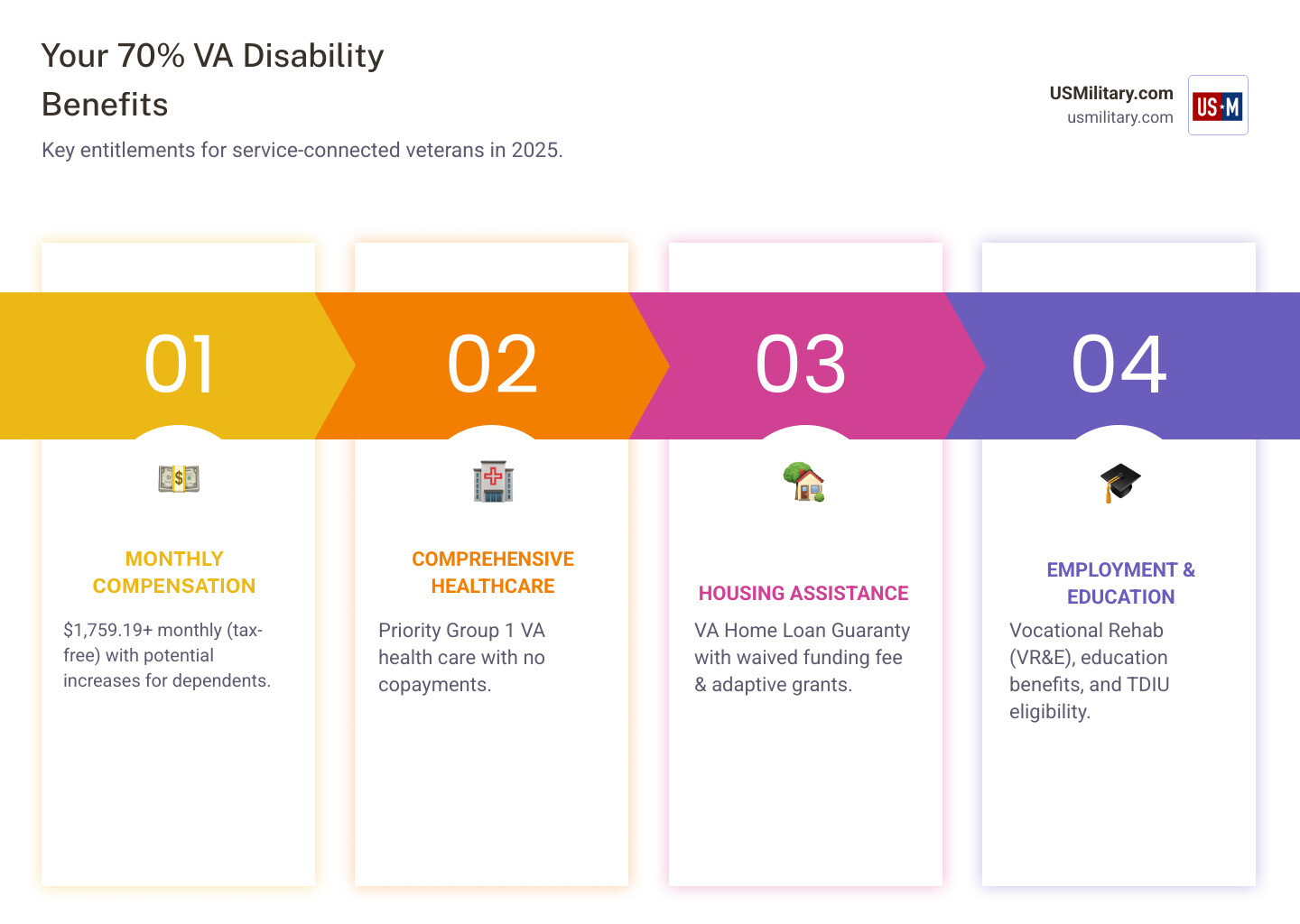
70 disabled veteran benefits provide substantial financial and healthcare support for veterans with service-connected disabilities rated at this level. If you have a 70% VA disability rating, here’s what you’re entitled to in 2025:
Monthly Compensation & Financial Benefits:
- $1,759.19/month for a single veteran (tax-free)
- $2,017.49/month with a spouse and one child
- Additional amounts for each dependent child and parent
- Potential for Total Disability Individual Unemployability (TDIU) to receive 100% pay
Healthcare & Priority Access:
- Priority Group 1 VA healthcare (no copays for services)
- Full access to VA hospitals and clinics
- Mental health and specialized treatment services
Housing & Education Support:
- VA Home Loan Guarantee with waived funding fee
- Adaptive housing grants (SAH/SHA) for accessibility modifications
- Vocational Rehabilitation and Employment (VR&E) services
- Education benefits through Post-9/11 GI Bill programs
A 70% disability rating represents a significant level of service-connected impairment that substantially affects your daily life and ability to work. The VA assigns this rating based on the frequency, duration, and severity of your symptoms. At this rating level, you cross an important threshold—you gain access to improved benefits that aren’t available at lower ratings, including no-copay healthcare and the potential to qualify for TDIU if your disabilities prevent substantial gainful employment.
This guide breaks down exactly what you’re entitled to, how to maximize your benefits, and what steps you can take to potentially increase your rating if your conditions have worsened.
Understanding Your 2025 70% VA Disability Compensation
A 70 disabled veteran benefits rating is a game-changer for many veterans, providing a robust foundation of financial security. This section dives into the specifics of your monthly compensation, how dependents can increase that amount, and what other financial support you might be eligible for.
Monthly Pay Rates for a 70% Rating
For a single veteran with a 70% VA disability rating, the compensation rate for 2025 is $1,759.19 per month. This amount is tax-free, which means you get to keep every penny, making it a powerful financial lifeline.
The VA is legally required to match the percentage of cost-of-living adjustments (COLAs) made to Social Security benefits. These annual adjustments ensure that the purchasing power of your benefits keeps up with inflation. For 2026, the VA disability pay rates reflect a 2.8% COLA increase, effective December 1, 2025. You can always get the latest cost-of-living adjustment (COLA) information on the Social Security Administration’s (SSA) website to stay informed.
It’s a common and important question: “Is VA disability income taxable?” The answer is a resounding no. Our VA disability benefits are generally tax-free, providing significant financial relief. For more details on this, you can visit our guide on Is VA Disability Income Taxable.
How Dependents Increase Your Monthly Pay
One of the most impactful aspects of 70 disabled veteran benefits is the additional compensation available for dependents. If you have a spouse, children under 18, children between 18-23 who are still in school, or even dependent parents, your monthly compensation can increase significantly.
Let’s look at some examples based on 2025 rates:
- Veteran with a spouse and one child: You could receive approximately $2,017.49 per month.
- Veteran with a spouse and three children under 18: This could increase to around $2,367.45 per month.
The additional amounts for dependents are calculated based on your disability rating. For a 70% rating, the added amount for each child under 18 is around $76.00. For a schoolchild over 18, it’s roughly $105.00. If your spouse is also receiving Aid and Attendance benefits, that can add approximately $141 to your monthly compensation.
These calculations can get a little complex, but we’ve done the work for you. For a detailed breakdown, check out our VA Disability Rating Chart 2025. You can also view the VA’s official compensation tables for the most up-to-date and comprehensive information.
Additional Compensation for Severe Needs
Beyond the basic monthly compensation and dependent add-ons, veterans with particularly severe service-connected disabilities may be eligible for Special Monthly Compensation (SMC). SMC is an additional financial benefit provided for specific disabilities such as the loss of a limb, blindness, or the need for daily aid and attendance.
For example, if your spouse requires Aid and Attendance due to a serious disability, you may receive an increased monthly payment. Similarly, if you are housebound due to your service-connected conditions, you could qualify for additional compensation. These benefits are designed to provide extra financial assistance to veterans and their families facing unique challenges. Learn more about how these benefits can support your loved ones through our resource on Spouse Benefits for Disabled Veterans.
Core Healthcare and Housing Benefits with a 70% Rating
A 70 disabled veteran benefits rating open ups crucial non-monetary benefits that significantly improve your quality of life. From comprehensive healthcare to housing assistance, these programs are designed to support your well-being and provide stability.
Comprehensive Healthcare Access (Priority Group 1)
One of the most significant advantages of a 70% VA disability rating is your enrollment in VA Health Care Priority Group 1. This is the highest priority group, meaning you generally receive comprehensive healthcare services through the VA with no copayments for services. This includes access to:
- VA hospitals and clinics
- Medical services
- Mental health services
- Prescription medications
This top-tier healthcare access ensures that your service-connected conditions, and often other healthcare needs, are addressed without the burden of out-of-pocket costs. It’s a huge relief, knowing that your health is protected. To understand more about how these priority groups work, you can learn more about VA health care priority groups.
Home Loan and Housing Assistance Benefits
Your 70% VA disability rating also opens doors to valuable housing benefits, designed to help you secure, adapt, or maintain a home.
The VA Home Loan Guaranty program is a fantastic benefit, offering eligible veterans access to home loans with favorable terms. For disabled veterans, this often includes a waived funding fee, which can save you thousands of dollars at closing. This program makes it easier to purchase, build, repair, or adapt a home. You can explore VA home loan benefits to see how this can help you achieve your homeownership dreams.
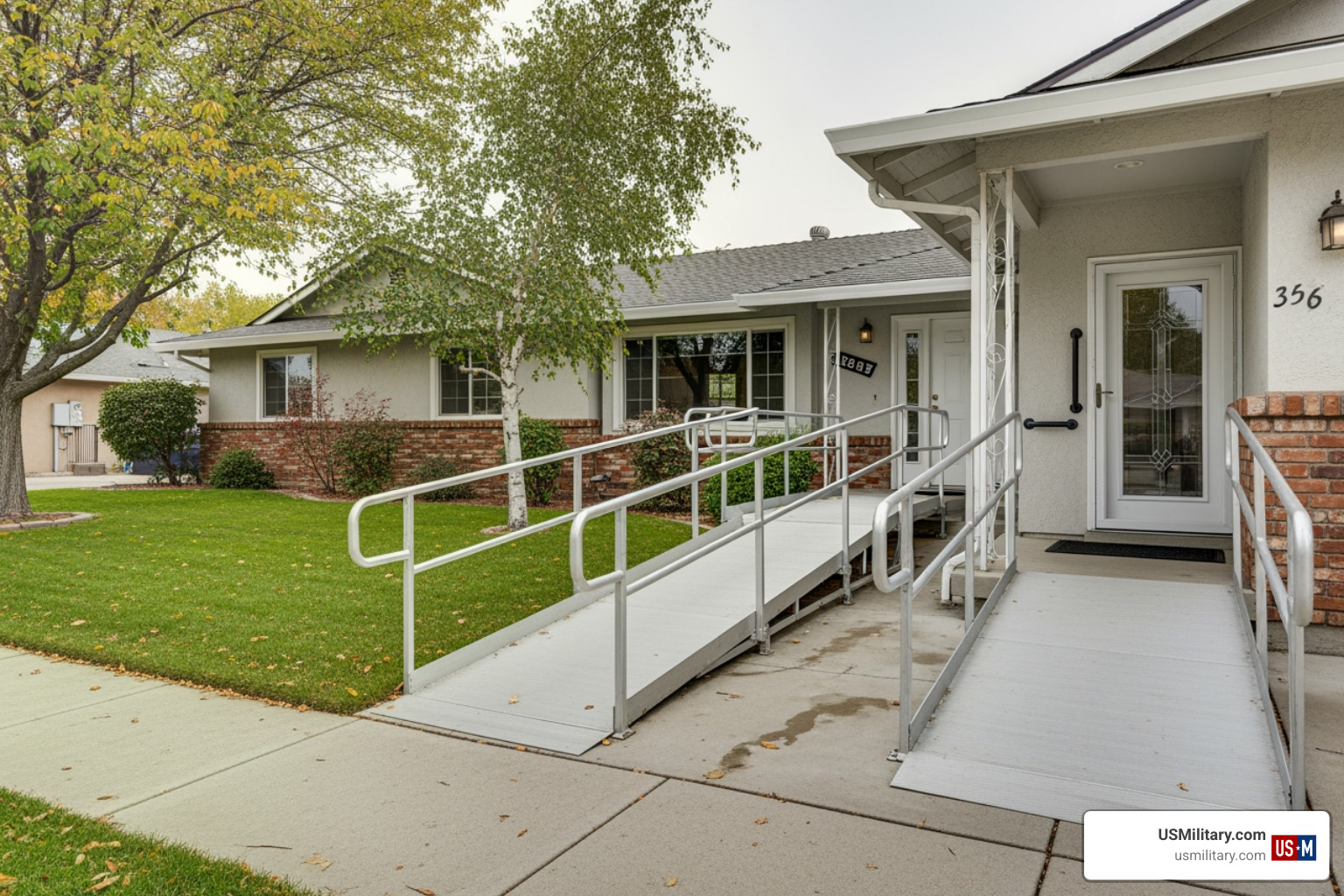
Beyond the home loan, the VA also offers Adaptive Housing Grants for veterans with certain service-connected disabilities. These grants, such as the Specially Adapted Housing (SAH) and Special Housing Adaptation (SHA) grants, can help cover the costs of modifying an existing home or building a new one to accommodate your disability. This ensures that your living environment supports your independence and well-being.
Maximizing Your 70 Disabled Veteran Benefits: TDIU and Other Programs
Beyond direct compensation, a 70 disabled veteran benefits rating can be a gateway to a suite of programs designed to support your career, education, and overall financial stability. These benefits are particularly crucial if your service-connected conditions impact your ability to work.
✉ Get updates like this in your inbox
Weekly VA benefit changes, pay updates, and money tips for service members, veterans, and military families. Free, no spam.

Qualifying for TDIU with a 70% Rating
Even if your combined disability rating is less than 100%, you might be eligible for Total Disability based on Individual Unemployability (TDIU). This benefit allows the VA to pay you at the 100% disability rate if your service-connected conditions prevent you from maintaining substantially gainful employment.
To qualify for TDIU on a schedular basis with a 70% rating, you typically need to meet one of these criteria as outlined under 38 CFR § 4.16:
- You have one service-connected disability rated at least 60% disabling; OR
- You have a combined rating of at least 70%, with one condition rated at least 40%.
Since you already have a 70% combined rating, if one of your conditions is rated at 40% or more, you could meet the schedular requirements. The key is to demonstrate that your service-connected conditions make it impossible for you to hold down a steady job that provides an income above the poverty line. We have more information on this vital program at More on Individual Unemployability.
Education and Employment Support
The VA is committed to helping veterans transition to civilian life and achieve their career goals. With a 70% disability rating, you have access to robust education and employment support programs.
The Vocational Readiness and Employment (VR&E) program (also known as Chapter 31) is available to veterans with service-connected conditions rated 10% or higher, including those with a 70% rating. VR&E provides a range of career services, including:
- Career counseling
- Job training
- Educational assistance
- Rehabilitation planning for employment
This program is invaluable for veterans looking to re-enter the workforce or pursue a new career path. To learn more about how VR&E can assist you, explore VA’s VR&E program.
Additionally, your disability rating can improve your access to other educational benefits. Programs like the Post-9/11 GI Bill and the Dependents’ Educational Assistance (DEA) program offer financial support for education, helping you or your dependents achieve academic and professional success.
Impact on Social Security (SSDI vs. SSI)
It’s crucial to understand how your VA disability benefits interact with Social Security benefits, as the rules differ between Social Security Disability Insurance (SSDI) and Supplemental Security Income (SSI).
- Social Security Disability Insurance (SSDI): Your VA disability benefits generally do not affect your entitlement to SSDI. SSDI is based on your work history and the Social Security taxes you’ve paid. Since VA disability compensation is not earned income, it doesn’t count against your SSDI eligibility. In fact, if you have a 100% permanent and total VA disability rating, your SSDI application may even be expedited.
- Supplemental Security Income (SSI): This is a needs-based program, and VA disability benefits do count as income when determining SSI eligibility. Because your monthly VA compensation for a 70% rating is substantial (over $1,700 for a single veteran), it’s likely that your VA benefits will put you over the income limit for SSI, making you ineligible for this program.
Understanding this distinction is vital for planning your financial future and exploring all available support avenues.
Strategies for Increasing Your VA Disability Rating
While a 70 disabled veteran benefits rating provides significant support, we understand that conditions can worsen, or new service-connected issues may arise. If your health has deteriorated, pursuing an increase in your VA disability rating can lead to even greater benefits and resources.
The Path from 70% to 100%
Many veterans with a 70% rating wonder how they can reach 100%. The path typically involves demonstrating to the VA that your service-connected disabilities have worsened, or that you have developed new conditions that are also service-connected.
Here are key strategies:
- Filing for an Increase: If an existing service-connected condition has become more severe, you can file a claim for an increased rating. This requires up-to-date medical evidence documenting the progression and impact of your condition.
- New Secondary Conditions: Sometimes, one service-connected condition can cause or aggravate another. For example, a service-connected knee injury might lead to problems in your back or hips due to altered gait. Claiming these as secondary service-connected conditions can add to your overall rating.
- Medical Documentation is Key: Consistent medical follow-ups and comprehensive medical records are your best friends. Ensure your doctors accurately document the severity, frequency, and duration of your symptoms, and how they impact your daily life and ability to work. A nexus letter from a doctor clearly linking your condition to your military service can be particularly persuasive.
For a deeper dive into this process, read our guide on How to Increase VA Disability Rating. Navigating these claims can be complex, and sometimes, seeking professional assistance is the best route. You might consider working with a VA-accredited agent, as detailed in 7 Best Reasons to Work with a VA Disability Accredited Agent for My VA Disability Claims.
Understanding “VA Math” and Combined Ratings
The VA doesn’t simply add up your individual disability ratings. Instead, they use a specific calculation method often referred to as “VA Math” or the “Whole Person Theory.” This system accounts for the fact that a person cannot be more than 100% disabled.
Here’s a simplified explanation:
- The VA starts with 100% “abled.”
- Your highest disability rating is taken first. For example, if you have a 50% disability, you are now 50% disabled and 50% abled.
- For your next disability, the VA calculates the impairment based on the remaining abled portion. So, if you have a second disability of 30%, it’s 30% of the remaining 50% abled (0.30 x 0.50 = 0.15 or 15%).
- This 15% is added to your initial 50%, giving you a combined 65%.
- Finally, the VA rounds the combined rating to the nearest 10%. So, 65% rounds up to a 70% combined rating.
This “VA Math” is why two individual ratings that seem like they should add up to 80% or more might result in a 70% combined rating. Understanding this system is crucial when planning to increase your rating. For a comprehensive overview of various conditions and their ratings, check out our List of VA Disability Conditions.
Filing Your Claim for an Increase
When you’re ready to pursue an increase in your disability rating, the process involves submitting a claim to the VA. You can do this in several ways:
- Online through the VA’s portal: This is often the fastest and most convenient method.
- By mail with VA Form 21-526EZ: This is the Application for Disability Compensation and Related Compensation Benefits.
- In person at your regional benefits office.
- With the help of a trained professional, such as a Veterans Service Officer (VSO) or a VA-accredited attorney.
Consider filing a Fully Developed Claim (FDC). With an FDC, you submit all relevant evidence upfront with your application, which can potentially speed up the decision-making process. As of November 2025, the average time to complete VA disability claims is around 85 days, but an FDC could be processed within 30 days.
Gathering robust evidence is paramount. This includes:
- Your military personnel records and service treatment records.
- Private medical records that document your service-connected conditions.
- VA health records from any treatment you’ve received at a VA facility.
- Buddy statements or lay statements from friends, family, or fellow service members who can attest to the impact of your disability.
The process can be challenging, but you don’t have to steer it alone. Seeking guidance from a legal professional specializing in veterans’ benefits can make a significant difference. Find out more about how they can assist you at Veterans Disability Attorney.
Conclusion
The 70 disabled veteran benefits rating represents a pivotal point in a veteran’s journey, offering a comprehensive suite of support designed to address both financial and personal well-being. We’ve explored how your monthly compensation is calculated, including the significant impact of dependents and the potential for Special Monthly Compensation for severe needs. We’ve also highlighted the invaluable healthcare access through Priority Group 1 with no copayments, as well as the robust housing assistance programs like the VA Home Loan Guaranty and Adaptive Housing Grants.
Beyond these core benefits, a 70% rating can open doors to Total Disability based on Individual Unemployability (TDIU), potentially elevating your compensation to the 100% rate if your disabilities prevent you from working. Furthermore, educational and employment programs like Vocational Readiness and Employment (VR&E) stand ready to help you thrive in civilian life.
Understanding these entitlements and how to maximize them is key to securing the stability and quality of life you’ve earned. If your conditions have worsened, the path to increasing your rating is available, supported by diligent medical documentation and a clear understanding of “VA Math.”
We at USMilitary.com are dedicated to providing you with the resources and information you need to steer your benefits. We encourage you to continue exploring all the opportunities available to you. For a broader look at the vast array of support available, please explore all the benefits of military service.
Free for Service Members & Veterans
Get the military benefits intel no one tells you about.
Weekly updates on VA benefits, pay changes, and money tips — free for service members and veterans.
No spam. Unsubscribe anytime. Your info is never shared.


