Understanding What You’ll Pay for TRICARE Prime
TRICARE Prime costs vary based on your military status and when you or your sponsor joined the service. Here’s what you need to know right now:
Active Duty Service Members:
- $0 enrollment fees
- $0 copayments
- $0 deductibles
- No out-of-pocket costs
Active Duty Family Members:
- $0 enrollment fees
- $0 network copayments
- Catastrophic cap: $1,000 (Group A) or $1,324 (Group B)
Retirees (2026 Costs):
- Group A enrollment: $381.96 (individual) or $765 (family)
- Group B enrollment: $462.96 (individual) or $927 (family)
- Primary care copay: $26
- Specialty care copay: $39
- Catastrophic cap: $3,000 (Group A) or $4,635 (Group B)
As 2025 comes to a close, TRICARE Prime costs are changing for 2026. If you’re considering military service or already serving, understanding these healthcare costs helps you plan your family budget.
Your costs depend on three main factors: your beneficiary status (active duty, retiree, or family member), your beneficiary group (A or B based on enlistment date), and the type of care you receive. Active duty members pay nothing. Family members and retirees face different cost structures.
The good news? TRICARE Prime offers predictable costs with no annual deductible. The 2026 increases are modest—about 3% or less for most beneficiaries—tied to the 2.8% cost-of-living adjustment.
This guide breaks down exactly what you’ll pay based on your specific situation. We’ll cover enrollment fees, copayments, catastrophic caps, and payment options so you can calculate your healthcare expenses with confidence.
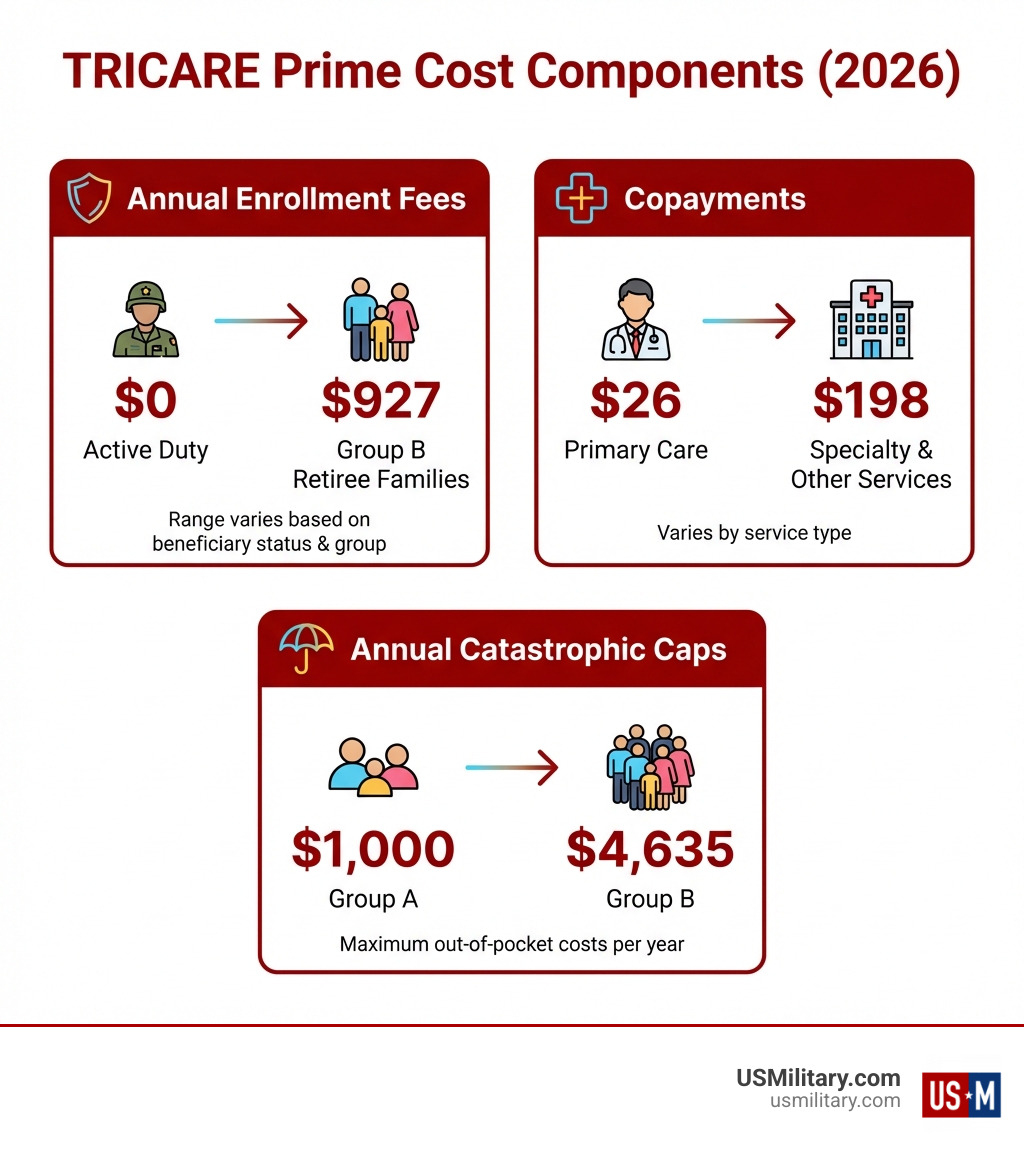
Key Factors That Determine Your TRICARE Prime Costs
Navigating healthcare costs can feel like deciphering a secret code, but with TRICARE Prime, once you understand a few key factors, it becomes much clearer. Your unique situation—specifically your beneficiary category and beneficiary group—is what truly determines your TRICARE Prime costs. Think of it like a personalized pricing plan, custom to your service.

Beneficiary Categories: Who Are You in the TRICARE Family?
First, let’s look at beneficiary categories. These broadly define your relationship to the military and, by extension, your TRICARE benefits:
- Active Duty Service Members (ADSMs): These are our uniformed service members currently serving. They are the backbone of our military, and their healthcare is paramount.
- Active Duty Family Members (ADFMs): Spouses and children of ADSMs. Their well-being directly impacts the readiness of our service members.
- Retired Service Members: Those who have honorably served and retired from the uniformed services. They’ve earned their benefits!
- Retired Service Family Members: Spouses and children of retired service members.
- Other Beneficiaries: This can include certain former spouses, Medal of Honor recipients, and their families.
Each category comes with its own general cost structure, which we’ll dive into shortly.
Beneficiary Groups: The A and B of TRICARE
Beyond your category, there’s a crucial distinction that further refines your costs: your beneficiary group. This is where things get a little more specific, dividing beneficiaries into Group A and Group B.
A clear explanation of Group A vs. Group B is essential for understanding your financial obligations. The dividing line for these groups is January 1, 2018.
- Group A: This group includes beneficiaries whose sponsor’s initial enlistment or appointment in the uniformed services began before January 1, 2018. Generally, Group A beneficiaries tend to have lower enrollment fees and copayments compared to Group B. It’s a bit of a “grandfathered” status.
- Group B: This group includes beneficiaries whose sponsor’s initial enlistment or appointment began on or after January 1, 2018. For these beneficiaries, costs, particularly enrollment fees for retirees and their families, are typically higher. This change was part of broader reforms to the military healthcare system.
So, when we talk about TRICARE Prime costs, always remember to factor in both your beneficiary category and whether you fall into Group A or Group B. This dual classification is key to understanding your individual expenses.
For a broader understanding of military health benefits, we encourage you to explore our comprehensive guide on TRICARE Military Health Benefits.
TRICARE Prime Plan Options
TRICARE Prime isn’t a one-size-fits-all solution; it comes with several variations designed to meet the diverse needs of military families across different geographical locations. While the core cost structure often remains consistent across these variations for the same beneficiary category and group, their eligibility and availability are geographically specific.
Here are the main TRICARE Prime options:
- TRICARE Prime: This is the standard TRICARE Prime plan for active duty service members and their families, as well as retirees and their families, who live in an area where TRICARE Prime is available, typically within a 100-mile radius of a military hospital or clinic (also known as a Military Treatment Facility or MTF). You choose a Primary Care Manager (PCM) who provides most of your care and refers you to specialists as needed.
- TRICARE Prime Remote (TPR): Designed for active duty service members and their families who live in designated remote locations within the United States. This means you reside more than 50 miles from an MTF or a Prime service area. You still select a PCM, but it will be a civilian provider in your remote community. The goal is to provide TRICARE Prime-level benefits even when an MTF isn’t nearby.
- TRICARE Prime Overseas (TPO): This plan covers active duty service members and their families stationed in overseas areas. Similar to TRICARE Prime stateside, you are assigned a PCM at an overseas MTF or a TRICARE-authorized civilian provider.
- TRICARE Prime Remote Overseas (TPROR): For active duty service members and their families who are in remote overseas locations, often where there is no nearby MTF. This plan ensures coverage in areas far from traditional military healthcare facilities.
Understanding which Prime option applies to you is mostly about where you live and work. The good news is that for cost purposes, TRICARE Prime Remote, Overseas, and Remote Overseas generally follow the same TRICARE Prime costs for enrollment fees, deductibles, and copayments as the standard TRICARE Prime plan, based on your beneficiary category and group.
TRICARE Prime Cost Breakdown by Beneficiary
Now that we’ve established the foundational factors—beneficiary category and group—let’s dive into the specifics. This section details the specific TRICARE Prime costs you can expect based on your status for the 2026 calendar year. We’ll break it down so you can clearly see what applies to you.
Costs for Active Duty Service Members (ADSM)
For our active duty service members, the cost structure for TRICARE Prime is wonderfully simple: there are virtually no out-of-pocket costs. We believe this is a well-deserved benefit for those dedicated to serving our nation.
Here’s the breakdown for ADSMs enrolled in TRICARE Prime:
- $0 enrollment fees: You don’t pay anything to enroll in TRICARE Prime.
- $0 network copayments: Whether it’s a primary care visit, a specialist appointment, or even an emergency room visit, you won’t face copayments when seeking care within the TRICARE Prime network.
- $0 deductibles: There’s no annual amount you need to pay out-of-pocket before TRICARE starts covering costs.
- $0 point-of-service fees: If you follow the TRICARE Prime rules (getting referrals, staying in-network), you won’t incur additional fees.
Essentially, if you’re an active duty service member, your TRICARE Prime costs are $0. Your healthcare is fully covered, allowing you to focus on your mission with peace of mind.
Costs for Active Duty Family Members (ADFM)
While active duty service members enjoy a completely cost-free TRICARE Prime experience, their family members (spouses and children) have minimal, but still present, out-of-pocket expenses. This is still an incredibly generous benefit, offering comprehensive coverage with very low financial impact.

For Active Duty Family Members (ADFMs) enrolled in TRICARE Prime, here’s what you can expect for 2026:
- $0 annual enrollment fee: Just like ADSMs, ADFMs do not pay an annual fee to be enrolled in TRICARE Prime.
- $0 network copayments: For the vast majority of services received within the TRICARE Prime network and with appropriate referrals, ADFMs will not pay copayments. This includes preventive care, primary care, specialty care, urgent care, emergency room visits, and inpatient admissions.
However, there are two main areas where ADFMs might incur costs:
- Point-of-Service (POS) Option: If you choose to see a non-network provider for care that could have been obtained from your PCM or with a referral, you are using the Point-of-Service option. This will incur significant out-of-pocket costs, including a separate annual deductible and a percentage of the TRICARE-allowable charge. Our advice? Always get a referral!
- Prescriptions outside a military pharmacy: While prescriptions filled at a military pharmacy are usually $0, filling them at a retail network pharmacy or through home delivery will typically have copayments. These are usually quite low but are something to be aware of.
The most important protection for ADFMs, however, is the Catastrophic Cap. This is the maximum amount your family will pay out-of-pocket for TRICARE-covered services in a calendar year. Once you hit this cap, TRICARE pays 100% of all additional covered costs for the remainder of the year. For 2026, the catastrophic caps for ADFMs are:
- Group A (sponsor’s initial enlistment before Jan. 1, 2018): $1,000 per family.
- Group B (sponsor’s initial enlistment on or after Jan. 1, 2018): $1,324 per family.
These caps provide excellent financial protection, ensuring that even in the face of significant medical needs, your family’s out-of-pocket expenses are limited and predictable.
Calculating Retiree TRICARE Prime Costs for 2026
For retired service members, their families, and other beneficiaries, TRICARE Prime costs involve a bit more detail than for active duty. You’ll generally pay annual enrollment fees and copayments for services, but still no annual deductible. The costs are carefully structured based on your beneficiary group (A or B).
Here’s a summary of the 2026 TRICARE Prime costs for retirees and their families:
| Cost Category | Group A (Pre-Jan 1, 2018) | Group B (Post-Jan 1, 2018) |
|---|---|---|
| Annual Enrollment Fee | ||
| Individual Plan | $381.96 | $462.96 |
| Family Plan | $765.00 | $927.00 |
| Annual Deductible | $0 | $0 |
| Copayments (Network) | ||
| Primary Care | $26 | $26 |
| Specialty Care | $39 | $39 |
| Urgent Care | $39 | $39 |
| Emergency Room | $79 | $79 |
| Inpatient Admission | $198 per admission | $198 per admission |
| Annual Catastrophic Cap | $3,000 per family | $4,635 per family |
Let’s break down each component:
- Annual Enrollment Fees: Unlike active duty families, retirees and their families pay an annual fee to be enrolled in TRICARE Prime. As you can see, Group B beneficiaries have higher enrollment fees. For example, a Group A individual pays $381.96 annually, while a Group B individual pays $462.96. These fees can typically be paid monthly, quarterly, or annually, depending on your region’s payment options.
- Annual Deductible: This is a big win for TRICARE Prime users! Regardless of your group, there is no annual deductible. This means you don’t have to pay a certain amount out-of-pocket before your benefits kick in for covered services. Your cost-sharing starts directly with copayments.
- Copayments (Network): These are fixed amounts you pay for specific services when you receive care from a network provider and have a referral (if required). You’ll notice that for most standard services like primary care, specialty care, urgent care, and emergency room visits, the copayment amounts are the same for both Group A and Group B retirees.
- Primary Care: A visit to your PCM will cost you $26.
- Specialty Care: Seeing a specialist (with a referral) will be $39.
- Urgent Care: For those unexpected, non-life-threatening situations, an urgent care visit is $39.
- Emergency Room: For emergencies, the cost is $79.
- Inpatient Admission: If you need to be admitted to a hospital, the cost is $198 per admission.
- Catastrophic Cap: This is your family’s ultimate financial safety net. It’s the maximum amount you’ll pay out-of-pocket for TRICARE-covered services in a calendar year. Once your family reaches this cap, TRICARE will cover 100% of all additional TRICARE-covered medical and pharmacy expenses for the rest of the year. For 2026, the caps are $3,000 for Group A families and $4,635 for Group B families. This is a crucial benefit for protecting families from exorbitant medical bills.
Understanding these detailed TRICARE Prime costs allows retired service members and their families to budget effectively and make informed decisions about their healthcare.
How 2026 Costs Compare to Previous Years
Keeping an eye on annual changes to your healthcare costs is always a smart move. For 2026, TRICARE Prime costs are seeing modest adjustments, largely influenced by the retiree cost-of-living adjustment (COLA).
The 2026 Cost Changes: A Modest Bump
The overall picture for 2026 is one of slight increases. Most TRICARE Prime and Select users will see an increase of about 3% or less in copays, premiums, and other payments. This aligns with the retiree COLA, which will be 2.8% in the upcoming year. While any increase might not be welcomed, these are generally in line with inflation and aim to keep the TRICARE program sustainable.
Let’s look at some specific comparisons between 2025 and 2026 for TRICARE Prime, focusing on Group A retirees as an example:
- Annual Enrollment Fees:
- Individual (Group A): Increased from $372 in 2025 to $381.96 in 2026.
- Family (Group A): Increased from $744 in 2025 to $765 in 2026.
- Similar increases apply to Group B retirees, with individual fees rising from $450 to $462.96 and family fees from $900.96 to $927.00.
- Copayments:
- Primary Care: Increased from $25 in 2025 to $26 in 2026.
- Specialty Care: Increased from $38 in 2025 to $39 in 2026.
- Other copayments, such as for urgent care, emergency visits, and inpatient admissions, also saw small adjustments or remained the same.
- Catastrophic Cap:
- For Group A retirees, the catastrophic cap remained at $3,000, consistent with 2025.
- For Group B retirees, the catastrophic cap increased from $4,509 in 2025 to $4,635 in 2026.
- Active duty family members also saw slight adjustments to their catastrophic caps, with Group A remaining at $1,000 and Group B increasing from $1,288 to $1,324.
These changes are part of the annual adjustment process to ensure TRICARE remains a robust healthcare option. You can find the full details in the official 2026 TRICARE cost announcement.
TRICARE Open Season: Your Annual Opportunity
With these cost changes on the horizon, it’s crucial to be aware of TRICARE Open Season. This is your annual window to make changes to your TRICARE Prime or TRICARE Select enrollment. For 2026, the enrollment period begins on November 10 and lasts through December 9. Any changes you make during this period will take effect on January 1, 2026.
Open Season is your chance to review your current plan, consider the updated TRICARE Prime costs for the coming year, and decide if a different plan might better suit your family’s needs and budget. It’s an important time to be proactive about your healthcare coverage.
Tools and Resources for Managing Your Expenses
Understanding your TRICARE Prime costs is one thing, but knowing how to manage them effectively and find detailed information is another. TRICARE provides several tools and resources to help you stay on top of your healthcare finances.
Payment Options for Enrollment Fees
If you’re a retired service member or family member, you’ll have annual enrollment fees. TRICARE understands that flexibility in payment can make a big difference for your budget. You typically have several options for how you pay these fees:
- Monthly
- Quarterly (every three months)
- Annually (once a year)
The specific methods for payment (e.g., electronic funds transfer, credit card, allotment) and where to send them can vary by your TRICARE region. It’s always best to check the dedicated payment pages for your specific region:
- For those in the East Region, visit the East Region Payment Options page.
- For West Region beneficiaries, you’ll find similar payment information on their respective payment page (often linked from the main TRICARE site).
- If you’re overseas, there’s also an Overseas Region Payment Option page to guide you.
Official TRICARE Tools for Cost Comparison
TRICARE itself offers excellent resources to help you compare costs and understand terminology:
- Plan Cost Comparison Tool: This is an invaluable tool for any beneficiary. The Plan Cost Comparison Tool allows you to input your specific beneficiary category, group, and desired plan to see a detailed breakdown of potential costs, including enrollment fees, deductibles, copayments, and catastrophic caps. We highly recommend using this tool to get the most accurate estimate for your situation.
- Cost Terminology: Healthcare can be full of jargon. If you ever encounter a term like “cost-share,” “copayment,” or “catastrophic cap” and need a refresher, TRICARE provides clear definitions. You can brush up on your understanding of common healthcare terms by visiting the TRICARE Cost Terms page. This ensures you’re always speaking the same language as your benefits provider.
By utilizing these tools and understanding your payment options, you can effectively manage your TRICARE Prime costs and ensure you’re making the best healthcare decisions for yourself and your family.
Frequently Asked Questions about TRICARE Prime Costs
We know that understanding healthcare costs can sometimes lead to more questions than answers. Here are some of the most common questions we hear about TRICARE Prime costs, answered directly and simply.
Do I have to pay an annual deductible with TRICARE Prime?
No, TRICARE Prime beneficiaries do not have an annual deductible. You will begin sharing costs through copayments for services once you are enrolled, but there is no set amount you must pay first. This is one of the significant advantages of TRICARE Prime, providing immediate cost-sharing relief from the first visit.
What happens if I see a doctor outside the TRICARE Prime network without a referral?
When you choose to see a non-network provider without a referral from your Primary Care Manager (PCM), you are using the Point-of-Service (POS) option. This option comes with its own distinct cost structure, which is generally higher than staying within the Prime network with a referral. Specifically, using the POS option means:
- You’ll have a separate annual deductible to meet ($300 for an individual, $600 for a family, for 2026).
- After meeting this deductible, you will pay 50% of the TRICARE-allowable charge for services.
This is why we always emphasize the importance of working with your PCM and getting referrals to avoid unexpected and higher out-of-pocket expenses.
Are the costs for TRICARE Prime Remote different from TRICARE Prime?
No, the cost structure for TRICARE Prime Remote is the same as for TRICARE Prime. Whether you’re enrolled in standard TRICARE Prime or TRICARE Prime Remote, your enrollment fees, copayments, and catastrophic cap amounts will be identical based on your beneficiary category and group. The primary difference between these plans is eligibility, which is based on living and working in designated remote locations in the U.S. that are more than 50 miles from a military hospital or clinic. TRICARE Prime Remote simply extends the Prime benefit to those who don’t have easy access to an MTF.
Conclusion
Understanding your TRICARE Prime costs is a vital part of managing your family’s financial well-being. We’ve explored how your beneficiary status (active duty, active duty family member, or retiree) and your beneficiary group (A or B, determined by your sponsor’s enlistment date) are the primary determinants of your healthcare expenses.
Active duty service members enjoy the incredible benefit of virtually no out-of-pocket costs. Active duty family members also benefit from $0 enrollment fees and network copayments, with the added protection of a low catastrophic cap. For our esteemed retired service members and their families, while there are annual enrollment fees and copayments, the predictable costs and absence of an annual deductible, coupled with a catastrophic cap, still offer robust and affordable healthcare coverage.
The 2026 cost adjustments are modest, reflecting annual changes tied to the COLA, reinforcing the stability and predictability of the TRICARE Prime plan. Remember to leverage the TRICARE Open Season each year to review your options and ensure your plan continues to meet your family’s needs.
At USMilitary.com, we are committed to providing you with the most accurate and up-to-date information to help you steer your military benefits. We hope this guide has empowered you to confidently calculate and understand your TRICARE Prime costs.
Don’t stop here! Your military journey is filled with benefits waiting to be finded. Explore all your military benefits and stay informed on changes by visiting USMilitary.com, your trusted resource for military information and guidance.
Free for Service Members & Veterans
Get the military benefits intel no one tells you about.
Weekly updates on VA benefits, pay changes, and money tips — free for service members and veterans.
No spam. Unsubscribe anytime. Your info is never shared.


