Understanding 100% Disabled Veteran Benefits Pay: What You Need to Know
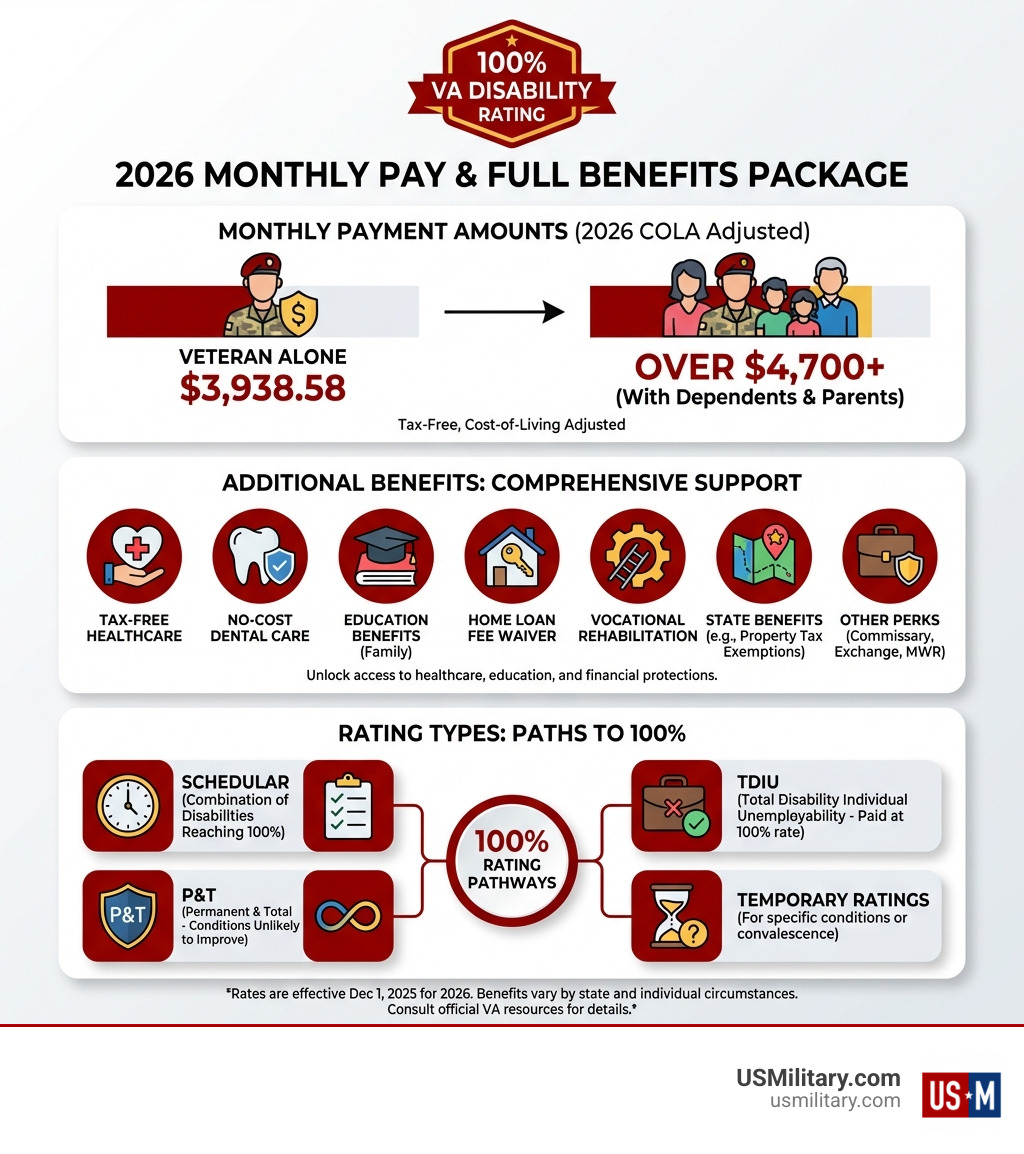
100% disabled veteran benefits pay refers to the monthly tax-free compensation the Department of Veterans Affairs provides to veterans with a total disability rating. For 2026, this means $3,938.58 per month for a single veteran rated at 100%, with higher amounts for those with dependents.
Quick Answer: 2026 100% VA Disability Pay Rates
| Veteran Status | Monthly Payment (2026) |
|---|---|
| Veteran alone | $3,938.58 |
| Veteran with spouse | $4,171.46 |
| Veteran with spouse and 1 child | $4,333.90 |
| Veteran with spouse and 2 children | $4,471.90 |
| Each additional child under 18 | $78.00 |
These rates reflect a 2.8% cost-of-living adjustment (COLA) that took effect December 1, 2025. All VA disability payments are completely tax-free.
If you’re rated at 100% disabled by the VA, you’ve reached the highest level of service-connected disability compensation. This rating recognizes that your military service caused or worsened conditions that severely impact your ability to work and care for yourself. But the 100% rating isn’t just one thing—it can mean different paths and protections depending on whether you have a schedular rating, Total Disability Individual Unemployability (TDIU), or Permanent and Total (P&T) status.
Beyond the monthly check, a 100% rating open ups a comprehensive suite of benefits including no-cost VA healthcare, dental care, education assistance for dependents, home loan funding fee waivers, and potential state-level benefits like property tax exemptions. Understanding exactly what you’re entitled to—and how to protect your rating—can make a significant difference in your financial stability and quality of life.
Understanding Your 2026 100 Disabled Veteran Benefits Pay
When we talk about 100 disabled veteran benefits pay, we’re discussing the highest tier of monthly compensation available from the VA. This isn’t just a number; it’s a recognition of the profound impact service-connected conditions have had on a veteran’s life. As of 2026, the base rate for a 100% disabled veteran with no dependents is $3,938.58 per month. This amount is a significant increase from previous years, primarily due to the annual Cost-of-Living Adjustment (COLA).
All VA disability payments are tax-free, which means more money stays in your pocket to support you and your family. The monthly payment can also increase significantly if you have dependents, such as a spouse, children (under 18, or over 18 and in school), or even dependent parents.
Beyond the basic monthly rate, some veterans may also qualify for Special Monthly Compensation (SMC) or Aid and Attendance benefits. These are additional tax-free payments provided for specific severe disabilities or if you require assistance with daily living activities.
Calculating Your 100 Disabled Veteran Benefits Pay
Calculating your exact 100 disabled veteran benefits pay involves understanding a few key components. The VA determines your basic monthly rate based on your disability rating and your dependent status.
For instance, while a single veteran rated at 100% will receive $3,938.58 per month in 2026, a veteran with a spouse and one child will see their payment jump to $4,333.90. Each additional child under 18 adds another $78.00 to that total. If you have children over 18 but still in school (up to age 23), they can also be counted as dependents, leading to increased benefits. Dependent parents, if you provide more than 50% of their support, can also boost your monthly compensation.
The VA provides detailed compensation tables to help you understand these rates. You can always refer to the official VA website for the most current information on these rates. We encourage you to review the Current disability compensation rates to see how your specific family situation impacts your potential monthly pay.
How Cost-of-Living Adjustments (COLA) Impact Your Payments
You might be wondering why the payment amounts change each year. This is thanks to the Cost-of-Living Adjustment (COLA). The VA is required by law to match the percentage of COLA adjustments made to Social Security benefits. These annual adjustments are crucial because they help ensure that the purchasing power of your benefits keeps up with inflation.
For 2026, the COLA is 2.8%, which took effect on December 1, 2025. This means a 100% disabled veteran without dependents saw their monthly payment increase by approximately $107.28. These adjustments are determined by the Social Security Administration (SSA) by measuring the Consumer Price Index (CPI) compared to the previous year. If there’s an increase in the CPI, there’s a COLA, protecting your benefits from being eroded by rising costs.
It’s a testament to the system that your benefits are designed to maintain their value over time, providing consistent financial support. You can always get the latest COLA information directly from the source: Get the latest cost-of-living adjustment (COLA) information on the Social Security Administration’s (SSA) website.
The Different Paths to a 100% VA Disability Rating
Receiving a 100% VA disability rating is a significant milestone, but it’s not a one-size-fits-all achievement. The VA has several ways to determine if a veteran is 100% disabled, each with its own criteria and implications. Understanding these different paths is key to maximizing your 100 disabled veteran benefits pay and ensuring you receive all the support you’re entitled to.
The main types of 100% ratings we see are:
- 100% Schedular Rating: Based on the severity of your service-connected conditions as defined by the VA’s rating schedule.
- Total Disability Based on Individual Unemployability (TDIU): For veterans who can’t hold substantially gainful employment due to their service-connected disabilities, even if their combined rating is less than 100%.
- Permanent and Total (P&T) Disability: A status indicating that your 100% disability is not expected to improve.
- Temporary 100% Ratings: Granted under specific circumstances, such as hospitalization, convalescence, or prestabilization.
- Cancer-Related 100% Ratings: An automatic 100% rating for active service-connected cancer.
Let’s explore each of these.
100% Schedular Rating
A 100% schedular rating means that your service-connected condition(s) meet the specific criteria outlined in the VA’s Schedule for Rating Disabilities (VASRD) for a total disability. This can happen in one of two ways:
- One Condition at 100%: A single, extremely severe service-connected disability, like a profound mental health condition or a severe physical impairment, is rated at 100% on its own.
- Multiple Conditions Combined to 100%: More commonly, a veteran reaches a 100% schedular rating through multiple service-connected conditions that, when combined, equal 100%. This is where “VA Math” comes into play, and it can be a bit tricky. The VA doesn’t simply add your percentages together (e.g., a 50% rating and a 50% rating do not equal 100%). Instead, they apply percentages to the “healthy” portion remaining. For example, if you have a 50% disability, you are considered 50% “healthy.” If you then have another 50% disability, it’s applied to that remaining 50% healthy portion (50% of 50% is 25%), resulting in a combined effective rating of 75%. This is then rounded to the nearest 10%. This process continues for all service-connected conditions until a final combined rating is reached.
The VASRD is the comprehensive guide the VA uses to assign diagnostic codes and disability ratings from 0 to 100 percent. Generally, the more severe a disability, the higher the rating. You can explore the Schedule for Rating Disabilities (VASRD) for a deep dive into the criteria.
Total Disability Based on Individual Unemployability (TDIU)
What if your combined schedular rating is less than 100%, but your service-connected conditions prevent you from maintaining steady employment? That’s where Total Disability Based on Individual Unemployability (TDIU) becomes incredibly important. TDIU allows the VA to compensate veterans at the 100% disability rate, even if their combined schedular rating is less than 100%.
To qualify for TDIU, you generally need to meet specific criteria:
- You must have at least one service-connected disability rated at 60% or more, OR two or more service-connected disabilities with at least one rated at 40% or more, and a combined rating of 70% or more.
- You must be unable to secure and follow a substantially gainful occupation due due to your service-connected conditions. This means your conditions prevent you from working enough to earn a living wage.
TDIU is a pathway to receiving the full 100 disabled veteran benefits pay when the impact on your ability to work is the primary factor, rather than just the numerical sum of your disabilities. It’s a critical benefit for many veterans whose conditions, while not necessarily adding up to 100% on paper, make it impossible to earn a livelihood. Learn more about Total Disability based on Individual Unemployability (TDIU).
Permanent and Total (P&T) Disability
A Permanent and Total (P&T) disability rating is a special designation that indicates the VA has determined your 100% disability is both permanent and total. This means your service-connected conditions are not expected to improve over time.
The “permanent” aspect is key here. Veterans with P&T status typically no longer need to attend Compensation and Pension (C&P) exams, which are re-examinations to assess if your condition has changed. This offers immense peace of mind and stability, knowing your benefits are secure. P&T status also open ups additional benefits, such as CHAMPVA healthcare for your dependents and dependents’ education benefits (Chapter 35). It’s the gold standard for long-term security in your 100 disabled veteran benefits pay.
Temporary and Cancer-Related 100% Ratings
Sometimes, a 100% rating is granted temporarily due to acute situations. These temporary ratings ensure veterans receive maximum support during critical periods:
- Hospitalization Rating: If you are hospitalized for a service-connected condition for more than 21 days, the VA may grant a temporary 100% rating.
- Convalescence Rating: Following surgery or treatment for a service-connected disability that requires a significant recovery period, you might receive a temporary 100% rating. For more details on eligibility, please refer to 38 CFR § 4.30.
- Prestabilization Rating: For recently discharged veterans with unstable, severe service-connected conditions that are likely to remain 100% disabling, but whose final rating is pending, a temporary 100% prestabilization rating can be awarded.
Cancer-Related 100% Ratings: Veterans service-connected for active cancer automatically receive a temporary 100% disability rating. This critical support continues throughout your treatment and for six months following the completion of your treatment. After this six-month period, the VA will re-evaluate your condition based on any residual effects of the cancer or its treatment. This ensures you can focus on recovery without the added stress of financial insecurity.
Beyond the Monthly Check: Additional Federal and State Benefits
While the monthly 100 disabled veteran benefits pay is substantial, it’s just one piece of the puzzle. A 100% VA disability rating open ups a comprehensive array of additional benefits at both federal and state levels, designed to provide holistic support for you and your family. These benefits can significantly improve your quality of life, access to care, and educational opportunities.

Federal Benefits for 100% Disabled Veterans
Being rated 100% disabled by the VA opens the door to numerous federal benefits that can make a profound difference:
- No-Cost VA Health Care: You are eligible for comprehensive health care services through the VA at no cost. This includes medical appointments, specialists, and prescription medications.
- Dental Care Eligibility: Unlike veterans with lower ratings, 100% disabled veterans are eligible for full dental care benefits through the VA.
- CHAMPVA for Dependents: The Civilian Health and Medical Program of the Department of Veterans Affairs (CHAMPVA) provides health care benefits for the spouse or child of a veteran who is permanently and totally disabled from a service-connected disability. This is a huge benefit for your family’s healthcare needs.
- Education Benefits (Chapter 35): Your dependents (spouse and children) may be eligible for education assistance under the Marine Gunnery Sergeant John David Fry Scholarship or the Survivors’ and Dependents’ Educational Assistance (DEA) program (Chapter 35). This can cover tuition, housing, and books for college or vocational training.
- VA Home Loan Funding Fee Waiver: When you use your VA home loan benefit, the typical funding fee (a percentage of the loan amount) is waived for veterans with a 100% disability rating. This can save you thousands of dollars.
- Vocational Rehabilitation & Employment (VR&E): If you are interested in re-entering the workforce or changing careers, the VR&E program (Chapter 31) offers services like career counseling, job training, and even assistance with starting a business.
- Concurrent Receipt of Military Retired Pay: If you are a military retiree and also receive VA disability compensation, a 100% rating typically allows for Concurrent Retirement and Disability Pay (CRDP), meaning you can receive both your full military retired pay and your VA disability compensation without offset.
Exploring Your State-Specific Benefits
Beyond federal programs, each state offers its own unique set of benefits for veterans, often with improved provisions for those rated 100% disabled. These benefits vary widely by state, but commonly include:
- Property Tax Exemptions: Many states offer full or partial exemptions from property taxes for 100% disabled veterans, providing significant savings on housing costs.
- Vehicle Registration Fee Waivers: You might be eligible for reduced or waived fees for vehicle registration, driver’s licenses, and even special disabled veteran license plates.
- State Education Assistance: Some states provide additional education benefits for 100% disabled veterans or their dependents, often supplementing federal programs.
- Hunting and Fishing Licenses: Free or reduced-cost hunting and fishing licenses are a common state benefit.
- State Park Access: Many states offer free or discounted access to state parks and recreational areas.
We highly recommend researching the specific benefits offered in your state of residence, as these can provide substantial additional support and savings.
Securing and Protecting Your 100% Rating
Achieving a 100% VA disability rating is a hard-earned recognition, and understanding how to apply for it and then protect it is paramount. Our goal is to empower you with the knowledge to steer this system effectively.
How to Apply for or Increase Your Rating
The process for applying for VA disability benefits, or seeking an increase to reach 100%, involves several steps:
- Filing a Claim: You can apply for disability compensation online through the VA’s portal, by mail with VA Form 21-526EZ, in person at a regional benefits office, or with the help of a trained professional like a Veterans Service Officer (VSO).
- Gathering Evidence: This is crucial. You’ll need all relevant medical records (both military and private), service treatment records, and sometimes lay statements from friends, family, or fellow service members. Establishing care at a VA health facility can also help support your claim.
- Nexus Letters: A “nexus letter” from your doctor clearly linking your current condition to your military service can be incredibly powerful in establishing service connection.
- C&P Exams: The VA will likely schedule you for Compensation and Pension (C&P) exams. These are medical examinations conducted by VA-appointed providers to assess your service-connected conditions and their severity. It’s vital to be thorough and honest about all your symptoms during these exams.
- Types of Claims for Faster Processing:
- Fully Developed Claims (FDC): If you submit all required evidence upfront, you can potentially get a decision within 30 days. This is often the fastest route.
- Decision Ready Claims (DRC): If you work with an accredited VSO, this program can also significantly speed up the process.
- Benefits Delivery at Discharge (BDD) Program: If you’re still in service but within 90 to 180 days of separation, you can file a pre-discharge claim to get a head start.
The average time to complete VA disability-related claims as of November 2025 was around 85 days, but filing an FDC can get you results much faster. If you’re facing extreme financial hardship or a terminal illness, you may qualify for Priority Processing by submitting VA Form 20-10207.
Can the VA Reduce a 100% Rating?
This is a common concern among veterans, and it’s understandable to want to protect your 100 disabled veteran benefits pay. While a 100% rating can be reduced, there are significant protections in place, especially for long-standing ratings.
The VA cannot arbitrarily reduce your rating. They must have evidence of “material improvement” in your condition under ordinary conditions. They cannot rely solely on a C&P exam showing improvement if it’s contradicted by other evidence or your daily life.
Key protections include:
- 5-Year Rule: If your rating has been in effect for five years or more, the VA needs to show sustained improvement in your condition to reduce it.
- 10-Year Rule: If your rating has been in effect for 10 years or more, it’s considered “protected.” The VA generally needs evidence of fraud or a clear and sustained improvement to reduce it.
- 20-Year Rule: This is the strongest protection. If your rating has been in place for 20 years or more, it is considered “stabilized” and cannot be reduced below its current level unless there is evidence of fraud.
- Permanent and Total (P&T) Status: As discussed, P&T status offers the highest level of protection, often eliminating the need for future re-examinations.
It’s important to understand these rules and your rights. If the VA proposes to reduce your rating, you have the right to respond and provide evidence against the reduction.
Conclusion: Take the Next Step in Securing Your Benefits
Navigating VA disability benefits, especially understanding your 100 disabled veteran benefits pay, can feel like a complex journey. But as we’ve explored, achieving a 100% rating opens doors to significant financial stability and a comprehensive suite of support for you and your family. From the generous monthly compensation—which for 2026 starts at $3,938.58 for a single veteran—to the numerous federal and state benefits, this rating is a testament to your service and sacrifice.
We’ve covered the different pathways to a 100% rating, whether through a schedular evaluation, Total Disability Based on Individual Unemployability (TDIU), or a Permanent and Total (P&T) designation. We’ve also highlighted the crucial additional benefits, such as no-cost VA healthcare, education assistance for dependents, and home loan fee waivers, as well as the valuable state-specific support available.
Being informed and proactive is your best strategy. We encourage you to use the resources available, whether it’s through our guides, a Veterans Service Officer, or the official VA website, to ensure you understand and access every benefit you’ve earned. Your service has given us so much, and we are committed to helping you secure the support you deserve.
Take the next step in empowering yourself with knowledge. Explore all military benefits and resources available through USMilitary.com, your trusted guide to military life and beyond.
Free for Service Members & Veterans
Get the military benefits intel no one tells you about.
Weekly updates on VA benefits, pay changes, and money tips — free for service members and veterans.
No spam. Unsubscribe anytime. Your info is never shared.


