Can Illegal Immigrants Join the U.S. Military?
No. Undocumented immigrants cannot enlist in the U.S. military under current rules. DACA and a work permit alone do not make someone eligible. Non-citizens who can generally enlist include green card holders and eligible citizens of the Freely Associated States. A past exception, the MAVNI program, is suspended.
That distinction matters: non-citizen does not mean undocumented. According to a Congressional Research Service report, 49,709 non-U.S. citizens served in the active and reserve forces as of February 2026. That figure is not a count of undocumented troops.
I’m Larry Fowler, as a veteran and the publisher of USMilitary.com, a military recruiting and veterans website I’ve led since 2007. That experience helps me answer the question, “Are Illegal Immigrants Joining The US Military Today?” by separating enlistment rules from common myths.
Must-know Are Illegal Immigrants Joining The US Military Today terms:
- How Massive is the US Military
- What is the Department of War
- Is The US Military Becoming More Confident & Stronger With President Trump
Are Illegal Immigrants Joining The US Military Today? Current Legal Standards
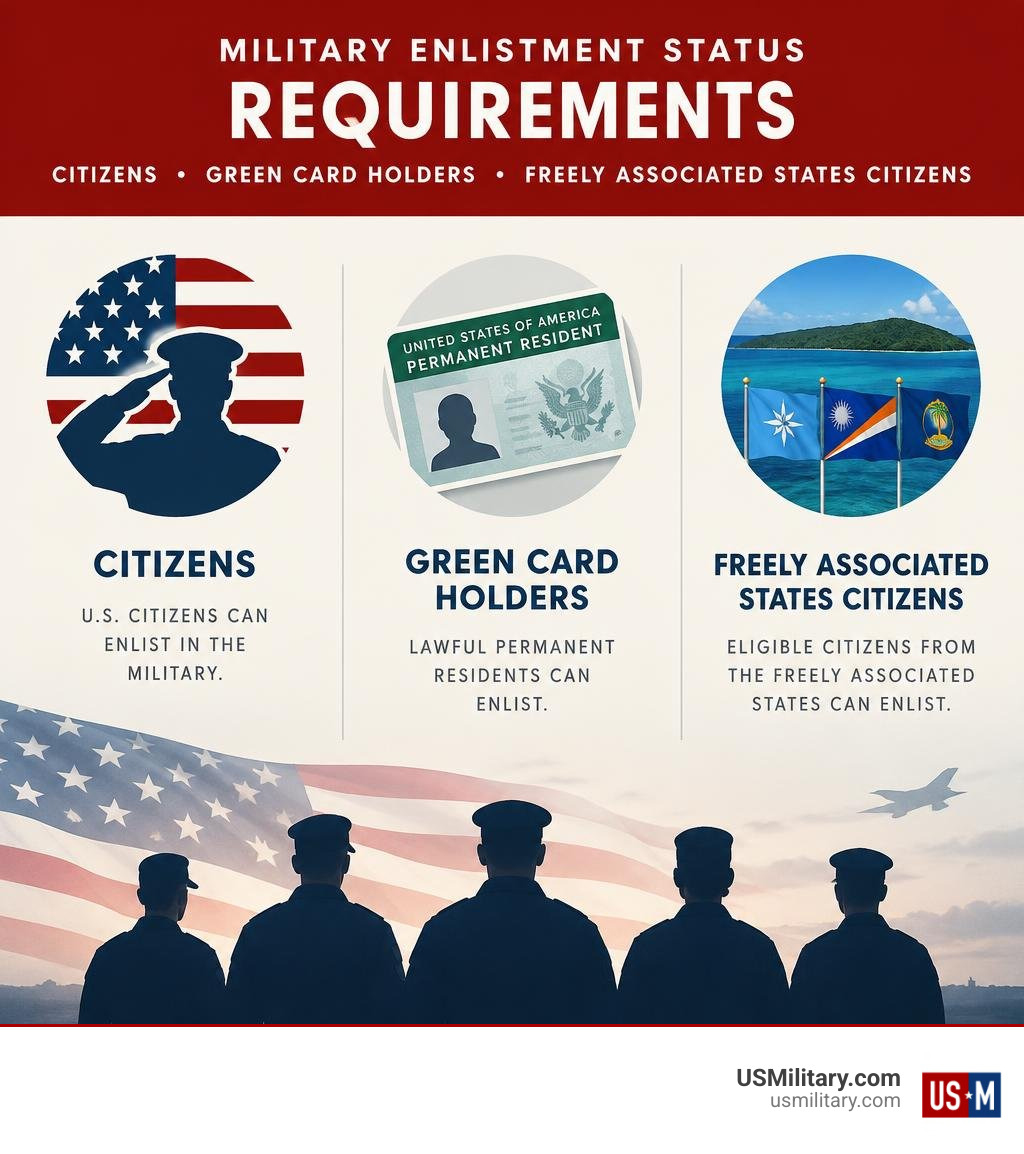
Federal law dictates military enlistment qualifications. Under Title 10 of the United States Code, Section 504 (10 U.S.C. § 504), accessions into the U.S. Armed Forces are restricted to specific legal categories. Meeting basic requirements to join the U.S. military requires an applicant to be one of the following:
- A United States citizen
- A non-citizen U.S. national (such as individuals born in American Samoa)
- A Lawful Permanent Resident (LPR), colloquially known as a Green Card holder
- A citizen of the Freely Associated States (the Federated States of Micronesia, the Republic of the Marshall Islands, and the Republic of Palau) under the Compact of Free Association
Individuals who entered the country without inspection, overstayed temporary visas, or lack lawful immigration status cannot enlist. A detailed walk-through of the enlistment workflow is available in our detailed guide to military enlistment.
| Immigration / Legal Status | Enlistment Eligible? | Commissioning Eligible (Officer)? | Expedited Citizenship Pathway? |
|---|---|---|---|
| U.S. Citizen / U.S. National | Yes | Yes | N/A (Already Citizen) |
| Lawful Permanent Resident (Green Card) | Yes | No (Must naturalize first) | Yes (INA § 328 / § 329) |
| Freely Associated States Citizen | Yes | No | Yes |
| DACA Recipient | No | No | No |
| Temporary Protected Status (TPS) | No | No | No |
| Undocumented Immigrant | No | No | No |
Why Undocumented Immigrants and DACA Recipients Cannot Enlist
Deferred Action for Childhood Arrivals (DACA) offers temporary relief from deportation and grants an Employment Authorization Document (EAD). However, DACA does not provide lawful permanent resident status or standard lawful immigration standing.
Recruiting stations run electronic verifications through Department of Homeland Security (DHS) databases alongside the Defense Manpower Data Center. Because military service regulations require an unexpired Permanent Resident Card (Form I-551) for all non-citizen enlistees, candidates holding only temporary work authorization are turned away. A broader look at applicant steps is outlined in our review of understanding how to join the armed forces.
Selective Service Registration vs. Active Enlistment
A frequent source of confusion is the Selective Service registration mandate. Federal law requires virtually all male non-citizens between ages 18 and 25 living in the United States—including undocumented individuals, DACA recipients, and green card holders—to register with the Selective Service System.
Registering for the draft is an administrative legal requirement, not active enlistment. It does not confer legal status, work authorization, or military eligibility. Under provisions tracked in national defense authorizations, registration frameworks and exemptions remain distinct from volunteer accession standards. You can check exemption categories using the US military draft disqualifications list.
The History of Non-Citizen Enlistment and the Suspended MAVNI Program
Foreign-born individuals have served in the United States Armed Forces since the Revolutionary War. Immigrants have earned over 20 percent of all Congressional Medals of Honor, as documented in records detailing the historical contributions of immigrant service members. More than 818,000 foreign nationals have naturalized through military service since the end of World War I.
The MAVNI Program: Vital Skills and Past Enlistment Paths
In 2008, the Department of Defense launched Military Accessions Vital to the National Interest (MAVNI). Authorized under 10 U.S.C. § 504(b)(2), MAVNI allowed certain non-immigrant visa holders (such as E, F, H, I, J, L, M, O, P, Q, R, S, T, TC, TD, TN, U, or V visas), as well as individuals with TPS or DACA, to enlist if they held high-demand skills.
These skills included certified medical training and fluency in strategic foreign languages like Arabic, Pashto, Russian, Persian-Farsi, and Mandarin Chinese. Between 2008 and 2016, approximately 10,400 individuals entered the armed forces through MAVNI. Additional entry criteria and qualifications are covered in our enlistment guide for modern recruits.
Why MAVNI Was Suspended: National Security and Vetting Concerns
MAVNI closed in 2016 due to background check backlogs and counterintelligence reviews. Non-citizen recruits without permanent resident status often proved difficult to vet through standard Single-Scope Background Investigations (SSBI).
A 2017 Department of Defense Inspector General assessment identified security vulnerabilities and inadequate tracking protocols within the program. The Pentagon suspended MAVNI accessions permanently, and the Department of Defense has not revived the initiative.
Military Naturalization Pathways: Peacetime vs. Wartime Service
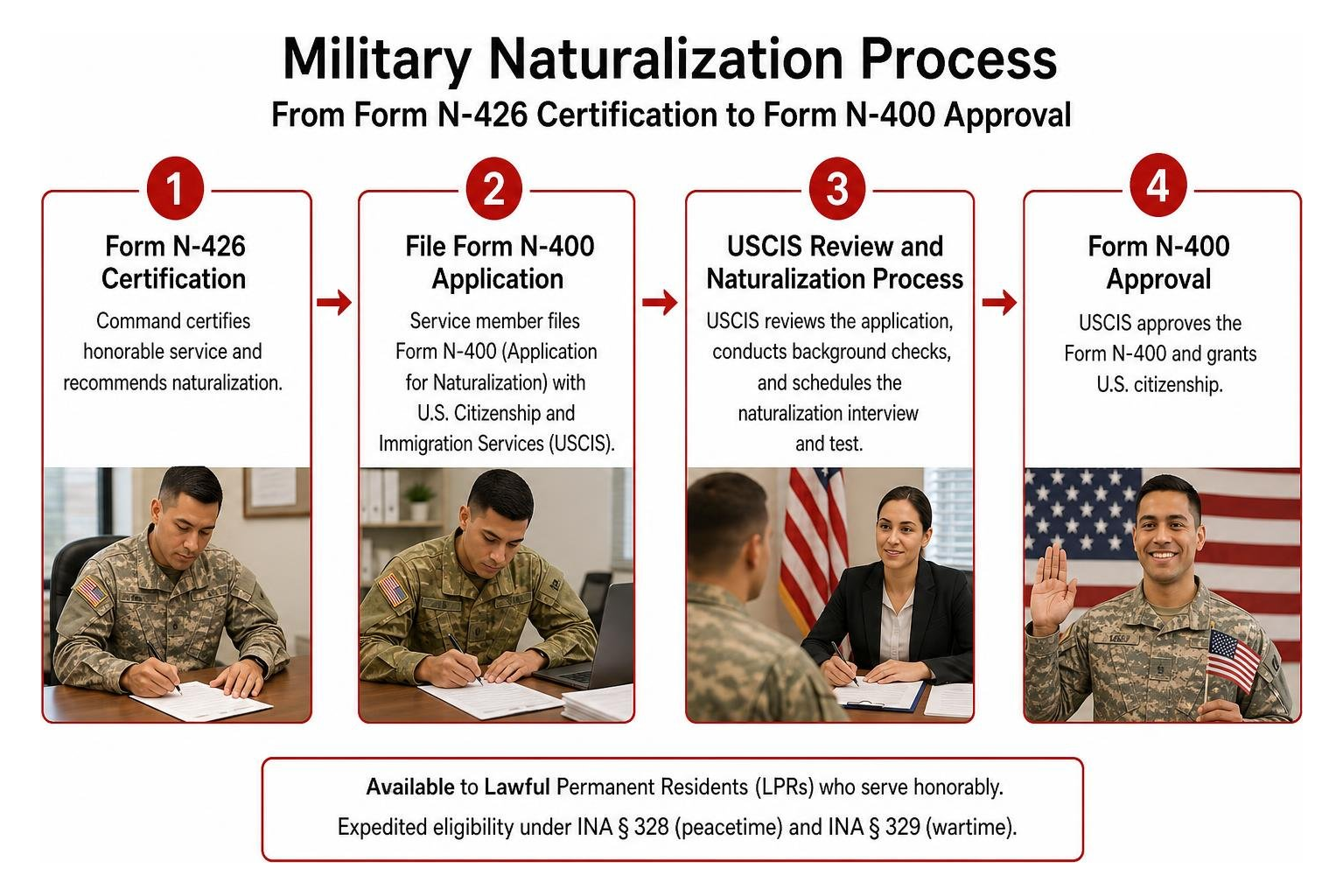
When non-citizens enlist as Lawful Permanent Residents, federal immigration law offers expedited paths to U.S. citizenship under Sections 328 and 329 of the Immigration and Nationality Act (INA). The naturalization journey, eligibility age brackets, and career steps are detailed in our comprehensive guide to military age requirements and in the CRS report on foreign nationals in the armed forces.
INA § 328 Peacetime Naturalization Rules
Under INA § 328, an LPR serving honorably during peacetime can apply for naturalization after one year of aggregate active-duty service.
- Requirements: Must hold a valid Green Card, maintain continuous honorable service, and submit Form N-400 alongside a certified Form N-426 (Request for Certification of Military or Naval Service).
- Waivers: Standard five-year physical residence and continuous presence requirements are waived, and USCIS waives all application fees.
INA § 329 Wartime Naturalization Rules
Under INA § 329, expedited naturalization opens immediately for service members during designated periods of military hostilities. Since September 11, 2001, the military has operated under an active executive designation for the War on Terrorism.
- Zero Waiting Period: An LPR can apply for citizenship immediately upon entry into active duty or selected reserve status, even during basic training.
- Volume: Over 148,000 foreign-national troops have naturalized through military service since 2001. After falling to a low of roughly 3,000 applications in FY2018 due to changed background check requirements, annual military naturalization applications rebounded to nearly 20,000 in FY2025.
Protections, Deportation Risks, and Relief for Military Families
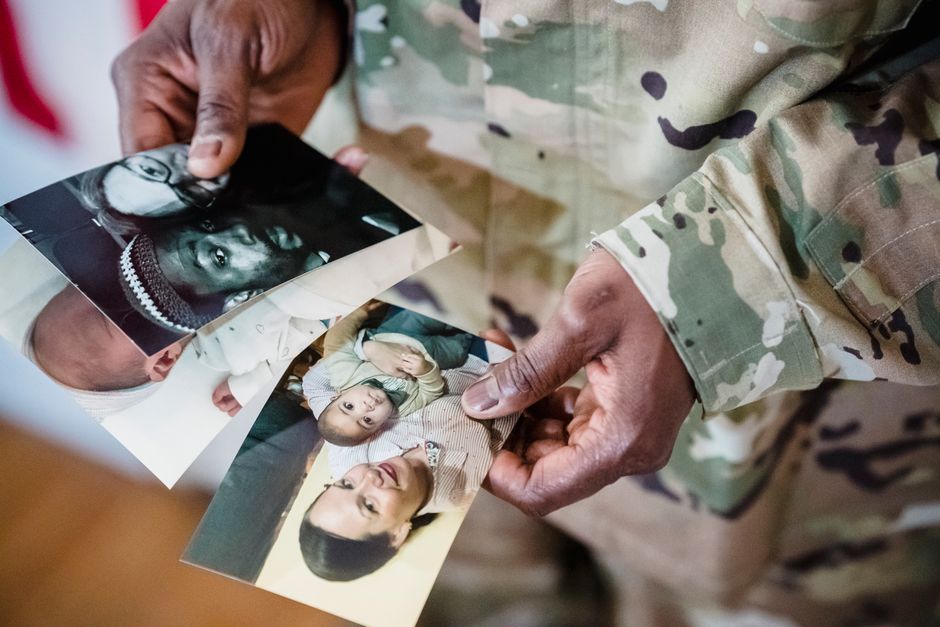
Immigration challenges can still surface for service members and their households, especially when immediate relatives lack lawful status. A detailed report highlighting family immigration stresses is examined by ABC News in their coverage of Pentagon recruitment and immigrant family protections.
Parole in Place (PIP) for Undocumented Relatives
Under INA § 212(d)(5)(A), USCIS exercises discretionary authority through Military Parole in Place (PIP). This form of relief assists undocumented spouses, parents, and unmarried children of active-duty service members, reservists, and veterans who served honorably.
- Function: PIP grants temporary lawful presence in one-year increments via Form I-131, shielding relatives from removal proceedings.
- Green Card Adjustment: PIP grants a formal “parole” entry, allowing undocumented relatives who originally crossed the border without inspection to adjust their status to Lawful Permanent Resident via Form I-485 without leaving the country or triggering statutory three- or ten-year re-entry bars.
- Volume: From 2013 through mid-2024, approximately 82,000 individuals applied for Military PIP, with over 61,000 approvals granted.
Veteran Deportations and the IMMVI Initiative
Non-citizen veterans who fail to naturalize during service remain Lawful Permanent Residents and are subject to deportation under INA § 237 if convicted of deportable offenses (such as aggravated felonies).
Between FY2018 and FY2024, Immigration and Customs Enforcement (ICE) arrested 125 former servicemembers, detained 142, and removed 68 from the United States. In response, DHS established the Immigrant Military Members and Veterans Initiative (IMMVI) to review deportations of honorably discharged veterans, reopen naturalization pathways, and ensure eligible veterans retain access to earned VA medical and disability benefits.
Frequently Asked Questions About Immigration and Military Enlistment
Are Illegal Immigrants Joining The US Military Today Through Special Waivers?
No. While 10 U.S.C. § 504(b)(2) allows Service Secretaries to authorize non-LPR enlistments if “vital to the national interest,” this authority has remained inactive since MAVNI closed in 2016. Recruiters cannot issue waivers for undocumented individuals, visa overstays, or DACA recipients. Prospective candidates can review branch-specific procedures using our step-by-step army recruitment guide.
Can Undocumented Immigrants Get Citizenship by Joining the Military?
No. Because undocumented immigrants cannot enlist, military naturalization under INA § 328 or § 329 is unavailable to them. An applicant must first obtain lawful permanent residency through existing family, humanitarian, or employment visa channels before applying for military service and subsequent naturalization.
How Does the Military Help Family Members of Non-Citizen Servicemembers?
Active-duty members, reservists, and veterans can assist undocumented immediate family through Military Parole in Place (PIP). PIP provides temporary protection from deportation, employment authorization, and a mechanism to adjust immigration status inside the U.S. without departing for consular processing.
Conclusion
Current federal statutes and Department of Defense recruitment policies strictly limit enlistment to U.S. citizens, nationals, Lawful Permanent Residents, and citizens of the Freely Associated States. Undocumented immigrants, including DACA recipients, cannot enlist.
For lawful permanent residents and military families seeking career paths, benefits reviews, or educational opportunities, explore military career paths and job opportunities at USMilitary.com.
Free for Service Members & Veterans
Get the military benefits intel no one tells you about.
Weekly updates on VA benefits, pay changes, and money tips — free for service members and veterans.
No spam. Unsubscribe anytime. Your info is never shared.



Leave a Reply