Your First Step to an Army Career: Understanding ASVAB Score Requirements
The Army ASVAB minimum score determines whether you’re eligible to enlist and which jobs you can pursue in your military career. Understanding these requirements is crucial before you take this important test.
Quick Answer: Army ASVAB Minimum Scores
| Education Level | Minimum AFQT Score | Tier Classification |
|---|---|---|
| High School Diploma | 31 | Tier 1 |
| GED or Currently in High School | 50 | Tier 2 |
| Score for Enlistment Bonuses | 50+ | Varies by MOS |
The Armed Forces Qualification Test (AFQT) is the score that matters most for basic eligibility. This score comes from four specific sections of the ASVAB: Arithmetic Reasoning, Mathematics Knowledge, Paragraph Comprehension, and Word Knowledge.
Here’s what you need to know right away:
- If you have a high school diploma, you need an AFQT score of 31 to join the Army
- If you have a GED or are still in high school, you need an AFQT score of 50
- Scoring 50 or higher opens doors to enlistment bonuses and more job options
- The AFQT is reported as a percentile from 1-99, comparing you to other test-takers
But your ASVAB journey doesn’t end with just meeting the minimum. Beyond basic eligibility, your scores on different ASVAB sections create what the Army calls “line scores.” These line scores determine which Military Occupational Specialties (MOS) you qualify for. A higher score means more career choices and better opportunities for bonuses and advanced rank.
The General Technical (GT) line score is particularly important. If you score 110 or higher on the GT, you open pathways to programs like Officer Candidate School through Green to Gold, even as an enlisted soldier.
I’m Larry Fowler, and since 2007, I’ve helped thousands of potential recruits understand the Army ASVAB minimum requirements and steer their path to military service through USMilitary.com. My experience working with all branches of the military has shown me that understanding these scores from the start makes all the difference in your enlistment journey.
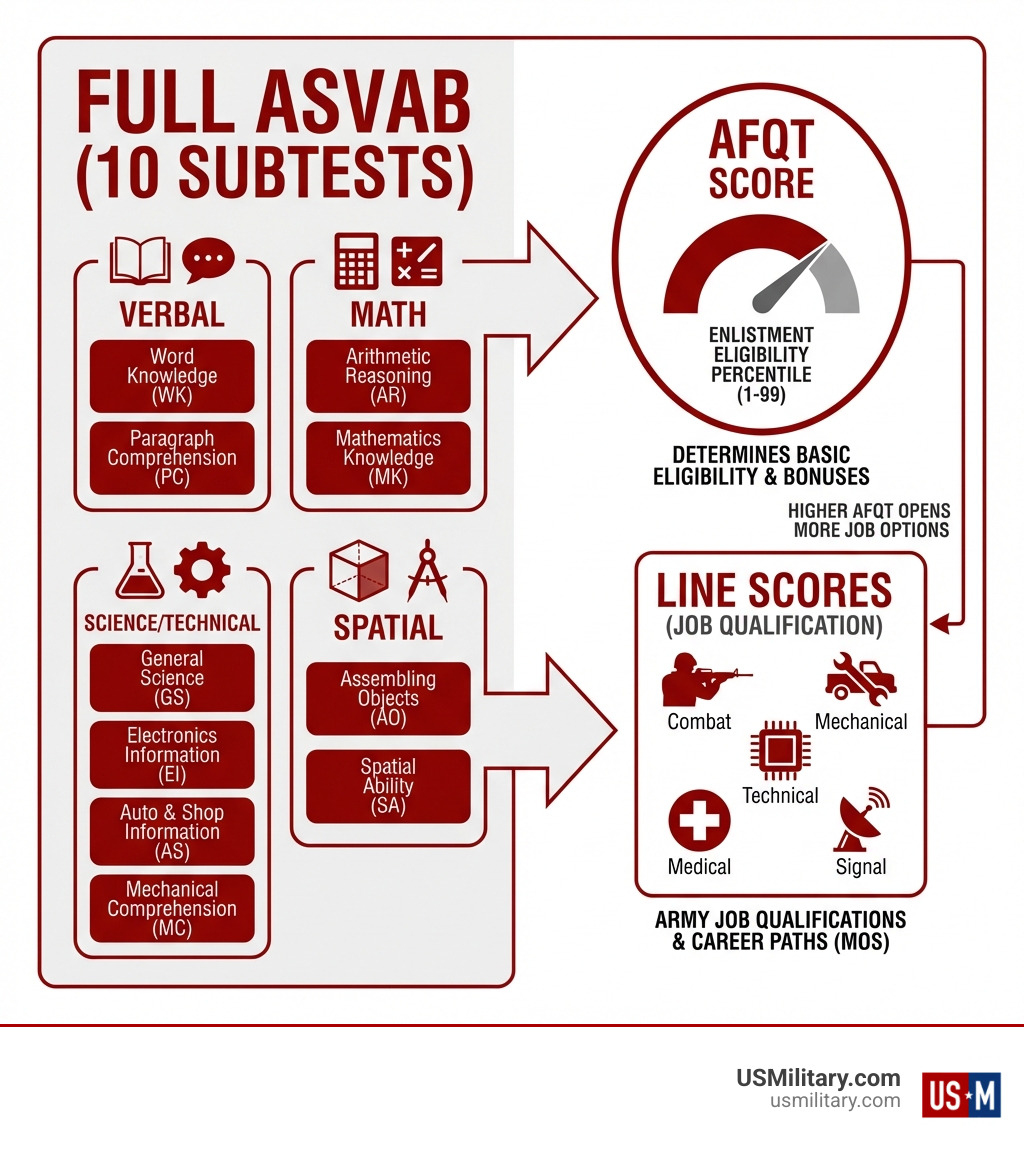
Army ASVAB minimum basics:
Understanding the ASVAB vs. the AFQT Score
When you’re looking to join the Army, you’ll hear a lot about the ASVAB and the AFQT score. While they’re related, they’re not the same thing, and understanding the distinction is crucial for your military journey.
The Armed Services Vocational Aptitude Battery (ASVAB) is a comprehensive test designed to measure your knowledge and aptitude across various subjects. It’s the most widely used multiple-aptitude test battery in the world, and it’s used by all branches of the U.S. military for two main purposes: to determine if you’re qualified to enlist, and to help assign you to the most suitable job in the military. Essentially, the ASVAB tests your knowledge of basic concepts and skills you’ve acquired, usually through high school, and helps identify your strengths in verbal, math, science and technical, and spatial domains.
If you want to see a neutral, high-level overview of the test itself, the Department of Defense provides one through the ASVAB program page on Wikipedia, which summarizes the test history, format, and scoring.
Now, let’s talk about the AFQT score. The Armed Forces Qualification Test (AFQT) score isn’t a separate test, but rather a critical composite score derived from specific sections of the ASVAB. This single score is what primarily determines your general eligibility to enlist in any branch of the military, including the Army. It acts as a gatekeeper, ensuring you meet the baseline cognitive requirements for military service.
So, how is this AFQT score calculated, and what does it mean? Your AFQT score is a percentile, ranging from 1 to 99. This percentile indicates how well you performed compared to a specific reference group. For current AFQT scores, this reference group is a nationally representative sample of 18 to 23-year-old youths who took the ASVAB in a 1997 study. For example, if you score an AFQT of 62, it means you scored as well as or better than 62% of that specific sample group. A score of 50, therefore, represents the average performance of that group.
While the AFQT score is your ticket to basic enlistment, the scores from all the ASVAB subtests play a vital role in job assignment. Your performance across the entire ASVAB helps determine which Military Occupational Specialties (MOS) – or specific jobs – you qualify for. We’ll dive deeper into this with “line scores” later, but for now, remember: AFQT for entry, full ASVAB for job placement.
What Subtests Make Up Your AFQT Score?
The AFQT score is a powerful number, but it’s built from just four specific subtests of the larger ASVAB examination. These subtests are carefully chosen because they are excellent indicators of general academic and cognitive ability.

The four subtests that contribute to your AFQT score are:
- Arithmetic Reasoning (AR): This section measures your ability to solve mathematical word problems. It assesses your understanding of basic arithmetic operations and your capacity to apply them to real-world scenarios.
- Mathematics Knowledge (MK): Here, you’ll tackle high school-level mathematical concepts, including algebra and geometry. This section evaluates your grasp of mathematical principles and formulas.
- Paragraph Comprehension (PC): This subtest assesses your reading comprehension skills. You’ll read various passages and answer questions based on the information provided, testing your ability to extract meaning and draw conclusions from written text.
- Word Knowledge (WK): This section measures your vocabulary and ability to understand the meaning of words in context. It’s a direct assessment of your verbal aptitude.
It’s also worth noting that the ASVAB often refers to “Verbal Expression (VE)” as a combined score. VE is a composite of your Word Knowledge (WK) and Paragraph Comprehension (PC) scores, and this combined verbal score is then used in the AFQT calculation alongside Arithmetic Reasoning and Mathematics Knowledge. So, while you’ll take WK and PC separately, their combined strength forms a crucial part of your overall AFQT.
What is the Army ASVAB Minimum Score?
Now that we understand the difference between the ASVAB and the AFQT, let’s get down to the specifics for the Army. The Army ASVAB minimum score is your first hurdle to clear, and it varies depending on your educational background. This distinction is critical because it impacts not only your eligibility but also your potential path within the Army.
The Army categorizes applicants into different tiers based on their educational credentials, and these tiers have corresponding AFQT score requirements. Generally, those with a high school diploma are in Tier 1, while those with a GED or who are still attending high school fall into Tier 2. Meeting these minimums is non-negotiable for enlistment.

Beyond just meeting the minimum for entry, your ASVAB scores can significantly influence other aspects of your enlistment, such as eligibility for certain enlistment incentives, bonuses, and even advanced rank opportunities. This means that while meeting the minimum gets your foot in the door, a higher score can open up a wider world of possibilities.
Army ASVAB Minimum for High School Graduates
For individuals who have earned a standard high school diploma, the path to joining the Army is typically more straightforward regarding the Army ASVAB minimum.
If you’re a high school graduate, the Army requires a minimum AFQT score of 31 to be eligible to enlist. This score of 31 serves as the basic entry requirement, marking you as a Tier 1 applicant. It signifies that you’ve demonstrated a foundational level of aptitude necessary for military service. Many recruits meet this threshold, making it a common starting point for an Army career.
Achieving this score means you’ve scored as well as or better than 31% of the 1997 national reference group. While 31 is the minimum, we always encourage aiming higher. Why? Because while it grants you basic eligibility, a higher score can open up more opportunities, which we’ll discuss shortly.
Tips for passing the ASVAB: Focus your study efforts on the four core AFQT subtests: Arithmetic Reasoning, Mathematics Knowledge, Paragraph Comprehension, and Word Knowledge. These are the building blocks of your enlistment eligibility!
Army ASVAB Minimum for GED Holders
If you have a General Equivalency Diploma (GED) instead of a traditional high school diploma, the Army ASVAB minimum requirement is significantly higher. This is a common policy across military branches, reflecting a preference for high school graduates.
For those with a GED or who are still attending high school, the Army requires a minimum AFQT score of 50 to be eligible to join. This is a substantial jump from the 31 required for high school diploma holders, placing GED applicants into what’s often considered Tier 2. This higher requirement ensures that individuals without a standard diploma demonstrate a stronger academic aptitude.
Historically, military branches have strict limits on the percentage of recruits they can accept with only a GED. While the Army may allow a higher percentage compared to some other branches (for instance, the Marine Corps typically doesn’t allow more than 5% of recruits with only a GED), competition can still be fierce.
If you’re a GED holder, it’s absolutely essential to score as high as possible on the ASVAB. Not only do you need to hit that 50 mark, but exceeding it will make you a more competitive candidate. We strongly recommend speaking with an Army recruiter for the most current details regarding GED applicant quotas and specific requirements, as these can sometimes change based on recruiting needs. They can provide guidance custom to your situation and help you steer the enlistment process effectively.
✉ Get updates like this in your inbox
Weekly VA benefit changes, pay updates, and money tips for service members, veterans, and military families. Free, no spam.
How Higher Scores Impact Bonuses and Rank
Meeting the Army ASVAB minimum is a great first step, but truly excelling on the test can open up a world of additional benefits and opportunities that can significantly impact your military career. It’s not just about getting in; it’s about setting yourself up for success.
One of the most exciting advantages of a higher AFQT score, particularly a score of 50 or above, is the potential for enlistment bonuses. While the availability of bonuses depends on various factors like specific Military Occupational Specialties (MOS) and current Army needs, scoring above 50 makes you eligible for certain incentives. The Army uses these bonuses to attract highly qualified recruits into critical or high-demand job fields. If you score higher than a 50, enlistment bonuses could be available depending on circumstances and your chosen MOS. This could mean extra cash in your pocket when you start your service!
Beyond financial incentives, a strong ASVAB score can also impact your potential for advanced rank opportunities. While college credits are often a direct path to higher initial enlistment ranks (for example, a college graduate might enlist as an E-4 in the Army), demonstrating high aptitude through your ASVAB scores can indicate a greater capacity for learning and leadership, which may contribute to faster career progression or eligibility for specialized programs down the line.
Perhaps most importantly, a higher AFQT score translates directly into more job choices. The research shows that a higher AFQT score will mean more MOS options. The Army has over 150 different jobs, and many of the more specialized, technical, or high-demand roles require higher ASVAB line scores (which are derived from your overall ASVAB performance). By scoring well, you gain access to a wider array of career fields, allowing you to select a job that aligns better with your skills, interests, and long-term goals. This can lead to greater job satisfaction and a more fulfilling military experience.
Insider tips for taking the ASVAB: Don’t just aim for the minimum. Put in the effort to study and prepare thoroughly. The time you invest now can pay dividends throughout your entire Army career. We’ve seen countless individuals benefit from dedicated preparation, turning a potential “just enough” score into a score that open ups incredible opportunities.
Beyond Entry: How Line Scores Determine Your Army Job (MOS)
We’ve established that your AFQT score is the gatekeeper for basic enlistment, determining if you’re qualified to join the Army. But once you’re past that initial hurdle, it’s your ASVAB line scores that truly define your career path, dictating which Military Occupational Specialties (MOS) you’re eligible for. Think of the AFQT as getting your driver’s license, and line scores as qualifying to drive a specific type of vehicle – from a tank to a helicopter to a specialized medical truck!
The Army, like other branches, needs to match recruits’ aptitudes with the demands of its vast array of jobs. This is where line scores come in. While your AFQT score is a single percentile, line scores are composite scores, meaning they are combinations of results from various ASVAB subtests. These combinations are specifically designed to predict your potential success in different career fields.
Your performance on the full ASVAB, encompassing all its subtests, is what generates these line scores. Each MOS requires a specific minimum score in one or more line score categories. This ensures that individuals entering specialized fields have the necessary foundational knowledge and aptitude. For example, a combat role might prioritize mechanical comprehension and general science, while an administrative role might emphasize verbal skills.
The Army organizes its jobs into various career fields, and your line scores will determine which of these fascinating areas you can enter. From combat roles to highly technical positions, medical fields, and administrative jobs, there’s a place for nearly every skill set – provided your ASVAB scores match the requirements.
What Are Army Line Scores?
Army line scores are essentially specialized composite scores derived from your performance on various ASVAB subtests. Instead of one overall score, these are several distinct scores, each custom to a different aptitude area relevant to military jobs. These line scores are crucial because they directly determine your eligibility for specific Military Occupational Specialties (MOS).
Each line score category is a unique combination of two or more ASVAB subtests. For instance, a line score for mechanical aptitude might combine your scores from Mechanical Comprehension, Auto & Shop Information, and Electronics Information. The Army uses these carefully constructed composites to assess your aptitude for different types of work.
Some of the common Army Line Score categories you’ll encounter include:
- CL (Clerical): Assesses aptitude for administrative and clerical duties.
- CO (Combat): Relevant for many combat arms roles, often combining arithmetic reasoning and mechanical comprehension.
- EI (Electronic Information): Important for jobs involving electronics and electrical systems.
- FA (Field Artillery): Specific to artillery-related roles.
- GM (General Maintenance): For maintenance and repair roles.
- GT (General Technical): A very important score for many technical, supervisory, and leadership roles. We’ll discuss this more in a moment.
- MM (Mechanical Maintenance): For jobs involving the repair and maintenance of mechanical equipment.
- OF (Operators and Food): For roles like heavy equipment operators and food service.
- ST (Skilled Technical): For various technical and skilled trades.
- SC (Surveillance and Communications): For jobs related to intelligence, surveillance, and communication systems.
To qualify for a particular MOS, you’ll need to meet the minimum required score in the relevant line score category. For example, if an MOS requires a “CO = 87,” you’ll need to achieve at least an 87 in the Combat line score to be eligible for that specific job. These requirements are precise and non-negotiable.
Finding a comprehensive list of Army MOS and their corresponding ASVAB line score requirements can be done through your recruiter or by searching for official Army resources online. These resources provide an excellent starting point for exploring the vast array of jobs available in the Army and understanding the specific ASVAB scores needed for each. The higher your scores across the board, the more options you’ll have!
The Importance of the General Technical (GT) Score
Among the various ASVAB line scores, the General Technical (GT) score holds a particularly significant position for career progression and opening up advanced opportunities within the Army. It’s often seen as a key indicator of your general learning ability and potential for success in more intellectually demanding roles.
The GT score is a composite score derived from your Word Knowledge, Paragraph Comprehension, and Arithmetic Reasoning subtest scores. A strong GT score indicates a solid foundation in verbal and mathematical reasoning, which are critical skills for many technical, administrative, and leadership positions.
For those looking beyond enlisted service, the GT score is an absolute game-changer. If you’re an enlisted soldier with ambitions of becoming an officer, your GT score will be a crucial factor. Specifically, if you wish to apply for Officer Candidate School (OCS) through programs like Green to Gold, you’ll generally need a minimum GT line score of 110. The Green to Gold program offers eligible enlisted soldiers the opportunity to complete a bachelor’s or master’s degree and commission as an Army Officer. Meeting that 110 GT score is a mandatory prerequisite for this challenging but rewarding path.
A high GT score signals to the Army that you possess the cognitive abilities necessary for complex problem-solving, effective communication, and strategic thinking – all hallmarks of successful officers and leaders. It can open doors to specialized training, leadership roles, and a faster trajectory up the ranks.
So, while meeting the Army ASVAB minimum AFQT score gets you into the Army, achieving a strong GT score, especially a 110 or higher, can significantly broaden your horizons and put you on a path toward greater responsibility and career advancement. If leadership or specialized technical roles are in your sights, focusing on improving your GT-related subtests during ASVAB preparation is a wise strategy.
Preparing for and Retaking the ASVAB
Taking the ASVAB can feel like a big moment, and it is! It’s your gateway to an Army career. The good news is that with proper preparation, you can significantly improve your chances of achieving the scores you need, not just to enlist, but to qualify for your desired MOS. We like to say, “You wouldn’t run a marathon without training, so don’t take the ASVAB without studying!”
Test preparation is key. It’s important to know what the minimum scores required in each section are, so you can work on the areas you might need a little help on. This targeted approach is far more effective than just randomly reviewing material.
Your study strategies should focus on the specific subtests that contribute to both your AFQT score and the line scores for your preferred MOS. Use available resources such as study guides, flashcards, and practice tests. Taking practice tests helps you identify your strengths and weaknesses, allowing you to concentrate your efforts where they’ll make the most impact.
Improving your scores is absolutely achievable. If your initial practice tests show areas where you’re struggling, dedicate extra time to those subjects. For instance, if Arithmetic Reasoning is a challenge, practice word problems daily. If Word Knowledge is weak, expand your vocabulary. Consistent effort and a structured study plan can lead to substantial score improvements. The ASVAB tests knowledge you would generally acquire in high school, so it’s about refreshing and solidifying those fundamentals.
For more detailed guidance, check out our resources on How to Pass the ASVAB, ASVAB Test Taking Tips, and ASVAB Preparation for Enlistment.
The Official Army ASVAB Retake Policy
Sometimes, despite our best efforts, the initial ASVAB score might not be exactly what we hoped for. Don’t fret! The military understands this, and there’s an official policy for retaking the ASVAB. This gives you a chance to improve your scores and open up more opportunities for your Army career.
Here’s how the ASVAB retake policy works:
- Initial Test: Your very first ASVAB attempt establishes your baseline score.
- First Retest: If you’re not satisfied with your initial score, you must wait one calendar month to retake the test. This waiting period is designed to give you time to study and improve, rather than just immediately re-attempting the test without further preparation.
- Second Retest: If your score after the first retest still isn’t where you need it to be, you must wait an additional one calendar month before taking the ASVAB for a third time. Again, this is your opportunity to double down on your studying.
- Subsequent Retests: After your second retest, the waiting period extends significantly. For any subsequent attempts, you must wait six calendar months between tests. This longer break emphasizes serious preparation and discourages repeated testing without substantial study.
Your ASVAB scores are valid for enlistment for up to 2 years from the date of testing. This means you have a window of time to use your scores for enlistment. If your scores expire, you’ll need to retake the ASVAB.
The retake policy is a great opportunity, but it’s not an excuse to take the initial test lightly. Each retake requires time and effort. We highly recommend using the waiting periods wisely for dedicated ASVAB Enlisted Exam Preparation. This will maximize your chances of achieving the Army ASVAB minimum you need, and the line scores that qualify you for your dream Army job.
Conclusion
Starting on a career in the U.S. Army is a noble and rewarding path, and understanding the Army ASVAB minimum requirements is your crucial first step. We’ve explored the nuances of the ASVAB, demystified the AFQT score, and highlighted how your performance on this test directly impacts your eligibility and career choices.
Here are the key takeaways from our journey:
- Your AFQT score is the first step: This percentile-based score, derived from four core ASVAB subtests (Arithmetic Reasoning, Mathematics Knowledge, Paragraph Comprehension, and Word Knowledge), determines your basic eligibility to enlist. A 31 is the minimum for high school graduates, while GED holders need a 50.
- Line scores define your career: Beyond the AFQT, your performance on all ASVAB subtests contributes to various “line scores” (like GT, CL, MM, ST). These specialized composite scores are what qualify you for specific Military Occupational Specialties (MOS), or jobs, within the Army.
- A high score opens doors: Scoring above the minimum, particularly an AFQT of 50 or higher, can open up valuable enlistment bonuses and a wider array of MOS options. A strong General Technical (GT) score, especially a 110 or above, can even pave the way for officer programs like Green to Gold.
- Preparation is paramount: The ASVAB is a test you can study for. Dedicated preparation, utilizing practice tests and focusing on your weaker areas, can significantly improve your scores and, by extension, your opportunities in the Army. And if you don’t hit your target score initially, the Army offers clear retake policies.
Your Army journey starts with a good score, and we at USMilitary.com are here to provide comprehensive resources every step of the way. We believe that informed recruits make for successful soldiers.
Ready to take the next step? Learn more about what it takes to serve our nation:
View Army enlistment requirements
Free for Service Members & Veterans
Get the military benefits intel no one tells you about.
Weekly updates on VA benefits, pay changes, and money tips — free for service members and veterans.
No spam. Unsubscribe anytime. Your info is never shared.


