Becoming a Navy SEAL: A Demanding Path From Screening to the Trident
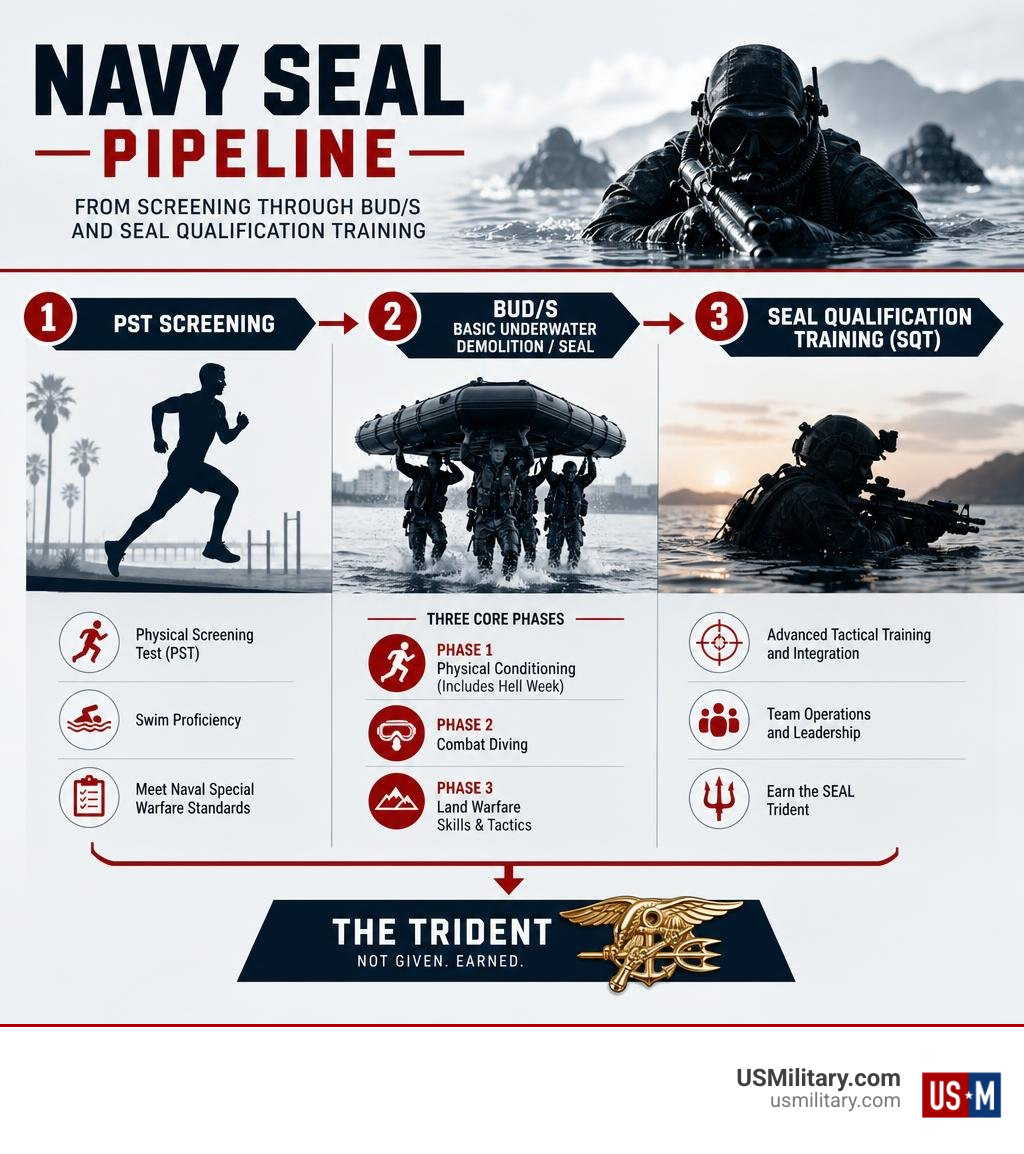
Becoming a Navy SEAL: To Hell And Back means clearing far more than Hell Week. Candidates must first qualify for Naval Special Warfare, exceed Physical Screening Test standards, complete BUD/S in Coronado, attend follow-on schools, and finish SEAL Qualification Training before earning the SEAL Trident.
The path takes well over a year, and most people who start do not finish. BUD/S alone includes three core phases:
- Physical conditioning, including the 5.5-day Hell Week.
- Combat diving, where water confidence and calm under pressure matter.
- Land warfare, covering weapons, demolitions, navigation, and small-unit skills.
Hell Week is the best-known test, but it is only one part of the pipeline. Candidates train with little sleep, cold water exposure, long runs, boat carries, and team tasks designed to test judgment, effort, and commitment under stress. The brass bell offers a clear way to quit, making the hardest battle often a mental one.
I am LARRY FOWLER, publisher of the USMilitary.com Network since 2007, where we help service members, veterans, and aspiring recruits make sense of military career decisions. This guide to Becoming a Navy SEAL: To Hell And Back explains the training path in plain language so you can better understand the standards, risks, and commitment involved.
Discover more about Becoming a Navy SEAL: To Hell And Back:
- Navy SEALs BUD/S Training Requirements
- What is Navy SEAL Training 3 Phases And WHy is it so tough
- A Day In The Life Of A Navy SEAL Operator
The Ultimate Pipeline: Becoming a Navy SEAL: To Hell And Back
The journey to earning the coveted Special Warfare insignia—the SEAL Trident—takes place at the Naval Special Warfare Center located at Naval Amphibious Base Coronado in San Diego, California. Enlisted candidates enter under the Special Warfare Operator (SO) rating, spending anywhere from 12 to 18 months navigating a rigorous selection gauntlet.
Meeting basic Navy SEAL qualifications is merely the entry ticket. The training pipeline demands world-class cardiovascular stamina, aquatic comfort, mental adaptability, and unwavering character.
| Fitness Event | Navy Minimum Standard | Competitive Candidate Target |
|---|---|---|
| 500-Yard Swim (Breast/Sidestroke) | 12:30 | Sub 8:00 – 9:00 |
| Push-ups (2 Minutes) | 50 reps | 80 – 100+ reps |
| Sit-ups (2 Minutes) | 50 reps | 80 – 100+ reps |
| Pull-ups (No Time Limit) | 10 reps | 15 – 20+ reps |
| 1.5-Mile Timed Run (Boots & Pants) | 10:30 | Sub 9:00 – 9:30 |
Initial Screening and Preparation for Becoming a Navy SEAL: To Hell And Back
Before a recruit ever touches the Pacific surf, they must pass academic and physical assessments. Candidates must achieve qualifying scores on the Armed Services Vocational Aptitude Battery (ASVAB)—typically a combined score of 220 or higher across specific technical and mechanical line segments.
Following the initial screening, candidates attend Navy Recruit Training Command at Great Lakes, Illinois. Enlisted sailors with special warfare contracts move directly to the 8-week BUD/S Preparatory School (Naval Special Warfare Prep), also in Great Lakes. This preparatory phase builds baseline conditioning and screens applicants through repeated physical testing. Meeting every Navy SEAL BUD/S training requirement here ensures candidates arrive in Coronado physically prepared to avoid preventable overuse injuries.
The Three Phases of Basic Underwater Demolition/SEAL (BUD/S)
BUD/S is a 24-week selection course structured into three 7-week phases, preceded by a three-week orientation phase.
- Phase 1 (Basic Conditioning): Spanning seven weeks, this phase builds grit and teamwork through endless timed runs, soft-sand obstacle courses, ocean swims, and log drills. The high-water mark of this phase is Hell Week during the third week. Understanding the intensity of First Phase Navy SEAL training BUD/S illustrates why the majority of class attrition happens in these opening weeks.
- Phase 2 (Combat Diving): Candidates transition to the pool and open water to master open-circuit and closed-circuit SCUBA diving. Pool competency tests push trainees to stay calm during simulated equipment failures and underwater line entanglements. Historical standards across United States Navy SEAL selection and training ensure that every diver possesses absolute aquatic poise.
- Phase 3 (Land Warfare): Conducted largely on San Clemente Island, Phase 3 covers basic weapons handling, demolitions, land navigation, patrolling, and small-unit tactics. Candidates must complete a grueling 2-mile ocean swim with fins in under 75 minutes, a 14-mile timed run, and a 20-mile tactical ruck march.
Post-BUD/S Milestones: SQT and Earning the Trident
Graduating BUD/S is a major milestone, but candidates do not receive their Tridents immediately. Graduates attend the 3-week Army Airborne School in Fort Moore, Georgia, mastering static-line parachuting. They also undergo Survival, Evasion, Resistance, and Escape (SERE) training.
Next comes the 26-week SEAL Qualification Training (SQT). SQT transforms conditioned athletes into operational tactical operators. Trainees learn advanced close-quarters combat (CQB), tactical combat casualty care, maritime navigation, and cold-weather tactics. Exploring what a Navy SEAL does reveals that earning the Trident is just the beginning of a demanding operational career within an active SEAL Team.
The Crucible: Surviving Hell Week in BUD/S First Phase
Hell Week represents the definitive test of the human spirit in military selection. Beginning on Sunday evening and concluding on Friday afternoon, candidates endure 5.5 days (over 120 continuous hours) of physical labor, covering more than 200 miles while receiving less than four hours of total sleep. Surviving Navy SEAL Hell Week requires deep resilience, humor, and complete reliance on one’s boat crew.
The Physiology and Mechanics of Sleep Deprivation
By Tuesday night of Hell Week, candidates enter severe circadian collapse. The human body burns up to 8,000 to 10,000 calories per day to maintain core temperature against the cold Pacific waters.
✉ Get updates like this in your inbox
Weekly VA benefit changes, pay updates, and money tips for service members, veterans, and military families. Free, no spam.
Under continuous stress and sleep deprivation, trainees frequently experience waking hallucinations—seeing imaginary bridges on the water or conversing with inanimate objects. Extreme exposure during Hell Week for Navy SEALs triggers muscle swelling, loss of toenails, and the threat of immersion pulmonary edema (often marked by pink, frothy sputum). The primary defense against total physical shutdown is pure mental resolve.
Key Evolutions: Log PT, IBS Boat Drills, and Mud Flats
Training evolutions during Hell Week run back-to-back with almost no recovery time:
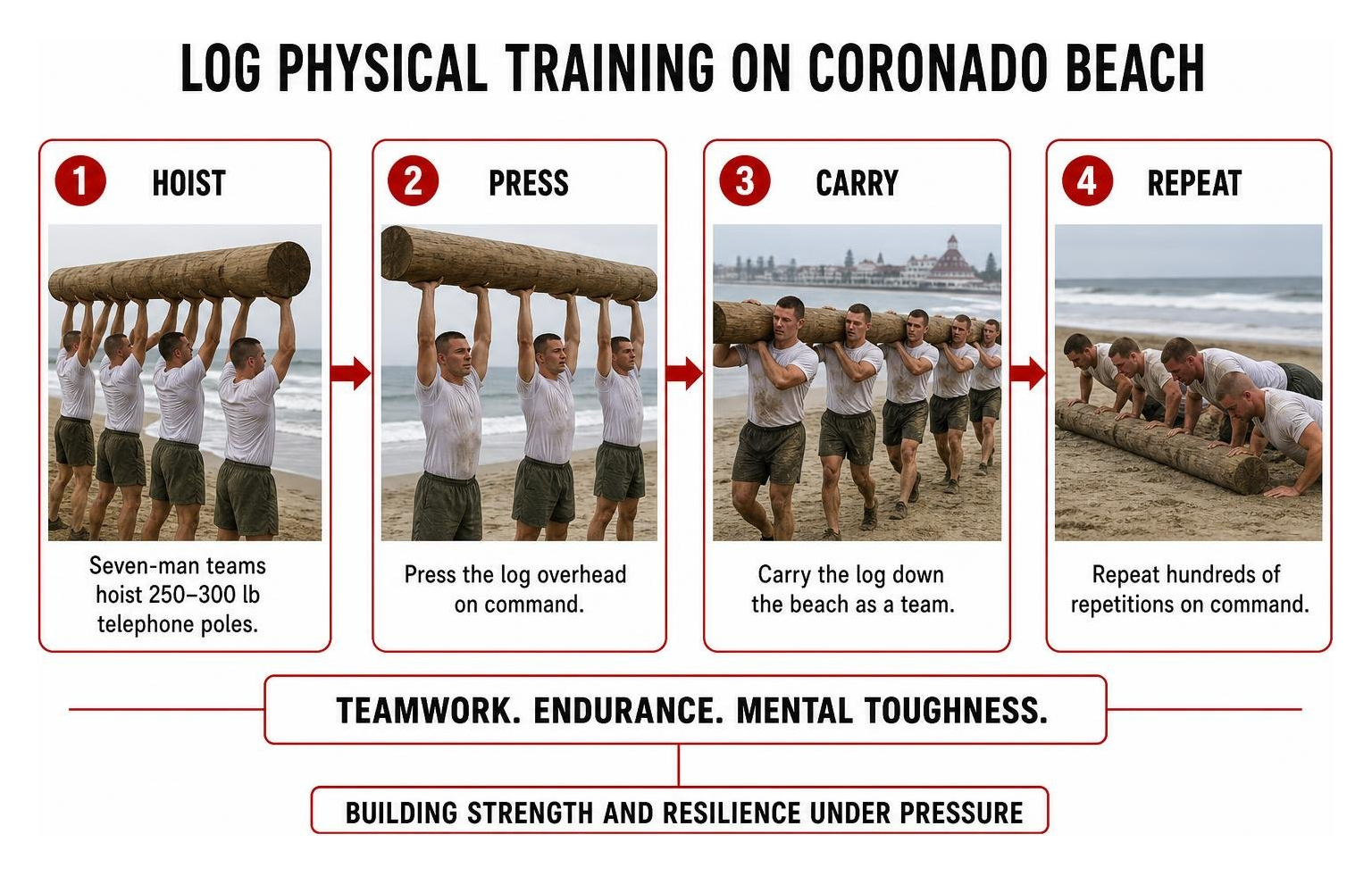
- Log Physical Training: Seven-man teams hoist, press, and carry 250-to-300-pound telephone poles (such as the infamous “Old Misery” log) through hundreds of repetitions on command.
- Inflatable Boat Small (IBS) Drills: Crews paddle through heavy ocean surf or balance 150-pound rubber raiding craft on their heads while running along the shoreline.
- Mud Flats & The Grinder: Trainees wade through waist-deep mudflats in San Diego Bay, conducting relentless calisthenics on the asphalt “Grinder.”
- Surf Torture & Sugar Cookies: Instructors order candidates to link arms and lay in the freezing ocean surf before rolling in dry sand until they become human “sugar cookies.” Learning what Navy SEAL Hell Week entails highlights why boat crew camaraderie is essential to surviving these drills.
The Psychological Battleground: Overcoming Attrition and the Brass Bell
The physical demands of training are designed to strip away mental defenses, revealing each candidate’s true inner motivation. In the center of the BUD/S courtyard hangs a brass ship’s bell. At any moment, any candidate can walk up, ring the bell three times, place their helmet on the grinder, and immediately Drop on Request (DOR).
Why Candidates Quit Becoming a Navy SEAL: To Hell And Back
Historically, roughly 75% to 80% of candidates who begin BUD/S do not graduate. During Hell Week alone, about 75% of the starting class drops out. For example, during BUD/S Class 278, out of approximately 300 candidates who began the pipeline, only about 15 completed training.
Candidates rarely quit because of physical inability alone. They ring the bell when mental fatigue, self-doubt, and the lure of warmth and rest overwhelm their resolve. Reviewing the overall journey of BUD/S Navy SEALs makes it clear: when personal motivation falters, even world-class athletes can step forward to ring the brass bell.
Instructor Mind Games and Combat Stress Inoculation
Instructors are experienced SEAL operators who push candidates to their breaking point. Through bullhorns, they play the role of the inner voice that urges candidates to surrender, offering hot coffee, warm showers, and pizza to anyone willing to quit.
This constant pressure serves a deliberate purpose: combat stress inoculation. An operator in combat must remain clear-headed and decisive under fire. Exploring how deadly Navy SEALs are shows that their tactical edge comes from this rigorous psychological conditioning, ensuring they perform reliably in real-world operations.
Safety Protocols, Training Controversies, and Lasting Resilience
Because BUD/S pushes human physiology to its limits, Naval Special Warfare maintains strict medical oversight throughout every phase of training.

Medical Safety and Training Reforms
Dedicated medical personnel, dive medical officers, and corpsmen monitor candidates during every evolution. Following notable training incidents—including instances of severe pulmonary edema, near-drownings, and high-profile safety reviews—the Navy has introduced updated safety protocols:
- Continuous biometric tracking and regular lung-sound evaluations during Hell Week.
- Clear temperature baselines for cold-water immersion and surf torture.
- Updated safety standards regarding tear gas use and pool competency drills.
- Expanded medical convalescent holds that allow injured candidates to heal and roll into a later class rather than leaving the pipeline permanently.
Long-Term Resilience and Combat Readiness
The lessons learned while enduring Hell Week remain with operators long after they complete training. Pushing past perceived mental and physical limits builds a lasting sense of resilience.
This mindset translates directly into operational capability and civilian leadership. Completing the comprehensive Navy SEAL BUD/S training teaches candidates that mindset matters far more than circumstance when facing difficult challenges.
Frequently Asked Questions About Navy SEAL Training
What is the primary reason candidates fail Hell Week?
The main reason candidates quit during Hell Week is psychological surrender rather than physical failure. When extreme sleep deprivation, cold-water exposure, and deep fatigue peak, candidates must rely on internal drive to keep going. Those who lose sight of their core purpose often choose to ring the brass bell and drop on request.
Can women attend BUD/S and become Navy SEALs?
Yes. Since the Department of Defense opened all combat roles to women in December 2015, female candidates who meet the screening standards can earn a contract and attend BUD/S. Candidates must meet the exact same physical, academic, and tactical standards as their male peers to graduate and receive the Trident.
How can candidates best prepare physically and mentally before BUD/S?
Candidates should train well beyond the minimum PST scores—aiming for sub-9:00 swims and runs, 80+ push-ups, and 15+ pull-ups. Prospective trainees should also practice progressive ruck marching, build strong water confidence through sidestroke and underwater drills, and develop mental resilience by consistently training through challenging conditions.
Conclusion
The journey through BUD/S and Hell Week tests the absolute limits of physical and mental endurance. It takes raw recruits and builds them into disciplined, quiet professionals capable of operating across land, sea, and air.
At USMilitary.com, we provide active service members, veterans, and prospective recruits with clear, reliable guidance on military careers, training programs, and VA benefits. If you are ready to explore the steps required to join Naval Special Warfare, read our Navy SEALs Complete Guide to plan your path forward.
Free for Service Members & Veterans
Get the military benefits intel no one tells you about.
Weekly updates on VA benefits, pay changes, and money tips — free for service members and veterans.
No spam. Unsubscribe anytime. Your info is never shared.


