Understanding Your Eligibility: Age Windows for Reserve Service
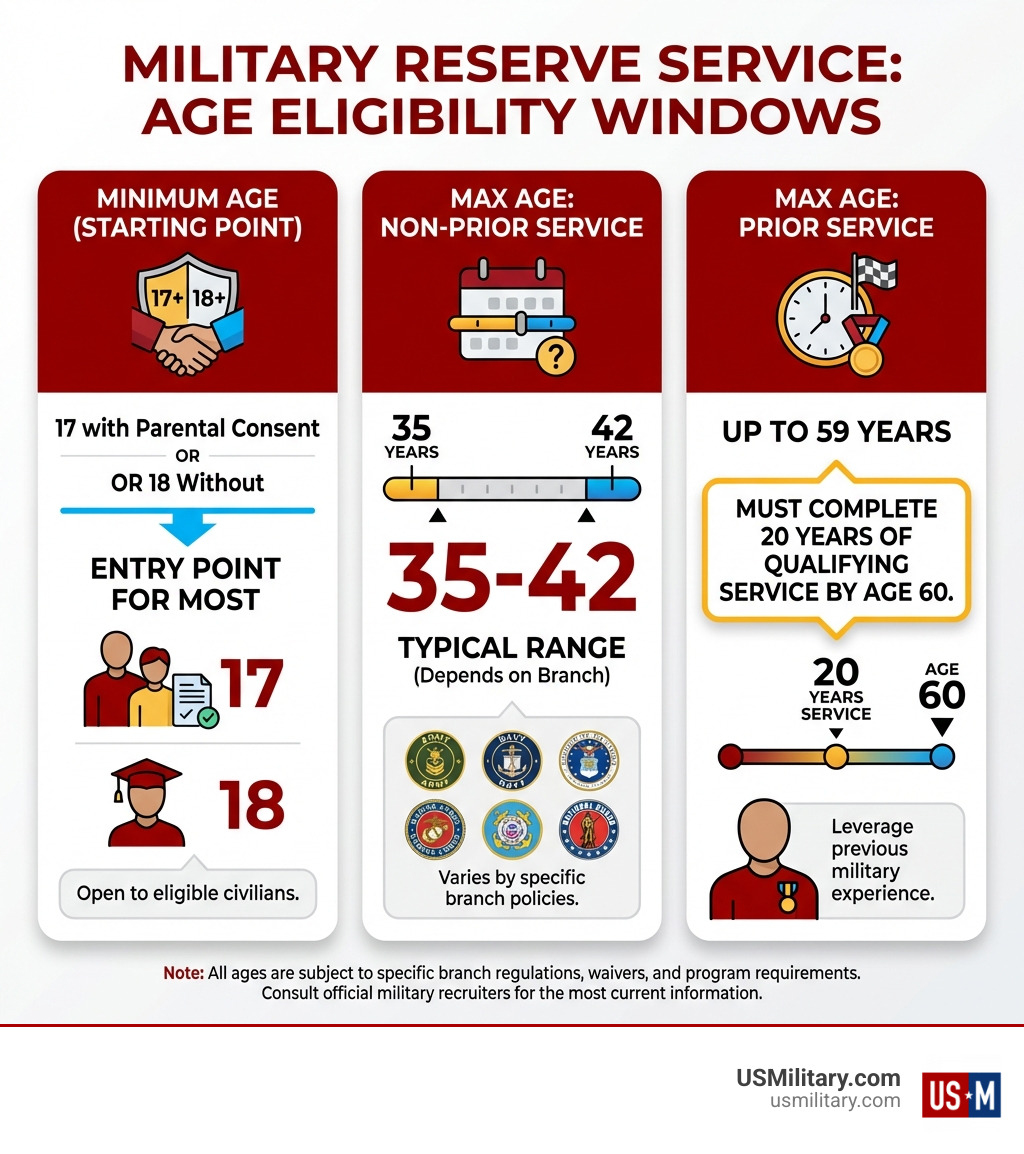
The age to join military reserves varies by branch and your military background, but the window is wider than most people think. If you’re wondering whether you’re too old—or too young—to serve part-time in the National Guard or Reserves, here’s what you need to know:
Quick Answer: Age to Join Military Reserves
| Your Status | Typical Age Range |
|---|---|
| No Prior Service (Enlisted) | 17-35 years (with parental consent at 17) |
| Prior Service | 17-59 years (must complete 20 years by age 60) |
| Officer Candidates | 18-42 years (varies by branch and program) |
| National Guard Enlisted | 17-45 years (17-64 for prior service) |
More than 1 in 4 active-duty service members intend to join the reserves after their active duty commitment ends. But the reserves aren’t just for transitioning service members—they welcome civilians, too. Whether you’re 18 or 40, the military reserves offer a path to serve your country while maintaining your civilian career and family life.
The common myth that military service is only for teenagers and twenty-somethings simply isn’t true. Life experience, maturity, and specialized skills gained in your civilian career can actually make you a more valuable candidate for reserve service. The Guard experimented with raising the maximum age to 42 in some cases, though it later reverted to 35 for most non-prior service roles.
Each branch of service—Army Reserve, Navy Reserve, Air Force Reserve, Marine Corps Reserve, Coast Guard Reserve, Army National Guard, and Air National Guard—has its own specific age requirements. These limits also change depending on whether you’re enlisting as an enlisted member or pursuing a commission as an officer.
This guide will walk you through the exact age requirements for each branch, explain how prior service affects your eligibility, and show you the waiver options and special programs that might extend your opportunity to serve beyond the standard limits.
What is the Age to Join Military Reserves for Each Branch?
Navigating the age requirements for the military reserves can feel a bit like reading a complicated instruction manual – there are general rules, and then there are specifics for each section. We’re here to simplify it for you. While there’s a general age window, each branch of the U.S. Military Reserve and National Guard has its own set of guidelines, often influenced by whether you’ve served before.
Here’s a breakdown of the minimum and maximum enlistment ages for non-prior service (NPS) individuals across the different reserve components. 17-year-olds always need parental consent, and these are general guidelines; exceptions and waivers are always a possibility depending on the branch and your qualifications.
| Reserve Component | Minimum Age | Maximum Age (Non-Prior Service) |
|---|---|---|
| Army Reserve | 17 | 27 |
| Navy Reserve | 17 | 42 |
| Air Force Reserve | 17 | 42 |
| Marine Corps Reserve | 17 | 28 |
| Coast Guard Reserve | 17 | 41 |
| Army National Guard | 17 | 45 |
| Air National Guard | 17 | 42 |
These figures represent the typical age to join military reserves for someone without prior military service. For instance, the Navy Reserve has a maximum age of 42 years, while the Army Reserve’s general limit is 27. The Marine Corps Reserve is known for having one of the youngest maximum age limits at 28. The National Guard, encompassing both Army and Air components, generally allows enlistment up to 45 years for the Army National Guard and 42 for the Air National Guard.
These are primarily for enlisted roles. Officer commissions often have different, sometimes higher, age considerations, which we’ll dig into shortly. Each branch’s policies are designed to ensure recruits can meet the physical and mental demands of service and complete a full career if desired. For the most precise and up-to-date information, we always recommend checking the official websites or speaking directly with a recruiter for your chosen branch.
- Air Force Reserve: Air Force Reserve
- Air National Guard: Air National Guard
- Army Reserve: Army Reserve
- Army National Guard: Army National Guard
- Coast Guard Reserve: Coast Guard and Coast Guard Reserve
- Marine Corps Reserve: Marine Corps Reserve
- Navy Reserve: Navy Reserve
Enlisted, Officer, and Prior Service: How Your Status Affects Age Limits
Age requirements are rarely a one-size-fits-all situation in the military. Your background – whether you’re a fresh face to military service, a seasoned veteran looking to return, or someone aiming for a leadership role – significantly impacts the age to join military reserves. Let’s break down these distinctions.
General age to join military reserves for Non-Prior Service
If you’ve never worn a military uniform before, you’re considered a Non-Prior Service (NPS) applicant. For NPS individuals, the typical age range to enlist in the reserves is generally between 17 and 35. As noted earlier, 17-year-olds need parental consent to enlist. This is a standard across all branches.
Beyond age, NPS applicants must meet other basic eligibility criteria. This includes being a U.S. citizen or a legal permanent resident (resident alien), possessing a high school diploma or GED, and passing the Armed Services Vocational Aptitude Battery (ASVAB) test. You’ll also need to pass a comprehensive military medical exam. For the Army Reserve, the maximum age for NPS is 27, and you generally cannot have more than two dependents.
Prior Service: A Higher age to join military reserves
For those who have previously served in any branch of the U.S. military, the door to the reserves often remains open much longer. Prior Service (PS) members can typically join the reserves up to age 59, sometimes even higher. The key factor here is often whether you can complete 20 years of creditable service for retirement by the age of 60. This is why you’ll often see prior service limits set to allow for this career milestone.
For example, the National Guard allows former members of the Regular Army, Navy, Air Force, or Marine Corps to enlist if they are under 64 years of age. This provides a significant window for those looking to continue their service journey. If you’re transitioning directly from active duty, it’s often a smooth process, allowing you to keep one foot in the military community and one in civilian life. More than 1 in 4 active-duty service members intend to join the reserves, recognizing it as a viable path to military retirement. Visiting a retention counselor or transitional recruiter on your installation within 180 days of active-duty separation is a smart step to discuss specific billets and benefits.
Officer Candidate Age Requirements
Becoming an officer in the reserves involves a different set of age considerations. Generally, a four-year college degree is a prerequisite for commissioning. Officer Candidate School (OCS) programs have their own age limits, which can vary by branch. For the Army Reserve, you typically need to apply for OCS prior to your 29th birthday, though exceptions can be made for individuals between ages 30-34.
However, for certain specialized roles, particularly in medical fields (doctors, nurses), legal professions, or chaplaincy, direct commissions are available. These pathways often come with significantly higher age limits, sometimes extending into the early 40s or even 50s, because the military values the specialized civilian experience these individuals bring. For instance, the Navy Reserve offers programs like the Accelerated Initial Accession Program (AIA) and Advanced Pay Grade (APG) for civilians with specialized skills, often allowing for higher entry ages.
Age Waivers and Special Programs
So, you’ve looked at the age charts and thought, “Darn, I just missed it!” Don’t despair just yet. The military, especially the reserves, recognizes that talent and dedication aren’t always confined to neat age brackets. That’s where age waivers and special programs come into play. These are designed to accommodate individuals who bring exceptional skills, prior experience, or who are simply a few years beyond the standard cutoff.

An age waiver is essentially a formal request to be considered for service even if you exceed the published age limit. The process is handled on a case-by-case basis and often depends on factors like your overall qualifications, physical fitness, education, and any specialized skills you possess that are in high demand. A recruiter will be your best friend in navigating this process. They can assess your eligibility for a waiver and guide you through the necessary paperwork and approvals. It might require a bit more effort, but for many, it’s a worthwhile path to service.
How Age Affects Specialty Roles
For highly specialized roles, particularly within Special Operations Forces (SOF), age limits can be quite distinct, reflecting the intense physical and mental demands of these positions. However, even here, there’s often more flexibility than commonly believed.
- Navy SEALs and SWCC: For civilians, the age range without waivers is typically 17-28 for SEALs and 17-31 for SWCC. However, a recent change has allowed officers to enter the SEAL program up to the age of 42. Life experience can be an advantage; we’ve seen numerous 30- to 33-year-old, highly qualified applicants selected for SEAL training.
- Army Special Forces: The age range for joining and attending the Special Forces training pipeline is 20-36.
- Army Rangers: For Ranger selection and Ranger School, the age range is 17-34. While direct entry into the 75th Ranger Regiment has strict age cutoffs, waivers for Ranger School itself are possible.
- Air Force Special Warfare: For roles like pararescue and combat controller, the age limit is 39 without waivers, giving individuals a bit more time to prepare.
- Marine Reconnaissance: Similar to SEAL training, the age range is 17-28, though age waivers may be granted based on specific circumstances.
- Coast Guard’s Deployable Specialized Forces (DSF): Applicants must be between 20 and 34, with age waivers possible on a case-by-case basis.
While these roles demand peak physical condition, the military often values the maturity and decision-making skills that come with age.
Programs for Older Applicants
Beyond waivers for specific roles, there are broader programs within the reserves that can be more accommodating to older applicants, especially those with valuable civilian skills.
- Direct Commissions: As mentioned, if you have professional qualifications (e.g., in healthcare, law, engineering, or religion), you might be eligible for a direct commission. These programs typically have higher age limits, as the military seeks to leverage your existing expertise.
- Individual Mobilization Augmentees (IMA): These reservists serve as backfill support for contingencies and deployments across various military departments. IMA positions can be a good fit for individuals with specific professional skills who want to contribute without the traditional “one weekend a month, two weeks a year” commitment of a Selected Reserve Unit.
- Active Guard Reserve (AGR): These reservists serve on active duty to keep units functioning day-to-day in training or administrative roles. AGR positions are full-time active duty assignments within the reserve component and might have different age considerations based on the needs of the service.
- High-Need Specialties: The military constantly evaluates its needs. If you possess a skill set that is in high demand, your chances of receiving an age waiver or being accepted into a specialized program increase significantly, regardless of whether you are slightly over the standard age to join military reserves.
Frequently Asked Questions about Reserve Age Requirements
We understand you likely have more questions swirling in your head. Let’s tackle some of the most common ones we hear about the age to join military reserves.
Do the Reserves have different age limits than active duty?
Yes, absolutely! This is one of the most significant distinctions between active duty and reserve service. Generally, the maximum age limits for joining the reserves are higher than for active duty enlistment.
Let’s look at a quick comparison for non-prior service individuals:
| Branch | Max Age (Active Duty) | Max Age (Reserve/National Guard) |
|---|---|---|
| Air Force | 42 | 42 |
| Army | 35 | 27 (Army Reserve), 45 (Army National Guard) |
| Coast Guard | 41 | 41 |
| Marine Corps | 28 | 28 |
| Navy | 41 | 42 |
| Space Force | 42 | N/A (currently no Space Force Reserve) |
As you can see, for branches like the Army, Navy, and National Guard, the reserves offer a much wider window for service. This flexibility is a core aspect of the reserve components, acknowledging that individuals can contribute valuable skills and experience at different stages of their lives, without the full-time commitment of active duty.
What is the absolute oldest you can be to join the military reserves?
While the general non-prior service limits hover in the 20s to early 40s, the absolute oldest you can be to join the military reserves is typically around 59 to 64 years old, primarily for prior service members.
The guiding principle for prior service members is often the ability to complete 20 years of creditable service for retirement by age 60. So, if you’re 40 and have 10 years of prior active duty, you could potentially join the reserves and serve until you reach 60, accumulating your 20 years.
For the National Guard specifically, U.S. Code Title 32, Section 313 states that former members of the Regular Army, Navy, Air Force, or Marine Corps can enlist if they are under 64 years of age. The same statutory limit applies to becoming an officer in the National Guard. These legal frameworks underscore the military’s intent to use experienced personnel for as long as they are fit and capable.
In very rare circumstances, and typically for individuals with critical, highly specialized skills (like certain medical professionals or cyber experts), waivers might extend beyond even these limits. However, these are exceptional cases and not the norm.
Where can I find the most up-to-date age requirements?
The landscape of military eligibility can shift due to policy changes, recruitment needs, and legislative updates. Therefore, relying on the most current information is crucial.
The best places to find the most accurate and up-to-date age requirements are:
- Official Branch Websites: Each reserve component maintains an official website with detailed eligibility criteria. We’ve provided links to these earlier in this article.
- Military Recruiters: This is hands down your best resource. Recruiters are the experts on current policies, specific job requirements, and the waiver process. They can provide personalized information based on your unique background and aspirations. We encourage you to use the following contact information to reach out:
- Air Force Reserve: 1-800-257-1212
- Air National Guard: 1-800-TO-GO-ANG (1-800-864-6264)
- Army Reserve: 1-888-550-ARMY (1-888-550-2769)
- Army National Guard: 1-800-GO-GUARD (1-800-464-8273)
- Coast Guard Reserve: Chat with a recruiter
- Marine Corps Reserve: 1-800-MARINES (1-800-627-4637)
- Navy Reserve: 1-800-USA-NAVY (1-800-872-6289)
Recruiters are there to answer all your questions, guide you through the process, and help you understand if your age to join military reserves aligns with current opportunities.
Conclusion: Is It Your Time to Serve?
The journey to serve our country in the military reserves is open to a surprisingly wide range of ages, backgrounds, and experiences. As we’ve seen, age is just one factor in a larger equation that includes your physical fitness, education, skills, and prior service. Whether you’re a young adult seeking to serve part-time, an active-duty member transitioning to civilian life, or an experienced professional looking for a new challenge, there’s likely a place for you.
The benefits of reserve service are numerous, from continued camaraderie and a sense of purpose to educational assistance, healthcare, and a path to military retirement. Don’t let preconceived notions about age limits deter you from exploring these opportunities. Your maturity, life experience, and civilian skills can be invaluable assets to our nation’s defense.
If you’re ready to take the next step, we encourage you to reach out to a recruiter from your branch of interest or dive deeper into the resources available on USMilitary.com. Find if it’s your time to answer the call.
Explore more about military age limits and requirements
Free for Service Members & Veterans
Get the military benefits intel no one tells you about.
Weekly updates on VA benefits, pay changes, and money tips — free for service members and veterans.
No spam. Unsubscribe anytime. Your info is never shared.


