Understanding the Current State of Military Service in America
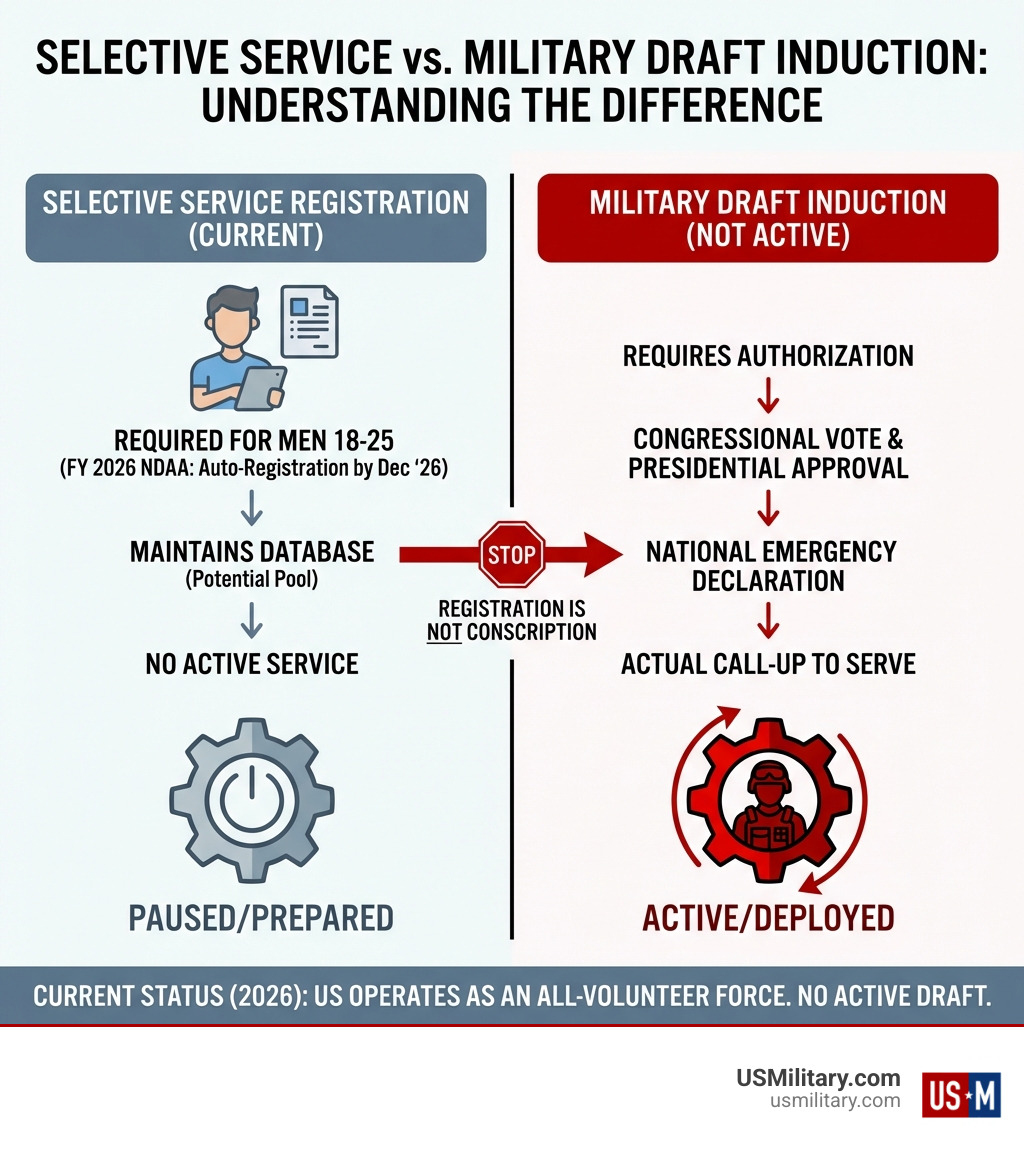
Does the US currently have a military draft? No, the United States does not have an active military draft. The country has operated under an all-volunteer force since 1973, meaning no one is currently being conscripted into military service. However, nearly all men ages 18-25 are still required by law to register with the Selective Service System, which maintains a database for potential use in a national emergency.
Quick Answer:
- Current Status: No active draft
- Last Draft: 1973 (Vietnam War era)
- Registration Required: Yes, for men 18-25
- Activation Process: Would require Congressional authorization AND presidential approval
- Women’s Status: Not currently required to register
The confusion around this topic is understandable. Many young men see the Selective Service registration question on job applications, driver’s license forms, and college aid paperwork—naturally leading them to wonder if they could actually be called to serve. The reality is that registration does not equal conscription. Think of it as the government’s contingency plan, similar to how your smoke detector sits ready but isn’t actively fighting fires.
Recent global events have sparked renewed interest in this question. Google searches for “military draft” spiked following tensions in the Middle East, the Ukraine-Russia conflict, and other international crises. Meanwhile, legislative changes are on the horizon: the Fiscal Year 2026 National Defense Authorization Act mandates automatic registration by December 2026, representing the most significant change to Selective Service law in over four decades.
I’m Larry Fowler, publisher of the USMilitary.com Network since 2007. I’ve spent nearly two decades helping active duty personnel and veterans steer complex military topics, including Does the US currently have a military draft, and have provided military recruitment support across all service branches. This guide will clarify exactly what registration means, what penalties exist for non-compliance, and what circumstances could potentially trigger a return to conscription.
Does the US currently have a military draft?
To directly answer the core question, Does the US currently have a military draft? No, we do not. The United States military has proudly operated as an all-volunteer force since 1973, a significant shift that followed the Vietnam War. This means that every man and woman currently serving in our armed forces has chosen to do so, volunteering their time and talents to protect our nation.
However, the absence of an active draft does not mean the concept has vanished entirely. The Selective Service System (SSS) remains in place as an independent agency, separate from the Department of Defense. Its primary mission is to be prepared to provide personnel to the U.S. armed forces in an emergency. This preparedness involves maintaining a database of potential draftees, which is why registration is still a legal requirement for most young men.
So, while military service in the U.S. is currently voluntary, the mechanism for a draft still exists, albeit in a standby mode. For a military draft to be reinstated, a series of very specific and significant events would need to occur:
- A National Emergency: There would need to be a severe national emergency or crisis that requires a rapid and substantial increase in military personnel beyond what the all-volunteer force can provide.
- Congressional Authorization: Both the House of Representatives and the Senate would need to pass legislation authorizing a military draft. This is a major legislative undertaking that would require broad political consensus and public support.
- Presidential Signature: The President of the United States would then need to sign this legislation into law.
- Activation of the Selective Service System: Only after these steps would the Selective Service System be activated to begin the process of drafting eligible young men. This process would involve a lottery system and subsequent classification and induction procedures.
These are not minor steps. Reinstating a draft would be a profound decision with immense national and social implications, and as of 2024, there is no concrete indication that such a draft will take place. While some influential former administration officials and lawmakers have discussed broader national service mandates, these remain speculative ideas rather than concrete plans for an immediate draft.
The current system ensures that our military is composed of dedicated volunteers, a model that has served our nation for over five decades. However, the Selective Service System stands ready, a silent contingency should our nation ever face a crisis requiring every eligible hand on deck.
Selective Service Registration and Penalties
Even though the U.S. military operates on an all-volunteer basis, the requirement for men to register with the Selective Service System is very much active. This is a crucial distinction that often causes confusion. Let’s clarify who needs to register, how to do it, and what happens if you don’t.

Who is required to register for the Selective Service?
Simply put, almost all men who are U.S. citizens or immigrants living in the United States, aged 18 through 25, are required to register. This includes a broad spectrum of individuals:
- U.S. Citizens: This covers men residing in the U.S. and those living abroad.
- Immigrants: Legal permanent residents, undocumented immigrants, refugees, and asylum seekers are all included.
- Individuals with Disabilities: Unless they are permanently physically or mentally unable to understand the nature of the registration requirement, men with disabilities must register.
- Transgender Individuals: The Selective Service System currently defines “male persons” based on sex assigned at birth. Therefore, individuals assigned male at birth are required to register, regardless of their current gender identity.
The law requires registration within 30 days of turning 18. This is a civic obligation, and while it doesn’t mean you’re signing up for immediate military service, it’s a vital step in maintaining the nation’s readiness for unforeseen emergencies. You can find detailed information on who needs to register and who is exempt on the official Selective Service website’s who is required and exempt from registering page.
How to register for Selective Service
Registering is a straightforward process designed to be as easy as possible:
- Online: The quickest and easiest way to register is online through the Register for Selective Service website. It typically takes less than two minutes.
- By Mail: You can also register by mail. Forms are often available at U.S. Post Offices. You can also Print the registration form [PDF, 1.7MB] directly from the Selective Service website, fill it out, and mail it in.
- Through Other Programs: In many states, you can register when applying for a driver’s license or state ID card. Some high schools also offer registration services.
We encourage all eligible young men to register promptly to avoid any future complications.
What are the penalties for not registering with the Selective Service?
While military service is voluntary, registration with the Selective Service is mandatory, and there are serious consequences for non-compliance. Failing to register is not just an oversight; it’s a federal felony.
The direct legal penalties for failing to register can be severe:
- A fine of up to $250,000.
- A prison sentence of up to five years.
- Or a combination of both.
While the Selective Service System notes that no one has been prosecuted for failing to register for the draft since 1986, this doesn’t mean there are no repercussions. The government has shifted its enforcement strategy, focusing more on denying benefits to non-registrants rather than pursuing criminal charges.
The most common and impactful consequences are administrative:
- Federal Student Financial Aid: You may be ineligible for federal student financial aid, including Pell Grants, Federal Work-Study, and federal student loans.
- Federal Employment: You could be denied eligibility for federal jobs, including positions with the U.S. Postal Service.
- U.S. Citizenship: Immigrants who fail to register may be denied U.S. citizenship.
- State-Funded Programs: Many states have laws that link Selective Service registration to eligibility for state benefits, such as driver’s licenses, state employment, or state-funded financial aid.
The statistics highlight the real-world impact of non-registration: more than 1 million men have been denied some government benefits because they weren’t registered for the draft. This can significantly hinder educational opportunities, career prospects, and the path to citizenship. We advise all eligible individuals to register to ensure they do not inadvertently forfeit these crucial benefits. You can learn more about these penalties on the Selective Service’s consequences if you fail to register page.
Here’s a quick look at how registration status can affect federal benefits:
| Federal Benefit/Program | Registered with Selective Service | Not Registered with Selective Service |
|---|---|---|
| Federal Student Financial Aid | Eligible | Ineligible |
| Federal Employment | Eligible | Ineligible |
| U.S. Citizenship | Eligible | Ineligible |
| Job Training Programs | Eligible | Ineligible |
The Future of Conscription: Automatic Registration and Women
The discussion around military service, conscription, and the Selective Service System is dynamic, constantly influenced by global events, societal changes, and legislative action. While Does the US currently have a military draft? remains a “no,” there are significant developments on the horizon and ongoing debates that shape its future.
Does the US currently have a military draft for women?
Currently, women are not required to register for the Selective Service System, and therefore, cannot be drafted. The existing law explicitly refers to “male persons” for registration. This has been a point of considerable debate and legal challenge over the years.
The Supreme Court, in the 1981 case Rostker v. Goldberg, upheld the male-only registration requirement, reasoning that because women were excluded from combat roles at the time, they were not “similarly situated” for draft purposes. However, the landscape has changed dramatically since then. Women now serve in all combat roles across all branches of the U.S. military, demonstrating their equal capability and commitment.
This shift has led to renewed calls for gender-neutral registration. Congress has debated the issue multiple times:
- In 2016, the Senate voted to include women in draft registration, but the measure did not become law.
- Again in 2021, similar legislation was proposed as part of the National Defense Authorization Act (NDAA), but it was ultimately removed before the final bill passed.
While there’s a strong argument for extending registration to women based on principles of equality and their expanded roles in the military, the legislative will to make this change has not yet fully materialized. For now, the law stands as male-only. It’s also worth noting the complexities this creates for transgender and non-binary individuals, as the Selective Service bases its requirements on sex assigned at birth, not current gender identity.
Does the US currently have a military draft automatic registration?
This is where things are set to change significantly in the near future. While we don’t have an active draft, the process of registration is undergoing a major overhaul.
A provision in the Fiscal Year 2026 National Defense Authorization Act (NDAA) will fundamentally alter how men register for the Selective Service. This groundbreaking change will require the Selective Service System (SSS) to implement automatic registration for men aged 18-26. This is slated to begin by December 18, 2026.
Why the shift to automatic registration? It’s largely a response to what many see as an “abject failure” of the current voluntary system due to “pervasive noncompliance.” Few young men voluntarily register, and even fewer update their addresses when they move. This has resulted in a Selective Service database that, according to former SSS Director Bernard Rostker, would be “less than useless” for an actual draft. The goal of automatic registration is to create a more comprehensive and accurate list of potential draftees.
The implementation of automatic registration will involve:
- Database Aggregation: The SSS will be authorized to collect information from various federal databases to identify and register eligible individuals. This means rather than 18-year-old males signing up themselves, the government will gather the necessary data.
- Increased Efficiency (in theory): Proponents argue this will streamline the process, reduce administrative burden, and ensure a more complete registrant pool.
However, this move is not without its critics and challenges. Concerns include:
- Privacy: Aggregating data from multiple federal agencies raises questions about data privacy and how this information will be secured and used.
- Accuracy: There are doubts about whether the SSS can construct a truly accurate and comprehensive list, especially given issues like identifying sex assigned at birth, confirming citizenship status, and tracking address changes across various systems.
- Effectiveness: Critics argue that even with automatic registration, the system might still be ineffective for an actual draft if the underlying issues of public trust and willingness to serve are not addressed.
- Political Implications: Some view automatic registration as moving the U.S. “closer to activation of a draft than at any time in the last half century,” making it easier for policymakers to consider conscription without facing the hurdle of widespread noncompliance.
This provision represents the largest change in Selective Service law since 1980, and its full implications are yet to be seen. It’s a clear signal that while a draft isn’t imminent, the government is taking steps to ensure the Selective Service System is ready should a national emergency ever demand it.
Frequently Asked Questions about the US Military Draft
We understand that the topic of military drafts can bring up many questions, especially given its historical significance and ongoing discussions. Let’s tackle some of the most common inquiries.
What are the historical draft classifications?
During periods of active conscription, the Selective Service System used a detailed classification system to determine a registrant’s availability for military service. These classifications helped evaluate who was immediately eligible, who was deferred, and who was exempt. While men are not classified now, understanding these historical categories provides valuable context:
- 1-A: Available for Unlimited Military Service. This was the most common classification for men eligible to be drafted.
- 1-A-O: Conscientious Objector available for noncombatant military service. These individuals had deeply held moral or religious objections to combat but were willing to serve in non-fighting roles.
- 1-O: Conscientious Objector available for civilian work. For those whose beliefs prevented any military service, they would perform alternative service in the national interest.
- 1-H: Registrant not currently subject to processing for induction or alternative service. This classification was widely used after the cessation of draft processing in 1976 and effectively meant a registrant would not be called up.
- 1-Y: Qualified for service only in time of war or national emergency. This category indicated a lesser degree of fitness for service, often due to minor medical issues. It was abolished in 1971.
- 2-S: Student Deferment. Granted to full-time students in good standing, allowing them to complete their education before being considered for service.
- 3-A: Hardship Deferment. Granted to individuals whose induction would cause extreme hardship to dependents.
- 4-C: Alien or Dual National. This classification was used for non-citizens, with varying subcategories based on their status and country of origin.
- 4-F: Registrant not qualified for any military service. This was typically due to physical, mental, or moral reasons, or criminal records.
These classifications were central to the draft process, and registrants often had the right to appeal their classification to a Selective Service Appeal Board. For a comprehensive historical overview, you can explore the Selective Service System’s classifications page.
Has anyone been prosecuted recently for not registering?
No, not in recent history. The last prosecution for failing to register with the Selective Service System occurred in 1986. While failure to register is a federal felony punishable by significant fines and prison time, the government has largely shifted away from criminal prosecution.
Instead, the primary consequence for non-registrants today is the denial of federal and, in some cases, state benefits. As we discussed earlier, this can include federal student aid, federal job opportunities, and even the path to U.S. citizenship for immigrants. So, while you might not face jail time, the impact on your life can still be substantial.
Can I volunteer instead of being drafted?
Absolutely! In the United States, military service is entirely voluntary. If you are interested in serving our country, you don’t need to wait for a draft. In fact, we highly encourage exploring the many opportunities available in the U.S. Armed Forces.
The all-volunteer force relies on dedicated individuals who choose to serve. There are countless paths within the Army, Navy, Air Force, Marine Corps, Space Force, and Coast Guard, offering unique career development, educational benefits, and a chance to make a profound difference.
If you’re contemplating military service, we can connect you with recruiters from the different branches. You can learn about the benefits of serving your country, how to pay for school, various military career paths, and much more. It’s a path chosen by millions of Americans, and it might be the right one for you.
Conclusion
As we’ve explored, the question, “Does the US currently have a military draft?” can be definitively answered with a “no.” The United States has proudly maintained an all-volunteer military since 1973, a testament to the dedication of those who choose to serve our nation.
However, the presence of the Selective Service System means that the infrastructure for a draft remains, acting as a critical contingency plan for future national emergencies. While an active draft is not imminent, eligible men aged 18-25 are legally required to register, a civic duty with significant consequences for non-compliance, particularly concerning federal benefits and citizenship.
The landscape is evolving, with the upcoming automatic registration provision in the Fiscal Year 2026 NDAA set to streamline, and potentially complicate, the registration process by December 2026. This change, while aimed at efficiency, also highlights ongoing debates about privacy, effectiveness, and the role of conscription in a modern military. The discussion around including women in registration also continues, reflecting broader societal shifts and military integration.
At USMilitary.com, our mission is to provide comprehensive, unbiased information to help you steer these complex topics. Whether you’re considering voluntary military service, understanding your Selective Service obligations, or simply staying informed about national defense, we are your central hub for military-related guidance.
The future of conscription in the U.S. will undoubtedly remain a topic of interest and debate. For now, our nation relies on the strength and dedication of its volunteers.
If you’re inspired to learn more about serving our country, or if you have questions about military career paths and benefits, we’re here to help.
Sign up now to hear from a recruiter
Free for Service Members & Veterans
Get the military benefits intel no one tells you about.
Weekly updates on VA benefits, pay changes, and money tips — free for service members and veterans.
No spam. Unsubscribe anytime. Your info is never shared.


